Tag: Security Best Practices

  • What Is a Security Guard Not Allowed to Do: A Comprehensive Guide

    What Is a Security Guard Not Allowed to Do: A Comprehensive Guide

    Table of Contents

    The answer to what is a security guard not allowed to do is that guards may not act as peace officers, arrest without witnessing an indictable offence on their assigned property, use unreasonable force, detain arrestees beyond immediate police handover, or work without a provincial licence.

    They may arrest without warrant only when they personally observe an indictable offence, such as robbery or assault, on the property they protect, or in fresh pursuit. Any use of force during an arrest must be necessary, proportionate and reasonable; excessive force can expose the guard and their employer to criminal or civil liability. After making an arrest, the guard must immediately deliver the detainee to a peace officer. Similarly, guards cannot search a person or their belongings without that person’s consent or a clear protective purpose tied to the site’s security policy. In British Columbia, every security guard must hold a valid provincial security licence, confirming completion of Basic Security Training and a background check.

    At Regent Security, we ensure all our professional licensed security guards are fully licensed and trained in these legal limits, so our commercial property, strata and hotel clients receive service that respects both safety and the law.

    With these legal limits in mind, we turn to the specific duties and actions that security guards may lawfully perform.

    Key Takeaways

    • Security guards in British Columbia hold a distinct set of legal authorities that are narrower than those of police but essential for maintaining order and safety.
    • Security guards possess certain powers to protect property.
    • While essential skills and best practices prepare guards for daily duties, understanding the legal boundaries that govern their actions is equally critical.
    • Following the discussion on more complex legal situations (i.e.
    • Having answered legal limits, we explain how our company ensures compliant protection.

    Core Duties and Authorized Actions of a Security Guard

    Security guards in British Columbia hold a distinct set of legal authorities that are narrower than those of police but essential for maintaining order and safety. Understanding what security guards are allowed to do clarifies the boundaries of their authority and builds trust with residents.

    Under section 494 of the Criminal Code of Canada, a security guard may perform a citizen’s arrest without a warrant when they personally observe an indictable offence, such as robbery or aggravated assault, on the property they protect. Security Guard Training Canada emphasizes that immediate handover to law enforcement is mandatory, and any use of force must be necessary, proportionate, and justified – excessive or retaliatory force is strictly prohibited. In British Columbia, all security personnel must hold a valid licence under the Security Services Act, and our guards at Regent Security Services are fully licensed and insured in accordance with that act.

    When dealing with tenants and guests, security guards are subject to a number of privacy restrictions. For instance, LawyerInfo.ca states that security personnel cannot open or otherwise handle tenants’ mail or packages. Security personnel may only ban guests when there is a documented threat to the individual’s safety. Lastly, security personnel may only use visitor sign-in/out logs for security and safety purposes.

    The following table illustrates a number of situations where security guards must differentiate between allowable and not-allowable behavior.

    Action/ScenarioAllowedNot Allowed
    Arresting a suspectIf observing an indictable offence (citizen’s arrest) and immediately handing over to policeWithout proper cause or without promptly contacting police
    Using forceOnly necessary, proportional, and justified forceExcessive or retaliatory force
    Opening tenant mail/packagesOnly if directed by a legal warrantUnder any other circumstance
    Banning guests from the buildingOnly after documenting a proven safety threatArbitrarily or without evidence
    Maintaining a visitor sign-in logStrictly for safety and security purposesUsing the log for surveillance or sharing data unlawfully
    Detaining a personIn the limited context of a citizen’s arrest (indictable offence observed)Detaining as if a peace officer or using prolonged restraint

    The restriction to not open mail ensures that communication remains private, the documented threat to safety justification prevents arbitrary harassment, and restricting the use of visitor sign-in logs to safety purposes is consistent with the Personal Information Protection Act and upholds residents’ right to quiet enjoyment.

    Knowing allowable acts gives a clear picture of the edge of the prohibited conduct.

    Security guards possess certain powers to protect property. The law also sets clear boundaries on what they may not do. Overstepping these boundaries exposes both the security guard and the property owner to serious liability.

    The following table summarizes six prohibited actions:

    Prohibited ActionWhy It’s Not AllowedPotential Legal Consequences
    Arresting for a summary offenceCitizen’s arrest under s.494 only covers indictable crimes.Criminal charges for unlawful confinement, civil liability.
    Applying disproportionate forceForce must be legal, necessary, and proportionate; Charter applies.Assault charges, licence loss, human rights complaints.
    Interfering with tenant mailViolates privacy laws; can be a criminal offence.PIPA complaint, possible mail-theft charges.
    Banning a guest without a documented threatResidential Tenancy Act guarantees guest access unless a safety risk is proven.Landlord/strata liability, RTB dispute, rent abatement.
    Using visitor logs for surveillancePIPA limits data collection to necessary safety purposes.OIPC complaint, order to stop, reputational harm.
    Working without a licenceSecurity Services Act requires licensing.Fines, removal, inability to perform duties.

    We protect our clients from liability by training every guard to understand that, under these restrictions, they act as private citizens, not peace officers, and must operate within strict legal limits. Our training and approach help win the confidence of tenants and property owners, as it assures them of the limits within which our guards will operate. This also helps build and strengthen our clients’ trust in us.
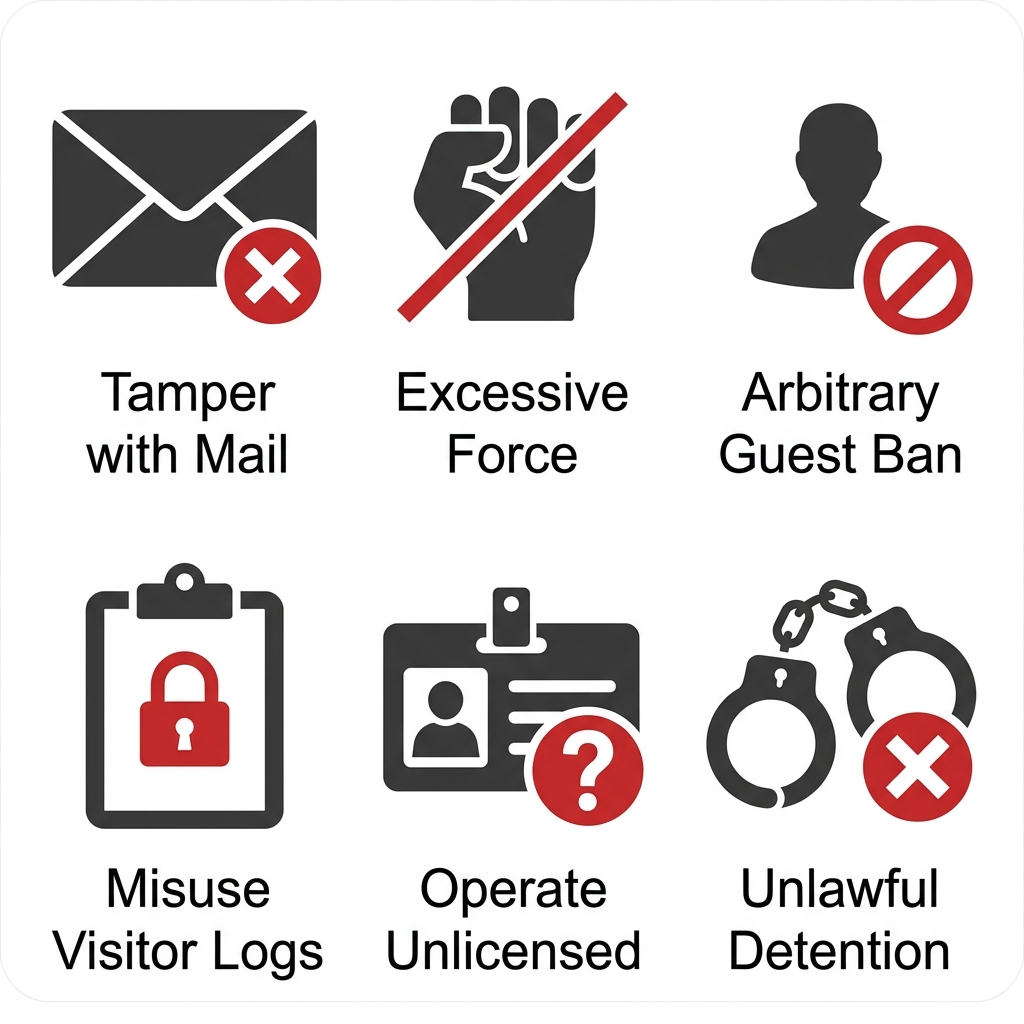
    Icon set of six prohibited actions for security guards: tamper with mail, excessive force, arbitrary guest ban, misuse visitor logs, operate unlicensed, unlawful detention, each with red no symbol
    Six prohibited actions for security guards depicted in icon set

    Prohibited Actions Under Canadian Law

    Security guards in Canada do not possess general arrest powers. They can only make a citizen’s arrest under s. 494 of the Criminal Code for indictable offences that they personally witness on, or in relation to, the protected property. Arresting for a summary offense constitutes unlawful confinement and may also result in criminal charges against the guard. Detained persons must be turned over to the police without delay. The arresting security guard has no power to interrogate the arrested person. Use of force must be necessary, proportionate, and consistent with the Charter; excessive force can result in assault charges and licence revocation. Handcuffs and batons require provincial training. Firearms are limited to rare high-risk roles and require additional licensing. Our guards are licensed and trained with a focus on limiting and respecting the above rules, with de-escalation as the first response.

    Privacy Rights, Property Access, and Tenant Protections

    As per BC privacy and tenancy laws, security can’t open or withhold a tenant’s mail or packages. This violates privacy laws and can be a criminal offence. In the same vein, security can’t ban a guest without a documented safety concern. The Residential Tenancy Act protects the right of tenants to have guests. Arbitrary guest bans can put the landlord at risk of liability and possibly lead to rent abatement. Logs can only be used for emergency planning. Mining the data for surveillance or for any other purpose is a violation of the Personal Information Protection Act (PIPA) and can be reported to the Office of the Information and Privacy Commissioner (OIPC). Our officers are trained to respect tenants’ rights to privacy and to ensure security of the property. We know these rights help us build and maintain strong relationships with our customers (tenants and property managers).

    Essential Skills and Security Best Practices for Professional Guards

    As mentioned, understanding the limits of the law is only one step. Acquiring the necessary skills and adopting the required behaviors will make a guard truly effective.

    Key Skills and Attributes of an Effective Security Guard

    The ability to recognize changes in the environment (i.e. a strange car, an unsecured door, unusual behavior) and determine the level of risk is key to doing the job. Communicating with clients, guests and members of the public requires clear verbal instructions and active listening, which de-escalate tension and ensure cooperation. Conflict resolution skills enable guards to defuse disputes before they escalate.

    All of our security personnel complete Basic Security Training as mandated by the BC Security Services Act, covering legal authority, report writing and professional ethics. Advanced Security Training further sharpens use of force and judgment and crisis intervention. Responding to medical emergencies and first aid is covered in the Occupational First Aid Level 2 course. Because the Security Services Act mandates guards to hold a valid license, our screening and certification efforts further build professionalism within the industry. Unwavering commitment to training and licensing, along with professionalism, integrity and dedication, supports professional standards. This foundation of skill and certification is how we deliver unmatched security expertise to properties across Vancouver and the Lower Mainland.

    Seven Practical Safety Tips for Guards on Duty

    1. Stay vigilant and scan your surroundings continuously. Report anomalies immediately to your supervisor and note them in the shift log.
    2. Communicate clearly and professionally with everyone you encounter. Use active listening to de-escalate tense situations and gather accurate facts.
    3. Wear your full uniform and visible identification at all times. Ensure your security license is displayed as required by BC law.
    4. Know the legal limits of your authority and never exceed them. Use force only as a last resort and in strict proportion to the threat.
    5. Secure all keys, access cards, and codes to prevent unauthorized access. Verify identity before granting entry and log each handover.
    6. Complete incident reports immediately after any occurrence, noting date, time, location, involved parties, and witness details to preserve factual documentation.
    7. Take care of your physical and mental wellbeing by staying hydrated, alert, and rested. Fatigue impairs judgment and reaction time, so manage breaks to maintain effectiveness.
    SituationDoDon’t
    Responding to a trespasserDe-escalate, calmly ask them to leave, and notify supervisorUse physical force immediately or threaten them
    Interacting with the publicMaintain professional demeanor, listen actively, and provide assistanceBe dismissive, argumentative, or share confidential information
    Reporting an incidentDocument details immediately with facts, times, and witness infoDelay reporting, fabricate details, or withhold information
    Handling keys and access credentialsKeep them secured, log access, and never lend to unauthorized personsLeave keys unattended or share codes casually
    Wearing uniform and identificationWear complete, clean uniform with visible photo ID and licenseLend uniform items to others or wear unauthorized accessories
    Using forceUse only reasonable, necessary force as a last resort after de-escalationUse excessive force, use force as first option, or fail to report use of force

    One of the outcomes of a guard’s training is proper behavior in the public, which builds trust with the public and reflects the depth of a guard’s training. These behaviors are foundational, rooted in certification and ethical conduct, and equip guards to navigate complex situations involving arrest, use of force, and liability.

    While essential skills and best practices prepare guards for daily duties, understanding the legal boundaries that govern their actions is equally critical. In Canada, security guards operate under the authority of a citizen’s arrest, as defined by section 494 of the Criminal Code.

    The following table outlines the key distinctions between security guard and police officer authority in Canada:

    AuthoritySecurity GuardPolice Officer
    Legal StatusPrivate citizen with limited arrest powersPeace officer with full enforcement authority
    Arrest Without WarrantPermitted only when catching a person committing an indictable offenceBroader statutory grounds for arrest
    Use of ForceMust be necessary, proportional, and justifiedMust be reasonable under the circumstances
    After ArrestMust hand over detainee to police immediatelyCan process and hold the individual in custody
    LicensingValid provincial security licence requiredFull police training and certification

    We may detain someone we have personally observed committing a serious indictable offence, but we cannot act on mere suspicion, after-the-fact reports, or for summary conviction matters like minor shoplifting. Any force used to effect an arrest must remain necessary and strictly proportional to the threat; excessive force would exceed our legal bounds and risk criminal or civil exposure.

    After an arrest, guards must promptly hand the detainee over to police. Holding someone for an extended period, conducting a personal search without explicit consent, or otherwise detaining beyond what is lawful can give rise to false imprisonment or assault claims.

    Provincial licensing under the Security Services Act in British Columbia is mandatory and confirms completion of Basic Security Training and related standards. We maintain full licensing and insurance for our 200-plus professionals across Vancouver and the Lower Mainland. Exceeding legal authority—through improper detention, excessive force, or an unauthorized search—can lead to criminal charges, regulatory sanctions, and substantial civil liability for both the individual and our company.

    Frequently Asked Questions About Security Guard Rights and Limitations

    Following the discussion on more complex legal situations (i.e. use of force, arrests and civil liability) this FAQ will address common legal constraints on security officer powers in British Columbia.

    Can a security guard arrest or detain in British Columbia?

    The detention powers of a security guard are more limited than those of police, and they may only hold someone in narrow citizen’s arrest circumstances when a criminal act is observed. We train our guards to recognize and respect legal boundaries, and to contact the police when necessary.

    Can a security guard search bags or personal items?

    A security guard cannot search bags or personal items without voluntary consent; searches must be consensual or conducted by the police. For guidance on searches and use of force, we recommend consulting BC regulations or a legal professional.

    Understanding the legal constraints security guards must work within explains the importance of retaining a security provider who is committed to legal compliance and professionalism.

    Frequently Asked Questions

    What makes a good security guard?

    A good security guard possesses alert observation skills, clear communication, and conflict resolution abilities to de-escalate situations. Regent Security ensures its guards complete Basic Security Training, Advanced Security Training, and Occupational First Aid Level 2, and they follow BC licensing and legal limits on use of force.

    What are 7 general security tips?

    The seven tips are: stay vigilant and report anomalies; communicate clearly with active listening; wear full uniform and visible identification; know legal limits and use proportional force only as a last resort; secure all access credentials and verify identities; complete incident reports immediately with full details; and maintain physical and mental wellbeing by staying hydrated and rested.

    Security guard skills

    Key security guard skills include observing environmental changes and assessing risks, delivering clear verbal instructions with active listening, and resolving conflicts peacefully. Regent Security’s guards are trained in Basic Security Training, Advanced Security Training, and Occupational First Aid Level 2 to meet BC licensing standards.

    3 major function of security guard

    The three major functions of a security guard are access control, patrols, and incident response. Access control involves verifying identity and managing entry to prevent unauthorized access. Patrols consist of regular rounds to detect suspicious activity. Incident response addresses disturbances, emergencies, and alarms according to protocols.

    Why Regent Security Services Ensures Compliant, Professional Protection

    Having answered legal limits, we explain how our company ensures compliant protection. Understanding what is a security guard not allowed to do guides our training: our 200+ licensed and insured professionals respect arrest limits, avoid unlawful detention, and protect tenant privacy under BC law. Guards do not act as peace officers, open mail, or arbitrarily ban guests. We custom-design site-specific plans to provide tailored protection in Vancouver and the Lower Mainland. Response times and alarm outcomes may vary; this is guidance, not a substitute for professional or legal advice.

    Get Your Custom Security Quote

    Now that you understand what a security guard is not allowed to do, the next step is securing protection that fully respects those legal boundaries. Our company has built its reputation on 15+ years of compliant, professional security in Vancouver and the Lower Mainland. Our licensed and insured guards are trained to apply citizen’s arrest powers properly, use proportional force, and protect tenant privacy under BC law. Every solution is custom-quoted based on a site assessment to meet your specific needs. With over 200 trained professionals, we deliver 24/7 coverage that prioritizes legal compliance and peace of mind. Our team ensures that every guard adheres to the strictest standards of conduct. Contact us to discuss how a personalized security plan can safeguard your property while staying within all legal limits.

    Get Your Custom Security Quote
    Resources

  • Vancouver Proactive Threat Detection: AI Video Analytics for 2026

    Vancouver Proactive Threat Detection: AI Video Analytics for 2026

    Table of Contents

    Proactive Threat Detection for Vancouver Businesses: A Strategic Approach

    Beyond reactive monitoring, a truly resilient security strategy employs proactive threat detection for Vancouver businesses, where we anticipate and mitigate risks before they escalate into costly incidents. Traditional passive systems merely record events for later review, but our approach actively identifies anomalies in real time. At Regent Security, we design proactive security measures that address unauthorized access and perimeter breaches common to Vancouver commercial properties, allowing our team to intervene swiftly.

    Central to this strategy is the use of AI video analytics, which applies intelligent software to your existing camera infrastructure. According to the Canadian Security Association, risk-based security planning should integrate such advanced monitoring tools. This technology reduces false alarms and provides immediate alerts on suspicious behavior, effectively complementing our on-site guard services. Another critical component is automated license plate recognition, a powerful access control tool that identifies vehicles of interest before they enter your property, adding a proactive layer to your perimeter defense.

    Our own research into commercial building security trends 2026 confirms a significant industry shift toward these proactive technologies. Rather than offering generic, one-size-fits-all packages, we assess your unique risk profile through on-site consultation. We then custom-design a unified security ecosystem that connects video, access control, and alarm systems into a centralized dashboard, providing you with unmatched security expertise, anytime, anywhere. This strategic alignment ensures your peace of mind, knowing a tailored defense is in place before a threat materializes.

    In the following section, we explore how we deploy these technologies to protect your business around the clock.

    Understanding Proactive Threat Detection in Vancouver, British Columbia

    Security challenges facing businesses in Vancouver have evolved dramatically, demanding smarter, faster responses to potential threats. Your peace of mind depends on moving beyond outdated approaches that merely document incidents after they occur. Proactive threat detection represents a fundamental shift in how we protect properties, using advanced technology to identify and neutralize risks before they escalate into costly events.

    What Sets Proactive Detection Apart from Traditional Monitoring

    Traditional security monitoring operates on a reactive model. Cameras record footage continuously, but that footage only gets reviewed after an incident has already happened. This approach leaves businesses vulnerable, as the damage has been done by the time anyone notices.

    In contrast, proactive detection leverages behavioral analysis and artificial intelligence to identify potential threats in real-time. Rather than passively recording, our systems actively scan for patterns that indicate suspicious activity. AI-driven surveillance can filter out up to 95% of false alarms, ensuring that security personnel focus only on genuine risks. This forward-looking approach transforms security from a passive record-keeper into an active deterrent, intervening while a situation is still developing rather than simply documenting the aftermath.

    The Role of AI Video Analytics in Proactive Security

    AI video analytics technology has fundamentally changed what business security systems can achieve. AI video analytics for business applications now analyze video feeds continuously, detecting specific behaviors that human operators might miss during long monitoring shifts. The system identifies loitering in restricted areas, unauthorized access attempts, perimeter breaches, and other suspicious behaviors the moment they occur. Automated license plate recognition adds another layer of intelligence, allowing the system to identify vehicles of interest or track patterns of unauthorized entry. Our technology processes these inputs simultaneously across multiple cameras, maintaining consistent vigilance that human operators alone cannot sustain.

    Integration with Professional Guard Services

    Technology alone cannot provide complete protection. The true strength of proactive security emerges when AI-driven detection integrates seamlessly with professional response capabilities. When our remote video monitoring services in Canada detect a verified threat, automated alerts immediately notify licensed security professionals who can assess the situation and take appropriate action. Trained agents use two-way audio to issue verbal warnings, deterring crime in progress before it escalates. This layered defense combines the tireless vigilance of AI analytics with the judgment and authority of trained personnel.

    Security professionals in British Columbia receive rigorous training through institutions such as the Justice Institute of British Columbia, ensuring that response teams possess the skills needed for effective intervention. When technology identifies a threat, a trained professional evaluates the situation and coordinates with mobile patrols or on-site guards as needed. This integrated approach delivers unmatched security expertise, providing comprehensive protection tailored to each client’s specific requirements.

    Benefits of Proactive Threat Detection for Vancouver Properties

    For commercial properties in Vancouver, shifting from reactive security measures to proactive threat detection is the most effective strategy for mitigating risk. Instead of simply recording incidents for later review, modern systems use intelligent analysis to stop threats before they escalate. This approach delivers tangible financial, operational, and psychological benefits for property managers and business owners.

    Reducing Insurance Premiums Through Risk Mitigation

    A robust proactive detection strategy directly impacts your bottom line by reducing the frequency and severity of security incidents. Insurers recognize that properties with AI-driven surveillance experience fewer theft and vandalism claims, which are driven by the system’s ability to verify and deter threats in real time. By filtering out false alarms and enabling immediate intervention before a crime is completed, these systems demonstrably lower a property’s risk profile. As a result, business owners often qualify for reduced commercial property insurance premiums, turning a security upgrade into a long-term financial asset. This demonstrable risk mitigation provides clear, quantifiable value, not just added safety. Features like automated license plate recognition create a complete audit trail that further supports claims and deters unauthorized vehicles from entering secured perimeters.

    Enhancing Response Times with Real-Time AI Alerts

    The true power of AI-driven threat detection lies in its speed. Traditional systems require a person to notice an event, but AI acts in milliseconds. When ai video analytics for business identifies a verified threat—such as a person loitering in a restricted zone after hours—it instantly alerts our 24/7 monitoring center. This immediate notification allows trained security professionals to assess the live feed, issue a verbal warning through two-way audio speakers, and, if necessary, dispatch mobile patrol units within seconds. This rapid intervention cycle minimizes the window of opportunity for criminal activity, stopping damage and loss before they can occur. A system that cuts response times from minutes to seconds fundamentally changes the security posture of your Vancouver property, aligning with our commitment to providing you with ‘Your peace of mind’.

    Cost-Effectiveness Compared to Traditional Surveillance

    While on-site guards and older CCTV systems have their place, a modern proactive threat detection platform is often the more cost-effective solution. The primary driver of these savings is the drastic reduction in false alarms, a capability we achieve through industry-leading AI. By cutting false alarms by up to 95%, you avoid the operational drain of chasing shadows and the potential fines from nuisance dispatches. This efficiency is a core advantage of remote video monitoring services in Canada, effectively combining the vigilance of a full-time security team with the scalability of cloud-based technology at a fraction of the cost. Rather than paying for on-site guards to observe every inactive corner of your property, you invest in a system that only escalates verified events. This model reduces overall personnel hours and extends the lifespan of your equipment by focusing all resources on genuine, high-priority threats, making it a predictable and budget-friendly operational expense. These strategic benefits culminate in a single, invaluable outcome for you: true ‘Your peace of mind’, knowing your property is protected by a smart, efficient, and proactive security partner.

    How Proactive Threat Detection Works with AI and Guard Monitoring

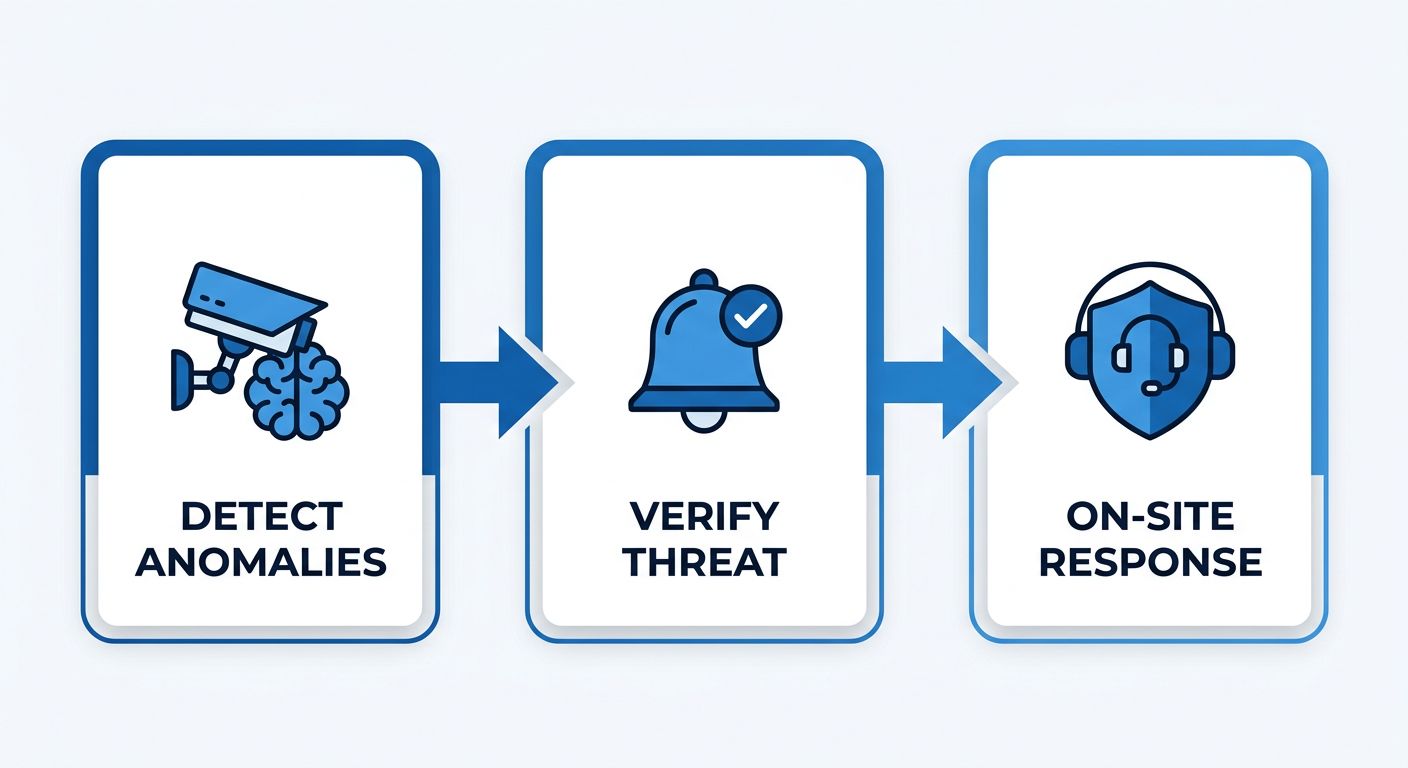
    Proactive threat detection represents a layered security approach where intelligent systems identify potential risks before they escalate into incidents. At Regent Security, we integrate advanced AI video analytics with professional guard monitoring to create a seamless, three-step workflow that provides real-time protection for your facility. By combining technology with human expertise, and following guidelines set by the Canadian Security Association, we deliver security solutions that prioritize prevention over reaction, ensuring your peace of mind anytime, anywhere.

    Three-step process flow for proactive threat detection showing AI video analytics detecting anomalies, automated alerts verifying threats, and coordinated guard dispatch for on-site response, using a clean blue and white design.
    Proactive threat detection workflow from AI analytics to on-site response.

    Step 1: AI Video Analytics Detect Anomalies

    The first layer of our defense involves sophisticated ai video analytics for business applications that continuously scan live camera feeds. These algorithms are trained to distinguish between normal activity and suspicious behavior by analyzing movement patterns, dwell times, and object trajectories. Unlike passive systems that simply record footage, our active monitoring identifies anomalies such as loitering in restricted areas, unauthorized access attempts, or unusual congregation patterns the moment they occur.

    A key capability within this layer is automated license plate recognition, which allows the system to instantly flag vehicles associated with known threats or those not registered for site access. The AI engine filters out benign environmental movements—like tree branches swaying or shifting shadows—which dramatically reduces false alarms and ensures operators focus only on genuine human threats. This intelligent video monitoring approach transforms raw footage into actionable intelligence, creating a complete audit trail for property management.

    Step 2: Automated Alerts and Verification

    When the AI identifies a potential threat, it triggers automated alerts that are immediately routed to our central monitoring station. Here, trained security operators step in to verify the situation before any physical response is initiated. This human verification step is critical: operators review the flagged footage in real time, assess the severity of the incident, and determine whether the alert represents a true emergency or a false positive.

    During verification, operators can leverage two-way audio systems to issue verbal warnings directly to intruders, often deterring criminal activity without the need for on-site deployment. Our standard alarm response protocol ensures that each alert is categorized, time-stamped, and documented, creating a reliable chain of evidence. This layer blends machine efficiency with human judgment, ensuring that resources are deployed only when genuinely needed.

    Step 3: Coordinated Guard Dispatch and Response

    Once a threat is verified, our professional security teams spring into action using mobile patrols and on-site guard resources. The monitoring center communicates incident details—nature of the threat, precise location, and suspect description—directly to responding units, enabling a rapid and informed arrival. Regent Security’s guard services include both scheduled mobile patrols and immediate alarm response, ensuring coverage gaps are eliminated.

    Our mobile patrols serve as a scalable, cost-effective layer that bridges the gap between remote monitoring and full-time on-site personnel. Guards follow established response protocols, conducting site sweeps, engaging with suspects when safe, and coordinating with law enforcement if the situation requires escalation. The entire process—from AI detection to on-the-ground intervention—unfolds with speed and precision, reflecting our unmatched security expertise.

    This three-step workflow demonstrates how technology and human vigilance work in concert to protect what matters most. Now that we understand how proactive threat detection operates, let’s explore the tangible benefits this approach delivers to property managers and business owners across Vancouver, Surrey, and the Lower Mainland.

    Best Practices for Implementing Proactive Threat Detection in BC

    Successful proactive threat detection in British Columbia begins with a structured approach that moves beyond reactive security measures. For property managers and strata councils across the Lower Mainland, implementing these best practices transforms security from a cost center into a strategic asset. The combination of thorough risk assessment, intelligent access control technology, and partnerships with qualified professionals creates a security posture that identifies and mitigates threats before they escalate. Our experience serving over 1,000 clients has demonstrated that integrating AI video analytics for business applications into daily operations significantly reduces incident response times and false alarm rates.

    Assessing Your Property’s Risk Profile

    Developing a clear risk profile is the essential first step toward meaningful proactive threat detection. This evaluation examines your property’s location, physical layout, existing access points, and any history of security incidents to identify specific vulnerabilities. By applying frameworks refined through our hotel security expertise, we help clients understand exactly where threats are most likely to emerge, whether from unauthorized parking garage access, unmonitored service entrances, or after-hours common area activity.

    A comprehensive risk assessment also considers operational patterns unique to your facility. Commercial properties with high tenant turnover present different challenges than established strata complexes, and construction sites require entirely distinct monitoring approaches. Once your risk profile is clear, integrating license plate recognition further strengthens access control and creates a layered defense against unauthorized entry.

    Integrating License Plate Recognition for Access Control

    Automated license plate recognition serves as a powerful tool for strata councils seeking to enhance parking lot security and building access management. ALPR systems capture and analyze vehicle plate data in real time, automatically comparing credentials against authorized resident and visitor databases. When integrated with AI video analytics for business environments, these platforms filter out routine traffic and alert personnel only to unrecognized or flagged vehicles, dramatically reducing the monitoring burden on security staff.

    This technology proves particularly effective for mixed-use buildings where distinguishing between resident, visitor, and commercial parking is essential. The system logs every entry and exit, creating an auditable trail that supports incident investigations and resolves parking disputes with objective evidence. Combined with centralized access control dashboards, ALPR data enables security teams to initiate immediate responses when unauthorized vehicles attempt entry, turning parking areas from vulnerable blind spots into monitored perimeters.

    Working with a Licensed Security Provider

    Partnering with a licensed and insured security provider ensures that proactive threat detection strategies are executed by qualified professionals. According to the Canadian Security Association, adherence to industry standards and proper certification remains fundamental to delivering reliable security outcomes. When evaluating providers, verify their licensing under BC’s Security Services Act and confirm they carry adequate liability coverage. Training credentials matter equally; many of British Columbia’s top security professionals complete programs through the Justice Institute of British Columbia, which offers recognized certification pathways for the province’s security workforce.

    Beyond credentials, operational capabilities distinguish effective partners. Look for providers offering 24/7 monitoring and same-day deployment, ensuring continuous coverage without gaps that threats can exploit. A technology-enabled approach that combines trained personnel with real-time analytics delivers the proactive threat detection results that property stakeholders expect. Contact our team at Regent Security to discuss a personalized security assessment tailored to your property’s unique requirements.

    Taking the Next Step with Proactive Threat Detection

    Proactive threat detection represents a fundamental shift in how businesses approach security. Instead of merely responding to incidents after they occur, this forward-looking strategy identifies and neutralizes risks before they escalate into costly disruptions. At Regent Security, we integrate this philosophy into every layer of our service delivery, combining advanced technology with vigilant human oversight to protect your assets around the clock.

    This approach relies on a powerful technological foundation. AI video analytics for business transforms standard surveillance into an intelligent monitoring system that flags unusual behavior in real time, while automated license plate recognition tracks vehicle movement across your property perimeter. Integrated access control systems further strengthen your defenses by ensuring only authorized personnel enter sensitive areas. These tools do not operate in isolation—our 24/7 monitoring center, mobile patrol units, and on-site guards form a unified response network that acts on the intelligence these systems provide.

    Industry standards reinforce the value of this methodology. The Canadian Security Association advocates for proactive frameworks that prioritize prevention over reaction, and the Justice Institute of British Columbia ensures security personnel receive training aligned with recognized professional benchmarks. These credentials matter because they translate directly into fewer incidents, faster response times, and genuine peace of mind for business owners across the Greater Vancouver area.

    Your peace of mind is our priority. With over 100 trained professionals and more than 1,000 clients served, we deliver unmatched security expertise anytime, anywhere. Contact Regent Security today for a no-obligation consultation and a custom quote tailored to your facility’s unique requirements.

    Resources