
BC Security Services Act Licensing Requirements: Complete Guide
Table of Contents
- British Columbia Security Services Act Licensing Requirements
- Key Licensing Requirements for Security Companies Under the Act
- Security Guard Training and Licensing Process in BC
- Insurance Obligations and Penalties for Security Firms in the Lower Mainland
- Steps to Verify and Hire Licensed Security Personnel in BC
- Your Path to Compliant Security Services in British Columbia
British Columbia Security Services Act Licensing Requirements
Effective hotel security protocols depend on licensed personnel adhering to the BC Security Services Act licensing requirements. Under BC law, every security guard and security business must be licensed under the Act. All security personnel must meet the British Columbia security licensing requirements set by the province.
The province requires completion of Basic Security Training (BST) and Occupational First Aid Level 1 (OFA-1). Understanding the BC Security Services Act licensing requirements confirms these standards are mandatory. We ensure all our guards hold current BST and OFA-1 certifications and fully comply with the Act. Our internal guidance on hotel security reaffirms that provincial licensing is essential. This commitment to professional licensed security guards ensures your peace of mind. With all guards fully licensed under the Act, Regent Security delivers unmatched security expertise—explore our tailored services. Information is for general guidance and not a substitute for professional or legal advice.
Key Licensing Requirements for Security Companies Under the Act
The BC Ministry of Public Safety and Solicitor General mandates strict BC Security Services Act licensing requirements for any security provider in the province. Under the Act, security companies must hold a business licence, carry adequate insurance, and ensure every guard possesses a valid Basic Security Training (BST) certificate. The Security Programs Division administers this system, and all licences must be renewed every two years with proof of continuing education.
While the BST is mandatory for every guard, security firms that provide specialized audit services often require their staff to hold the advanced Specialized Security Audit certification, which builds on BST. This dual licensing structure helps ensure that both day-to-day security duties and in-depth risk assessments are performed by qualified professionals.
Basic Security Training vs Specialized Security Audit
| Aspect | Basic Security Training (BST) | Specialized Security Audit |
|---|---|---|
| Purpose | Entry-level training for general security duties. | Advanced certification for conducting comprehensive risk assessments. |
| Duration | Typically 40 hours of classroom and practical instruction. | Varies by program; often includes field work and report writing. |
| Eligibility | No prior experience required; must be at least 19 years old. | Requires prior BST certification and relevant work experience. |
| Renewal | Must be renewed every 2 years with continuing education. | May require proof of ongoing professional development. |
| Who Needs It | All security guards in BC must hold valid BST. | Optional but recommended for security firms offering audit services. |
The BST program typically involves 40 hours of instruction in legal authority, use of force, and emergency procedures. Candidates must be at least 19 years old and pass a criminal record check. While BST covers general duties, the Specialized Security Audit deepens risk assessment skills. For strata councils or commercial clients, verifying that a security provider’s staff hold these credentials is crucial. When hiring strata security company in British Columbia, it is essential to confirm that the company is properly licensed under the Act. Both credentials demonstrate compliance; the audit certification signals a higher level of expertise for firms conducting comprehensive security assessments.
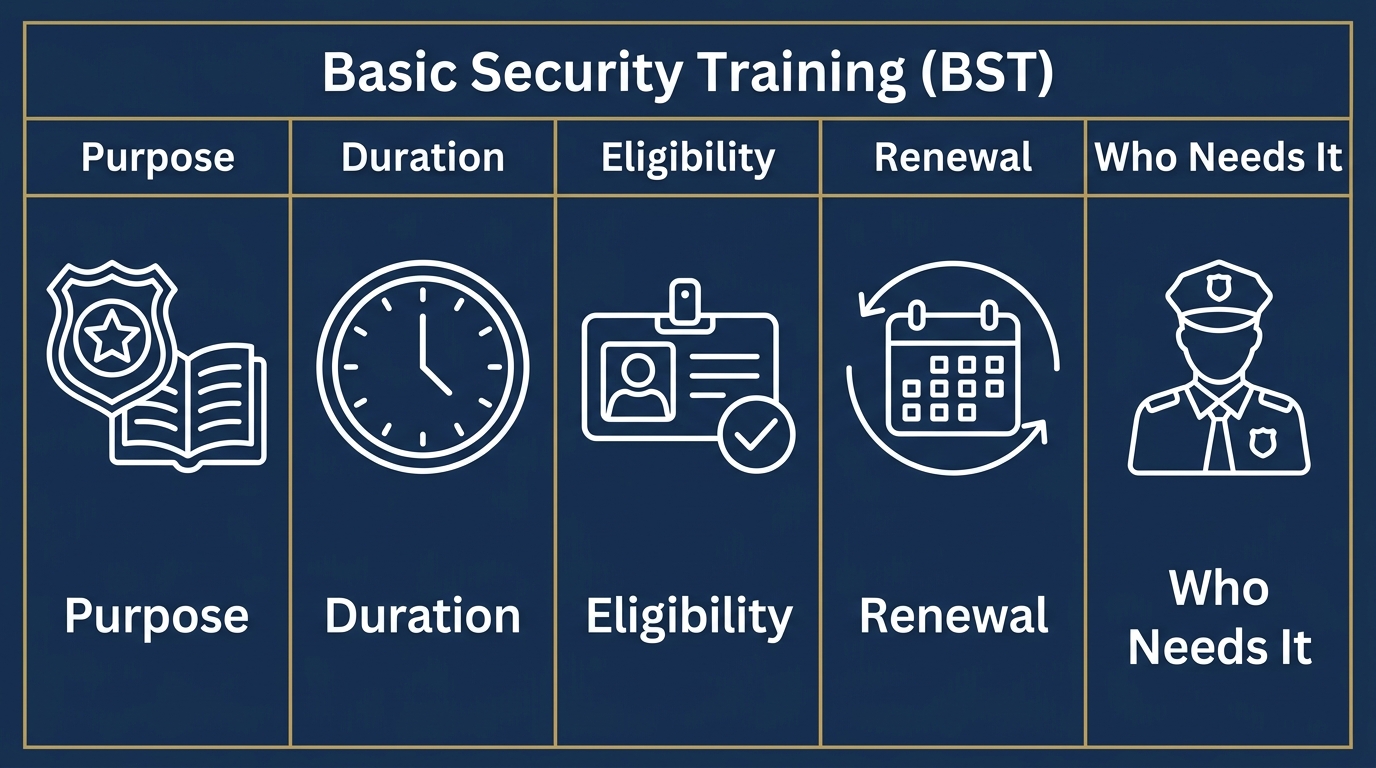
Overview of Basic Security Training requirements under the BC Security Services Act.
Once training requirements are understood, the next step is the formal licence application. Information is for general guidance and not a substitute for professional or legal advice. For complete details, visit the BC government’s security licensing page.
Security Guard Training and Licensing Process in BC
Before a strata council can hire a security company, they must understand the training and licensing requirements each guard must meet. Professional licensed security guards in British Columbia must complete mandatory 40-hour Basic Security Training (BST) or a program deemed equivalent by the Ministry of Public Safety and Solicitor General. A criminal record check is a non-negotiable step in the licensing process. Understanding the BC Security Services Act licensing requirements is essential for any strata council considering a security provider. For a complete overview of how strata councils can hire a licensed security company, refer to our guide on the strata council security hiring process in British Columbia.
The licensing steps include:
- Complete Basic Security Training and pass a criminal record check.
- Submit an application and supporting documents to the Ministry.
- Receive a security worker license upon ministry approval.
Our strata council hiring guide emphasizes that councils should request proof of licensing and training from any security provider they consider. According to our security guard cost breakdown, licensed, well-trained guards represent a level of service that is reflected in custom quotes rather than fixed rates. Verifying that a security company’s personnel meet all BC Security Services Act licensing requirements helps ensure a professional standard and contributes to your peace of mind.
These regulations exist to protect clients and maintain quality across the security industry in British Columbia. By partnering with Regent Security Services, strata councils tap into unmatched security expertise and a commitment to custom, site-specific solutions. Please consult a licensed security professional for site-specific advice.
Insurance Obligations and Penalties for Security Firms in the Lower Mainland
Under the BC Security Services Act licensing requirements, security firms operating in the Lower Mainland must carry valid general liability insurance and workers’ compensation coverage through BCWorksafe. Insurance policies must satisfy minimum coverage amounts established by regulation, and verification occurs during initial licensing and at renewal, with firms required to submit proof of coverage. Firms offering specialized services like emergency response or loss prevention need policies that explicitly cover those activities — for example, loss prevention strategies retail demand liability coverage tailored to retail risk. As part of our strata hiring guidance, Regent Security emphasizes insurance verification as a critical screening step.
Failure to maintain the required insurance exposes a security firm to significant administrative penalties. Under the BC Security Services Act, the Registrar can levy fines of up to $25,000, suspend or even cancel a licence. Additionally, the Registrar audits insurance status during licence renewal and can impose sanctions upon discovering any gap. These consequences underscore why Regent Security rigorously verifies coverage for every service we offer, including emergency response and loss prevention, and ensures compliance is documented at both initial licensing and renewal.
By meeting every insurance obligation under the Act, we protect our clients, our personnel, and the integrity of our security services.
Steps to Verify and Hire Licensed Security Personnel in BC
Understanding BC Security Services Act licensing requirements is essential for any business hiring security personnel in British Columbia, as the law mandates verified licensing. Here are the concrete steps to verify and hire licensed security personnel in BC:
- Check the BC government’s online license registry (gov.bc.ca) to verify an individual’s security license by name or license number. This step confirms the license is current and active.
- Request proof of current liability insurance and Workers’ Compensation Board (WorkSafeBC) coverage from the security company. A reputable provider will gladly supply these documents.
- Confirm that the license type matches the role required (e.g., security guard vs private investigator) and that it is valid for the work location, such as in Vancouver or Surrey.
At Regent Security, every professional is fully vetted, licensed, and technology-trained, operating in full PIPA compliance. When you choose a provider that meets all licensing requirements under the BC Security Services Act, you can trust your site is protected by compliant, capable staff. With properly verified staff from a trusted provider like Regent Security, you can rely on effective 24/7 protection.
Information is for general guidance and not a substitute for professional or legal advice.
Your Path to Compliant Security Services in British Columbia
Navigating BC Security Services Act licensing requirements in British Columbia is straightforward with Regent Security. Every guard we deploy is licensed under the BC Security Services Act, and our operations, including loss prevention, follow BC regulations. We create a site-specific security plan for every client, informed by 15+ years of experience in British Columbia. Explore our compliant security solutions below for your peace of mind. Please note this information is for general guidance and not a substitute for professional advice.

