
What Is a Security Guard Not Allowed to Do: A Comprehensive Guide
Table of Contents
- The Legal Limits of Security Guard Authority
- Core Duties and Authorized Actions of a Security Guard
- What Security Guards Are Not Allowed to Do: Legal Restrictions and Consequences
- Essential Skills and Security Best Practices for Professional Guards
- Navigating Complex Legal Scenarios: Arrest, Force, and Liability
- Frequently Asked Questions About Security Guard Rights and Limitations
- Why Regent Security Services Ensures Compliant, Professional Protection
The Legal Limits of Security Guard Authority
The answer to what is a security guard not allowed to do is that guards may not act as peace officers, arrest without witnessing an indictable offence on their assigned property, use unreasonable force, detain arrestees beyond immediate police handover, or work without a provincial licence.
They may arrest without warrant only when they personally observe an indictable offence, such as robbery or assault, on the property they protect, or in fresh pursuit. Any use of force during an arrest must be necessary, proportionate and reasonable; excessive force can expose the guard and their employer to criminal or civil liability. After making an arrest, the guard must immediately deliver the detainee to a peace officer. Similarly, guards cannot search a person or their belongings without that person’s consent or a clear protective purpose tied to the site’s security policy. In British Columbia, every security guard must hold a valid provincial security licence, confirming completion of Basic Security Training and a background check.
At Regent Security, we ensure all our professional licensed security guards are fully licensed and trained in these legal limits, so our commercial property, strata and hotel clients receive service that respects both safety and the law.
With these legal limits in mind, we turn to the specific duties and actions that security guards may lawfully perform.
Key Takeaways
- Security guards in British Columbia hold a distinct set of legal authorities that are narrower than those of police but essential for maintaining order and safety.
- Security guards possess certain powers to protect property.
- While essential skills and best practices prepare guards for daily duties, understanding the legal boundaries that govern their actions is equally critical.
- Following the discussion on more complex legal situations (i.e.
- Having answered legal limits, we explain how our company ensures compliant protection.
Core Duties and Authorized Actions of a Security Guard
Security guards in British Columbia hold a distinct set of legal authorities that are narrower than those of police but essential for maintaining order and safety. Understanding what security guards are allowed to do clarifies the boundaries of their authority and builds trust with residents.
Under section 494 of the Criminal Code of Canada, a security guard may perform a citizen’s arrest without a warrant when they personally observe an indictable offence, such as robbery or aggravated assault, on the property they protect. Security Guard Training Canada emphasizes that immediate handover to law enforcement is mandatory, and any use of force must be necessary, proportionate, and justified – excessive or retaliatory force is strictly prohibited. In British Columbia, all security personnel must hold a valid licence under the Security Services Act, and our guards at Regent Security Services are fully licensed and insured in accordance with that act.
When dealing with tenants and guests, security guards are subject to a number of privacy restrictions. For instance, LawyerInfo.ca states that security personnel cannot open or otherwise handle tenants’ mail or packages. Security personnel may only ban guests when there is a documented threat to the individual’s safety. Lastly, security personnel may only use visitor sign-in/out logs for security and safety purposes.
The following table illustrates a number of situations where security guards must differentiate between allowable and not-allowable behavior.
| Action/Scenario | Allowed | Not Allowed |
|---|---|---|
| Arresting a suspect | If observing an indictable offence (citizen’s arrest) and immediately handing over to police | Without proper cause or without promptly contacting police |
| Using force | Only necessary, proportional, and justified force | Excessive or retaliatory force |
| Opening tenant mail/packages | Only if directed by a legal warrant | Under any other circumstance |
| Banning guests from the building | Only after documenting a proven safety threat | Arbitrarily or without evidence |
| Maintaining a visitor sign-in log | Strictly for safety and security purposes | Using the log for surveillance or sharing data unlawfully |
| Detaining a person | In the limited context of a citizen’s arrest (indictable offence observed) | Detaining as if a peace officer or using prolonged restraint |
The restriction to not open mail ensures that communication remains private, the documented threat to safety justification prevents arbitrary harassment, and restricting the use of visitor sign-in logs to safety purposes is consistent with the Personal Information Protection Act and upholds residents’ right to quiet enjoyment.
Knowing allowable acts gives a clear picture of the edge of the prohibited conduct.
What Security Guards Are Not Allowed to Do: Legal Restrictions and Consequences
Security guards possess certain powers to protect property. The law also sets clear boundaries on what they may not do. Overstepping these boundaries exposes both the security guard and the property owner to serious liability.
The following table summarizes six prohibited actions:
| Prohibited Action | Why It’s Not Allowed | Potential Legal Consequences |
|---|---|---|
| Arresting for a summary offence | Citizen’s arrest under s.494 only covers indictable crimes. | Criminal charges for unlawful confinement, civil liability. |
| Applying disproportionate force | Force must be legal, necessary, and proportionate; Charter applies. | Assault charges, licence loss, human rights complaints. |
| Interfering with tenant mail | Violates privacy laws; can be a criminal offence. | PIPA complaint, possible mail-theft charges. |
| Banning a guest without a documented threat | Residential Tenancy Act guarantees guest access unless a safety risk is proven. | Landlord/strata liability, RTB dispute, rent abatement. |
| Using visitor logs for surveillance | PIPA limits data collection to necessary safety purposes. | OIPC complaint, order to stop, reputational harm. |
| Working without a licence | Security Services Act requires licensing. | Fines, removal, inability to perform duties. |
We protect our clients from liability by training every guard to understand that, under these restrictions, they act as private citizens, not peace officers, and must operate within strict legal limits. Our training and approach help win the confidence of tenants and property owners, as it assures them of the limits within which our guards will operate. This also helps build and strengthen our clients’ trust in us.
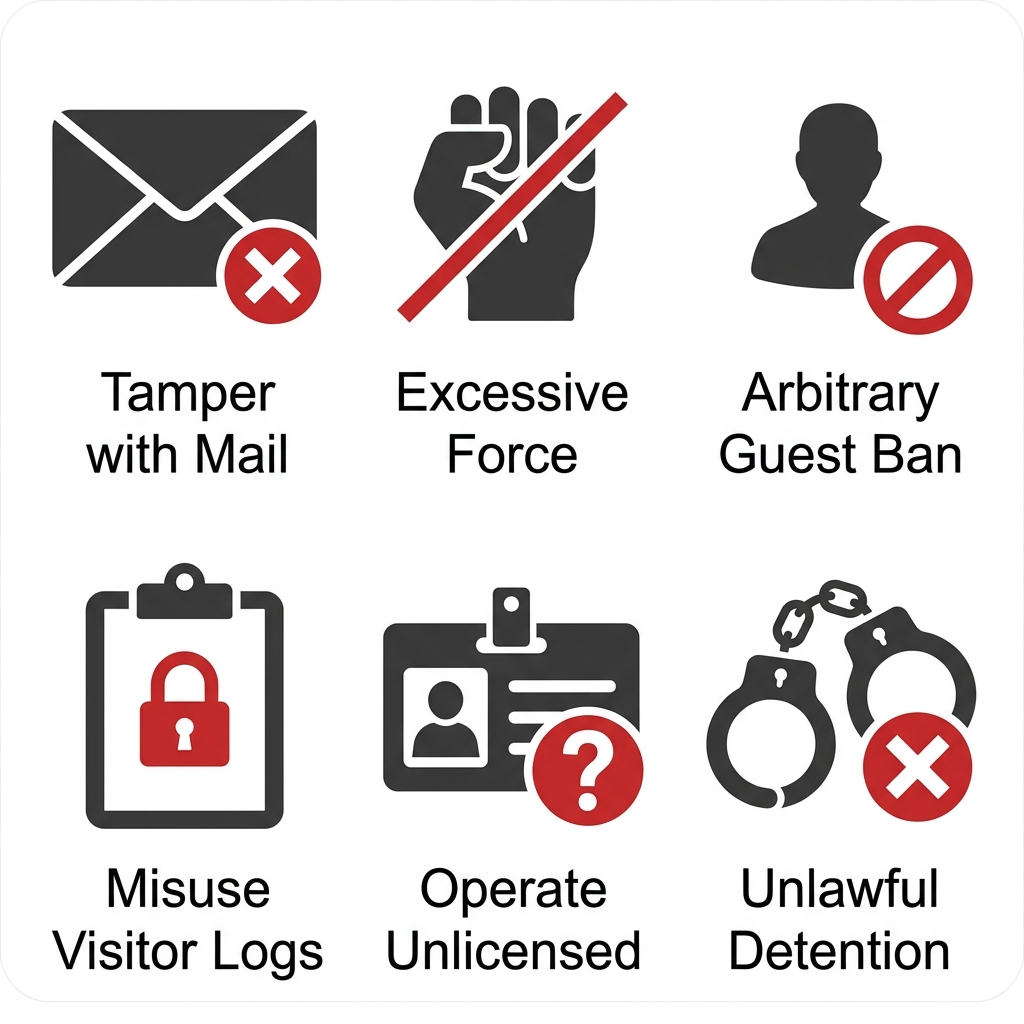
Prohibited Actions Under Canadian Law
Security guards in Canada do not possess general arrest powers. They can only make a citizen’s arrest under s. 494 of the Criminal Code for indictable offences that they personally witness on, or in relation to, the protected property. Arresting for a summary offense constitutes unlawful confinement and may also result in criminal charges against the guard. Detained persons must be turned over to the police without delay. The arresting security guard has no power to interrogate the arrested person. Use of force must be necessary, proportionate, and consistent with the Charter; excessive force can result in assault charges and licence revocation. Handcuffs and batons require provincial training. Firearms are limited to rare high-risk roles and require additional licensing. Our guards are licensed and trained with a focus on limiting and respecting the above rules, with de-escalation as the first response.
Privacy Rights, Property Access, and Tenant Protections
As per BC privacy and tenancy laws, security can’t open or withhold a tenant’s mail or packages. This violates privacy laws and can be a criminal offence. In the same vein, security can’t ban a guest without a documented safety concern. The Residential Tenancy Act protects the right of tenants to have guests. Arbitrary guest bans can put the landlord at risk of liability and possibly lead to rent abatement. Logs can only be used for emergency planning. Mining the data for surveillance or for any other purpose is a violation of the Personal Information Protection Act (PIPA) and can be reported to the Office of the Information and Privacy Commissioner (OIPC). Our officers are trained to respect tenants’ rights to privacy and to ensure security of the property. We know these rights help us build and maintain strong relationships with our customers (tenants and property managers).
Essential Skills and Security Best Practices for Professional Guards
As mentioned, understanding the limits of the law is only one step. Acquiring the necessary skills and adopting the required behaviors will make a guard truly effective.
Key Skills and Attributes of an Effective Security Guard
The ability to recognize changes in the environment (i.e. a strange car, an unsecured door, unusual behavior) and determine the level of risk is key to doing the job. Communicating with clients, guests and members of the public requires clear verbal instructions and active listening, which de-escalate tension and ensure cooperation. Conflict resolution skills enable guards to defuse disputes before they escalate.
All of our security personnel complete Basic Security Training as mandated by the BC Security Services Act, covering legal authority, report writing and professional ethics. Advanced Security Training further sharpens use of force and judgment and crisis intervention. Responding to medical emergencies and first aid is covered in the Occupational First Aid Level 2 course. Because the Security Services Act mandates guards to hold a valid license, our screening and certification efforts further build professionalism within the industry. Unwavering commitment to training and licensing, along with professionalism, integrity and dedication, supports professional standards. This foundation of skill and certification is how we deliver unmatched security expertise to properties across Vancouver and the Lower Mainland.
Seven Practical Safety Tips for Guards on Duty
- Stay vigilant and scan your surroundings continuously. Report anomalies immediately to your supervisor and note them in the shift log.
- Communicate clearly and professionally with everyone you encounter. Use active listening to de-escalate tense situations and gather accurate facts.
- Wear your full uniform and visible identification at all times. Ensure your security license is displayed as required by BC law.
- Know the legal limits of your authority and never exceed them. Use force only as a last resort and in strict proportion to the threat.
- Secure all keys, access cards, and codes to prevent unauthorized access. Verify identity before granting entry and log each handover.
- Complete incident reports immediately after any occurrence, noting date, time, location, involved parties, and witness details to preserve factual documentation.
- Take care of your physical and mental wellbeing by staying hydrated, alert, and rested. Fatigue impairs judgment and reaction time, so manage breaks to maintain effectiveness.
| Situation | Do | Don’t |
|---|---|---|
| Responding to a trespasser | De-escalate, calmly ask them to leave, and notify supervisor | Use physical force immediately or threaten them |
| Interacting with the public | Maintain professional demeanor, listen actively, and provide assistance | Be dismissive, argumentative, or share confidential information |
| Reporting an incident | Document details immediately with facts, times, and witness info | Delay reporting, fabricate details, or withhold information |
| Handling keys and access credentials | Keep them secured, log access, and never lend to unauthorized persons | Leave keys unattended or share codes casually |
| Wearing uniform and identification | Wear complete, clean uniform with visible photo ID and license | Lend uniform items to others or wear unauthorized accessories |
| Using force | Use only reasonable, necessary force as a last resort after de-escalation | Use excessive force, use force as first option, or fail to report use of force |
One of the outcomes of a guard’s training is proper behavior in the public, which builds trust with the public and reflects the depth of a guard’s training. These behaviors are foundational, rooted in certification and ethical conduct, and equip guards to navigate complex situations involving arrest, use of force, and liability.
Navigating Complex Legal Scenarios: Arrest, Force, and Liability
While essential skills and best practices prepare guards for daily duties, understanding the legal boundaries that govern their actions is equally critical. In Canada, security guards operate under the authority of a citizen’s arrest, as defined by section 494 of the Criminal Code.
The following table outlines the key distinctions between security guard and police officer authority in Canada:
| Authority | Security Guard | Police Officer |
|---|---|---|
| Legal Status | Private citizen with limited arrest powers | Peace officer with full enforcement authority |
| Arrest Without Warrant | Permitted only when catching a person committing an indictable offence | Broader statutory grounds for arrest |
| Use of Force | Must be necessary, proportional, and justified | Must be reasonable under the circumstances |
| After Arrest | Must hand over detainee to police immediately | Can process and hold the individual in custody |
| Licensing | Valid provincial security licence required | Full police training and certification |
We may detain someone we have personally observed committing a serious indictable offence, but we cannot act on mere suspicion, after-the-fact reports, or for summary conviction matters like minor shoplifting. Any force used to effect an arrest must remain necessary and strictly proportional to the threat; excessive force would exceed our legal bounds and risk criminal or civil exposure.
After an arrest, guards must promptly hand the detainee over to police. Holding someone for an extended period, conducting a personal search without explicit consent, or otherwise detaining beyond what is lawful can give rise to false imprisonment or assault claims.
Provincial licensing under the Security Services Act in British Columbia is mandatory and confirms completion of Basic Security Training and related standards. We maintain full licensing and insurance for our 200-plus professionals across Vancouver and the Lower Mainland. Exceeding legal authority—through improper detention, excessive force, or an unauthorized search—can lead to criminal charges, regulatory sanctions, and substantial civil liability for both the individual and our company.
Frequently Asked Questions About Security Guard Rights and Limitations
Following the discussion on more complex legal situations (i.e. use of force, arrests and civil liability) this FAQ will address common legal constraints on security officer powers in British Columbia.
Can a security guard arrest or detain in British Columbia?
The detention powers of a security guard are more limited than those of police, and they may only hold someone in narrow citizen’s arrest circumstances when a criminal act is observed. We train our guards to recognize and respect legal boundaries, and to contact the police when necessary.
Can a security guard search bags or personal items?
A security guard cannot search bags or personal items without voluntary consent; searches must be consensual or conducted by the police. For guidance on searches and use of force, we recommend consulting BC regulations or a legal professional.
Understanding the legal constraints security guards must work within explains the importance of retaining a security provider who is committed to legal compliance and professionalism.
Frequently Asked Questions
What makes a good security guard?
A good security guard possesses alert observation skills, clear communication, and conflict resolution abilities to de-escalate situations. Regent Security ensures its guards complete Basic Security Training, Advanced Security Training, and Occupational First Aid Level 2, and they follow BC licensing and legal limits on use of force.
What are 7 general security tips?
The seven tips are: stay vigilant and report anomalies; communicate clearly with active listening; wear full uniform and visible identification; know legal limits and use proportional force only as a last resort; secure all access credentials and verify identities; complete incident reports immediately with full details; and maintain physical and mental wellbeing by staying hydrated and rested.
Security guard skills
Key security guard skills include observing environmental changes and assessing risks, delivering clear verbal instructions with active listening, and resolving conflicts peacefully. Regent Security’s guards are trained in Basic Security Training, Advanced Security Training, and Occupational First Aid Level 2 to meet BC licensing standards.
3 major function of security guard
The three major functions of a security guard are access control, patrols, and incident response. Access control involves verifying identity and managing entry to prevent unauthorized access. Patrols consist of regular rounds to detect suspicious activity. Incident response addresses disturbances, emergencies, and alarms according to protocols.
Why Regent Security Services Ensures Compliant, Professional Protection
Having answered legal limits, we explain how our company ensures compliant protection. Understanding what is a security guard not allowed to do guides our training: our 200+ licensed and insured professionals respect arrest limits, avoid unlawful detention, and protect tenant privacy under BC law. Guards do not act as peace officers, open mail, or arbitrarily ban guests. We custom-design site-specific plans to provide tailored protection in Vancouver and the Lower Mainland. Response times and alarm outcomes may vary; this is guidance, not a substitute for professional or legal advice.
Get Your Custom Security Quote
Now that you understand what a security guard is not allowed to do, the next step is securing protection that fully respects those legal boundaries. Our company has built its reputation on 15+ years of compliant, professional security in Vancouver and the Lower Mainland. Our licensed and insured guards are trained to apply citizen’s arrest powers properly, use proportional force, and protect tenant privacy under BC law. Every solution is custom-quoted based on a site assessment to meet your specific needs. With over 200 trained professionals, we deliver 24/7 coverage that prioritizes legal compliance and peace of mind. Our team ensures that every guard adheres to the strictest standards of conduct. Contact us to discuss how a personalized security plan can safeguard your property while staying within all legal limits.
Get Your Custom Security Quote

