Category: Security Guard Services

  • What Is a Security Guard Not Allowed to Do: A Comprehensive Guide

    What Is a Security Guard Not Allowed to Do: A Comprehensive Guide

    Table of Contents

    The answer to what is a security guard not allowed to do is that guards may not act as peace officers, arrest without witnessing an indictable offence on their assigned property, use unreasonable force, detain arrestees beyond immediate police handover, or work without a provincial licence.

    They may arrest without warrant only when they personally observe an indictable offence, such as robbery or assault, on the property they protect, or in fresh pursuit. Any use of force during an arrest must be necessary, proportionate and reasonable; excessive force can expose the guard and their employer to criminal or civil liability. After making an arrest, the guard must immediately deliver the detainee to a peace officer. Similarly, guards cannot search a person or their belongings without that person’s consent or a clear protective purpose tied to the site’s security policy. In British Columbia, every security guard must hold a valid provincial security licence, confirming completion of Basic Security Training and a background check.

    At Regent Security, we ensure all our professional licensed security guards are fully licensed and trained in these legal limits, so our commercial property, strata and hotel clients receive service that respects both safety and the law.

    With these legal limits in mind, we turn to the specific duties and actions that security guards may lawfully perform.

    Key Takeaways

    • Security guards in British Columbia hold a distinct set of legal authorities that are narrower than those of police but essential for maintaining order and safety.
    • Security guards possess certain powers to protect property.
    • While essential skills and best practices prepare guards for daily duties, understanding the legal boundaries that govern their actions is equally critical.
    • Following the discussion on more complex legal situations (i.e.
    • Having answered legal limits, we explain how our company ensures compliant protection.

    Core Duties and Authorized Actions of a Security Guard

    Security guards in British Columbia hold a distinct set of legal authorities that are narrower than those of police but essential for maintaining order and safety. Understanding what security guards are allowed to do clarifies the boundaries of their authority and builds trust with residents.

    Under section 494 of the Criminal Code of Canada, a security guard may perform a citizen’s arrest without a warrant when they personally observe an indictable offence, such as robbery or aggravated assault, on the property they protect. Security Guard Training Canada emphasizes that immediate handover to law enforcement is mandatory, and any use of force must be necessary, proportionate, and justified – excessive or retaliatory force is strictly prohibited. In British Columbia, all security personnel must hold a valid licence under the Security Services Act, and our guards at Regent Security Services are fully licensed and insured in accordance with that act.

    When dealing with tenants and guests, security guards are subject to a number of privacy restrictions. For instance, LawyerInfo.ca states that security personnel cannot open or otherwise handle tenants’ mail or packages. Security personnel may only ban guests when there is a documented threat to the individual’s safety. Lastly, security personnel may only use visitor sign-in/out logs for security and safety purposes.

    The following table illustrates a number of situations where security guards must differentiate between allowable and not-allowable behavior.

    Action/ScenarioAllowedNot Allowed
    Arresting a suspectIf observing an indictable offence (citizen’s arrest) and immediately handing over to policeWithout proper cause or without promptly contacting police
    Using forceOnly necessary, proportional, and justified forceExcessive or retaliatory force
    Opening tenant mail/packagesOnly if directed by a legal warrantUnder any other circumstance
    Banning guests from the buildingOnly after documenting a proven safety threatArbitrarily or without evidence
    Maintaining a visitor sign-in logStrictly for safety and security purposesUsing the log for surveillance or sharing data unlawfully
    Detaining a personIn the limited context of a citizen’s arrest (indictable offence observed)Detaining as if a peace officer or using prolonged restraint

    The restriction to not open mail ensures that communication remains private, the documented threat to safety justification prevents arbitrary harassment, and restricting the use of visitor sign-in logs to safety purposes is consistent with the Personal Information Protection Act and upholds residents’ right to quiet enjoyment.

    Knowing allowable acts gives a clear picture of the edge of the prohibited conduct.

    Security guards possess certain powers to protect property. The law also sets clear boundaries on what they may not do. Overstepping these boundaries exposes both the security guard and the property owner to serious liability.

    The following table summarizes six prohibited actions:

    Prohibited ActionWhy It’s Not AllowedPotential Legal Consequences
    Arresting for a summary offenceCitizen’s arrest under s.494 only covers indictable crimes.Criminal charges for unlawful confinement, civil liability.
    Applying disproportionate forceForce must be legal, necessary, and proportionate; Charter applies.Assault charges, licence loss, human rights complaints.
    Interfering with tenant mailViolates privacy laws; can be a criminal offence.PIPA complaint, possible mail-theft charges.
    Banning a guest without a documented threatResidential Tenancy Act guarantees guest access unless a safety risk is proven.Landlord/strata liability, RTB dispute, rent abatement.
    Using visitor logs for surveillancePIPA limits data collection to necessary safety purposes.OIPC complaint, order to stop, reputational harm.
    Working without a licenceSecurity Services Act requires licensing.Fines, removal, inability to perform duties.

    We protect our clients from liability by training every guard to understand that, under these restrictions, they act as private citizens, not peace officers, and must operate within strict legal limits. Our training and approach help win the confidence of tenants and property owners, as it assures them of the limits within which our guards will operate. This also helps build and strengthen our clients’ trust in us.
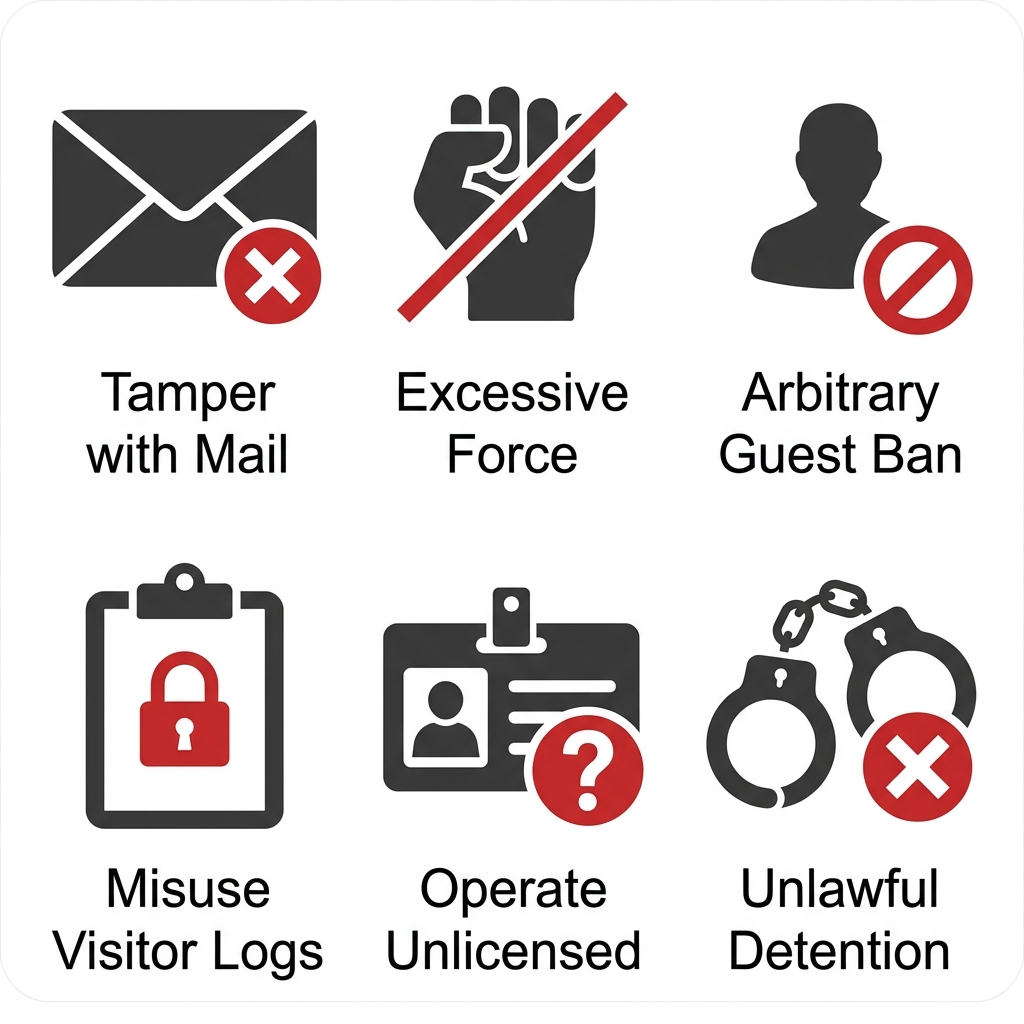
    Icon set of six prohibited actions for security guards: tamper with mail, excessive force, arbitrary guest ban, misuse visitor logs, operate unlicensed, unlawful detention, each with red no symbol
    Six prohibited actions for security guards depicted in icon set

    Prohibited Actions Under Canadian Law

    Security guards in Canada do not possess general arrest powers. They can only make a citizen’s arrest under s. 494 of the Criminal Code for indictable offences that they personally witness on, or in relation to, the protected property. Arresting for a summary offense constitutes unlawful confinement and may also result in criminal charges against the guard. Detained persons must be turned over to the police without delay. The arresting security guard has no power to interrogate the arrested person. Use of force must be necessary, proportionate, and consistent with the Charter; excessive force can result in assault charges and licence revocation. Handcuffs and batons require provincial training. Firearms are limited to rare high-risk roles and require additional licensing. Our guards are licensed and trained with a focus on limiting and respecting the above rules, with de-escalation as the first response.

    Privacy Rights, Property Access, and Tenant Protections

    As per BC privacy and tenancy laws, security can’t open or withhold a tenant’s mail or packages. This violates privacy laws and can be a criminal offence. In the same vein, security can’t ban a guest without a documented safety concern. The Residential Tenancy Act protects the right of tenants to have guests. Arbitrary guest bans can put the landlord at risk of liability and possibly lead to rent abatement. Logs can only be used for emergency planning. Mining the data for surveillance or for any other purpose is a violation of the Personal Information Protection Act (PIPA) and can be reported to the Office of the Information and Privacy Commissioner (OIPC). Our officers are trained to respect tenants’ rights to privacy and to ensure security of the property. We know these rights help us build and maintain strong relationships with our customers (tenants and property managers).

    Essential Skills and Security Best Practices for Professional Guards

    As mentioned, understanding the limits of the law is only one step. Acquiring the necessary skills and adopting the required behaviors will make a guard truly effective.

    Key Skills and Attributes of an Effective Security Guard

    The ability to recognize changes in the environment (i.e. a strange car, an unsecured door, unusual behavior) and determine the level of risk is key to doing the job. Communicating with clients, guests and members of the public requires clear verbal instructions and active listening, which de-escalate tension and ensure cooperation. Conflict resolution skills enable guards to defuse disputes before they escalate.

    All of our security personnel complete Basic Security Training as mandated by the BC Security Services Act, covering legal authority, report writing and professional ethics. Advanced Security Training further sharpens use of force and judgment and crisis intervention. Responding to medical emergencies and first aid is covered in the Occupational First Aid Level 2 course. Because the Security Services Act mandates guards to hold a valid license, our screening and certification efforts further build professionalism within the industry. Unwavering commitment to training and licensing, along with professionalism, integrity and dedication, supports professional standards. This foundation of skill and certification is how we deliver unmatched security expertise to properties across Vancouver and the Lower Mainland.

    Seven Practical Safety Tips for Guards on Duty

    1. Stay vigilant and scan your surroundings continuously. Report anomalies immediately to your supervisor and note them in the shift log.
    2. Communicate clearly and professionally with everyone you encounter. Use active listening to de-escalate tense situations and gather accurate facts.
    3. Wear your full uniform and visible identification at all times. Ensure your security license is displayed as required by BC law.
    4. Know the legal limits of your authority and never exceed them. Use force only as a last resort and in strict proportion to the threat.
    5. Secure all keys, access cards, and codes to prevent unauthorized access. Verify identity before granting entry and log each handover.
    6. Complete incident reports immediately after any occurrence, noting date, time, location, involved parties, and witness details to preserve factual documentation.
    7. Take care of your physical and mental wellbeing by staying hydrated, alert, and rested. Fatigue impairs judgment and reaction time, so manage breaks to maintain effectiveness.
    SituationDoDon’t
    Responding to a trespasserDe-escalate, calmly ask them to leave, and notify supervisorUse physical force immediately or threaten them
    Interacting with the publicMaintain professional demeanor, listen actively, and provide assistanceBe dismissive, argumentative, or share confidential information
    Reporting an incidentDocument details immediately with facts, times, and witness infoDelay reporting, fabricate details, or withhold information
    Handling keys and access credentialsKeep them secured, log access, and never lend to unauthorized personsLeave keys unattended or share codes casually
    Wearing uniform and identificationWear complete, clean uniform with visible photo ID and licenseLend uniform items to others or wear unauthorized accessories
    Using forceUse only reasonable, necessary force as a last resort after de-escalationUse excessive force, use force as first option, or fail to report use of force

    One of the outcomes of a guard’s training is proper behavior in the public, which builds trust with the public and reflects the depth of a guard’s training. These behaviors are foundational, rooted in certification and ethical conduct, and equip guards to navigate complex situations involving arrest, use of force, and liability.

    While essential skills and best practices prepare guards for daily duties, understanding the legal boundaries that govern their actions is equally critical. In Canada, security guards operate under the authority of a citizen’s arrest, as defined by section 494 of the Criminal Code.

    The following table outlines the key distinctions between security guard and police officer authority in Canada:

    AuthoritySecurity GuardPolice Officer
    Legal StatusPrivate citizen with limited arrest powersPeace officer with full enforcement authority
    Arrest Without WarrantPermitted only when catching a person committing an indictable offenceBroader statutory grounds for arrest
    Use of ForceMust be necessary, proportional, and justifiedMust be reasonable under the circumstances
    After ArrestMust hand over detainee to police immediatelyCan process and hold the individual in custody
    LicensingValid provincial security licence requiredFull police training and certification

    We may detain someone we have personally observed committing a serious indictable offence, but we cannot act on mere suspicion, after-the-fact reports, or for summary conviction matters like minor shoplifting. Any force used to effect an arrest must remain necessary and strictly proportional to the threat; excessive force would exceed our legal bounds and risk criminal or civil exposure.

    After an arrest, guards must promptly hand the detainee over to police. Holding someone for an extended period, conducting a personal search without explicit consent, or otherwise detaining beyond what is lawful can give rise to false imprisonment or assault claims.

    Provincial licensing under the Security Services Act in British Columbia is mandatory and confirms completion of Basic Security Training and related standards. We maintain full licensing and insurance for our 200-plus professionals across Vancouver and the Lower Mainland. Exceeding legal authority—through improper detention, excessive force, or an unauthorized search—can lead to criminal charges, regulatory sanctions, and substantial civil liability for both the individual and our company.

    Frequently Asked Questions About Security Guard Rights and Limitations

    Following the discussion on more complex legal situations (i.e. use of force, arrests and civil liability) this FAQ will address common legal constraints on security officer powers in British Columbia.

    Can a security guard arrest or detain in British Columbia?

    The detention powers of a security guard are more limited than those of police, and they may only hold someone in narrow citizen’s arrest circumstances when a criminal act is observed. We train our guards to recognize and respect legal boundaries, and to contact the police when necessary.

    Can a security guard search bags or personal items?

    A security guard cannot search bags or personal items without voluntary consent; searches must be consensual or conducted by the police. For guidance on searches and use of force, we recommend consulting BC regulations or a legal professional.

    Understanding the legal constraints security guards must work within explains the importance of retaining a security provider who is committed to legal compliance and professionalism.

    Frequently Asked Questions

    What makes a good security guard?

    A good security guard possesses alert observation skills, clear communication, and conflict resolution abilities to de-escalate situations. Regent Security ensures its guards complete Basic Security Training, Advanced Security Training, and Occupational First Aid Level 2, and they follow BC licensing and legal limits on use of force.

    What are 7 general security tips?

    The seven tips are: stay vigilant and report anomalies; communicate clearly with active listening; wear full uniform and visible identification; know legal limits and use proportional force only as a last resort; secure all access credentials and verify identities; complete incident reports immediately with full details; and maintain physical and mental wellbeing by staying hydrated and rested.

    Security guard skills

    Key security guard skills include observing environmental changes and assessing risks, delivering clear verbal instructions with active listening, and resolving conflicts peacefully. Regent Security’s guards are trained in Basic Security Training, Advanced Security Training, and Occupational First Aid Level 2 to meet BC licensing standards.

    3 major function of security guard

    The three major functions of a security guard are access control, patrols, and incident response. Access control involves verifying identity and managing entry to prevent unauthorized access. Patrols consist of regular rounds to detect suspicious activity. Incident response addresses disturbances, emergencies, and alarms according to protocols.

    Why Regent Security Services Ensures Compliant, Professional Protection

    Having answered legal limits, we explain how our company ensures compliant protection. Understanding what is a security guard not allowed to do guides our training: our 200+ licensed and insured professionals respect arrest limits, avoid unlawful detention, and protect tenant privacy under BC law. Guards do not act as peace officers, open mail, or arbitrarily ban guests. We custom-design site-specific plans to provide tailored protection in Vancouver and the Lower Mainland. Response times and alarm outcomes may vary; this is guidance, not a substitute for professional or legal advice.

    Get Your Custom Security Quote

    Now that you understand what a security guard is not allowed to do, the next step is securing protection that fully respects those legal boundaries. Our company has built its reputation on 15+ years of compliant, professional security in Vancouver and the Lower Mainland. Our licensed and insured guards are trained to apply citizen’s arrest powers properly, use proportional force, and protect tenant privacy under BC law. Every solution is custom-quoted based on a site assessment to meet your specific needs. With over 200 trained professionals, we deliver 24/7 coverage that prioritizes legal compliance and peace of mind. Our team ensures that every guard adheres to the strictest standards of conduct. Contact us to discuss how a personalized security plan can safeguard your property while staying within all legal limits.

    Get Your Custom Security Quote
    Resources

  • Concierge vs Security Guard Differences: A Complete Guide

    Concierge vs Security Guard Differences: A Complete Guide

    Table of Contents

    Understanding Concierge and Security Guard Roles

    The concierge vs security guard differences depend primarily on a property’s design and risk profile: high-rise residential buildings typically benefit from concierge services that balance hospitality with access control, while townhouse and mid-rise developments often need dedicated security guards for active perimeter monitoring and alarm response. We recommend property managers start with a formal security audit to pinpoint their building’s specific vulnerabilities and determine the most effective staffing model. Adopting this assessment framework allows property managers to objectively determine whether their building’s layout and resident expectations are better served by a hospitality-driven concierge or a security-focused guard. Understanding these fundamental differences is the first step; the following comparison explores the key contrasts between concierge and security guard responsibilities.

    Key Takeaways

    • Concierge services and security guards each focus on a particular area.
    • One major difference is the formal training and licensing of security guards, compared to concierges.
    • In British Columbia, concierges provide critical front-desk services, but are legally prohibited from performing security functions without a valid security license.
    • Balancing front desk duties between hospitality and security relies heavily on your building’s layout and the types of risks you face.
    • Modern hotel lobbies in Vancouver handle constant foot traffic that demands both welcoming hospitality and vigilant security.

    1. Concierge vs. Security Guard: Key Differences

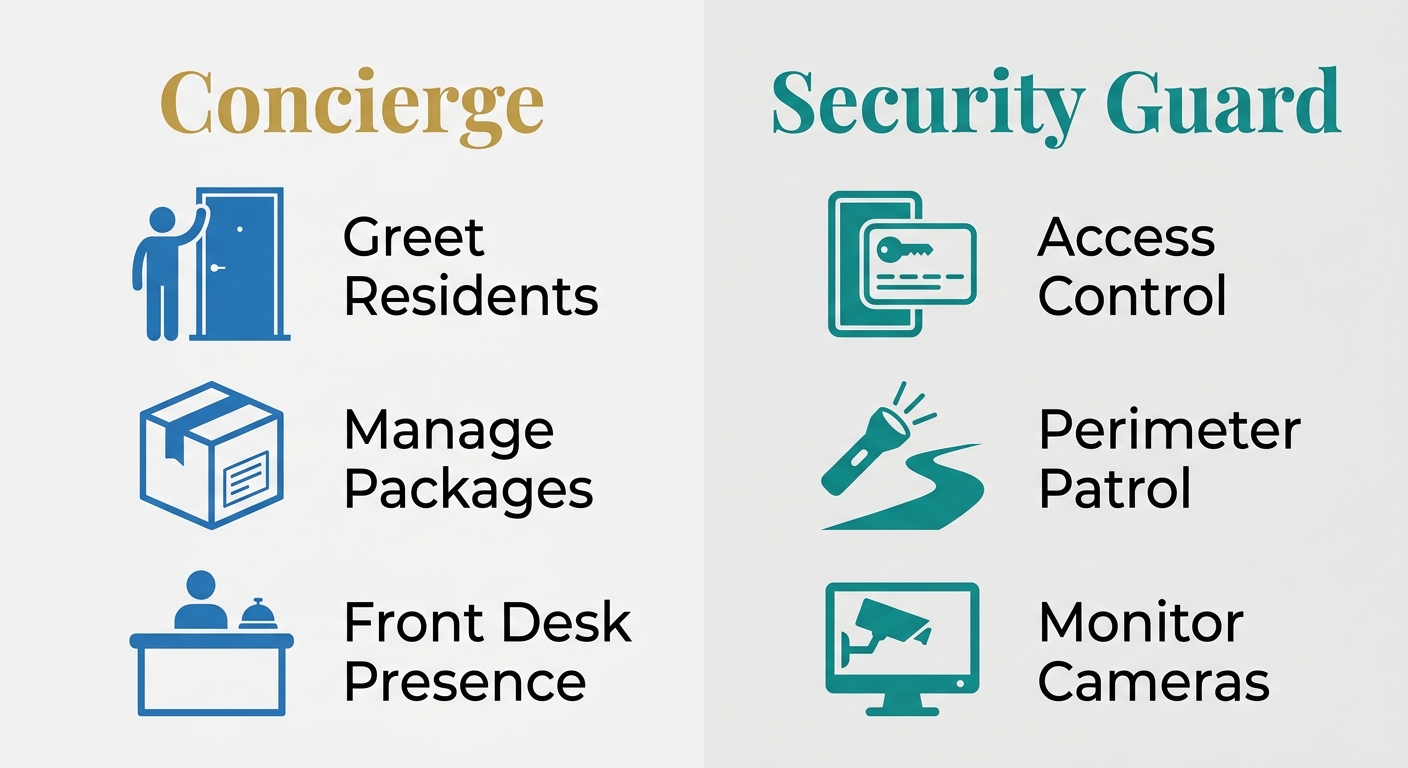
    Concierge services and security guards each focus on a particular area. Concierge services typically manage packages and greet residents. On the other hand, security guards manage the safety and patrol the perimeter of a location. In a high-rise residential tower in a downtown area, a concierge service to manage the front desk would likely be of best value. On the other hand, townhouse complexes and mid-rise residential towers require uniformed guards who can monitor fences, gates, and entry points.

    Side-by-side comparison infographic of Concierge and Security Guard roles, each with three labeled features: Concierge with Greet Residents, Manage Packages, Front Desk Presence; Security Guard with Access Control, Perimeter Patrol, Monitor Cameras.
    Infographic comparing Concierge and Security Guard responsibilities.

    At Regent Security Services, we recommend beginning with a formal security audit to identify a site’s unique exposures, enabling us to address those exposures specifically with a guard mix, rather than taking a one-size-fits-all approach. We pride ourselves on being able to take a concierge staffing and a security staffing approach to serve our clients. This naturally leads to training and licensing standards for staffing and security guard services.

    2. Training and Licensing that Set Them Apart

    One major difference is the formal training and licensing of security guards, compared to concierges. In British Columbia, the Security Services Act requires all security guards to have a license and, to earn the license, guards must have completed a basic training course (BST) and, for many assignments, advanced training (AST), in addition to Occupational First Aid Level 2 (OFA 2). All Regent Security staff are licensed and insured guards who have completed this rigorous training, ensuring full compliance with provincial standards.

    This structured preparation equips our team to manage emergencies, conduct surveillance, and protect property at a level that concierge staff, who lack equivalent credentials, cannot match. Your peace of mind comes from knowing that trained professionals are handling your site’s safety rather than relying on unlicensed personnel whose qualifications stop at guest services. Because security guards hold these legislated certifications, they are legally and practically qualified to perform protective duties that a concierge is not authorized or trained to carry out.

    3. Can a Concierge Perform Security Duties?

    In British Columbia, concierges provide critical front-desk services, but are legally prohibited from performing security functions without a valid security license. Without a security license, concierges cannot detain individuals or use force to respond to incidents—a function reserved for licensed security personnel.

    According to a legal guide from LawyerInfo.ca, tenants’ right to peaceful enjoyment under the Residential Tenancy Act prohibits concierges from opening mail or interfering with parcel deliveries without explicit authority. Under the Personal Information Protection Act, concierges cannot log daily tenant movements or conduct persistent surveillance unless a specific security threat requires it. These restrictions apply to protect the privacy of residents and help define the extent of the concierge’s functions.

    Knowledge of these legal boundaries helps property managers decide whether to hire a concierge, a licensed security guard, or a combination of both. With our unrivalled security industry experience and expertise, our team supports clients in staffing properties with the right personnel while respecting all applicable laws.

    4. Hiring a Concierge or a Security Guard for Your Front Desk

    Balancing front desk duties between hospitality and security relies heavily on your building’s layout and the types of risks you face. In the case of many high rise residential towers in downtown Vancouver, the concierge model provides the right balance. Resident service and package control, coupled with lobby presence provide the guest service amenity that many residents’ expectations have come to include. Elsewhere in the Lower Mainland, townhouse complexes and low-rise developments are better served by licensed security guards who focus on perimeter monitoring, alarm response, and active patrols.

    We suggest having a formal security audit completed prior to making any new hires. The right professionals can identify your greatest risks and security exposures based on site inspections and assessments. An audit would consider entry and exit points, resident volume, and surveillance to determine the right front desk solution or patrol configuration to provide the greatest deterrent. No one-size-fits-all model works. The right configuration for front-desk service relies on the nature of the property and the clear definition of security and service needs.

    5. Effectiveness in High-Traffic Hotel Lobbies

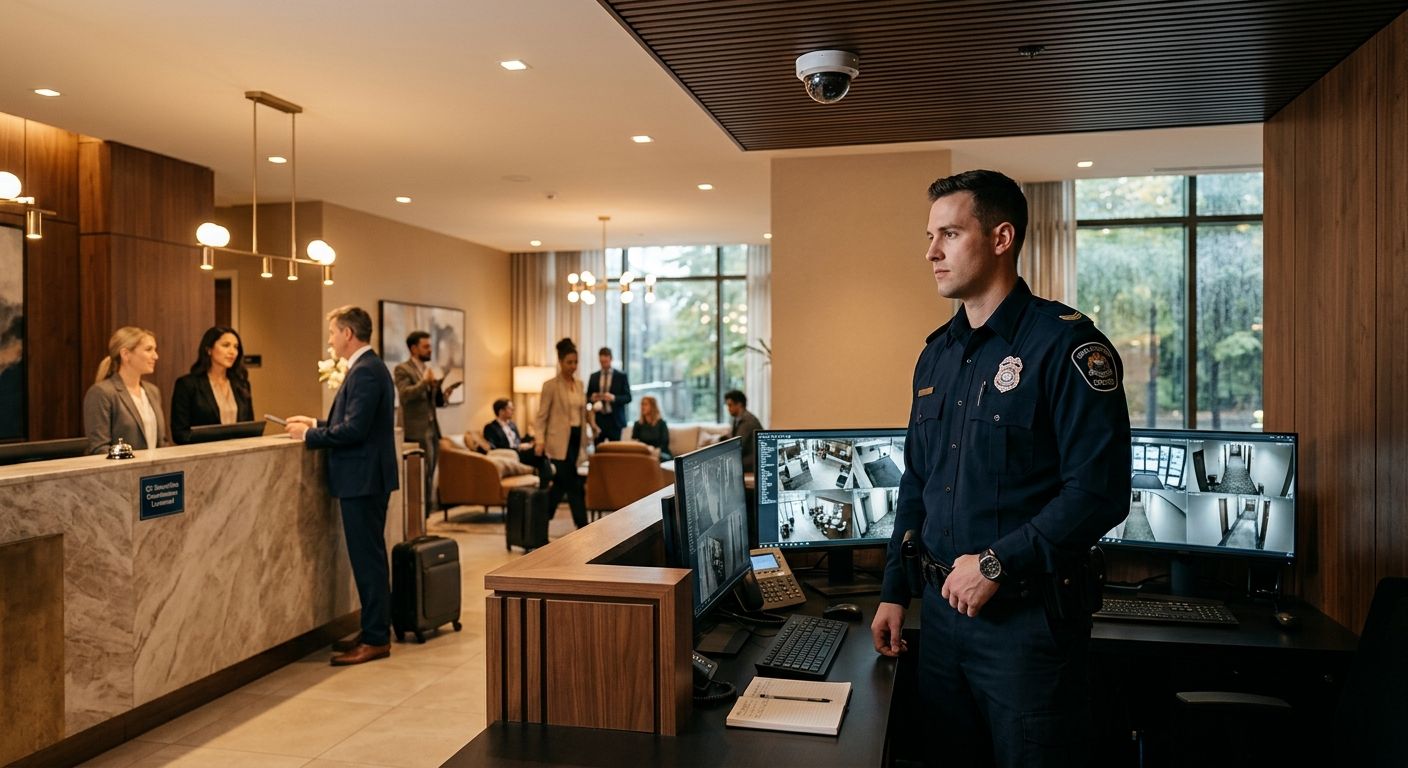
    Modern hotel lobbies in Vancouver handle constant foot traffic that demands both welcoming hospitality and vigilant security. When weighing concierge vs security guard differences for a high-traffic hotel lobby, we look at how each role meets the unique pressures of a 24-hour guest environment.

    A concierge focuses primarily on guest experience and front-of-house management. They greet arrivals, handle luggage, provide local recommendations, and create a polished first impression. A security guard, by contrast, oversees access verification, monitors entry points, and conducts surveillance to prevent unauthorized access. Our industry guidance emphasizes that the best choice depends on a property’s architecture, location, and specific risk profile.

    The effectiveness of either role hinges on a site-specific security audit. Where your safety is our story, we help hotels assess their lobby traffic patterns and security goals before recommending a staffing model. Understanding how each function performs under lobby conditions clarifies the combined responsibilities a concierge security officer would handle.

    6. The Concierge Security Officer Job Description

    Staffing high-traffic hotel lobbies to provide security and guest service requires a unique blend of skills. We look for this balance in concierge security officer candidates in Vancouver.

    Key responsibilities and qualifications for the role include:

    • Welcoming guests, answering inquiries, and providing directions while maintaining a visible deterrent to unauthorized behaviour.
    • Monitoring live CCTV feeds across the property to promptly detect and respond to suspicious activity.
    • Managing keycard access systems and entry points, ensuring only authorized individuals gain entry.
    • Holding full licensure under the BC Security Services Act, including Basic Security Training (BST) and Advanced Security Training (AST) certifications.
    • Drawing on our 15+ years of industry experience and a team of over 200 trained professionals to deliver consistent, reliable service.

    Because this position demands a presence that integrates both security and guest services, we assign concierge security officers to hotels throughout the Lower Mainland and Vancouver.

    7. How Regent Security Integrates Both Roles

    Regent Security’s integrated security and concierge services provide property-specific solutions based on layout and risk factors.

    For one high rise in Vancouver, we lean toward a concierge-heavy deployment. Recommended in our guidance for strata property managers, concierge services control access, greet visitors and manage deliveries. Our solution prioritizes residents’ convenience while effectively managing controlled access.

    An example in the Lower Mainland would be a townhouse complex, where our solution includes more security guard services. Guards on patrol monitor all access points and provide a visible deterrent. Our solution takes an open-air and suburban layout into consideration by providing pro-active security services.

    A formal security audit ultimately drives our integrated solution. The audit identifies the overall risk exposure of the property, and based on the findings, appropriately integrates concierge, security services, or a combination of the two. Our solution ensures that the strategies property managers utilize are not one-size-fits-all. By understanding our integration, property managers can implement best practices that strengthen both safety and day-to-day resident experience.

    8. Best Practices for Property Managers

    Integrated solutions like Regent Security’s dual-role model exist, but property managers need a clear framework for choosing between a concierge and a security guard for their property.

    • Conduct a formal security audit. Our team recommends mapping your property’s risks, incident history, and resident expectations before deciding on a staffing model. This process helps determine whether front-desk concierge hospitality or patrol-based guard coverage fits your layout.
    • Match the service to your building type. For high-rise towers, a concierge provides guest welcoming, package handling, and access control. Townhouse and mid-rise complexes are better served by mobile security guards who focus on perimeter monitoring and alarm response.
    • Uphold tenant privacy rights. British Columbia’s Residential Tenancy Act and privacy laws prohibit security staff from opening private mail, arbitrarily logging daily movements, or detaining guests. As LawyerInfo.ca highlights, property managers are legally responsible for ensuring staff compliance.

    With these best practices in hand, you’ll be prepared to make the choice that protects your property and respects your residents.

    Frequently Asked Questions

    What are the main functional differences between a hotel concierge and a security guard?

    A hotel concierge focuses on guest services such as greeting, luggage handling and local recommendations, while a security guard concentrates on access control, surveillance and perimeter patrols. Concierges manage packages and create a polished first impression; guards monitor entry points and prevent unauthorized access.

    Should my property hire a concierge or a security guard for the front desk?

    The choice depends on your property type: high-rise residential towers typically benefit from a concierge for hospitality and package management, while townhouse complexes need a licensed security guard for perimeter monitoring and alarm response. A formal security audit is recommended to identify the right fit.

    Can a concierge perform the same security duties as a licensed security guard?

    No, a concierge cannot perform security duties without a valid security license. Under BC law, unlicensed concierges are prohibited from detaining individuals, using force, conducting surveillance, logging tenant movements or opening private mail. Only licensed guards may carry out protective functions.

    Is it more effective to have a dedicated security guard or a concierge in a high-traffic hotel lobby?

    Effectiveness depends on a property-specific security audit that assesses architecture, location and risk. A concierge delivers guest hospitality, while a security guard ensures access control and surveillance; the best model balances both based on the lobby’s unique traffic patterns and security needs.

    How do the training requirements differ for concierge staff compared to on-site security guards?

    Security guards must be licensed under BC’s Security Services Act, requiring Basic Security Training (BST), often Advanced Security Training (AST) and Occupational First Aid Level 2 (OFA 2). Concierge staff have no such mandated training; their qualifications focus on guest services without the legislated protective skills.

    Making the Right Choice for Your Property

    Selecting the right service model depends on your property’s architecture and risk profile. High-rise strata buildings in Vancouver benefit from concierge services that combine hospitality, package management, and controlled access, while townhouse complexes need security guards for perimeter monitoring and access control. Understanding the concierge vs security guard differences helps property managers align service selection with their building’s needs. A formal security audit identifies the most effective risk mitigation strategy. We respect tenants’ rights to quiet enjoyment, mail privacy, and PIPA-compliant CCTV use. To determine the fit, contact us for a site assessment and custom quote. Services are subject to site assessment and custom quotation; response times and results may vary. This article is for general guidance and does not constitute legal advice.

    Find Your Perfect Security Solution

    Now that you understand the key differences between concierges and security guards, you are well-prepared to make the right choice for your property. Our guide highlighted how high-rise buildings benefit from concierge hospitality, while townhouse complexes require security-focused perimeter patrols. A formal security audit, as recommended throughout the comparison, is the critical next step to identify your building’s unique risks. Moving from insight to action is where real protection begins. We blend both roles seamlessly, drawing on over 15 years of experience serving properties across the Lower Mainland. Schedule your personalized site assessment today and take the first step toward a safer, well-managed property.

    Find Your Perfect Security Solution

    Resources

  • Hotel Loss Prevention Strategies: A Complete Guide for 2026

    Hotel Loss Prevention Strategies: A Complete Guide for 2026

    Table of Contents

    Hotel Loss Prevention Strategies in British Columbia

    Developing effective hotel loss prevention strategies in British Columbia requires a multi-layered approach that proactively addresses theft, vandalism, and liability risks. The British Columbia Security Services Act mandates that all security providers and guards be properly licensed and trained, creating a regulated environment where professional expertise is essential. One-size-fits-all packages fall short; instead, our process begins with a comprehensive audit that evaluates site-specific risks, from perimeter vulnerabilities to internal operational gaps. The most visible and foundational element of our strategy is deploying professional on-site security guards who serve as a deterrent and first line of response. Our team of over 200 licensed, insured professionals brings decades of experience to hotels across the Lower Mainland, delivering customized loss prevention programs that align with BC regulations.

    1. Visible On-Site Security Guards

    In loss prevention strategies for hotels, having uniformed security guards on the premises is a key element. A uniformed, professional guard appearance reinforces authority and acts as a strong visual deterrent to theft and loitering. The British Columbia Security Services Act requires security guards to have a valid license and complete mandatory training. Our team of over 200 licensed professionals meets these requirements and receives training and professional development to manage security incidents.

    Security guards typically monitor hotel entrances and exits, conduct regular patrols of lobbies, corridors, and parking areas, and manage access control. Guards are trained to detect suspicious behavior, defuse tense situations, and serve as a first point of contact for guests with safety concerns.

    We provide 24/7 security guard coverage to ensure a human response is available to de-escalate incidents or address emergencies. While on-site security guards deliver essential human oversight, pairing them with electronic surveillance systems creates a comprehensive security layer that strengthens a hotel’s overall security posture.

    2. AI-Powered Live Video Monitoring

    Live video monitoring technology fills coverage gaps in Vancouver hotel corridors where uniformed guards provide human presence, using AI-powered intelligent surveillance.

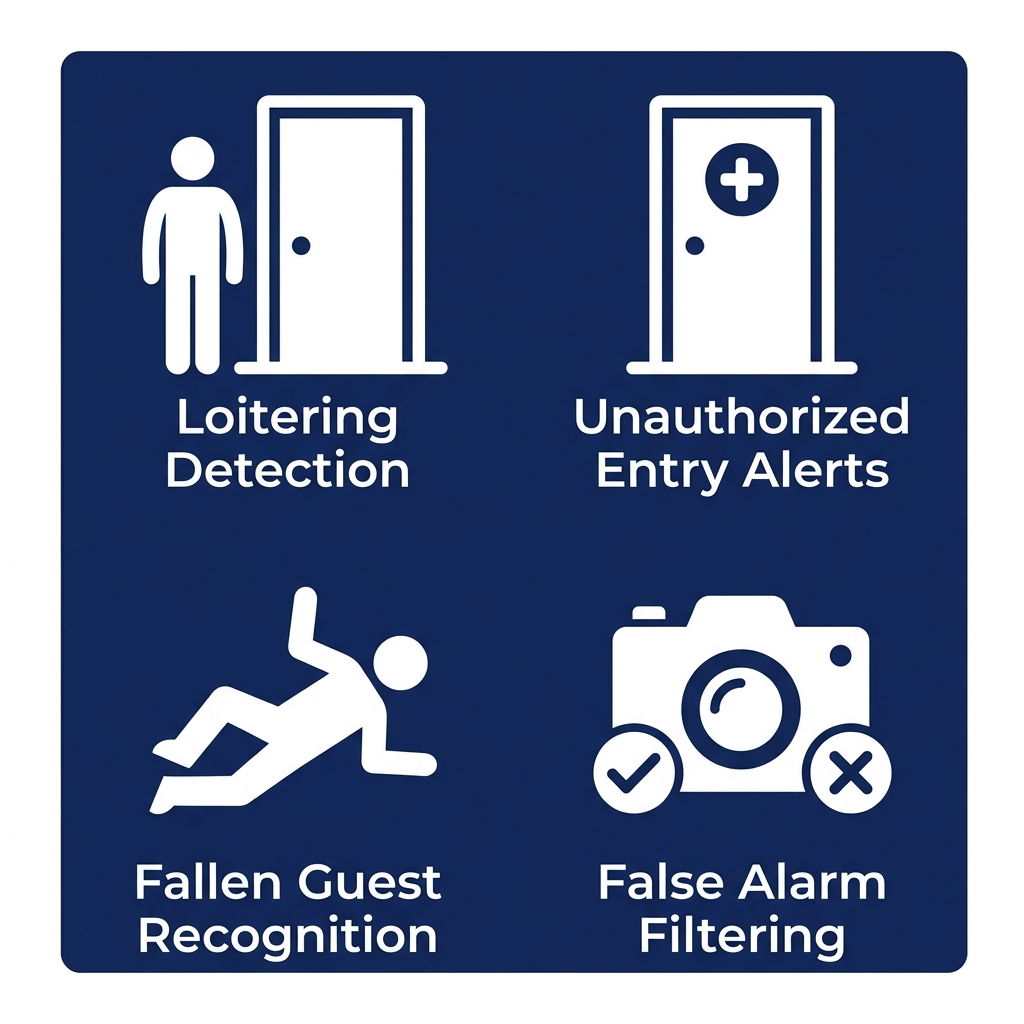
    The technology features analytics that help distinguish real threats from insignificant motion. Threats can include a person loitering by a guest door, or a person attempting to enter a restricted mechanical room or office. It also differentiates those threats from innocuous motion such as shadows or passing vehicles. It also detects anomalies like a fallen guest in a corridor, triggering immediate assistance.

    Grid of four white icons on navy background showing loitering detection, unauthorized entry, fallen guest recognition, and false alarm filtering.
    AI-powered threat detection icons for proactive security monitoring

    While our AI is designed to work over existing closed-circuit television (CCTV) systems, hotels do not need to totally overhaul their existing systems. In compliance with BC’s PIPA, we restrict surveillance to common areas and never guest rooms. Our hybrid model ensures AI is monitoring 24/7, and licensed guards validate alerts and deploy rapid response when needed.

    Verified data is utilized to perform comprehensive and ongoing security audits. Audits help us improve our protective services and ensure the peace of mind of our valued customers.

    3. Comprehensive Security Audits

    Video monitoring offers an immediate threat detection solution. However, a more comprehensive evaluation of an organization’s overall security posture is required on a recurring basis. Our security experts evaluate the physical and operational gaps that exist within an organization, as aligned with the ASIS International practice standards and guidelines.

    We follow a four-step audit framework—inspection, assessment, recommendation, and implementation—that incorporates thorough onsite walkthroughs, staff interviews, incident log reviews, and risk scoring. Throughout the evaluation, we remain compliant with British Columbia’s Security Services Act and the Personal Information Protection Act (PIPA), ensuring all licensing requirements and privacy standards for CCTV and visitor data are met without offering legal advice.

    We recommend annual audits or re-assessments whenever threat levels or operations change significantly. Access control systems, including keyless entry and biometrics, IP camera placement with PTZ, perimeter security, and emergency response protocols are assessed. Findings, including those pertaining to access control and entry point security, directly inform the implementation of strict visitor management protocols.

    4. Strict Visitor Management Protocols

    Results from security audits indicate areas of weakness that strict visitor management protocols can remedy. Hotels and commercial properties in the Vancouver region, and throughout the Lower Mainland, can benefit from implementing a layered approach to security, consisting of concierge-led check-in paired with technology. These approaches strengthen hotel security plans. Our protocols ensure that every visitor is screened without compromising the guest arrival experience.

    Concierge-led check-in acts as a visible security checkpoint. Digital kiosks and self-registration portals provide visitor management systems that validate visitor information, improve throughput and accuracy of visitor logs, and provide records and logs readily available. Maintaining accurate visitor logs and verified visitor information helps reduce unauthorized access. These systems, in conjunction with NFPA codes, allow real time visitor tracking and compliance with emergency lockdowns. The levels of automation and human oversight are adjusted to the foot traffic and risk profile of the property.

    These layered visitor controls are complemented by randomized mobile patrols that further deter and detect unauthorized activity.

    5. Randomized Mobile Patrols

    We have strict visitor policies at the front entrance, and equally important patrols throughout the property. To stay one step ahead of criminals, we use mobile patrols with randomized schedules and routes, making guard presence unpredictable. This irregularity prevents criminals from exploiting predictable security gaps.

    Our patrol units use GPS to time and log their locations, giving hotel management proof of patrols and accountability. Our mobile patrols complement static guards by covering parking lots, perimeter fences, and secondary building entrances when the checkpoint officer is occupied. One mobile unit can efficiently monitor multiple zones, reducing the need for numerous fixed posts while maintaining comprehensive coverage.

    Patrols help document risks by reporting deficiencies like insufficient lighting and unsecured access points. These reports support our clients’ risk management and insurance requirements by demonstrating due diligence and helping them identify and address security weaknesses proactively.

    When paired with sophisticated electronic access control systems, random mobile patrols create a multi-layered security environment that deters theft and vandalism without relying on predictable routines.

    6. Advanced Access Control Systems

    While randomized patrols provide dynamic deterrence, advanced access control systems provide a fixed perimeter of security which denies unauthorized entry. At Regent Security, we provide advanced access control systems for hotels in Vancouver and throughout British Columbia. With our systems, only guests and authorized personnel have access to the restricted areas of the hotel.

    Advances in technology have resulted in modern solutions that prioritise keyless entry by means of mobile credentials, cards or biometric verification such as fingerprint or facial recognition. With these systems, hotels can program access down to individual zones—guest floors, back offices, and storage rooms—while automatically generating detailed audit trails for every entry attempt.

    Combining these systems with CCTV and alarm response provides a secure and responsive mesh. When the system detects an unauthorized access attempt, it can trigger a real-time alert and pull up the relevant camera feed. Our systems and solutions are site specific and tailored to the unique layout and risk profile of a property. We provide a range of security systems and solutions which complement the existing layers of security for a property.

    Ultimately the technology is only as good as the people who manage it. This makes well-trained staff essential for incident response.

    7. Staff Training and Crisis Drills

    Advanced access control systems can protect only to the extent that front-line staff has been adequately trained to understand their operation and respond to alarms and other incidents. As indicated in Regent Security’s hotel security protocols, the British Columbia Security Services Act mandates that security guards employed at hotels complete both basic and advanced training, in addition to holding a valid security guard’s license. Therefore, it is imperative for hotels to verify that the above compliance requirements are satisfied prior to employing any security staff.

    Detailed crisis management plans must be documented, prepared for site-specific incidents, and reviewed after every drill or real incident. It is important to conduct post-drill debriefs to capture lessons learned and update plans to immediately adjust procedures. We recommend running realistic, site-tailored exercises at least quarterly, covering fire, medical, active threat, and guest disturbance scenarios. Each drill should test techniques to de-escalate and resolve conflicts, and verify the proper use of the property’s CCTV and access control systems.

    We offer hotel-specific, site-tailored training programs, supported by over 200 licensed and insured professionals, that ensure every hotel can mount a rapid, coordinated response that protects people and property.

    8. Elevating Guest Satisfaction with Visible Security

    Staff who are well-trained form the core of any effective security program, but their impact is amplified when supported by visible security infrastructure that guests can see and trust.

    We create "active security" through the use of AI-based behavioral analytics to detect and classify various threats in our video surveillance system. Our behavioral analytics are used to identify anomalies and distinguish threats from non-threatening motion such as shadows or wildlife. This allows our system to understand and detect threats like loitering near guest doors or unauthorized access to restricted areas, reducing false alarms. As part of a comprehensive security program, proactive detection directly supports loss prevention and gives guests a better sense of security without the need for intrusive surveillance.

    Licensed security guards, trained under British Columbia’s Security Services Act, create a strong visual deterrent in parking areas and hotel entrances/exits. A visible security presence, integrated with access control and other security infrastructures, builds confidence in guests that their room has been secured. As a result, a security program can become a "guest experience differentiator" in the hospitality industry.

    Through such program synergies, both guest experience and security are strengthened.

    Building a Comprehensive Hotel Security Program

    Visible security measures boost guest satisfaction but are a layer of a security program. A robust program underpins loss prevention strategies and combines compliance with the BC Security Services Act—licensed guards, mandatory training—with layered technology: IP PTZ cameras in high-risk areas and keyless access (mobile credentials, biometrics). With over 200 licensed, insured professionals with 24/7 coverage, we help hotels build programs integrating people, process, and technology. Contact us for a site-specific quote; services are subject to site assessment, custom quotation; results and pricing may vary. Response times and alarm outcomes may vary; CCTV must comply with applicable privacy laws in British Columbia. Please consult a licensed security professional for site-specific advice; this is general guidance, not a substitute for professional or legal advice.

    Request Your Custom Security Proposal

    From visible on-site guards to AI-powered live monitoring, these strategies are designed to protect your hotel, guests, and reputation. We deliver all these layers with over 200 trained, licensed, and insured professionals providing 24/7 coverage across British Columbia. With more than 15 years of experience serving Vancouver and the Lower Mainland, we understand the local regulations that matter—including the BC Security Services Act and PIPA privacy requirements. Our team will assess your property’s unique vulnerabilities and build a comprehensive, site-specific security program that integrates access control, randomized patrols, and staff training. A tailored solution not only deters theft and vandalism but visibly boosts guest satisfaction. Take the next step toward a more secure hotel by requesting a custom quote based on your specific needs. Your property’s safety and your guests’ peace of mind deserve a trusted partner.

    Request Your Custom Security Proposal

  • Event Security Companies BC: Top Vancouver Security Services

    Event Security Companies BC: Top Vancouver Security Services

    Table of Contents

    Event Security Companies in British Columbia: Professional Protection for Your Events

    Planning an event anywhere in British Columbia requires meticulous attention to detail, and security is one element you cannot overlook. Event security companies BC provide essential protection for functions of all sizes, from intimate private celebrations to large-scale public festivals. At Regent Security, we understand that seamless crowd management services in Vancouver and throughout the province are vital for creating safe, enjoyable experiences. Your peace of mind is our priority. We deploy licensed and insured guards who are trained to handle access control, perimeter monitoring, and rapid emergency response. With over 100 dedicated professionals and more than 1,000 clients served, our 24/7 availability and same-day deployment ensure you are never left waiting for professional support. We tailor our special event security Vancouver solutions to each venue’s unique needs, ensuring a reassuring presence without disrupting the atmosphere. For more information on our additional security services in Vancouver, we invite you to explore our full range of protective solutions.

    Event Security Coverage Across Vancouver, Surrey, and Burnaby

    As a premier event security company serving BC’s Lower Mainland, we tailor our approach to match the unique demands of each city we serve. Our licensed and insured professionals bring specialized expertise to venues across Vancouver, Surrey and Burnaby, ensuring every gathering—from intimate corporate functions to large public festivals—receives the vigilant protection it deserves. Understanding these city-specific strengths helps you choose a security partner who truly knows the local landscape.

    The following table highlights how our services, deployment speed and expertise vary across these key centres.

    Event Security Services by City in the Lower Mainland
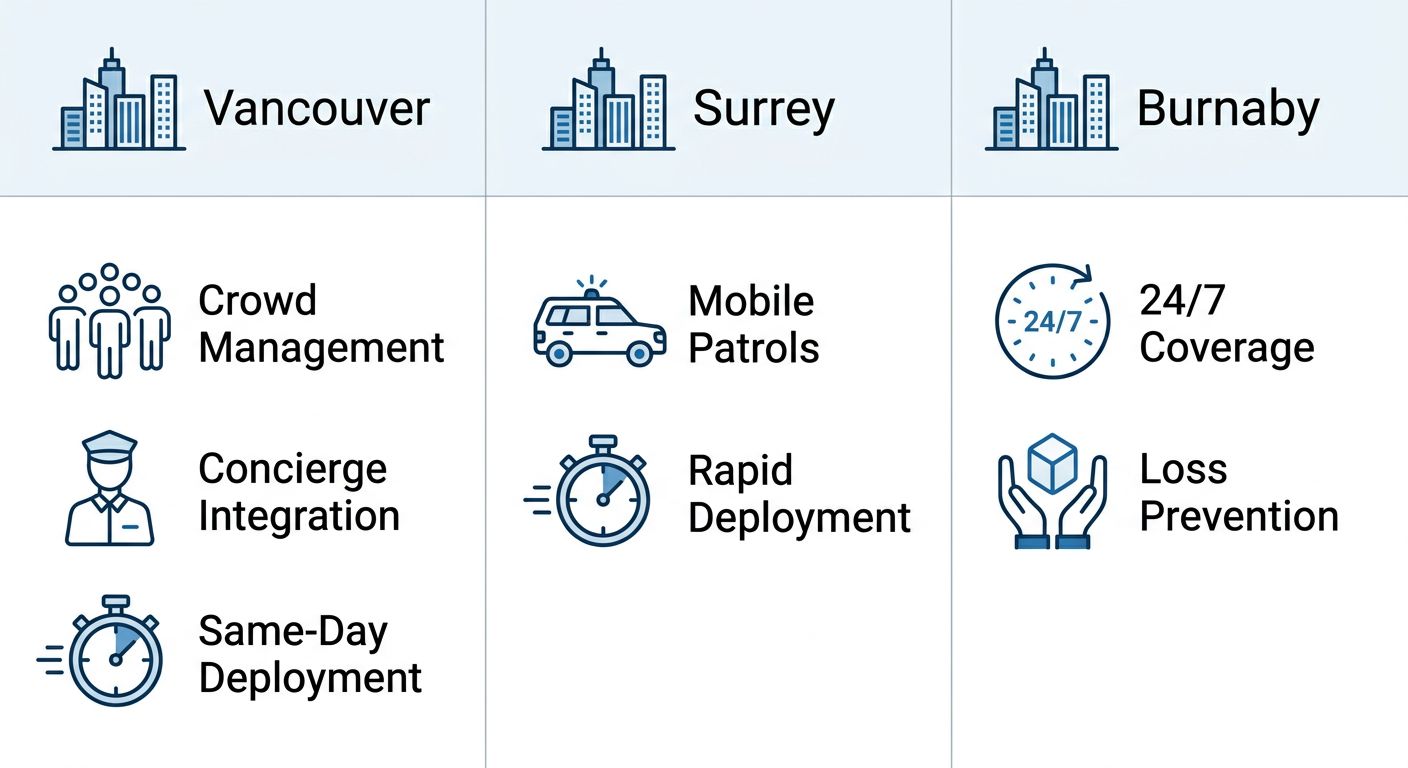
    CityService OfferingsDeployment SpeedSpecialized Expertise
    VancouverComprehensive event security, crowd management, concierge integrationSame-day deploymentLarge festivals, corporate events, concerts
    SurreyConstruction site security, mobile patrols, event securityRapid deploymentCommunity events, sports venues
    BurnabyHotel security, loss prevention, event security24/7 coverageTrade shows, conferences

    These city-level differentiators allow us to align our resources precisely with your event’s character and scale. Whether you need same-day deployment for a downtown Vancouver gala, rapid response for a Surrey sports tournament or around-the-clock coverage for a Burnaby trade show, our team of over 100 trained professionals draws on more than a million hours of collective service experience.

    In Vancouver, our crowd management services Vancouver and special event security Vancouver solutions integrate seamlessly with concierge teams, making us the go-to event security provider in BC for large festivals, corporate galas and concerts. Same-day deployment means last-minute requests never compromise safety.

    Across Surrey, our security services in Surrey combine event security with robust mobile patrols and construction site protection. Rapid deployment and deep familiarity with community events and sports venues ensure your gathering runs smoothly from setup to teardown.

    Throughout Burnaby, we layer event security onto our established hotel security and loss prevention programs, delivering 24/7 coverage for trade shows, conferences and hospitality-centred functions. Every deployment is backed by our commitment to licensed, insured service and personalized attention.

    Infographic comparing Regent Security's event security services in Vancouver, Surrey, and Burnaby, showing city-specific offerings like crowd management and mobile patrols with blue and white icons.

    Event security coverage comparison across three Lower Mainland cities.

    Our unified service quality and deployment flexibility mean you receive consistent excellence regardless of location. For any event type in Vancouver, Surrey or Burnaby, we provide custom security quotes that align precisely with your operational needs and peace-of-mind expectations.

    24/7 Event Security Deployment and Rapid Response

    Building on our comprehensive event security approach, Regent Security delivers round-the-clock protection with same-day deployment across Vancouver and British Columbia. As one of the leading event security companies BC event organizers rely on, we ensure your gathering receives immediate, professional coverage whenever you need it.

    Our licensed and insured team stands ready to serve events of every scale, from intimate private functions to large public festivals. With over 100 trained staff and more than 1,000 clients served, we bring proven reliability to crowd management services in Vancouver and surrounding communities to meet evolving client needs. Mobile patrols and alarm response capabilities integrate seamlessly with our event security operations, providing layered protection that adapts to evolving situations.

    Every deployment is tailored to your specific requirements through a personalized quote, ensuring you receive precisely the coverage your event demands without standardized pricing constraints. We understand that each gathering presents unique challenges, and our special event security Vancouver professionals work closely with you to develop the right security plan for your venue and attendee profile.

    Once deployed, our guards use advanced monitoring to ensure seamless protection. Beyond event security, we also provide concierge services in Vancouver, supporting residential and commercial properties with the same dedication to safety and professionalism.

    Understanding British Columbia Security Regulations for Events

    Beyond understanding the need for event security, it is essential to know the British Columbia regulations that govern these services. For organizers seeking event security companies BC, compliance starts with the province’s legislative framework. The Security Services Act stands as the primary legislation that all security providers, including those offering crowd management services in Vancouver and special event security in Vancouver, must follow.

    Under this British Columbia legislation, every security professional working at events must hold a valid security worker license. We ensure this requirement is fully met through the mandatory Basic Security Training (BST) provided by the Justice Institute of British Columbia (JIBC). According to the Government of British Columbia, this provincial training standard forms the foundation for all licensed security work in BC.

    Large events often demand specialized competencies. The JIBC and approved training providers deliver courses in crowd management and conflict resolution, which are frequently prerequisites for working at major venues. Hiring a licensed and insured security company like ours reduces legal risk for event organizers and demonstrates A Commitment to Unparalleled Excellence in safety planning. Proper record-keeping and adequate insurance coverage are also regulatory requirements that we handle, giving you Your peace of mind throughout the event.

    Our team is fully licensed and trained to meet all BC requirements, which we explore in the following section.

    How to Hire Event Security in BC: From Quote to Deployment

    Now that you understand the stakes, here is how we make hiring event security in BC seamless from quote to deployment. When you connect with leading event security companies BC, our first step is understanding your specific requirements. We provide a free, no-obligation custom quote based on your event’s size, venue, and risk profile, ensuring coverage is never one-size-fits-all.

    Our hiring process moves through four clear stages. You begin by submitting an inquiry, after which we deliver a personalized proposal. We then verify that all licensing and insurance compliance under the BC Security Services Act is in order. In keeping with standards upheld by the Canadian Security Association (CANASA), our guards complete comprehensive security training in British Columbia before deployment.

    Finally, you sign a straightforward service agreement and we coordinate deployment logistics. For large-scale events across the province, we recommend booking at least two weeks in advance. However, because we staff over 100 licensed and fully insured professionals, urgent requests for crowd management services Vancouver and special event security Vancouver can typically be accommodated with rapid, same-day response.

    Once your guards are deployed, our team remains in constant communication to ensure smooth execution — more on that in the next section.

    Secure Your Event with Regent Security’s Proven Expertise

    For those seeking event security companies in BC, our licensed and insured team provides trusted protection for any gathering. As a proud member of the CANASA Security Association, we bring rigorous training in crowd management services in Vancouver and special event security in Vancouver. With 24/7 availability, rapid deployment, and a record of over 1,000 clients served, we ensure expert coverage. Your peace of mind is our priority. Contact us for a customized quote.

    Resources