Tag: Security License Requirements BC

  • How Hard Is It to Get Hired as a Security Guard: Career Guide

    How Hard Is It to Get Hired as a Security Guard: Career Guide

    Table of Contents

    How Hard Is It to Get Hired as a Security Guard in British Columbia?

    How hard is it to get hired as a security guard in British Columbia? The process is moderately competitive, but demand for licensed and trained professionals remains consistent across the Lower Mainland. With over 15 years of experience in BC security, we at Regent Security know that candidates who complete mandatory Basic Security Training and hold a valid security worker licence have a clear advantage. Licensed and insured applicants receive stronger consideration. Employers value thorough preparation, strong communication skills, and a professional presentation. This article explores the key factors that influence hiring difficulty—including training, licensing, and experience—so you can approach the application process with confidence. Understanding the basic eligibility requirements is the first step to building a strong, competitive application.

    Key Takeaways

    • As a security services provider operating across British Columbia, we know that understanding the regulatory baseline is essential to evaluating how hard it is to get hired as a security guard.
    • The Security Worker Licence is mandatory when working as a security worker in BC.
    • A good clean criminal record is just one requirement that must be met before you can become a security guard in BC.

    Basic Eligibility Requirements for Security Guard Jobs in BC

    As a security services provider operating across British Columbia, we know that understanding the regulatory baseline is essential to evaluating how hard it is to get hired as a security guard. The BC Security Services Licensing Office requires that every security guard hold a valid security worker licence before starting work. This mandatory licensing framework ensures all personnel meet provincial standards for safety and competence.

    Applicants need to go through a course called Basic Security Training (BST) with an approved provider and then get certified by the Justice Institute of British Columbia (JIBC). However, alternative pathways may satisfy the training prerequisite for qualified individuals who have gaming security training or a background in Canadian police services. Beyond this, they must provide proof of Canadian citizenship or valid work authorization, along with a government-issued photo ID. Every candidate must be at least 19 years old, or 16 years old for specific supervised roles. They are also required to reside in Canada and demonstrate fluency in English. Candidates have to hand in a criminal record check and be fingerprinted for all initial applications; fingerprinting is also required for renewals unless the applicant uses a BC Services Card account for identity verification.

    All applications must be made online via the Security Services Platform. The Security Programs Division recommends using a BC Services Card account to streamline identity verification, though support is available for those unable to use the digital system. Applicants should know their application fee is non-refundable whether they receive a licence or are denied. After December 2025, the JIBC and other approved training providers stopped issuing physical training completion certificates. Instead, proof of completion is submitted directly to the registrar.

    At Regent Security, we see that meeting these eligibility requirements signals a candidate’s dedication and ensures they can legally perform security work in British Columbia. Completing Basic Security Training (BST) stands as the single most critical requirement for aspiring guards, and we’ll explore next how this foundational training directly improves hiring prospects and aligns with employer expectations.

    How Basic Security Training (BST) Improves Your Hiring Prospects

    The Security Worker Licence is mandatory when working as a security worker in BC. The Basic Security Training (BST) course is the only government approved way to get this licence. When candidates complete the course, they gain a clear advantage: it signals to employers that they are licence-ready and have absorbed the essential knowledge required to perform the role safely and effectively. This includes how to communicate effectively and follow the necessary procedures in case of emergencies. All guards who have their own licences must know these things.

    BC government requires training providers, such as the Justice Institute of British Columbia (JIBC), to conduct BST for learners. Once a candidate passes the course, the provider reports completion directly to the provincial registrar. This creates a straightforward verification path for employers, replacing the need to chase paper documents. This digital-first approach aligns with modern hiring practices, where background and credential checks happen quickly.

    As a licensed security company serving Vancouver and the Lower Mainland, our firm relies on BST certification as a minimum hiring standard. When we review applications, a verified BST record immediately sets a candidate apart from those who have not yet completed this foundational step. It tells us the individual understands use-of-force principles, legal responsibilities, and basic emergency response—topics that every security guard needs from day one. We, like all licensed security firms in BC, value this standardized training because it creates a consistent baseline of knowledge across every new hire.

    Two practical ways BST improves hiring prospects stand out:

    • Immediate licence eligibility: Without BST, an applicant cannot legally work as a security guard in British Columbia. Completing the training removes this barrier and makes the candidate hireable on the spot.
    • Demonstrated commitment: Investing time and effort in BST shows employers that the candidate is serious about the profession, not just casually exploring options.

    While a BST isn’t a job guarantee, it’s the single most important credential a new security worker can earn in this province. It moves a candidate to the front of the hiring queue. It shows that you’re ready and able to take up the responsibility that comes with working as a security worker. While the BST does meet the training requirement for licensing, a clean criminal record is equally critical. That is another non-negotiable requirement in order to get your security worker license.

    The Importance of a Clean Criminal Record in Security Hiring

    These records make up part of the application procedure when securing a license for this type of profession and have a lot of weight on whether or not someone will get the job as well as their chances to obtain work at all within the province. All applicants must pass a background screening conducted by the Security Programs Division before a license can be granted. That requirement makes a clean record a critical step in getting hired in the province.

    The BC Security Programs Division requires every security worker applicant to undergo a criminal record check as part of the licensing process. Fingerprinting is mandatory for identity verification and initial background screening; the division performs these checks on each candidate to confirm they meet provincial eligibility standards. Applicants submit fingerprints electronically through accredited services, and results are reviewed against law enforcement databases. Fingerprinting links the applicant’s identity to the background check, preventing errors and fraudulent applications. To apply, individuals must be at least 19 years old, reside in Canada, and hold relevant security training, as well as provide a passport-quality photo and valid government identification. All application materials are processed through the BC Security Services Platform, and the division only issues licences to those who meet these rigorous standards, emphasizing that a clean criminal history is non-negotiable. For licence renewals, applicants can use a BC Services Card account for identity verification, potentially avoiding a second fingerprint submission. The criminal record check reviews the applicant’s history for any convictions that would disqualify them from holding a security position, ensuring public trust.

    A clear criminal record means something more than just a license. It’s also about having a good enough background that the employer can feel comfortable putting someone in charge of protecting individuals or assets. When a candidate does have a clean record, he or she will be perceived to be a low risk hire which increases his chances of being offered employment. The licence is proof that the candidate was vetted, but the clean background tells the prospective employer that he or she is a law abiding citizen, trustworthy, reliable and able to meet all legal requirements. This helps the employer to offer the job to the candidate.

    Now that they have a solid background and proper licenses, would-be professionals should aim for extra training to make their resumes more competitive against other applicants.

    Certifications and Skills That Set Security Guard Candidates Apart

    A good clean criminal record is just one requirement that must be met before you can become a security guard in BC. But most security agencies like Regent Security ask candidates to meet more criteria.

    Security guards need this basic course in order to become licensed workers according to BC law. Basic Security Training has two primary focuses. First off, he must learn legal and other necessary rules for a job under the provincial Security Services Act and then demonstrate his understanding of how to use force appropriately, proper ways to write reports and abide by standards expected from him as a professional working as a security guard. Any unlicensed applicants will have their applications rejected for failing to complete basic security training and lacking a legitimate security worker licence. Therefore, BST is non-negotiable when it comes time to obtaining your security licence.

    The Advanced Security Training (AST), along with the Occupational First Aid Level 2 (OFA2) adds on the minimum standards required, and makes security guards more employable. The AST provides guard training that can be utilised to handle more risky circumstances, whilst OFA2 certifies the guard’s ability to deliver emergency medical intervention before first responders arrive. In any case, this is another credential that is valued because it allows the guard to deal better with the conditions found in the active site.
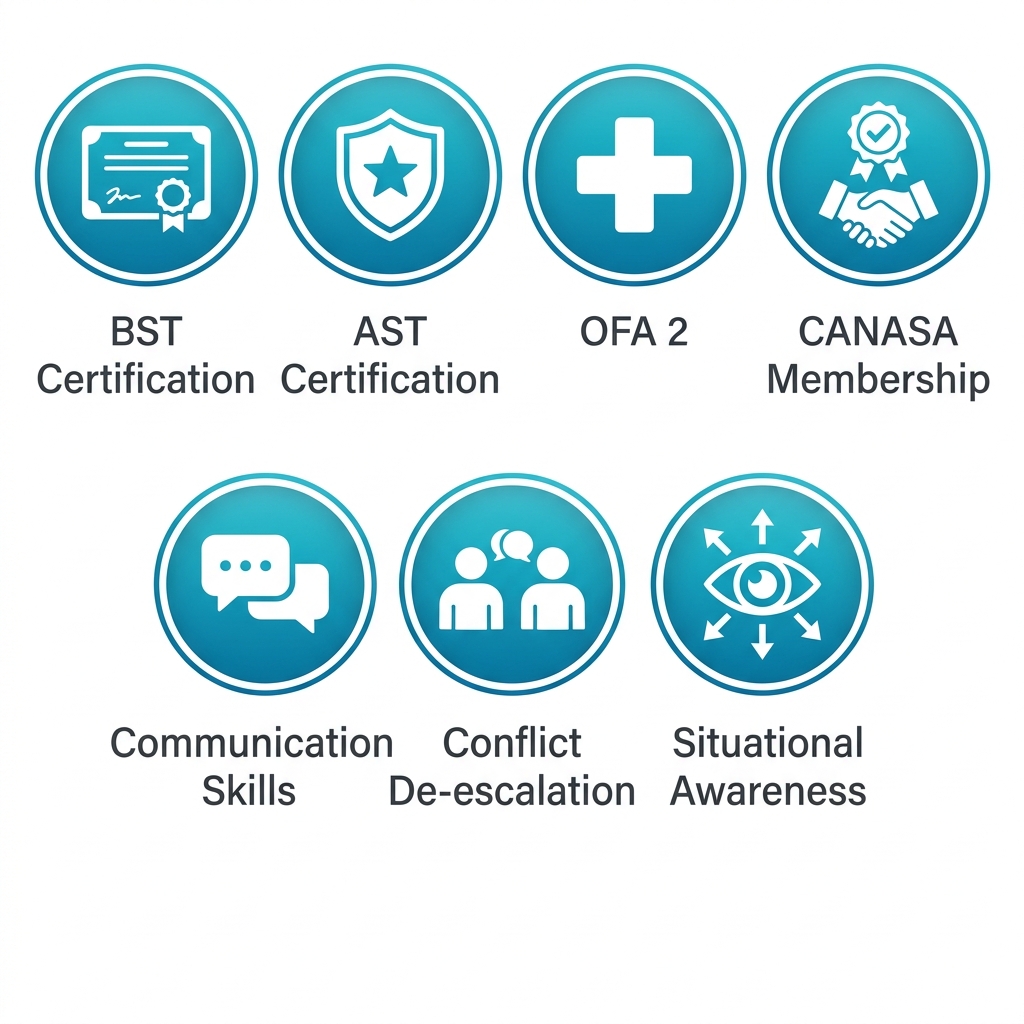
    Set of seven icons representing security guard certifications and skills, including BST and AST certifications, OFA 2 first aid, CANASA membership, communication, conflict de-escalation, and situational awareness.
    Seven icon set for BC security guard certifications and essential skills.

    A membership with a professional body like the Canadian Security Association (CANASA), for example, signals that the person has made a commitment to professional standards and ongoing development. Our company is a member of CANASA. As a result, we can say the candidate takes their career seriously and keeps up with new practices and tools. We continue this tradition because over 15 years later, our company remains committed to serving Vancouver, Surrey, Burnaby, and the Lower Mainland.

    Apart from the usual certifications required, soft skills are just as important. The ability to talk things down during a confrontation is critical in diffusing tension between individuals involved. Conflict de-escalation, which entails reading a situation and defusing it, can be what stands between someone getting hurt and the whole thing blowing up. The ability to recognize signs of trouble coming and being able to anticipate potential risks is what sets apart a reactive guard from a proactive professional.

    Get a BST certificate, pursue AST and OFA 2 qualifications, join a relevant trade body, and develop communication and de-escalation skills. These steps represent the first concrete steps toward landing a security role.

    Steps to Landing a Security Guard Role in British Columbia

    After completing your security training, the official licensing application in British Columbia is the next step,if you’re wondering how hard it is to get hired as a security guard in BC, this process is your entry point.

    1. Begin by gathering three essential documents: evidence of approved security training, proof of Canadian citizenship or valid work authorization, and a current government-issued photo ID. The BC Security Programs Division requires these to confirm that you meet the province’s eligibility requirements and have successfully completed the mandatory training necessary for a security worker licence.
    2. Next, complete the fingerprint submission for identity verification and a mandatory initial background screening. According to the BC Security Programs Division, this step is non-negotiable for initial licence applications to ensure a thorough criminal record check before a licence can be issued.
    3. Access the online application through the BC Security Services Platform and log in with your BC Services Card to securely verify your identity. This government digital portal streamlines the process by linking your verified identity to the licence submission and reduces the likelihood of delays when your information is complete.
    4. Pay the non-refundable application fee through the platform when you submit your application. The fee covers processing costs, but it is strictly non-refundable under any circumstances, regardless of whether your licence is ultimately approved, denied, or withdrawn.
    5. After you submit your payment, the Security Programs Division will conduct a criminal record check. Processing times are not fixed; they vary based on how complete your application is and the results of the security risk assessment, so ensure you have provided all required documents accurately.
    6. Once your background check is satisfactory and your application is approved, the Security Programs Division will issue your security worker licence, enabling you to work legally in British Columbia.

    Once you satisfy the requirements set forth above, not only will you be eligible to work as a security guard in BC, but you will also signal to employers that you have met the province’s official standards, positioning you to step confidently into your new career.

    FAQ

    Is it difficult to get hired as a security guard in BC if I have no prior experience?

    It is moderately competitive, but candidates without prior experience can get hired if they complete Basic Security Training and obtain a security worker licence. Employers value the standardized knowledge this training provides, and holding a verified BST record immediately sets an applicant apart. Strong communication skills and a professional presentation further improve hiring prospects.

    What are the primary eligibility requirements to be hired as a security guard in British Columbia?

    The primary eligibility requirements are completing Basic Security Training, being at least 19 years old, residing in Canada, and passing a criminal record check. Applicants must also provide proof of Canadian citizenship or valid work authorization, a government-issued photo ID, and undergo fingerprinting for identity verification. Fluency in English is required.

    How does completing Basic Security Training (BST) improve my chances of being hired by a security company?

    Completing BST makes you immediately licence-eligible, which is a legal requirement for any security guard job in BC. It signals to employers that you understand use-of-force principles, legal responsibilities, and emergency response. A verified BST record sets a candidate apart from those who have not completed this mandatory step, demonstrating commitment and readiness.

    Does having a clean criminal record significantly affect how hard it is to get hired as a security guard?

    Yes, a clean criminal record is critical. The BC Security Programs Division conducts a criminal record check for every applicant, and a licence cannot be granted without passing this screening. Employers view a clean record as evidence of trustworthiness and reliability, making the candidate a lower-risk hire and significantly improving the chance of receiving a job offer.

    What skills or certifications besides the security license make me a more competitive candidate for security jobs?

    Advanced Security Training, Occupational First Aid Level 2, and membership in the Canadian Security Association make a candidate more competitive. AST qualifies guards for higher-risk situations, while OFA2 certifies emergency medical skills. Strong communication and de-escalation skills are also highly valued by employers.

    Start Your Security Guard Career with Confidence

    If you have been wondering how hard it is to get hired as a security guard in British Columbia, the steps we have covered show that it is very achievable with the right training, licensing, and a professional attitude. At our firm, we have seen this firsthand throughout our more than two decades of serving clients across the Lower Mainland,we have operated since 2001 and built a team of over 200 dedicated professionals who understand exactly what employers look for. That deep industry presence confirms that preparation and persistence consistently pay off for motivated candidates. Begin your journey today by applying for positions that match your qualifications. Information in this article is for general guidance and is not a substitute for professional or legal advice; CCTV and surveillance services must comply with applicable privacy laws, including PIPA in BC. Services are subject to site assessment and custom quotation, and results, response times, and alarm outcomes may vary.

    Prepare for Your Security Interview

    Now that you’ve learned the essential steps to becoming a security guard in British Columbia, including the mandatory Basic Security Training and licensing process, you’re ready to prepare for your interview. Regent Security’s interview preparation resource provides expert insights from over 15 years of experience. With more than 200 dedicated professionals, the company knows what BC employers look for. This guide helps you practice common questions and improve your confidence. Thorough preparation is a key advantage in a competitive field. Use this free resource to build the interview skills that make you stand out. Start your security career with the confidence of being fully prepared.

    Prepare for Your Security Interview
    Resources

  • BC Security Services Act Licensing Requirements: Complete Guide

    BC Security Services Act Licensing Requirements: Complete Guide

    Table of Contents

    British Columbia Security Services Act Licensing Requirements

    Effective hotel security protocols depend on licensed personnel adhering to the BC Security Services Act licensing requirements. Under BC law, every security guard and security business must be licensed under the Act. All security personnel must meet the British Columbia security licensing requirements set by the province.

    The province requires completion of Basic Security Training (BST) and Occupational First Aid Level 1 (OFA-1). Understanding the BC Security Services Act licensing requirements confirms these standards are mandatory. We ensure all our guards hold current BST and OFA-1 certifications and fully comply with the Act. Our internal guidance on hotel security reaffirms that provincial licensing is essential. This commitment to professional licensed security guards ensures your peace of mind. With all guards fully licensed under the Act, Regent Security delivers unmatched security expertise—explore our tailored services. Information is for general guidance and not a substitute for professional or legal advice.

    Key Licensing Requirements for Security Companies Under the Act

    The BC Ministry of Public Safety and Solicitor General mandates strict BC Security Services Act licensing requirements for any security provider in the province. Under the Act, security companies must hold a business licence, carry adequate insurance, and ensure every guard possesses a valid Basic Security Training (BST) certificate. The Security Programs Division administers this system, and all licences must be renewed every two years with proof of continuing education.

    While the BST is mandatory for every guard, security firms that provide specialized audit services often require their staff to hold the advanced Specialized Security Audit certification, which builds on BST. This dual licensing structure helps ensure that both day-to-day security duties and in-depth risk assessments are performed by qualified professionals.

    Basic Security Training vs Specialized Security Audit

    Comparison
    Aspect Basic Security Training (BST) Specialized Security Audit
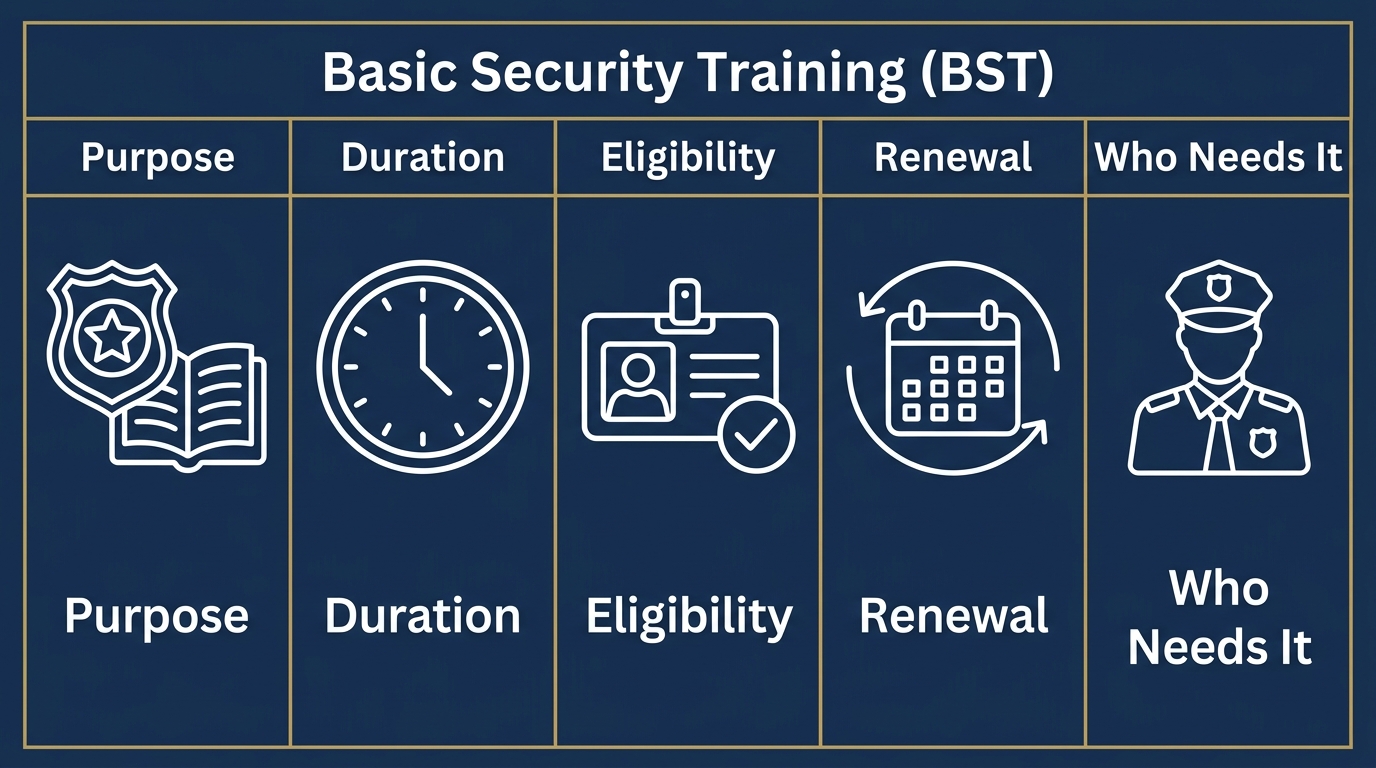
    Purpose Entry-level training for general security duties. Advanced certification for conducting comprehensive risk assessments.
    Duration Typically 40 hours of classroom and practical instruction. Varies by program; often includes field work and report writing.
    Eligibility No prior experience required; must be at least 19 years old. Requires prior BST certification and relevant work experience.
    Renewal Must be renewed every 2 years with continuing education. May require proof of ongoing professional development.
    Who Needs It All security guards in BC must hold valid BST. Optional but recommended for security firms offering audit services.

    The BST program typically involves 40 hours of instruction in legal authority, use of force, and emergency procedures. Candidates must be at least 19 years old and pass a criminal record check. While BST covers general duties, the Specialized Security Audit deepens risk assessment skills. For strata councils or commercial clients, verifying that a security provider’s staff hold these credentials is crucial. When hiring strata security company in British Columbia, it is essential to confirm that the company is properly licensed under the Act. Both credentials demonstrate compliance; the audit certification signals a higher level of expertise for firms conducting comprehensive security assessments.

    Infographic showing Basic Security Training (BST) requirements: Purpose, Duration, Eligibility, Renewal, Who Needs It.

    Overview of Basic Security Training requirements under the BC Security Services Act.

    Once training requirements are understood, the next step is the formal licence application. Information is for general guidance and not a substitute for professional or legal advice. For complete details, visit the BC government’s security licensing page.

    Security Guard Training and Licensing Process in BC

    Before a strata council can hire a security company, they must understand the training and licensing requirements each guard must meet. Professional licensed security guards in British Columbia must complete mandatory 40-hour Basic Security Training (BST) or a program deemed equivalent by the Ministry of Public Safety and Solicitor General. A criminal record check is a non-negotiable step in the licensing process. Understanding the BC Security Services Act licensing requirements is essential for any strata council considering a security provider. For a complete overview of how strata councils can hire a licensed security company, refer to our guide on the strata council security hiring process in British Columbia.

    The licensing steps include:

    • Complete Basic Security Training and pass a criminal record check.
    • Submit an application and supporting documents to the Ministry.
    • Receive a security worker license upon ministry approval.

    Our strata council hiring guide emphasizes that councils should request proof of licensing and training from any security provider they consider. According to our security guard cost breakdown, licensed, well-trained guards represent a level of service that is reflected in custom quotes rather than fixed rates. Verifying that a security company’s personnel meet all BC Security Services Act licensing requirements helps ensure a professional standard and contributes to your peace of mind.

    These regulations exist to protect clients and maintain quality across the security industry in British Columbia. By partnering with Regent Security Services, strata councils tap into unmatched security expertise and a commitment to custom, site-specific solutions. Please consult a licensed security professional for site-specific advice.

    Insurance Obligations and Penalties for Security Firms in the Lower Mainland

    Under the BC Security Services Act licensing requirements, security firms operating in the Lower Mainland must carry valid general liability insurance and workers’ compensation coverage through BCWorksafe. Insurance policies must satisfy minimum coverage amounts established by regulation, and verification occurs during initial licensing and at renewal, with firms required to submit proof of coverage. Firms offering specialized services like emergency response or loss prevention need policies that explicitly cover those activities — for example, loss prevention strategies retail demand liability coverage tailored to retail risk. As part of our strata hiring guidance, Regent Security emphasizes insurance verification as a critical screening step.

    Failure to maintain the required insurance exposes a security firm to significant administrative penalties. Under the BC Security Services Act, the Registrar can levy fines of up to $25,000, suspend or even cancel a licence. Additionally, the Registrar audits insurance status during licence renewal and can impose sanctions upon discovering any gap. These consequences underscore why Regent Security rigorously verifies coverage for every service we offer, including emergency response and loss prevention, and ensures compliance is documented at both initial licensing and renewal.

    By meeting every insurance obligation under the Act, we protect our clients, our personnel, and the integrity of our security services.

    Steps to Verify and Hire Licensed Security Personnel in BC

    Understanding BC Security Services Act licensing requirements is essential for any business hiring security personnel in British Columbia, as the law mandates verified licensing. Here are the concrete steps to verify and hire licensed security personnel in BC:

    • Check the BC government’s online license registry (gov.bc.ca) to verify an individual’s security license by name or license number. This step confirms the license is current and active.
    • Request proof of current liability insurance and Workers’ Compensation Board (WorkSafeBC) coverage from the security company. A reputable provider will gladly supply these documents.
    • Confirm that the license type matches the role required (e.g., security guard vs private investigator) and that it is valid for the work location, such as in Vancouver or Surrey.

    At Regent Security, every professional is fully vetted, licensed, and technology-trained, operating in full PIPA compliance. When you choose a provider that meets all licensing requirements under the BC Security Services Act, you can trust your site is protected by compliant, capable staff. With properly verified staff from a trusted provider like Regent Security, you can rely on effective 24/7 protection.

    Information is for general guidance and not a substitute for professional or legal advice.

    Your Path to Compliant Security Services in British Columbia

    Navigating BC Security Services Act licensing requirements in British Columbia is straightforward with Regent Security. Every guard we deploy is licensed under the BC Security Services Act, and our operations, including loss prevention, follow BC regulations. We create a site-specific security plan for every client, informed by 15+ years of experience in British Columbia. Explore our compliant security solutions below for your peace of mind. Please note this information is for general guidance and not a substitute for professional advice.

    Resources

  • Certified Security Guard Training BC Explained: Requirements

    Certified Security Guard Training BC Explained: Requirements

    Table of Contents

    Certified Security Guard Training in British Columbia

    To ensure the highest level of professionalism, every Regent Security guard undergoes certified security guard training in BC. This mandatory training equips our personnel with the essential skills to protect your property and maintain a safe environment.

    All security guards in British Columbia must complete the 40-hour Basic Security Training (BST) program. This foundational course, regulated by the BC Ministry of Public Safety and Solicitor General, covers critical topics such as legal authorities, emergency procedures, and effective communication skills. In addition to the BST, specialized roles may require advanced certifications in use of force or standard first aid, enhancing a guard’s ability to manage complex situations.

    After successfully completing the BST through an approved provider, individuals must apply for a BC security worker license from the provincial government. The application process includes a criminal record check and ensures that every licensed professional meets strict security license requirements in BC. At Regent Security, we manage all compliance details, ensuring our more than 100 professionals have fulfilled every mandatory step before their first assignment.

    The importance of certified training cannot be overstated. Adherence to these provincial standards is our commitment to delivering “Unmatched security expertise.” When you need to hire security guards for your property, you can trust that our fully licensed and insured team has undergone this rigorous preparation. We believe this training is the bedrock of “Your peace of mind.”

    Understanding BC Security Worker License Requirements

    To work as a security guard in British Columbia, individuals must meet specific licensing prerequisites set by the province. Understanding certified security guard training BC requirements is the first step toward a professional career in this field. We know that navigating the path to a bc security worker license can seem complex, but breaking down the training components makes it manageable. Here we outline the mandatory courses every applicant must complete and the optional certifications that can help you advance.

    Mandatory Training for BC Security Guards

    Before you can apply for your license, you must finish three mandatory training components. These core courses are non-negotiable and form the foundation of your security license requirements bc. The primary requirement is the Basic Security Training (BST) program. This comprehensive 40-hour course is issued by the Justice Institute of British Columbia and covers essential topics like legal responsibilities, professional ethics, patrolling, and emergency procedures.

    In addition to the BST, you are required to complete an 8-hour Use-of-Force training module. This course is offered by the Justice Institute of BC or another approved provider and ensures you understand the legal parameters around physical intervention. Finally, you must hold a valid Emergency First Aid certificate. This 8-hour program needs to be from a WorkSafeBC-approved provider. Together, these three certifications prove you have the baseline knowledge required for public safety and professional conduct in British Columbia. It is important to note that while completing this training is a critical step, final license approval is subject to additional criteria set by the provincial government.

    Optional Advanced Certifications

    Once you hold your foundational certifications, you might consider pursuing optional training to expand your capabilities and career opportunities. Advanced Security Training (AST) is a 40-hour program offered by the Justice Institute of BC. This course delves into more specialized subject matter, giving you hands-on knowledge of tools and techniques like handcuffing and firearms handling, which are not covered in the basic curriculum. Earning an AST certification demonstrates a higher level of commitment to the profession and can prepare you for more specialized security assignments in the field.

    The following table provides a clear comparison of mandatory and optional training components for security professionals in British Columbia:

    Mandatory vs. Optional Training for BC Security Guards
    Training TypeMandatory/OptionalHoursIssuing Body
    Basic Security Training (BST)Mandatory40Justice Institute of BC
    Use-of-ForceMandatory8JIBC or approved provider
    Emergency First AidMandatory8WorkSafeBC approved
    Advanced Security Training (AST)Optional40JIBC

    The table highlights that while 56 hours of mandatory training are required for all applicants, adding the optional 40-hour AST program allows individuals to differentiate themselves further. Understanding these distinctions is vital for planning your career path in security.

    Advanced Certifications and Specialized Training for BC Security Guards

    The security industry in British Columbia demands continuous professional development. While obtaining a bc security worker license is the foundational step for any guard, advanced certifications distinguish professionals who are committed to excellence. Regent Security views these qualifications as essential, not optional, because they directly translate to Unmatched security expertise for our clients. From complex physical intervention protocols to emergency medical response, advanced training ensures our team is prepared for any scenario, truly embodying our ethos that your safety is our story.

    Beyond the Basic License: Why Advanced Certifications Matter

    In British Columbia, the security license requirements bc provide a baseline competency, but modern security roles require far more specialized knowledge. Advanced certifications demonstrate a guard’s dedication to their craft and significantly enhance their employability and effectiveness on site. These credentials bridge the gap between basic monitoring and proactive, professional protection. They equip security personnel with the skills to handle medical emergencies, de-escalate volatile situations, and manage specialized environments like construction zones or luxury hotels. When you hire security guards from Regent Security, you benefit from our team’s advanced certifications and specialized training, ensuring a higher standard of service wherever we operate.

    Key Advanced Certifications for BC Security Guards

    Pursuing advanced security training in BC opens doors to diverse and rewarding roles. While the basic license permits a person to work, specialized certifications define their career path. Regent Security actively supports our personnel in obtaining these qualifications, which align with WorkSafeBC standards and best practices outlined by institutions like the Justice Institute of British Columbia. The following certifications represent the core training that elevates our guards from standard officers to specialized security professionals, ready to serve with confidence anytime, anywhere.

    Use-of-Force Certification

    This certification is considered mandatory for all security guards at Regent Security, reflecting the critical nature of safe physical intervention. The comprehensive program requires an initial 8-hour course followed by an annual refresher to maintain validity. Training focuses on legal responsibilities, de-escalation techniques, and controlled physical control tactics. This ensures that if a situation ever requires hands-on intervention, our guards act lawfully and effectively, minimizing risk to themselves and the public.

    Emergency Response (First Aid/CPR)

    Emergency response training is a non-negotiable requirement for security professionals, equipping them to manage medical incidents until first responders arrive. Standard certification involves an 8-hour initial course, with a 4-hour annual recertification to stay current with WorkSafeBC regulations. Whether responding to a slip-and-fall at a hotel or a cardiac event at a construction site, our guards serve as crucial first responders. For our clients, knowing that our team holds these life-saving credentials provides genuine Your peace of mind every day.

    Fire Watch Certification

    For guards stationed at construction sites or large-scale public events, fire watch certification is a critical asset. This focused training, typically condensed into a 4-hour initial session, teaches guards to identify fire hazards, monitor hot work operations, and execute evacuation protocols. While renewal is generally employer-driven, the skills are vital for maintaining site safety during vulnerable periods, such as when sprinkler systems are offline.

    Concierge and Hotel Security Training

    Specialized training for concierge and hotel security roles represents the intersection of security and hospitality. These 8-hour certification courses emphasize customer service skills, professional access control procedures, and loss prevention strategies. Guards learn to balance a welcoming presence with stringent security protocols, managing visitor logs, monitoring luggage, and handling guest disturbances discreetly. For Vancouver’s high-end residential towers and busy hotels, this training ensures that security personnel enhance the guest experience while maintaining an uncompromising safety standard.

    Steps to Obtain Your BC Security Worker License and Deploy with Confidence

    Now that you understand why licensing matters, let’s walk through the exact steps to obtain your BC Security Worker License and get deployed with confidence. The certified security guard training BC requires combines mandatory coursework, a government application, and verification by a reputable employer. The following table outlines every stage of the process at a glance.

    Advanced Certifications for BC Security Guards
    CertificationFocus AreaDurationRenewal PeriodTypical Roles
    Use-of-ForcePhysical intervention & control8 hours initial + annual refresher1 yearAll security guards
    Emergency Response (First Aid/CPR)Medical emergencies8 hours initial + 4 hours annual1 yearAll security guards
    Fire WatchFire prevention & response4 hours initialNo renewal (employer-specific)Construction & event security
    Concierge SecurityCustomer service & access control8 hours initialNo renewal (employer-specific)Building & hotel security
    Hotel SecurityGuest safety & loss prevention8 hours initialNo renewal (employer-specific)Hotel security guards
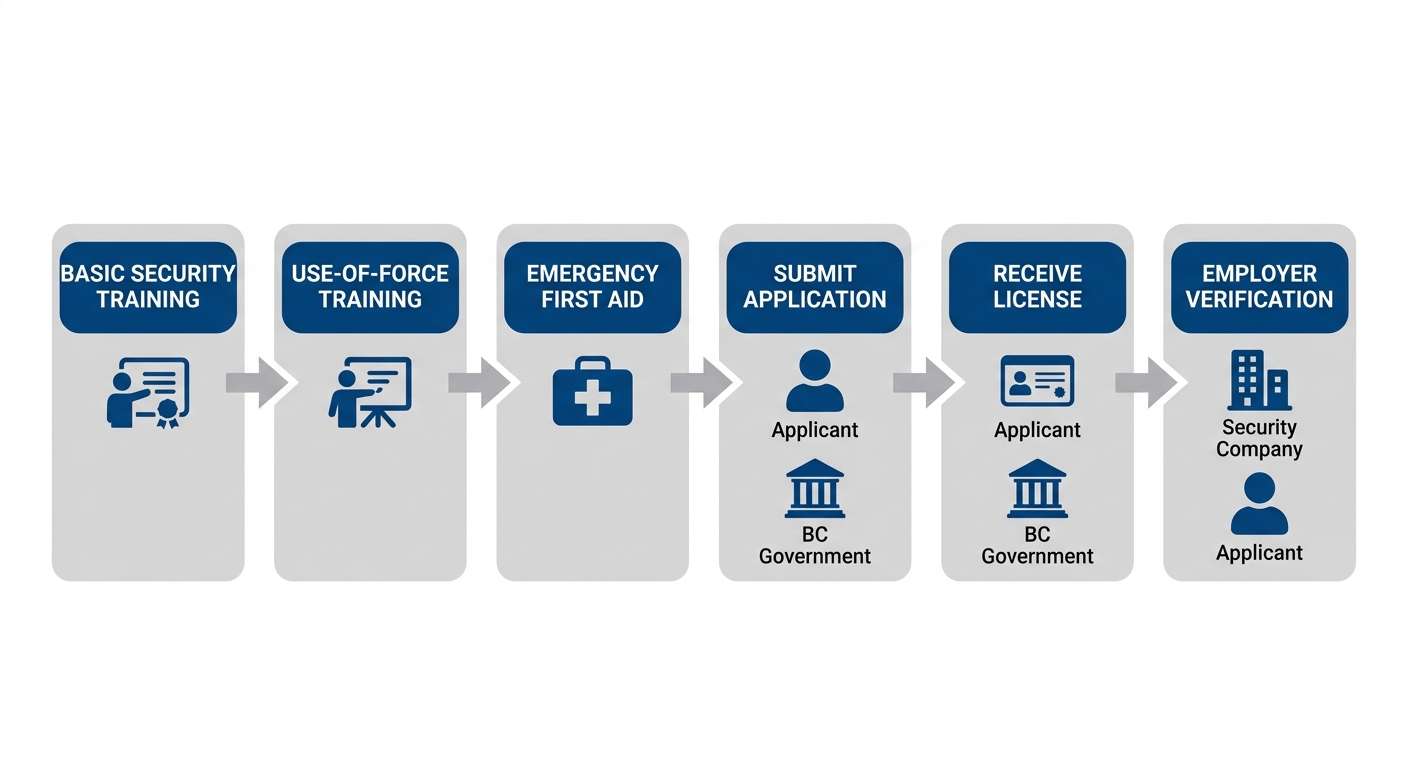
    Six-step horizontal process flow for obtaining a BC Security Worker License in British Columbia, with stages from basic training through employer verification.

    Six steps to obtain your BC Security Worker License and deploy.

    Mandatory Training Prerequisites

    Before you can apply for a bc security worker license, you must complete three mandatory training components. The cornerstone is Basic Security Training, a 40-hour course that covers legal authorities, communication skills, report writing, and emergency procedures. According to our internal training guidelines, this program ensures every candidate understands the legal boundaries and professional standards required in British Columbia. Most applicants complete BST within one to two weeks through an approved training provider.

    The second requirement is an 8-hour Use-of-Force training course, which teaches physical intervention and control techniques. This training emphasizes proportional response and aligns with the de-escalation principles we reinforce at Regent Security. The third prerequisite is an 8-hour WorkSafeBC-approved Emergency First Aid certification. Together, these three components form the foundation of certified security guard training BC employers expect, and our team verifies each certificate before moving candidates forward.

    Submitting Your License Application

    Once you have completed your training, the next phase addresses the security license requirements bc enforces. You must submit your application to the BC Security Programs Division, providing proof of all completed training, undergoing a criminal record check, and paying the required application fee. Processing typically takes two to four weeks, after which the province issues your Security Worker License.

    Verifying Company Licensing and Insurance

    When you are ready to work, or if you are a business hiring security personnel, verifying a security company’s licensing and insurance is essential. Start by requesting the company’s license number and then cross-reference it with the BC Security Programs Division to confirm the firm is in good standing. You should also ask for proof of insurance, which reputable providers keep current and readily available.

    From Training to Deployment: Regent Security’s Approach

    Once a guard holds a valid bc security worker license, our focus shifts to preparing them for the field. We verify each individual’s license and insurance, then layer on site-specific training that reflects the unique demands of concierge, building, construction, and event security roles. With over 15 years of experience and a team of more than 100 licensed professionals, we understand what it takes to transition from classroom learning to real-world deployment.

    Beyond Basic Training: Use-of-Force and Emergency Response Certifications

    While a basic security worker license is the foundation for any career in this field, advanced certifications in use-of-force and emergency response elevate a guard’s capabilities far beyond the core requirements. For those pursuing certified security guard training in BC, these specialized programs represent a commitment to professional excellence and operational readiness. They complement the BC security worker license and ensure guards meet evolving security license requirements in BC while being prepared for the complex, dynamic situations they may encounter in the line of duty.

    Frequently Asked Questions About Security Guard Training in British Columbia

    Here are answers to common questions about security guard training in British Columbia.

    What does certified security guard training in BC involve?

    Certified security guard training in BC covers the Basic Security Training (BST) course mandated by the province. According to Regent Security’s internal guidelines, this program typically requires about 40 hours to complete and includes essential topics like legal responsibilities, report writing, and emergency procedures.

    What are the prerequisites for security guard training in BC?

    The primary security license requirements BC mandates include a clean criminal record check and meeting a minimum age threshold, which is generally 19 years old. We ensure all our team members meet or exceed these foundational criteria before they begin their field preparation.

    Your Partner in Certified Security Guard Training and Deployment

    As a leading provider of certified security guard training BC, we ensure every candidate is prepared to meet the requirements for their BC security worker license. Our comprehensive programs cover all security license requirements BC, giving recruits the skills needed for real-world challenges. From hotels and construction sites to high-profile events, we deploy our trained professionals to safeguard what matters most. For details on our competitive pricing, see our FAQ on security guard cost in British Columbia. Contact us today for a custom quote and experience unmatched security expertise.

    Resources