
What Is Level 1, 2, 3 Security: A Comprehensive Guide for 2026
Table of Contents
- What Are Level 1, 2, and 3 Security Services?
- Core Principles of Security Levels and Their Distinctions
- How Level 2 and 3 Protocols Address Elevated Risks
- Determining the Right Security Level for Your British Columbia Property
- Scaling Security Levels with Integrated Monitoring and Response
- Frequently Asked Questions About Level 1, 2, and 3 Security
- Securing Your Property with the Right Level of Protection
What Are Level 1, 2, and 3 Security Services?
Understanding Level 1, 2 and 3 Security: To clarify what these terms mean, companies rely on the Maturity Framework to define how different types of security activities , reactive, basic monitoring, morph into mature, proactive security programs. In doing so, this gives security leadership a way to measure their organization’s level of security maturity, find areas where they’re lacking capabilities, and plan around improving their staff, procedures, tools and technologies. Regardless of where a company is along the maturity spectrum, the model enables IT security personnel to speak the same language when discussing security maturity improvements.
According to recent industry data published in Security Management magazine, based on research conducted by HiveWatch, there seems to be a serious problem. Although nearly all (93%) of security professionals believe that their organization has adequate means to spot coordinated attacks, less than two-fifths (19%) can consistently hit their targets when it comes to response times, alarm processing, and resolutions. As per the report, roughly half (56%) of these initiatives are at stage 2 or stage 3 of maturity. This means that more than half are not taking advantage of available tools and procedures. In addition, high false alarm rates, reaching almost half (44%) in the largest firms, are compounding the issue, showing that confidence doesn’t necessarily translate into preparedness.
The key benefit of using our model is that it helps us understand what makes each level unique. This principle explains why a security operation either only deals with alarms or actively works to minimize its risks. For instance, at Regent Security we use maturity-based assessments to design customised security programs for hotels, commercial properties, and construction sites across Vancouver and the Lower Mainland.
Key Takeaways
- Security levels represent distinct tiers of protection that define how properties monitor, deter, and respond to threats.
- Active safety precautions on commercial property must be more than passive monitoring.
- Each property has a separate level of potential threat.
- HiveWatch reports from ASIS International research showing that 93% of physical security leaders expressed confidence about detecting coordinated threats, while only 19% always met service level agreement requirements for response and remediation times.
- If your question is "what is level 1, 2, 3 security," this FAQ clarifies key findings from recent industry research and how we use them to shape effective security strategies.
Core Principles of Security Levels and Their Distinctions
Security levels represent distinct tiers of protection that define how properties monitor, deter, and respond to threats. In British Columbia, owners face a spectrum of security demands—from quiet residential lobbies to high-traffic commercial buildings—and understanding the key differences between levels 1, 2, and 3 security enables property managers to select the appropriate mix of personnel and technology for their facility’s risk profile.
These differences show up most plainly in terms of what’s covered, how many staff are on site and how systems are configured.
| Level | Description | Typical Coverage | Staffing Model | Technology Examples |
|---|---|---|---|---|
| Level 1 | A deterrent-focused approach using visible guard presence and manual reporting. The posture is reactive, logging incidents without proactive intervention or live monitoring. | One guard per shift performing periodic interior and perimeter checks. After-hours coverage is minimal or non-existent. | A single guard or a small rotation; no supplementary monitoring center or specialized support. | Basic CCTV cameras recording locally, handwritten logs, and standard mechanical locks. |
| Level 2 | A prevention-oriented posture that combines uniformed guards with mobile patrols and scheduled surveillance. It moves beyond reactive response by incorporating real-time alerts and daily reporting. | Multiple guards across shifts, covering entry points, common areas, and high-risk zones around the clock. 24/7 availability ensures quick incident escalation. | A dedicated security team with shift supervisors; integration with concierge or front-desk services is common. | Centralized alarm panels, access control keypads, GPS-tracked patrols, and remote-viewable CCTV. |
| Level 3 | A fully integrated security program that blends on-site personnel, continuous remote monitoring, and advanced analytics. It is proactive, using predictive threat detection and immediate response protocols. | Comprehensive 24/7 surveillance of all perimeters, interiors, and high-value assets. Coverage extends to real-time alarm verification and patrolling. | Layered teams including on-site guards, remote video operators, rapid-response units, and management oversight. | AI-driven CCTV with facial recognition, biometric access, intrusion sensors, and integrated building management dashboards. |
Level 1 suits low-risk environments like small offices or retail outlets where deterrence and basic incident logs suffice. Level 2, incorporating 24/7 coverage and mobile patrols, is common in hotels, mid-rise stratas, and construction sites that need visible security after hours. Level 3 is reserved for high-value facilities—data centres, luxury properties, or critical infrastructure—where continuous monitoring, biometric access control, and swift incident response are vital. By understanding these levels, our team can recommend the right solutions without over-engineering or under-protecting a site.
With these distinctions established, we can explore how Level 2 and 3 protocols are designed to handle elevated risks.
How Level2 and 3 Protocols Address Elevated Risks
Active safety precautions on commercial property must be more than passive monitoring. Level 2 and Level 3 safety systems help guard against dangers static measures cannot.
The Shift from Baseline to Heightened Awareness
According to ASIS International’s 2026 benchmarking survey, 56 percent of physical security programs currently operate at maturity levels 2 or 3, signaling that most organizations have moved beyond basic, reactive measures. That heightened posture is evident in the fact that 93 percent of security leaders surveyed expressed confidence in their ability to detect coordinated threats—a confidence that can only be maintained through structured Level 2 protocols. For commercial properties in the Lower Mainland, this shift means integrating structured patrol schedules, live monitoring, and defined escalation procedures. Security leaders in British Columbia are recognizing that passive camera footage and occasional guard patrols no longer suffice; instead, they are implementing policies that drive early detection and immediate intervention, which in turn shorten response times and contain incidents before they escalate.
Integrating Technology for RealTime Response
Live CCTV, integrated alarm platform technology and remote monitoring technology transform detection into action. Typically in an SOC, the operator manages nearly 342 daily alarms, and about a third are false, as per the ASIS study. With analysis layered onto verified video, SOC teams can ignore distractions and focus more quickly on actual threats. Remote video monitoring enables off-site professionals to examine a scenario and contact on-site personnel and local authorities without pause. According to the same ASIS survey, just 19% of organizations consistently hit their internal SLAs for how long they take to respond when asked. That means there’s quite a wide gap between getting an alert and taking action once we know what the problem is. When we can verify a burglary attempt in seconds via live video, we can coordinate with on-site guards or law enforcement before damage occurs, closing the loop between detection and response.
The Role of Centralized SOCs in Meeting SLA Goals
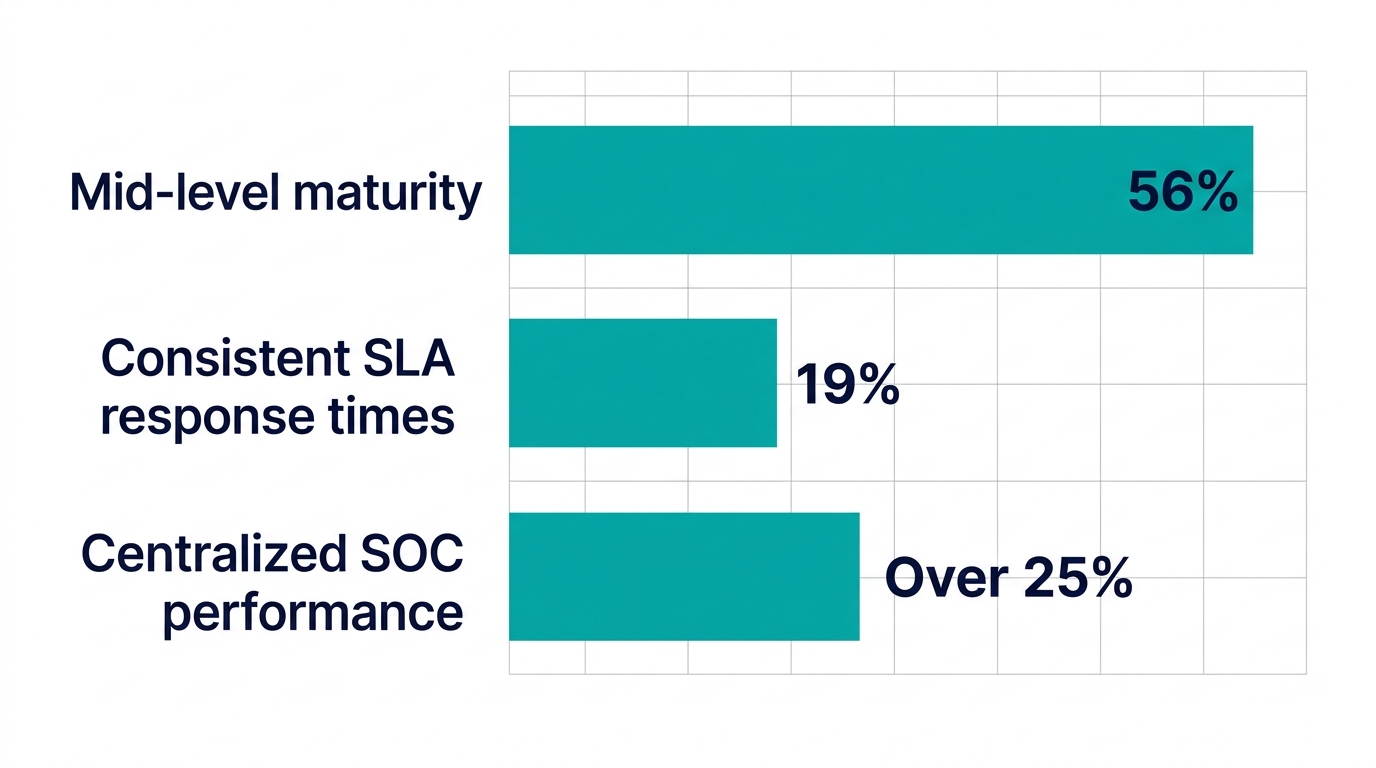
Centralized SOCs deliver more consistent SLA performance because the results are displayed above.
| Metric | Level1 (Basic) | Level2 (Mid) | Level3 (SOCcentric) |
|---|---|---|---|
| Organizations at this maturity level | Not specified | 56% (including Levels2 &f3) | Part of the 56% (no breakout) |
| SLA compliance rate | Not specified | 19% (overall industry) | Over 25% (centralized SOCs) |
| Centralized SOC effectiveness | N/A | Narrative only | Over 25% consistently meet SLAs |
Source: ASIS 2026 survey data.
The data tells the story: few organisations at Level 2 achieve consistent SLA adherence, but those that move toward a Level 3 centralised model, often supplemented by dedicated monitoring centres, substantially improve their ability to hit response targets. 56% of organisations operate at mid-maturity, yet only 19% always meet their SLAs; centralising operations can lift that figure above 25%. The jump from 19% to over 25% may seem modest. But in high-stakes environments, that incremental gain can mean the difference between a contained incident and a major loss.
Ultimately, property-specific risk factors determine the appropriate security maturity level, something many commercial owners in British Columbia are evaluating today.
Determining the Right Security Level for Your British Columbia Property
Each property has a separate level of potential threat. Which security grade you decide upon hinges on where that particular building sits in this threat level table. Before understanding just exactly how serious levels of security can be regarding your British Columbia premises, you should understand what a Level 1, 2, or 3 means for these sites. Consider how your security level reflects a site’s maturity and potential incident outcomes.
Assessing Risk for Hotels vs. Strata Properties
Hotels function as public-access facilities with high guest turnover, frequent after-hours activity, and fluctuating occupancy. Those conditions concentrate risk around lobbies, parking areas, and service corridors, so we commonly recommend at least Level 2 protection for downtown Vancouver hotels and Level 3 when a property hosts events, serves liquor, or handles high-value guest belongings. Concierge personnel combined with CCTV monitoring and layered access control create a visible but non-intrusive security posture that supports guest experience and loss prevention.
Strata properties present different vulnerabilities: multiple entry points, shared amenities such as gyms and underground parking, and regular resident turnover. For many strata buildings in Burnaby, Coquitlam, and Surrey, a Level 2 framework that pairs scheduled mobile patrols with integrated access control and remote CCTV monitoring balances cost and coverage, closing gaps that opportunistic and package thieves exploit.
Construction Sites: When Baseline Isn’t Enough
Construction sites attract theft, arson, vandalism, and significant injury liability from day one. Lumber, copper wiring, heavy equipment, and unsecured scaffolding make sites a magnet for loss, and British Columbia fire safety codes can require dedicated fire watch during hot-work and after-hours. For these reasons, construction security programs typically begin at Level 3 with on-site guards, continuous video surveillance, and fire watch patrols coordinated through a centralized command that can dispatch additional personnel as incidents escalate.
Early investment in a Level 3 posture protects materials and helps avoid stop-work orders, insurance complications, and reputational harm from a publicized theft or injury.
| Facility Type | Typical Risk Factors | Recommended Level | Key Regent Services |
|---|---|---|---|
| Hotel | High guest turnover, public access, occupancy variations | Level 2–3 | Concierge, CCTV monitoring, access control |
| Strata | Multiple entry points, shared amenities, resident turnover | Level 2 | Mobile patrols, access control, CCTV monitoring |
| Construction | Theft, vandalism, injury liability from day one | Level 3 | On-site guards, video surveillance, fire watch |
Customizing Levels with Regent’s On-Site Audits
Regent Security Services includes a complimentary on-site audit as part of every custom quote, mapping specific vulnerabilities to the appropriate security level and service mix. Our unmatched security expertise, built over twenty-five years of protecting properties across British Columbia, ensures no detail, from blind spots in perimeter lighting to the rhythm of foot traffic around a loading bay—is overlooked.
According to industry benchmarking for this type of program, 56% of programs operate at Level 2 or 3 maturity, while only 19% consistently meet service level agreements. Often, the reason why the gaps in these two metrics existed was because the plans that looked right on paper did not take into account the unique needs and specific conditions on the ground within a specific facility. An audited framework can help to eliminate this issue as service providers will be selected based upon their demonstrated ability to achieve specific, quantifiable goals.
With the appropriate security measures in place based on our audit process, we can build out additional safeguards with added monitoring and swift response times for protection round-the-clock.
Scaling Security Levels with Integrated Monitoring and Response
HiveWatch reports from ASIS International research showing that 93% of physical security leaders expressed confidence about detecting coordinated threats, while only 19% always met service level agreement requirements for response and remediation times. Centralized SOC models performed better – about 74% always or often met the SLAs vs. around 48% for regional models – with 56% between levels 2 and 3.
| Service Component | Level1 | Level2 | Level3 |
|---|---|---|---|
| On-site Security Guards | Uniformed guards stationed during scheduled hours; manual incident reporting | Guards supplemented by digital check-in systems and shift supervision | Fully integrated guard force with real-time communication loops, central monitoring oversight, and structured escalation protocols |
| CCTV Monitoring | Cameras installed with local recording; footage reviewed reactively after incidents | Live CCTV monitoring during designated hours with remote viewing capability | 24/7 live remote CCTV monitoring with immediate operator intervention and evidence preservation |
| Access Control | Stand-alone keypad or PIN-based entry systems | Networked access control with audit trails and schedule-based permissions | Centralized access control monitoring integrated with intrusion detection and biometric or mobile credential verification |
| Remote Video Monitoring | Not typically included; may rely on on-site personnel reviews | Scheduled remote video checks with alert-based escalation for after-hours activity | Continuous remote monitoring with AI-assisted analytics that flag anomalies and trigger verified response protocols |
| AI Analytics and Response Coordination | Limited to none; manual processes dominate | Basic motion detection and alarm integration with on-site guard dispatch | AI-driven behavior analysis, false-alarm filtering, and centralized command workflows that route verified threats to the appropriate response channel |
Each configuration will be built around site-specific needs for your business, and we have our own software as well as 24/7 emergency guard support to maintain accountability and professional, client-facing shift reports.
You can build your security quote with us at any time.
Frequently Asked Questions About Level 1, 2, and 3 Security
If your question is "what is level 1, 2, 3 security," this FAQ clarifies key findings from recent industry research and how we use them to shape effective security strategies.
How many organizations operate at Level 2 or 3?
According to ASIS International’s 2026 security operations survey, 56% of security programs sit at maturity Level 2 or 3, indicating many organizations fail to fully leverage existing technology. Only 35% advance to Level 4 or higher.
Does higher maturity guarantee quicker response times?
Only 19% of organizations always meet their internal response-time SLAs, so maturity alone cannot ensure faster incident response. Centralized SOCs perform better, but even then just over a quarter consistently meet targets.
To make our benchmarking effective for you we’ll help you understand what information, skills, and tech will go into building your program.
FAQ
What are the differences between Level 1 2 and 3 security for commercial properties?
Level 1 security is a deterrent-focused approach using a visible guard presence, basic CCTV, and manual logs. Level 2 adds prevention with 24/7 coverage, mobile patrols, and real-time alerts. Level 3 is a fully integrated proactive program with on-site guards, continuous remote monitoring, AI analytics, and immediate response protocols. Staffing intensity, technology sophistication, and shift from reactive logging to predictive detection distinguish the levels.
How do I determine which level of security service is appropriate for my hotel or strata building?
The appropriate level depends on risk factors like guest turnover, entry points, and activity. Hotels with high public access often need Level 2 or Level 3. Strata buildings with multiple shared amenities commonly suit Level 2, combining mobile patrols with CCTV and access control. Regent Security provides a complimentary on-site audit to map vulnerabilities and recommend the right mix.
What is the difference between baseline security measures and heightened risk response levels?
Baseline security measures are reactive and deterrent-focused, relying on periodic guard patrols and locally recorded CCTV without live monitoring. Heightened risk response levels integrate structured patrol schedules, real-time alerts, remote video verification, and defined escalation procedures to detect and intervene before incidents escalate.
Does my facility require Level 1 2 or 3 security protocols to protect my staff and assets?
The requirement depends on your facility’s type and risk profile. Small offices or retail may need Level 1 deterrence. Hotels and strata buildings commonly require Level 2 for 24/7 coverage and mobile patrols. Construction sites and high-value facilities should implement Level 3 with on-site guards, continuous video surveillance, and fire watch. Regent Security’s audit determines the precise level.
How can Regent Security help us scale our security levels based on changing threat environments?
Regent Security conducts maturity-based assessments and a complimentary on-site audit to identify vulnerabilities and recommend the current optimal security level. They then design custom programs blending personnel, technology, and procedures, allowing the security posture to scale from basic deterrence to fully integrated proactive protection as threat environments change.
Securing Your Property with the Right Level of Protection
Understanding what is level 1, 2, 3 security helps owners pick the right protection.
Our team consists of over 200 licensed and insured experts who have been working for more than 15 years continuously providing services across 24/7 throughout Vancouver and the Lower Mainland area; we also carry out site-specific evaluations as well as issuing bespoke quotes accordingly.
The services depend on location evaluation and can result in differing time to respond and different results for your alarms.
Please contact a licensed security specialist for assistance; please be aware that the information provided here should not be considered as legal recommendations.
CCTV and surveillance must comply with applicable privacy laws, including PIPA in BC.
Contact us to schedule your assessment.
Get Your Custom Security Assessment
You now understand the differences between Level 1, 2, and 3 security and how each addresses varying risk profiles for properties across British Columbia. The ASIS data reveals a critical insight: only 19% of organizations consistently meet their response-time SLAs, regardless of their maturity level. This makes a property-specific strategy essential, not optional. Our team has spent over 15 years helping clients in Vancouver and the Lower Mainland match their risks to the right security mix, starting with a complimentary on-site audit. We’ll assess your vulnerabilities and recommend whether baseline observation, proactive technology integration, or centralized SOC monitoring fits your needs. Call us directly at (+1) 866-603-1303 or request a custom quote through our website to begin your tailored security plan. Protecting your property deserves nothing less than an expert-guided approach.
Get Your Custom Security Assessment

