
Tag: Security Guard Training

  • What Are the 5 C’s for Security Guards: A Comprehensive Guide

    What Are the 5 C’s for Security Guards: A Comprehensive Guide

    Table of Contents

    Why the 5 C’s Shape Professional Security Guard Conduct

    One of the most common questions we hear is: what are the 5 C’s for security guards? The 5 C’s are Context, Consistency, Culture, Congruence, and Clusters. They form an analytical framework used in surveillance observation and analysis to guide licensed security personnel in British Columbia. This structured approach helps professionals maintain operational accuracy while preventing overcomplication by providing a clear lens for focused observations. Each C reinforces the ethical pillars that underpin professional conduct—integrity, objectivity, competence, and confidentiality—ensuring security personnel meet the standards expected of their role. Together, these elements shape day-to-day conduct and decision-making in security operations, making the 5 C’s essential for ethical, lawful, and accurate field work. This framework ensures that every observation and response aligns with both operational goals and the highest standards of professional behavior.

    Key Takeaways

    • Security experts who ask what are the 5 C’s for security guards will usually get an answer based on five key aspects of observation and response they need to be mindful about.
    • Putting the 5 C’s into action transforms routine hotel security into trusted protection.
    • The five c’s depend upon the ethical values which each security guard should adhere to while making all decisions and doing his job.
    • What ethical standards guide our guards’ day-to-day work?
    • We bring the 5 C’s of professionalism and accountability to your Vancouver hotel, with well-trained and licensed personnel covering 24/7.

    The 5 C’s for Security Guards Defined

    Security experts who ask what are the 5 C’s for security guards will usually get an answer based on five key aspects of observation and response they need to be mindful about. They include Context, Consistency, Culture, Congruence, and Clusters. The principles behind these ideas have been taken from the existing material related to surveillance-level training, which is something the guard could then use when assessing situations and making decisions without having too many thoughts clouding his mind.

    Context

    Context is fundamental to any observation because it helps us ask what’s going on and why does it matter. A guard needs to understand where things happen and what they mean. They might observe a customer acting up in the lobby of a hotel, or see that a delivery man has to go all over the building in order to get his stuff inside. Without this contextual understanding, a harmless behavior would become suspicious, thus generating an unfounded incident. As such, this idea works together well with the objective ethics guideline. In other words, we want to make sure our guards base their observations strictly on facts instead of assumptions.

    Consistency

    Guards must also consistently apply the same standard across similar events over the course of time. If the procedure specifies that all entries need to be logged at 10 p.m., then this has got to happen on every single night. This will prevent inConsistency and ensure that there aren’t any gaps in documentation which can harm the process of investigation if some kind of incident happens later. This principle helps uphold professional competence, thereby making sure that every guard is reliable when performing his duties.

    Culture

    Culture recognizes that security practices must be respectful of the way things work where they’re being protected. So in a hotel you want to show security at the same time as you make people feel welcome but in a strata building, you have to understand how the residents expect their surroundings to function. Security guards have to act accordingly because they may come off as arrogant if they’re completely oblivious to what its like there. This is why ethics are associated with our behaviour since our actions affect others behavior.

    Congruence

    The idea is to ensure there is consistency between what was seen and what should have been happening according to policy. When a guest says they’re on the list, but does something wrong per house protocol, a guard’s responsibility is simply to identify this fact for record keeping, without making assumptions about why things may have gone south. It upholds the principle of integrity because if you don’t understand where the issue came from, you can’t get mad about it. Congruence

    Clusters

    Clustered behavior means certain actions, when viewed collectively, become significant. One guest who loitered around restricted areas might not be unusual. However, if he repeatedly lingered across different shifts, those occurrences could indicate a security concern. This helps enforce confidentiality for security personnel because they have to report any observed Clusters while refraining from making assumptions against anyone specifically.

    This will provide some degree of framework that can assist in keeping the guard within the bounds set forth by law and profession when making observations. This should not eliminate risk, but allow them to make judicious decisions based on their training.

    Five outline icons in deep navy representing the 5 C's for security guards: Context, Consistency, Culture, Congruence, Clusters, with gray sans-serif labels beneath each icon.
    5 C's for Security Guards: Context, Consistency, Culture, Congruence, Clusters.

    How Each C Guides Guards Through a Hotel Shift

    Putting the 5 C’s into action transforms routine hotel security into trusted protection. In Vancouver hotels, our guards lean on communication, cautiousness, and compassion to shape every shift, ensuring guests feel safe and cared for from the moment they arrive.

    Communication and Confidence in Guest and Concierge Interactions

    Front-desk and concierge responsibilities should include clear, simple instructions. This makes each transaction reassuring for all concerned parties. Guards relay their check-in details in a quiet voice, calmly, so the guest leaves with proper knowledge before they get on the elevator. The constant tone at the front desk can make you feel like this is exactly where you need to be. Guards inform guests about safety and hospitality because the property values those two things.

    Our security personnel answer their questions or direct them efficiently with warmth while creating confidence in the first greeting. Security personnel’s self-confidence emanates from rigorous training that emphasizes clarity under pressure, ensuring every interaction—whether with a first-time visitor or a returning guest—feels intentional and reassuring. Thus, each conversation with either new or old visitors is treated intentionally and convincingly, rather than haphazardly and uncertainly. Communication between guards and other people helps reduce any misunderstandings that may arise and can create unnecessary concerns over safety or service.

    Cautiousness and Courage Under Pressure

    For example, situational awareness means paying attention and observing a building, including its lobbies, hallways and guest floors without jumping to a hasty conclusion. The guards are trained to observe subtle cues: a guest lingering too long in a restricted area, unfamiliar faces lingering near service entrances, or inconsistencies in behavior that might indicate a potential issue. This deliberate approach minimizes false positives while ensuring that real concerns are addressed promptly.

    However, should disturbances or theft attempts arise on-site, our security personnel pause to assess the scene, weighing risks before acting. Courage can’t be reckless. It results from training that guides measured responses aligned with site protocols. Their aim is to protect guests, employees, and property whilst avoiding any inappropriate actions which may cause conflict to rise. By being observant and deliberate in how they respond, our security personnel ensure that order is maintained, yet at no time is this done at the expense of a guest’s experience.

    Compassion in Guest Care and Incident Handling

    Most of all, compassion turns tense encounters into positive resolutions. Whether supporting a distressed guest after a lost item or respecting privacy during an incident investigation, our guards balance empathy with firmness. A calm voice and attentive listening de-escalate conflicts, while clear boundaries preserve order.

    When a guest reports a missing item, our guards approach the situation with patience, ask open-ended questions to gather details without making assumptions, document the report thoroughly, and reassure the guest that we’re taking the matter seriously. This human element is needed because the guest should feel like security was not only here for enforcement but also there to provide care. As such, we want to reassure the guest of our willingness to help look into his issue, which will increase the loyalty to the property.

    It all comes down to that moment where the guards put all their training into play using the 5 C’s. They turn those theories and ideals into something useful for protecting people inside the hotel.

    Applying the 5 C’s to De-escalation, Risk Management, and Training

    After reviewing each of the 5 C’s individually, the practical question becomes how they function together under pressure to defuse aggression, reduce liability, and support sound risk-management decisions in real-world hotel and strata incidents.

    De-escalation and Risk Management in Real Incidents

    In Vancouver, a hotel guest gets verbally aggressive with the guard at the front desk after having been told she can’t get into some restricted area. Context helps him to know that although the guest is angry, he has no reason to believe her anger was because she intended any harm. Consistency makes sure that all guests and contractors are treated according to the same rules and standards. That reinforces both equity and predictability. Culture guides him to align his responses with the property’s values of respect and professionalism, even when emotions run high. Congruence tells him whether what he is saying matches the words taught to him. Clusters of related behaviors, like how a guard maintains his posture and how he uses his language, together work against escalating this incident further.

    The actions performed are rooted within the six ethical pillars: Integrity, Objectivity, Expectation of Privacy, Professional Competence, Professional Behavior, and Confidentiality. By adhering to these principles, the guard not only defuses the incident but also reduces liability exposure for the property.

    How Licensed Providers Train Guards for Concierge and Site-Specific Roles

    Trainees learn about all 5 C’s through specialized training including BST and AST programs focused on concierge responsibilities at Vancouver hotels and specific site-based positions. Training helps them gain a better understanding of Context by having trainees analyze real-world situations and explore why events happened as they did prior to taking action. Consistency is reinforced through standardized drill routines that ensure every guard applies the same protocols whether managing a hotel lobby or a construction site in Burnaby. Culture is embedded by aligning training with the client’s values and the guard’s professional identity.

    During Congruence training, participants learn to perform assigned tasks exactly according to documentation without variations. Trainees also practice Clusters of related skills in parallel to prepare for shifts on duty, such as observation techniques alongside communication strategies. While conducting ethics-based training focused on integrity and confidentiality, instructors ensure that trainees understand how their conduct standards extend beyond de-escalation into surveillance-adjacent duties.

    A Day-in-the-Life View: Conduct Standards Across Assignments

    In a hotel lobby, guards start working shifts, as the contractor has asked to have the access required for later. By applying Context, they verify the contractor’s credentials against the property’s access list before granting entry. On the construction site, which lies in the city of Burnaby, the same guard encounters an unauthorized visitor; here Consistency ensures the response mirrors the hotel lobby protocol, with a polite but firm request to leave and an offer to assist with proper access procedures.

    Then later, in a commercial building after hours, the guard spots a maintenance worker without proper identification. Culture guides a respectful but firm interaction. Congruence then dictated how he should respond according to what the company policy said.

    The 5 C’s Applied: Scenario to Standard

    The CTypical On-Shift ScenarioProfessional Standard of ConductRisk It Mitigates
    ContextGuest disputes hotel policy in a lobbyAssess underlying motivation before actingPrevents misinterpretation and escalation
    ConsistencyContractor requests access after hoursApply the same standard to every requestReduces liability from inconsistent enforcement
    CultureWorker becomes frustrated during a routine checkAlign responses with property valuesPreserves professional reputation
    CongruenceGuard improvises a response to an unfamiliar situationMatch actions to documented proceduresMinimizes errors and maintains accountability
    ClustersCombining communication, observation, and documentationUse related skills as an integrated responseEnsures comprehensive incident handling
    The 5 C’s Applied: Scenario to Standard

    These standards are anchored in the ethical and professional principles that persist across assignments. By grounding conduct in integrity, objectivity, and confidentiality, we ensure our guards deliver consistent, professional service whether in a Vancouver hotel lobby, a Surrey construction site, or a commercial building after hours.

    Ethics, Structured Frameworks, and Continuous Improvement

    The five c’s depend upon the ethical values which each security guard should adhere to while making all decisions and doing his job. Our guards operate within six core ethical pillars: integrity, objectivity, expectation of privacy, professional competence, professional behavior, and confidentiality, each reinforced by the 5 C’s. The 5 C’s are context, consistency, culture, congruence, and clusters. Together, these principles define what the 5 C’s for security guards mean in ethical terms.

    Ethical Pillars That Underpin Guard Conduct

    The four pillars support good business conduct within difficult situations. We stay true through integrity on all occasions. Objectivity helps avoid opinions that may prevent accurate insight. Under BC’s Personal Information Protection Act (PIPA), our need to be mindful of confidentiality and privacy affects how open we are about being visible or private. Professional competency requires continuing education; professional behavior reflects respect and responsibility. Confidentiality safeguards sensitive information, reinforcing trust with every client.

    Structured Observation and Incident Review

    Field accuracy hinges on disciplined observation. Avoiding "smoking guns," keeping the process simple, and never overextending efforts prevent overcomplication and maintain operational clarity. Having a structured framework ensures our guards focus on essential data, reducing errors and supporting lawful surveillance practices that align with provincial privacy standards. Regularly reviewing incidents will show that the experience becomes valuable when it is turned into improved performance.

    Choosing a Provider Whose Guards Live the 5 C’s

    When selecting a security provider in Vancouver or the Lower Mainland, prioritize licensing under BC’s Security Services Act, depth of training, and site-specific audits. Look for 24/7 responsiveness and a commitment to ethical conduct, not fixed response windows, but reliable, accountable service. Our guards embody these standards, delivering peace of mind through professionalism and adherence to the 5 C’s.

    Build Your Security Quote today to discuss how we can tailor a solution for your property.

    Common Questions About Security Guard Conduct

    What ethical standards guide our guards’ day-to-day work?

    In other words, we base how we behave upon these six values – truthfulness, objectivity, respect for privacy, expertise, professionalism in acting towards others, and confidentiality. By adhering to that code of ethics, we stay true to both the law and all of those whom we serve in the area of Vancouver as well as throughout the entire Lower Mainland.

    How do guards maintain objective and lawful observations?

    We don’t take any shortcut that leaves us with the proverbial smoking gun; we are as straightforward as possible, focusing only on what we have to focus on; and, finally, we will never go beyond anything which is really needed. And that makes sure that our structured approach keeps surveillance accurate, lawful, and professionally sound, without unnecessary complexity.

    What prevents guards from overreaching during surveillance?

    This approach enables us to make our analysis fit the bill, without overextending ourselves. In this manner, we achieve an ideal combination of precision and restraint. We stay mindful that everything we observe must be in line with the limits of legality as well as ethics, while still getting meaningful information back.

    Frequently Asked Questions

    What are the 5 C’s of professional security guard conduct?

    The 5 C’s are Context, Consistency, Culture, Congruence, and Clusters. These principles guide licensed security personnel in British Columbia to maintain operational accuracy and ethical standards during observations and responses.

    How does the ‘5 C’s’ framework help security guards during their shifts?

    The 5 C’s framework helps guards assess situations accurately, apply consistent standards, respect site-specific norms, align actions with policies, and recognize patterns that indicate risks or incidents during their shifts.

    Why are communication cautiousness confidence courage and compassion essential for hotel security staff?

    Communication ensures clear instructions, cautiousness prevents assumptions, confidence maintains professionalism under pressure, and compassion de-escalates conflicts while balancing firmness in guest interactions.

    Do security companies use the 5 C’s to train guards for concierge and site-specific roles?

    Licensed providers incorporate the 5 C’s into training programs such as BST and AST, teaching guards to apply Context, Consistency, Culture, Congruence, and Clusters in concierge and site-specific assignments.

    How do the 5 C’s of security contribute to better incident de-escalation and risk management?

    The 5 C’s guide guards to assess situations accurately, apply consistent responses, respect property values, follow documented procedures, and recognize behavioral patterns, reducing escalation and liability risks.

    Where Your Safety Is Our Story

    We bring the 5 C’s of professionalism and accountability to your Vancouver hotel, with well-trained and licensed personnel covering 24/7. You can rely on us whether it be having concierge in addition to your front desk, specific site security measures or anything else. We are able to build security programs to include people, processes and technology which will ensure guest safety as well as asset security for all of Lower Mainland.

    Your security needs are unique, so results and pricing may vary based on site assessment and custom requirements. This is due to a variety of factors and some may be unpredictable. Response times and alarm outcomes may vary depending on circumstances.

    Choose Guards Who Live the 5 C’s

    You now understand what the 5 C’s for security guards are and how Context, Consistency, Culture, Congruence, and Clusters shape professional conduct on every hotel shift. Conduct, not just presence, is what separates a quality security team from an ordinary one. When you evaluate providers in Vancouver and the Lower Mainland, weigh licensed, trained personnel and 24/7 responsiveness against those same standards. Regent Security Services Ltd. builds these principles into its concierge, hotel, and site-specific guard programs. Our team offers licensed and insured guards, BST and AST training, and 24/7 reliable service backed by rapid response. All services are subject to site assessment and custom quotation, so reach out for a quote tailored to your property. Call (+1) 866-603-1303 to discuss how professional guard conduct can support your hotel’s peace of mind.

    Choose Guards Who Live the 5 C’s

    Resources

  • Security Guard Interview Questions: Complete Guide for Success 2026

    Security Guard Interview Questions: Complete Guide for Success 2026

    Table of Contents

    Preparing for Your Security Guard Interview

    When researching security guard interview questions, candidates should focus on demonstrating reliability, communication, and sound judgement. These are the soft skills that employers weigh above technical knowledge.

    The type of security role can vary drastically from location to location. Hotel lobbies will be quite different as compared with construction sites. Therefore, research the kind of job site being applied for thoroughly before writing your resume.

    Experts in career development at CareerTestPrep suggest answering behavioral interview questions based upon the STAR strategy (Situation, Task, Action, and Result). The STAR technique forces a candidate to prove past action with hard facts. Generally, interviews are brief, 20 to 40 minutes, and focus on situational and behavioral responses. Candidates should prepare using this format, confirm license information ahead of time, and dress professionally to show reliability and attention to detail.

    To get into work as a security guard in BC, you will need to hold an active license under the BC Security Services Act. Since we’re a licensed provider with more than 200 security guards serving Vancouver and the Lower Mainland, we at Regent Security Services know that verifying licence status is one of the first checks employers make before an interview.

    Candidates can concentrate their efforts on the basics of the interview if they prepare accordingly and use STAR examples tailored to the site, which lets them focus on the interview fundamentals that set professional licensed security guards apart.

    Key Takeaways

    • Hiring managers in the security industry consistently rank reliability, communication, and observation above technical certifications when assessing interview candidates.
    • Beyond job-related information and training, interview questions also measure values, observational judgment, and calm reactions to incidents.
    • Having addressed all of those questions, you can now focus on the next steps that strengthen your candidacy.

    Fundamentals of Security Guard Interviews

    Hiring managers in the security industry consistently rank reliability, communication, and observation above technical certifications when assessing interview candidates. According to a leading career preparation resource, the typical security guard interview lasts only 20 to 40 minutes and focuses on situational and behavioral competencies rather than rote knowledge. This emphasis on soft skills reflects the reality of the job: guards are expected to observe, report, deter, and de-escalate, not act heroically.

    Security employers need staff who can remain calm under pressure, deter incidents through a professional presence, and communicate clearly with both the public and supervisors. Attendance and a solid work history signal the dependability that is essential for any post, from a hotel lobby to a construction site requiring 24/7 coverage. During the interview, candidates should frame their experiences to highlight these qualities, often using the STAR method to structure answers that provide context and concrete results.

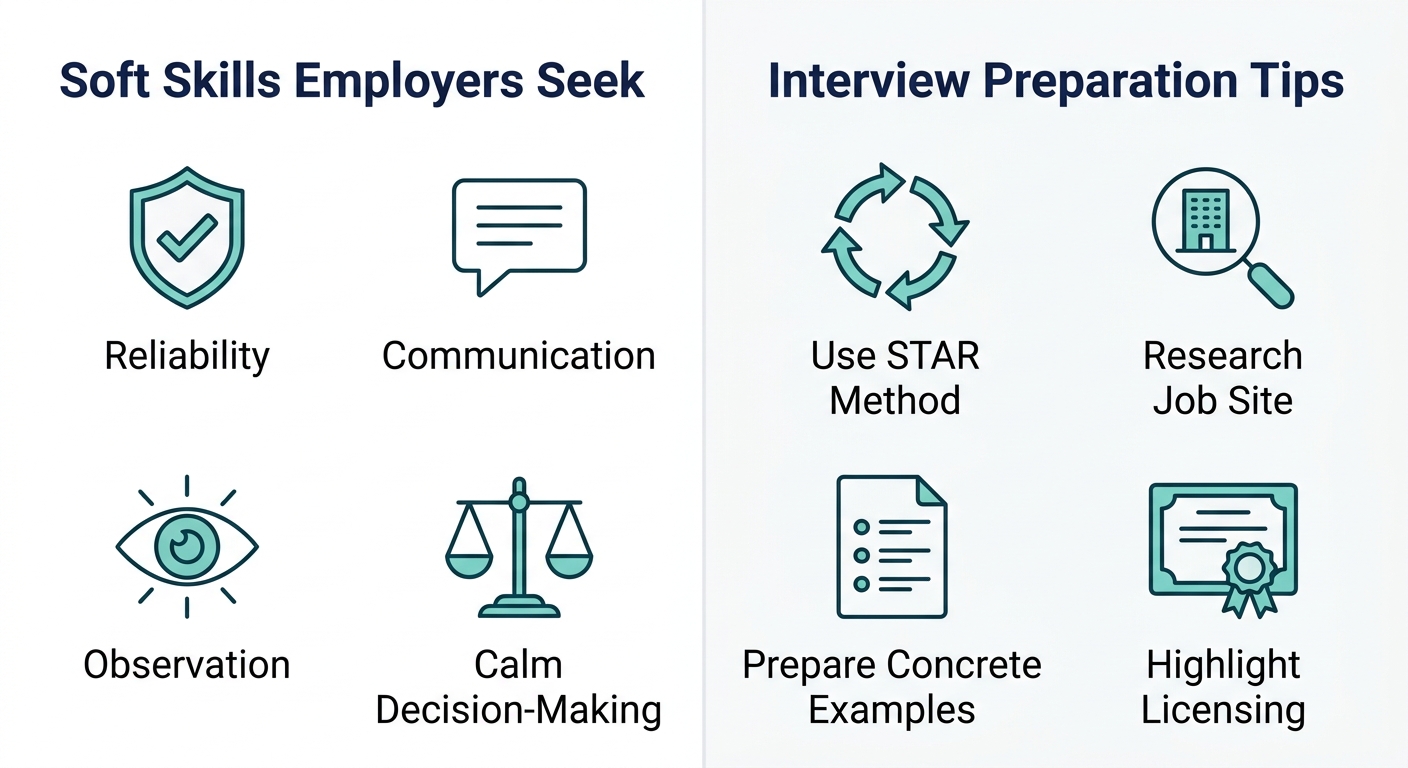
    Infographic comparing soft skills employers seek in security guards and interview preparation tips, with icons for reliability, communication, observation, calm decision-making, STAR method, researching job site, concrete examples, and licensing.
    Key attributes and interview strategies for security guard candidates.

    The STAR method, Situation, Task, Action, Result, is a straightforward formula that helps interviewers understand exactly how a candidate handled a real-world challenge. We recommend preparing a few concise stories in advance, each illustrating a core competency such as de-escalating a tense interaction or following a detailed post order. By keeping the focus on actions taken and the outcome that followed, you demonstrate the judgment and restraint that security roles demand.

    Beyond soft skills, recruiters look for awareness of the environment in which the guard will work. A retail loss-prevention role requires different instincts than a corporate concierge desk or a construction site overnight watch. Before the interview, study the job posting and the client’s business, and prepare questions that show you understand the unique risks of that setting. For example, a hotel security interview might call for insights on guest privacy and access control, while a warehouse role emphasizes perimeter checks and material protection. This preparation conveys genuine interest and proactive thinking, traits that separate memorable candidates from the rest.

    With these fundamentals in place, candidates can approach their interviews knowing what is truly being evaluated and how to present their strengths effectively. From there, it becomes easier to tackle the specific questions that commonly arise.

    Deep Dive into Interview Questions and Answers

    Beyond job-related information and training, interview questions also measure values, observational judgment, and calm reactions to incidents. Labour data from British Columbia indicates that employers across the province consistently value candidates who can demonstrate calm decision-making and accountability, qualities the data identifies as essential for the profession. As such, learning how to properly answer through using the STAR format (situation, task, action, results) should help ensure that you can successfully incorporate all these things into your responses.

    Common Situational Questions and How to Tackle Them

    In this section we examine common security guard interview questions and effective response strategies that emphasize soft skills. Interviewers frequently ask how you would handle aggressive individuals, respond to an alarm activation, or manage patrol routines. These prompts evaluate your judgment and adherence to procedure rather than physical prowess. A strong answer uses the STAR method and stresses de-escalation, maintaining a safe distance, and reporting incidents. For instance, you might describe a hotel lobby confrontation where you used verbal techniques to calm the person, contacted the supervisor according to post orders, and documented a resolution. Security Force USA’s guide reinforces that explaining the actions you took and the concrete result—such as a situation resolved without injury—reflects the calm professionalism that BLS and O*NET data ties to the role. Practicing two or three STAR-based scenarios drawn from your own experience will help you recall them naturally under interview pressure.

    Role-Specific Questions for Different Security Settings

    From our experience staffing properties like hotels, stratas, construction sites, and commercial buildings across British Columbia, interviewers adapt questions to the environment. A hotel security interview probes guest service and conflict resolution, with questions about handling noise complaints or medical incidents while maintaining a welcoming atmosphere. Construction site interviews emphasize access control and worksite safety, asking how you would verify subcontractor credentials or respond after discovering an open gate at night. Strata community interviews centre on resident privacy and community safety, testing your approach to noise complaints within bylaw processes. Commercial property interviews focus on loss prevention and asset protection, exploring how you monitor entry points or spot suspicious behaviour. Matching your examples to these distinct priorities shows you have researched the role and can contribute immediately.

    Addressing the ‘Tell Me About Yourself’ Question

    This common opener is your chance to frame your background as a security professional. We suggest a three-part structure: first, state your current role or primary security experience; second, highlight two key skills directly aligned with the job—such as observational reporting and quick decision-making—with a brief real-world example; third, connect your career goals to the employer’s needs, perhaps expressing interest in specializing in hotel or strata security. This format delivers a concise, credible narrative that builds rapport in the first minutes of the interview. As this guide shows, real security guard interview questions and answers succeed when they reflect researched, calm, and site-specific examples. Mastering these question categories equips you with the confidence needed for the practical preparation steps that follow.

    Practical Preparation for Freshers and Experienced Candidates

    What really gives them a competitive edge, is having prepared systematically, turning mere general knowledge into well thought out, assured replies which reflect their judgement, presence and the confidence of a person whom an employer would feel comfortable to trust.

    Developing Your STAR Method Responses

    STAR stands for Situation, Task, Action & Result and provides a nice structure on which answers can be put rather than going too vague and leaving it at intentions only.

    • Situation: Set the context. Describe where you were and what was happening.
    • Task: Identify your specific responsibility in that moment.
    • Action: Explain the steps you took, emphasizing calm decision-making and protocol adherence.
    • Result: Close with the outcome, ideally a measurable or observable positive result.

    For a security-specific example, consider a candidate describing how they de-escalated a disturbance at a building entrance. The situation involved an agitated individual refusing to sign in. The task was to maintain lobby safety while upholding access procedures. The action included speaking in a low, steady voice, acknowledging the visitor’s frustration, and offering a solution that respected both the visitor’s time and the site’s rules. The result was a peaceful resolution with the visitor complying voluntarily, and a detailed incident report that gave the property manager a clear record of what occurred. According to the industry-focused interview resource from Security Force USA, employers consistently prefer candidates who present authentic, experience-based narratives over rehearsed scripts.

    If you practice the STAR pattern for some scenarios beforehand, it can turn nervous, rambling replies into crisp, professional stories.

    Addressing Common Concerns for Entry-Level Candidates

    Applicants at first-timer level tend to feel concerned about their lack of employment experience during security guard job interviews. But actually, most security guard interview questions asked of new hires revolve around skills such as communication, punctuality, observation, and staying calm under pressure. These qualities are often developed in past roles like retail, customer service, volunteering, or sports. In short, applicants can change how they’ve viewed previous role, demonstrating past jobs through the perspective of guarding – having worked at a busy counter to manage and balance many responsibilities, dealing with angry customers to resolve complaints effectively.

    One way we try to narrow the experience gap is with a Basic Security Training course. BST covers Legal Responsibilities, Patrol Procedures, Emergency Response and Report Writing. This will help a prospective employee answer the question on their interview form for security jobs "what to do about the job." and make them look prepared for employment. When someone completes BST, they have taken the first steps towards being ready and know what it takes to work in the province of BC and be able to step right in to a worksite if needed.

    When a newbie pairs honest self-evaluation with BST-backed knowledge, the conversation shifts from “lack of experience” to “demonstrated preparation.”

    Leveraging PDF Resources and Online Guides

    Live practice combined with written material provides another edge. The Security Force USA guide outlines 25 common interview questions and offers "strong angle" frameworks that encourage authentic, situation-specific answers rather than memorized lines. The guide has strong angle questions that the examinee must answer using true life circumstances instead of memorizing information. It’s good for the applicant to review things like response to an incident, what type of language you’d use if talking to someone, problems dealing with an ethical situation as well as career goals. This can help fill any holes in your own story before going into the interview.

    Searching online will surface many materials on the web that feature years of publishing, and those published in 2022 remain widely circulated. However, when candidates come across these documents, they should treat them as examples from which to derive ideas, not to be copied word-for-word. Also, our own career page provides company-specific insights into what we look for during the hiring process, helping applicants align their preparation with the actual expectations of the team they hope to join.

    Creating a personal answer bank that includes a candidate’s own responses based on past experiences, BST skills and knowledge, and the exercises we’ve performed during this course helps a candidate respond quickly to standard questions. However, this approach can be even more effective as the interview moves into advanced topics such as specific site conditions, the technology used at sites, or how the client expects people to behave in certain circumstances.

    Advanced Interview Strategies for Specialized Security Roles

    This type of preparation builds up the skills that we need for hotel, construction, and event security, including how we practice our stories, role play situations, and deliver them as professional presentations to convince interviewers about why we should be hired. We need to also tell our stories effectively in a way which conveys something practical rather than abstract.

    Employ the STAR strategy for describing what happened: Situation, Task, Action, Result. A leading career prep guide says STAR can be used as a means to structure behavioral responses. For example, suppose you’re applying at a hotel and your experience involves noticing that someone looked suspicious inside the lobby. In this case, your task would have been to prevent the guest from coming to any harm but avoid conflict. Your action should have involved approaching them calmly, and asking some non-accusational questions, thereby attempting to dissuade their bad behavior. Finally, the result was that the behavior was deterred without incident and supervision was notified. It must remain professional and stick to the site’s policies.

    To avoid using industry jargon, describe your concrete behaviours and skills—how you maintained situational awareness on a busy shift, what you said to de-escalate tension, and how you ensured consistent attendance and punctuality. Security Force USA reinforces that calm decision-making and a professional, non-confrontational demeanour are signals interviewers actively seek.

    Writing reports isn’t always given due credit, yet it is incredibly crucial. Write out some examples which include time, place, observations and actions taken. Explain how objective language and timestamping assist in protecting against liability problems while keeping operations going. Talk about your knowledge with templates for incident reports, or if you’ve worked on reports that clients would see during their shifts. Summarise what happened with the incident for a mock up scenario, demonstrating verbal as well as written skills.

    Make sure you mention the Basic Security Training (BST) and Advanced Security Training (AST) courses as soon as possible, and include any compliance information relating to the BC Security Services Act if applicable. Being upfront about having a licence also makes things easier for everyone involved. In closing, ask some well-thought-out, specific questions about the site, such as who handles incidents, and whether there’s any onsite training available to you. After you’ve done all this, candidates will have their own common questions about the interview, which we’ll get onto next.

    Frequently Asked Questions About Security Guard Interviews

    How do you handle conflict or de-escalation in a tense situation?

    Interviewers typically present a scenario involving an agitated visitor or a disturbance and evaluate whether a candidate can de-escalate calmly, using clear communication and a composed presence before considering physical intervention.

    Are you familiar with basic security protocols such as patrol procedures and incident reporting?

    Expect questions that explore your knowledge of routine patrol habits, logbook accuracy, and timely incident documentation, all of which demonstrate the ability to maintain a safe, transparent environment.

    Are you available for shifts that include nights, weekends, and statutory holidays?

    Security coverage runs around the clock, so hiring managers consistently confirm a candidate’s willingness to accept non-traditional hours and remain dependable across a rotating schedule.

    Having addressed all of those questions, you can now focus on the next steps that strengthen your candidacy.

    Short FAQ

    How do you introduce yourself in an interview as a security guard?

    To introduce yourself in a security guard interview, state your current role or primary security experience, then highlight two key skills like observational reporting and quick decision-making with a brief real-world example. Finally, connect your career goals to the employer’s needs, such as expressing interest in specializing in hotel or strata security.

    What is security guard interview questions and answers pdf

    It is a preparatory guide that provides common interview questions and “strong angle” answer frameworks, such as the resource from Security Force USA covering 25 questions. Candidates should use these PDFs as examples for ideas, not as scripts to memorize.

    Security guard interview questions and answers pdf

    A security guard interview questions and answers PDF is a resource that outlines common interview questions and strong angle frameworks, such as the guide from Security Force USA covering 25 questions, to help candidates form authentic, specific responses.

    Security guard interview questions and answers PDF 2022

    A security guard interview questions and answers PDF from 2022 remains widely circulated online and provides interview question frameworks. Candidates should treat these documents as examples to generate ideas, not word-for-word scripts, to ensure their responses stay authentic and tied to their own experience.

    Next Steps for Your Security Career

    Having explored the most common security guard interview questions, you can now prepare concrete STAR-method examples that demonstrate your reliability and keen observation skills. Employers value soft skills like dependability, so highlight those in your application. We encourage you to research job sites and explore career opportunities with Regent Security Services in Vancouver and the Lower Mainland. Services require site assessment and custom quotation; response times, results, and pricing vary. Please consult a licensed security professional for site-specific advice. CCTV and surveillance services must comply with BC privacy laws (PIPA).

    Take the Next Career Step

    You have now explored the most common security guard interview questions and learned how to use the STAR method to showcase your reliability and communication skills. Employers consistently value these soft skills over technical expertise, so your preparation will set you apart from other candidates. As you move from preparation to application, consider connecting with a professional security firm that invests in its people. Our company is a licensed provider in Vancouver, British Columbia, offering Basic Security Training (BST) and Advanced Security Training (AST) to help you meet industry standards. With over 15 years of experience and a dedicated team of licensed guards, we are always looking for reliable professionals to join our team. Take the next step toward a rewarding security career by visiting our website or calling us at 1-866-603-1303 to learn about current opportunities. Your journey from interview preparation to a fulfilling role starts here.

    Take the Next Career Step

    Resources

  • Concierge vs Security Guard Differences: A Complete Guide

    Concierge vs Security Guard Differences: A Complete Guide

    Table of Contents

    Understanding Concierge and Security Guard Roles

    The concierge vs security guard differences depend primarily on a property’s design and risk profile: high-rise residential buildings typically benefit from concierge services that balance hospitality with access control, while townhouse and mid-rise developments often need dedicated security guards for active perimeter monitoring and alarm response. We recommend property managers start with a formal security audit to pinpoint their building’s specific vulnerabilities and determine the most effective staffing model. Adopting this assessment framework allows property managers to objectively determine whether their building’s layout and resident expectations are better served by a hospitality-driven concierge or a security-focused guard. Understanding these fundamental differences is the first step; the following comparison explores the key contrasts between concierge and security guard responsibilities.

    Key Takeaways

    • Concierge services and security guards each focus on a particular area.
    • One major difference is the formal training and licensing of security guards, compared to concierges.
    • In British Columbia, concierges provide critical front-desk services, but are legally prohibited from performing security functions without a valid security license.
    • Balancing front desk duties between hospitality and security relies heavily on your building’s layout and the types of risks you face.
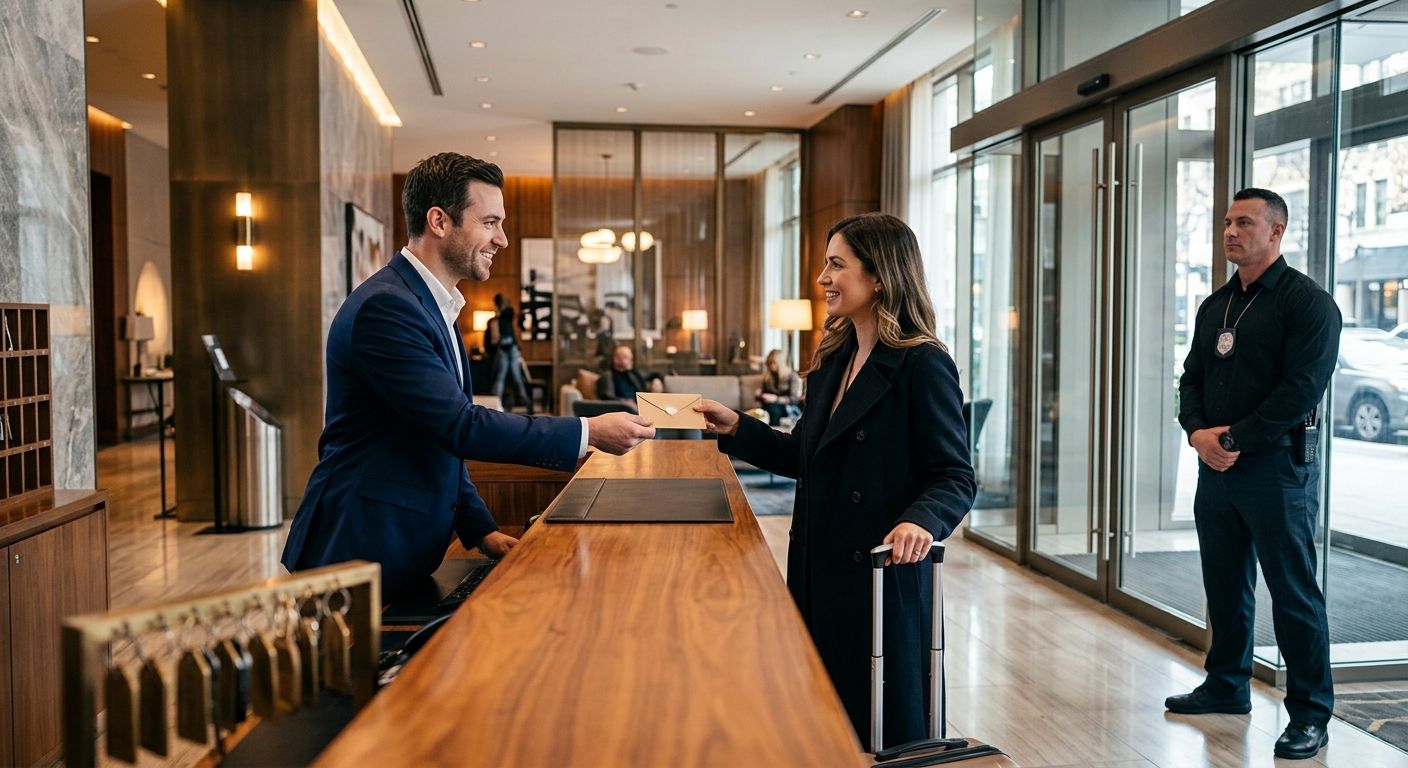
    • Modern hotel lobbies in Vancouver handle constant foot traffic that demands both welcoming hospitality and vigilant security.

    1. Concierge vs. Security Guard: Key Differences

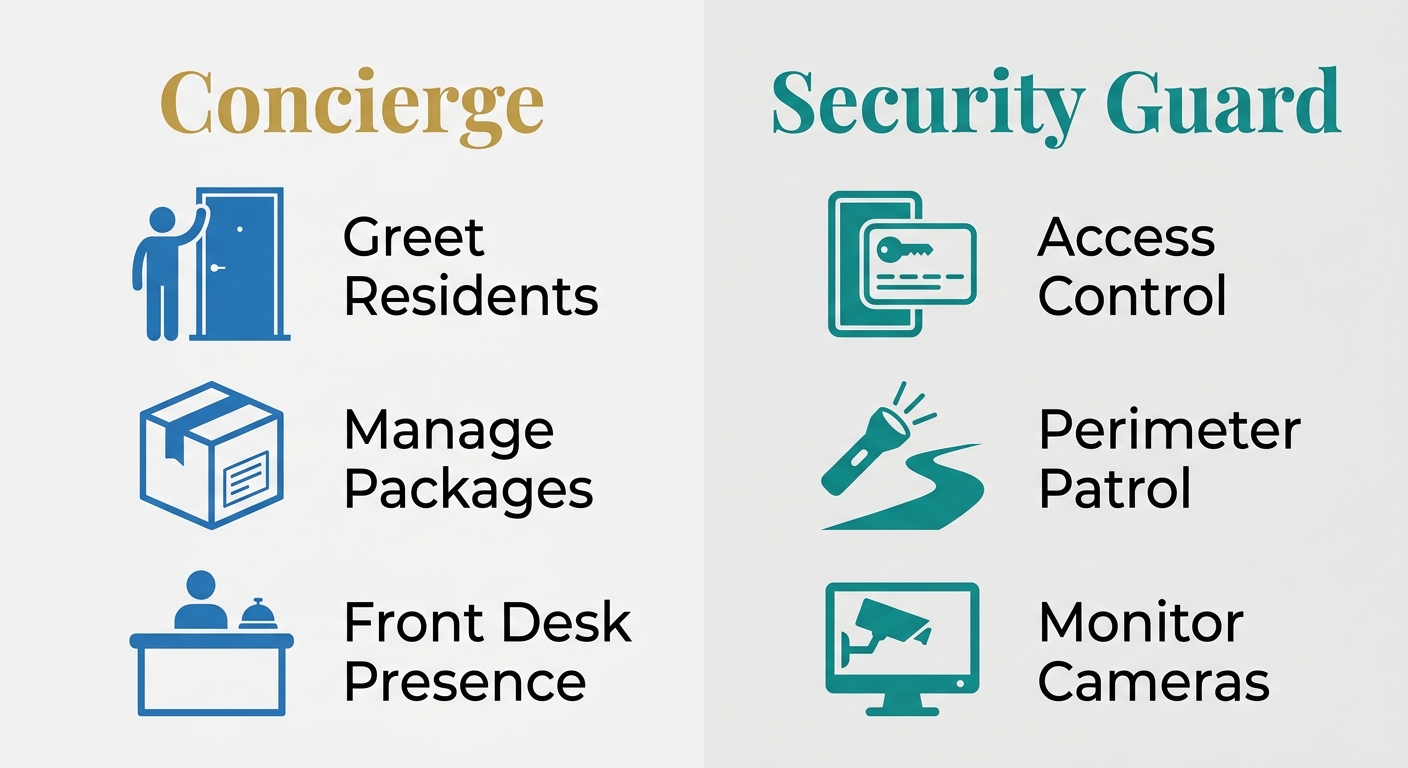
    Concierge services and security guards each focus on a particular area. Concierge services typically manage packages and greet residents. On the other hand, security guards manage the safety and patrol the perimeter of a location. In a high-rise residential tower in a downtown area, a concierge service to manage the front desk would likely be of best value. On the other hand, townhouse complexes and mid-rise residential towers require uniformed guards who can monitor fences, gates, and entry points.

    Side-by-side comparison infographic of Concierge and Security Guard roles, each with three labeled features: Concierge with Greet Residents, Manage Packages, Front Desk Presence; Security Guard with Access Control, Perimeter Patrol, Monitor Cameras.
    Infographic comparing Concierge and Security Guard responsibilities.

    At Regent Security Services, we recommend beginning with a formal security audit to identify a site’s unique exposures, enabling us to address those exposures specifically with a guard mix, rather than taking a one-size-fits-all approach. We pride ourselves on being able to take a concierge staffing and a security staffing approach to serve our clients. This naturally leads to training and licensing standards for staffing and security guard services.

    2. Training and Licensing that Set Them Apart

    One major difference is the formal training and licensing of security guards, compared to concierges. In British Columbia, the Security Services Act requires all security guards to have a license and, to earn the license, guards must have completed a basic training course (BST) and, for many assignments, advanced training (AST), in addition to Occupational First Aid Level 2 (OFA 2). All Regent Security staff are licensed and insured guards who have completed this rigorous training, ensuring full compliance with provincial standards.

    This structured preparation equips our team to manage emergencies, conduct surveillance, and protect property at a level that concierge staff, who lack equivalent credentials, cannot match. Your peace of mind comes from knowing that trained professionals are handling your site’s safety rather than relying on unlicensed personnel whose qualifications stop at guest services. Because security guards hold these legislated certifications, they are legally and practically qualified to perform protective duties that a concierge is not authorized or trained to carry out.

    3. Can a Concierge Perform Security Duties?

    In British Columbia, concierges provide critical front-desk services, but are legally prohibited from performing security functions without a valid security license. Without a security license, concierges cannot detain individuals or use force to respond to incidents—a function reserved for licensed security personnel.

    According to a legal guide from LawyerInfo.ca, tenants’ right to peaceful enjoyment under the Residential Tenancy Act prohibits concierges from opening mail or interfering with parcel deliveries without explicit authority. Under the Personal Information Protection Act, concierges cannot log daily tenant movements or conduct persistent surveillance unless a specific security threat requires it. These restrictions apply to protect the privacy of residents and help define the extent of the concierge’s functions.

    Knowledge of these legal boundaries helps property managers decide whether to hire a concierge, a licensed security guard, or a combination of both. With our unrivalled security industry experience and expertise, our team supports clients in staffing properties with the right personnel while respecting all applicable laws.

    4. Hiring a Concierge or a Security Guard for Your Front Desk

    Balancing front desk duties between hospitality and security relies heavily on your building’s layout and the types of risks you face. In the case of many high rise residential towers in downtown Vancouver, the concierge model provides the right balance. Resident service and package control, coupled with lobby presence provide the guest service amenity that many residents’ expectations have come to include. Elsewhere in the Lower Mainland, townhouse complexes and low-rise developments are better served by licensed security guards who focus on perimeter monitoring, alarm response, and active patrols.

    We suggest having a formal security audit completed prior to making any new hires. The right professionals can identify your greatest risks and security exposures based on site inspections and assessments. An audit would consider entry and exit points, resident volume, and surveillance to determine the right front desk solution or patrol configuration to provide the greatest deterrent. No one-size-fits-all model works. The right configuration for front-desk service relies on the nature of the property and the clear definition of security and service needs.

    5. Effectiveness in High-Traffic Hotel Lobbies

    Modern hotel lobbies in Vancouver handle constant foot traffic that demands both welcoming hospitality and vigilant security. When weighing concierge vs security guard differences for a high-traffic hotel lobby, we look at how each role meets the unique pressures of a 24-hour guest environment.

    A concierge focuses primarily on guest experience and front-of-house management. They greet arrivals, handle luggage, provide local recommendations, and create a polished first impression. A security guard, by contrast, oversees access verification, monitors entry points, and conducts surveillance to prevent unauthorized access. Our industry guidance emphasizes that the best choice depends on a property’s architecture, location, and specific risk profile.

    The effectiveness of either role hinges on a site-specific security audit. Where your safety is our story, we help hotels assess their lobby traffic patterns and security goals before recommending a staffing model. Understanding how each function performs under lobby conditions clarifies the combined responsibilities a concierge security officer would handle.

    6. The Concierge Security Officer Job Description

    Staffing high-traffic hotel lobbies to provide security and guest service requires a unique blend of skills. We look for this balance in concierge security officer candidates in Vancouver.

    Key responsibilities and qualifications for the role include:

    • Welcoming guests, answering inquiries, and providing directions while maintaining a visible deterrent to unauthorized behaviour.
    • Monitoring live CCTV feeds across the property to promptly detect and respond to suspicious activity.
    • Managing keycard access systems and entry points, ensuring only authorized individuals gain entry.
    • Holding full licensure under the BC Security Services Act, including Basic Security Training (BST) and Advanced Security Training (AST) certifications.
    • Drawing on our 15+ years of industry experience and a team of over 200 trained professionals to deliver consistent, reliable service.

    Because this position demands a presence that integrates both security and guest services, we assign concierge security officers to hotels throughout the Lower Mainland and Vancouver.

    7. How Regent Security Integrates Both Roles

    Regent Security’s integrated security and concierge services provide property-specific solutions based on layout and risk factors.

    For one high rise in Vancouver, we lean toward a concierge-heavy deployment. Recommended in our guidance for strata property managers, concierge services control access, greet visitors and manage deliveries. Our solution prioritizes residents’ convenience while effectively managing controlled access.

    An example in the Lower Mainland would be a townhouse complex, where our solution includes more security guard services. Guards on patrol monitor all access points and provide a visible deterrent. Our solution takes an open-air and suburban layout into consideration by providing pro-active security services.

    A formal security audit ultimately drives our integrated solution. The audit identifies the overall risk exposure of the property, and based on the findings, appropriately integrates concierge, security services, or a combination of the two. Our solution ensures that the strategies property managers utilize are not one-size-fits-all. By understanding our integration, property managers can implement best practices that strengthen both safety and day-to-day resident experience.

    8. Best Practices for Property Managers

    Integrated solutions like Regent Security’s dual-role model exist, but property managers need a clear framework for choosing between a concierge and a security guard for their property.

    • Conduct a formal security audit. Our team recommends mapping your property’s risks, incident history, and resident expectations before deciding on a staffing model. This process helps determine whether front-desk concierge hospitality or patrol-based guard coverage fits your layout.
    • Match the service to your building type. For high-rise towers, a concierge provides guest welcoming, package handling, and access control. Townhouse and mid-rise complexes are better served by mobile security guards who focus on perimeter monitoring and alarm response.
    • Uphold tenant privacy rights. British Columbia’s Residential Tenancy Act and privacy laws prohibit security staff from opening private mail, arbitrarily logging daily movements, or detaining guests. As LawyerInfo.ca highlights, property managers are legally responsible for ensuring staff compliance.

    With these best practices in hand, you’ll be prepared to make the choice that protects your property and respects your residents.

    Frequently Asked Questions

    What are the main functional differences between a hotel concierge and a security guard?

    A hotel concierge focuses on guest services such as greeting, luggage handling and local recommendations, while a security guard concentrates on access control, surveillance and perimeter patrols. Concierges manage packages and create a polished first impression; guards monitor entry points and prevent unauthorized access.

    Should my property hire a concierge or a security guard for the front desk?

    The choice depends on your property type: high-rise residential towers typically benefit from a concierge for hospitality and package management, while townhouse complexes need a licensed security guard for perimeter monitoring and alarm response. A formal security audit is recommended to identify the right fit.

    Can a concierge perform the same security duties as a licensed security guard?

    No, a concierge cannot perform security duties without a valid security license. Under BC law, unlicensed concierges are prohibited from detaining individuals, using force, conducting surveillance, logging tenant movements or opening private mail. Only licensed guards may carry out protective functions.

    Is it more effective to have a dedicated security guard or a concierge in a high-traffic hotel lobby?

    Effectiveness depends on a property-specific security audit that assesses architecture, location and risk. A concierge delivers guest hospitality, while a security guard ensures access control and surveillance; the best model balances both based on the lobby’s unique traffic patterns and security needs.

    How do the training requirements differ for concierge staff compared to on-site security guards?

    Security guards must be licensed under BC’s Security Services Act, requiring Basic Security Training (BST), often Advanced Security Training (AST) and Occupational First Aid Level 2 (OFA 2). Concierge staff have no such mandated training; their qualifications focus on guest services without the legislated protective skills.

    Making the Right Choice for Your Property

    Selecting the right service model depends on your property’s architecture and risk profile. High-rise strata buildings in Vancouver benefit from concierge services that combine hospitality, package management, and controlled access, while townhouse complexes need security guards for perimeter monitoring and access control. Understanding the concierge vs security guard differences helps property managers align service selection with their building’s needs. A formal security audit identifies the most effective risk mitigation strategy. We respect tenants’ rights to quiet enjoyment, mail privacy, and PIPA-compliant CCTV use. To determine the fit, contact us for a site assessment and custom quote. Services are subject to site assessment and custom quotation; response times and results may vary. This article is for general guidance and does not constitute legal advice.

    Find Your Perfect Security Solution

    Now that you understand the key differences between concierges and security guards, you are well-prepared to make the right choice for your property. Our guide highlighted how high-rise buildings benefit from concierge hospitality, while townhouse complexes require security-focused perimeter patrols. A formal security audit, as recommended throughout the comparison, is the critical next step to identify your building’s unique risks. Moving from insight to action is where real protection begins. We blend both roles seamlessly, drawing on over 15 years of experience serving properties across the Lower Mainland. Schedule your personalized site assessment today and take the first step toward a safer, well-managed property.

    Find Your Perfect Security Solution

    Resources

  • Best Loss Prevention Vancouver Services in 2026

    Best Loss Prevention Vancouver Services in 2026

    Table of Contents

    Addressing Loss Prevention Needs in Vancouver Retail

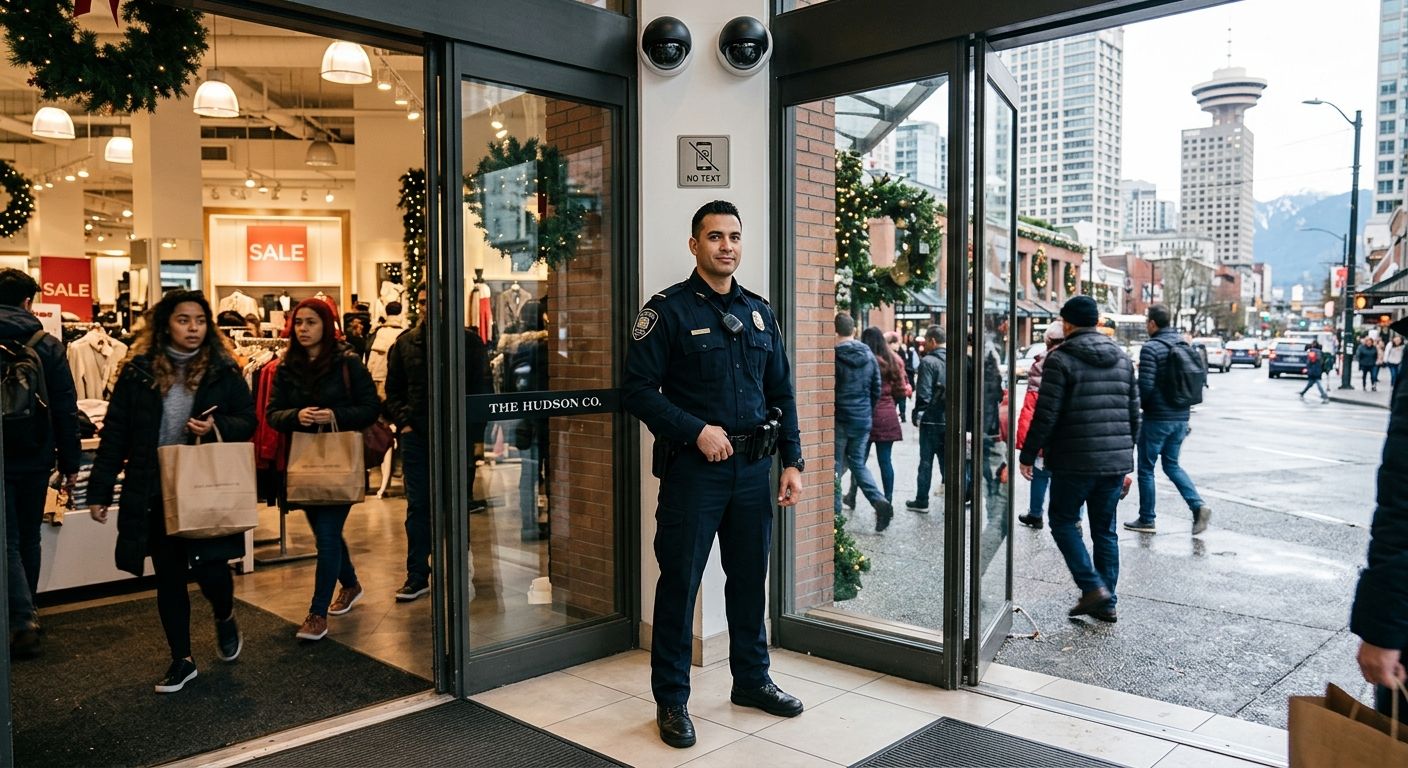
    In Vancouver’s dynamic retail landscape, high shoplifting rates create substantial economic impacts for stores. Loss prevention in Vancouver demands targeted strategies to curb theft and shrinkage, as Regent Security’s expertise highlights in local deployments.

    We deliver comprehensive loss prevention services in Vancouver, featuring uniformed patrols, CCTV monitoring, and undercover officers. Regent Security’s core offerings, tailored for Vancouver stores, include real-time surveillance and theft deterrence programs to address unique retail challenges.

    Our retail loss prevention strategies customize solutions for high-traffic malls and downtown shops, incorporating shoplifting prevention in Vancouver through trained personnel and inventory controls. With over 15 years of experience serving more than 2,000 clients, we reduce losses effectively across the Lower Mainland.

    Contact us at Regent Security for a site assessment today.

    Retail Landscape and Security Challenges in Vancouver

    Vancouver’s vibrant retail landscape features high tourist traffic, urban density, downtown malls, and strip retail, creating unique demands for effective loss prevention vancouver measures. These environments heighten risks of shoplifting and organized retail crime, with national retail theft costing Canadian businesses over $9 billion annually, according to the Retail Council of Canada. Local stores face elevated shrink rates, prompting the need for robust retail loss prevention strategies.

    Key challenges include pickpocketing in tourist zones like Gastown and Yaletown, internal theft in high-volume stores, and vulnerabilities during peak holiday seasons. High foot traffic amplifies these issues, as industry benchmarks from the Retail Council of Canada note a 76% rise in retail violence. Shoplifting prevention vancouver requires addressing these urban-specific pressures to safeguard assets and customer safety.

    At Regent Security, our security services in Vancouver deliver tailored solutions like undercover guards, CCTV monitoring, 24/7 patrols, and dedicated loss prevention teams. These proprietary offerings, drawn from our extensive deployments, effectively deter theft and reduce shrinkage in retail settings.

    The following table, sourced from industry reports and Regent Security deployment statistics, compares loss prevention across Lower Mainland areas:

    Loss Prevention Comparison Across Lower Mainland Areas
    AreaKey ChallengesRecommended Strategies
    VancouverUndercover guards, CCTV monitoring24/7 patrols, loss prevention teams
    SurreyMobile patrols, access controlRapid deployment, trained professionals
    BurnabyAlarm response, video surveillanceCustom concierge security
    Lower MainlandTechnology integration, event securityComprehensive coverage with 100+ staff

    Vancouver leads in tourist-driven risks, but our strategies provide scalable protection, as evidenced by over 1 million service hours delivered to more than 1,000 clients. This comprehensive approach with our 100+ trained professionals ensures Vancouver retail theft reduction across the region.

    These comparisons highlight how Regent Security adapts anti-shoplifting measures in Vancouver to local needs, integrating technology and rapid response for optimal results. Retail operators benefit from our 24/7 coverage, fostering secure environments amid diverse challenges.

    Loss Prevention Services Available in Lower Mainland

    For Lower Mainland businesses, specialized local services elevate these strategies—here’s what’s available. In loss prevention Vancouver, we at Regent Security deliver tailored solutions to combat retail shrinkage in high-theft areas like Vancouver, Burnaby, and Surrey.

    Regent Security’s loss prevention services, as the provider’s own specialized offerings, include:

    • Uniformed patrols for visible deterrence in high-risk retail zones.
    • Plainclothes loss prevention officers blending seamlessly to observe and intervene.
    • Internal audits identifying vulnerabilities.
    • Customized employee training workshops.

    Building on retail loss prevention in Canada best practices, our retail loss prevention strategies empower Vancouver retailers with proactive defenses against theft.

    Justice Institute of British Columbia (JIBC) training supports these efforts as official provincial standards. The Basic Security Training Theory course, a 40-hour online program, covers legal powers, use of force, and emergency procedures, leading to Security Worker License prerequisites. JIBC’s advanced Law Enforcement Studies Diploma emphasizes criminal code, investigations, and asset protection for shoplifting prevention.

    These combined resources tackle common retail theft in Vancouver and Surrey, reducing losses through skilled personnel and Vancouver loss prevention services. Our team responds quickly and tailors plans to each retailer’s operating environment and schedule daily. Contact Regent Security today for a free loss prevention assessment to implement these proven solutions.

    Regulatory and Best Practices for Loss Prevention in BC

    In British Columbia, effective loss prevention vancouver strategies must comply with specific regulations under the security services regulation in British Columbia, the primary provincial legislation governing security operations as outlined by the Province of British Columbia. Security professionals require licensing for roles involving loss prevention, with strict restrictions on powers of arrest and use of force.

    Key requirements include:

    • Obtaining a security worker license, mandatory for those 19 and older.
    • Adhering to ethical standards and legal authorities in detention scenarios.

    The Justice Institute of British Columbia (JIBC), the official training provider for BC security professionals, delivers Criminal Justice and Security programs tailored to loss prevention scenarios like shoplifting response.

    JIBC’s Basic Security Training Theory course, a mandatory foundational standard, covers modules relevant to retail environments:

    • Patrol procedures and personal safety.
    • Report writing and conflict resolution.
    • Customer service in high-risk settings.

    We recommend JIBC-certified training for loss prevention strategies in Vancouver teams to apply retail loss prevention strategies effectively while ensuring compliance. Adherence reduces liability for businesses, enhancing shoplifting prevention vancouver outcomes. Regent Security’s JIBC-trained officers embody these best practices.

    Steps to Implement Effective Loss Prevention

    Building on the need for proactive measures, Vancouver businesses can adopt robust loss prevention Vancouver strategies to safeguard retail operations. Drawing from Regent Security’s over 15 years of expertise in security services, these retail loss prevention strategies minimize shrinkage through structured implementation.

    1. Conduct a Comprehensive Risk Assessment
      Identify high-risk areas like entrances and stockrooms using Regent Security’s loss prevention protocols. Evaluate vulnerabilities in Vancouver retail spaces to prioritize threats effectively.
    2. Train Staff in Shoplifting Detection
      Equip teams with customer service techniques, de-escalation, and reporting procedures. Comprehensive security training JIBC-certified programs enhance shoplifting prevention Vancouver tactics for proactive deterrence.
    3. Deploy Visible Security Measures
      Station uniformed guards and install CCTV systems tailored for Vancouver retail. Regent Security’s localized offerings provide 24/7 visible deterrence against theft.
    4. Integrate Technology Solutions
      Use access control and inventory tracking software to curb internal theft. Our technology-enabled tools, as per Regent Security guidelines, streamline monitoring.
    5. Regularly Audit and Review Performance
      Analyze loss data and adjust strategies, partnering with Regent Security for ongoing support in Vancouver.

    These steps, supported by professional partners like us, yield measurable results in reducing losses.

    Partner with Regent Security for Loss Prevention

    Regent Security provides the solution—partner with us for loss prevention in Vancouver. We deliver customized retail loss prevention strategies, including undercover officers, uniformed guards, and advanced surveillance to deter theft effectively.

    Our shoplifting prevention in Vancouver integrates seamlessly with broader services like construction site security, reducing incidents and protecting your bottom line, as per Regent Security’s dedicated loss prevention offerings.

    Contact us today at 1-866-603-1303 to secure your business.

    This article was researched and written with the assistance of AI tools.

    Resources