Tag: security guard services

  • Security Guard Duties and Responsibilities PDF: Complete Guide

    Security Guard Duties and Responsibilities PDF: Complete Guide

    Table of Contents

    Security Guard Duties and Responsibilities PDF: The Complete Guide

    A security guard duties & responsibilities PDF consolidates the essential tasks and duties performed by licensed security officers in accordance with BC’s security training framework. The downloadable PDF contains the fundamental skills necessary for these officers, ranging from access controls and patrol activities through to emergency responses, which are all in line with provincial certification requirements. This guide can be used as a reference point for either new staff members or those already working in the security field in BC.

    This document provides guidelines to support mandatory Basic Security Training (BST) and Advanced Security Training (AST) courses for licensing within British Columbia. It helps security firms and guard personnel understand the scope of lawful duties, including those authorized for armed guards and handlers of restraints, while emphasizing the importance of ongoing professional development. this document becomes a useful tool for guarding agencies and guards alike to comply with current laws and deliver their professional services uniformly and effectively.

    In practice, these duties translate into daily protocols such as monitoring CCTV systems, conducting patrols, and managing access control. At Regent Security Services, we integrate these standards into our Vancouver and Lower Mainland operations to guarantee our licensed guards are prepared for any assignment. These responsibilities are documented in and across professional post orders templates, which detail site-specific instructions for every shift.

    Key Takeaways

    • The post orders template transforms high-level security regulations into concrete tasks for every day at individual facilities.
    • Hotel and concierge security guards have greater than basic patrol obligations when compared to security positions elsewhere.
    • A key aspect in site safety is the transformation of general task orders into precise checklists that can be effectively implemented in day-to-day tasks.
    • Commercial security guard contracts in British Columbia are used to detail exactly what security guards are expected to accomplish through their employment according to the terms established under provincial law.
    • We answer common questions about BC security guard licensing and training.

    Core Duties in Security Guard Post Orders Templates

    The post orders template transforms high-level security regulations into concrete tasks for every day at individual facilities. Instead of a template per se, the document acts as a guide that modifies basic types of duties based on industry-specific needs: access control, patrol methods, monitoring, incident reporting, licenses, etc., which then become detailed tasks that must be carried out accordingly. All guards receive detailed guidance about how to meet their responsibilities within each of these duty categories according to provincial law.

    Duty CategoryHotelCommercialConstruction
    Access ControlKey card management, guest access restrictions, lobby screeningVisitor management systems, employee credential verification, loading dock accessPerimeter check-in/out of workers and vehicles, material delivery logging
    Patrol MethodsGPS-tracked patrols covering underground parking, mechanical rooms, and guest floorsScheduled interior and exterior patrols focused on asset protectionSite patrols including material laydown areas, equipment storage, and after-hours checks
    CCTV MonitoringIntegrated CCTV with real-time monitoring and recordingMonitoring of common areas, parking facilities, and entry pointsSurveillance of perimeter, temporary fencing, and equipment storage zones
    Incident ReportingDigital incident logs with software-enabled shift reports for transparencyDetailed incident documentation for liability and trend analysisImmediate documentation of safety incidents, theft, and site condition changes
    Licensing RequirementsBST certification, criminal record check, authorizations for restraints or guard dogs as neededSame mandatory BST and background checksSame mandatory BST and background checks
    Guest/Customer InteractionConcierge-level guest assistance, fire watch duties, emergency coordinationProfessional interaction with tenants and visitors, maintaining a visible security presenceLiaison with contractors and site supervisors, reporting safety hazards
    Comparison of Core Security Guard Duties by Sector

    The hotel post order places equal importance on providing for the comfort and wellbeing of its guests whilst also ensuring that staff conduct themselves in a safe manner at all times. In addition to this, each type of environment uses the latest technological methods to monitor guards’ activity, including GPS-tracked patrol systems and online incident logbooks which help them keep track of what goes on when they’re out on duty. Across all three environments, every guard must hold a valid Basic Security Training (BST) certificate and pass criminal record checks as mandated by the British Columbia government’s security industry licensing framework, ensuring a uniform baseline of competence and accountability.

    In addition, improvements in hotel-related security include concierge-style duties, lobby access procedures, and emergency assembly tasks, which help form a complete strategy on how to approach such issues.
    Infographic showing three columns of security guard duties: Hotel (Guest Hospitality, CCTV Monitoring, Patrol Tracking, Incident Logs), Commercial (Asset Protection, Visitor Management, Access Control, 24/7 Coverage), and Construction (Perimeter Monitoring, Equipment Checks, Site Patrol, Emergency Response).
    Security guard duties sector comparison: Hotel hospitality, Commercial asset protection, Construction site security.

    Customizing Security Guard Responsibilities for Hotels and Concierge Services

    Hotel and concierge security guards have greater than basic patrol obligations when compared to security positions elsewhere. Their obligations involve protecting the property as well as providing guests’ services. Post regulations just can give them some instruction about the basic functions they should be performing at their posts. These workers must employ these skills along with additional expertise to ensure they fulfill their main purposes on the job. Assignments must suit the need for hospitality and safety.

    Tailoring Post Orders for Hospitality Environments

    A comprehensive post order template for hotel employees might contain instructions to welcome customers, help them carry bags and other items in their possession, watch the lobby area and public spaces, etc. When developing hotel security guard duties and responsibilities pdf you need to adjust standard protocols to the property layout and guest traffic. Security Force USA has an incident report writing guide that specifies the incident report should include the objective language, chronological event account, documentation of de-escalation attempts, and a brief two- to three-sentence conclusion. Also guards shouldn’t use their own gadgets for taking pictures, photos or videos and need to rely only on company’s systems to preserve the evidence chain of custody.

    Here’s how some key parts from a hotel’s security staff job duty list look compared to what would be included for concierges in hotels:

    SectionHotel SecurityConcierge Service
    Primary ObjectiveProtect guests, staff, and property; deter crime; monitor access points.Provide a welcoming presence, assist guests with requests, while maintaining discreet oversight.
    DocumentationDetailed incident reports with objective language, chronological narrative, de-escalation notes, and brief summary. Evidence captured via official devices.Log guest interactions, service requests, and any unusual observations in a daily activity report.
    Technology IntegrationGPS-tracked patrols, CCTV monitoring, digital incident logs for real-time reporting to management.Same surveillance technology used to support guest assistance and oversight.
    Training RequirementsBasic Security Training (BST), Advanced Security Training (AST), Occupational First Aid Level 2, and criminal record check under BC Security Services Act.Same BST and licensing, with additional emphasis on customer service, communication, and hospitality protocols.
    Guest InteractionMaintain visible security presence; respond to incidents; enforce hotel policies discreetly.Engage with guests, offer directions, handle luggage, and provide a friendly yet observant demeanor.
    Essential Sections of a Hotel Security Guard Duty Checklist vs Concierge Checklist

    Both positions require identical regulatory licensing under the BC Security Services Act, but the role of a concierge requires heightened hospitality skills. The difference in tasks forms the basis for our site specific post orders that keep security personnel both safe as well as providing great services to our guests.

    Concierge-Like Security Roles in Vancouver Hotels

    In Vancouver’s hospitality sector, security personnel often adopt a concierge-like role, blending oversight with guest relations. Our team members are trained to assist with directions, manage luggage, and respond to inquiries. All our guards hold Basic Security Training and Advanced Security Training certifications, with many also obtaining Occupational First Aid Level 2, which exceeds the minimum requirements set by the BC Security Services Act.

    Integrating Technology for Enhanced Guest Safety

    With GPS-tracked patrol systems in place, managers have access to real-time information about their staff when they are on duty, allowing them to see whether all parts of the building are monitored by security personnel – from underground car parks to guests’ rooms. Digital incident logs then produce timestamped records which, following relevant reporting procedures for incidents, are kept as per the chain of custody process. The software allows shift reports for clients to be set up to suit individual sites, enabling managers to ensure your peace of mind.

    These specific job responsibility duties serve as a blueprint when setting up a site-specific task checklist for each property. This makes certain that both hotel and the concierge desk run effectively to ensure that guests are well looked after.

    Building Site-Specific Security Guard Duty Checklists

    A key aspect in site safety is the transformation of general task orders into precise checklists that can be effectively implemented in day-to-day tasks. An excellent checklist assigns each guard their particular set of duties based upon the dangers and requirements of the property under protection, offering a framework for everyday operation whilst making sure all obligations are satisfied by adhering to local regulations of the state of BC.

    Key Components of a Comprehensive Guard Duty Checklist

    A complete security patrol checklist should start with the guards’ credentials being verified including confirming that all guards have a valid Basic Security Training (BST) license and have passed any required Advanced Security Training(AST), or OFA 2 certifications, and must also include checks for equipment readiness, such as functioning radios, flashlights, CCTV monitoring stations, and access control systems. Then specify what procedures occur once they arrive at their post; whether this includes checking the post log for any updates, inspect the site perimeter prior to assuming duties. Once the guards assume duties the checklist should outline how patrols are carried out, verifying if the correct patrol routes were used, how many times each route was travelled on, and did the officers use the proper tour tracking system if available. Finally the checklist should also contain clearly outlined procedures for incident documentation to ensure reports are completed promptly.

    POPProbe’s staffing coverage review checklist provides a practical template based on 35 key inspection points across seven categories, including shift coverage, officer licensing, patrol route verification, equipment readiness, supervisory oversight, incident reporting, and contingency planning. We adapt this format into weekly site-specific audits so that every guard fulfills their duties as required by the British Columbia Security Services Act. Our unmatched security expertise informs how we integrate backup resource identification—such as emergency standby officer contacts—directly into each site checklist, ensuring ULA02050 compliance and rapid continuity in any emergency.

    Incident Reporting: Best Practices and Documentation Templates

    Incident reports are legal documents that may be scrutinized by authorities. In British Columbia, the Security Services Act mandates objective, accurate documentation that clearly distinguishes observations from assumptions. Security Force USA’s guide suggests starting with a 2-to-5-sentence summary and then a chronological account that includes any de-escalation attempts. Guards should never use personal devices to capture evidence images.

    MethodManual LogbookDigital SoftwareHybrid Approach
    ReliabilitySimple, no power; risk of illegibility or lossTimestamped, cloud backup; requires deviceCombines paper capture with digital backup
    SearchabilitySlow, manual scanKeyword search and filtersSearchable after digitization
    Legal DefensibilityLacks timestamps, may be challengedAutomated audit trail, tamper evidenceOriginal paper plus digital audit
    Incident Reporting Methods Comparison

    The mixed approach often suits sites with unreliable connectivity or client mandates for paper records. We supplement any method with in-house reporting software that standardizes documentation and delivers professional client-facing shift reports.

    Using Technology to Streamline Daily Activity Logs

    Instead of relying on handwritten logs that are often open to interpretation and inconsistencies due to poor handwriting, digital tools can capture time-stamped observations, photo evidence, and patrol confirmations as they happen. With security software, security guards can record their duties using their smartphone or tablet, and these entries will be converted into organized shift reports for each property.

    Our custom-built software allows supervisors to view guards’ check-in times, monitor patrols, be alerted immediately when a stop is missed, and review pictures and notes about environmental hazards that may arise. This information can then be used to address problems prior to them becoming critical. By integrating duty checklists with digital reporting, we ensure that every arrival, patrol, and equipment check is recorded in a searchable, auditable format. This integration supports compliance with B.C. regulations and builds a defensible record for liability management.

    They provide the foundation for all the services that we perform on our BC commercial security contracts. They serve as checklists to help ensure consistency across clients.

    Scope of Services for Commercial Security Guard Contracts in BC

    Commercial security guard contracts in British Columbia are used to detail exactly what security guards are expected to accomplish through their employment according to the terms established under provincial law. Each contract must ensure that all assigned guards hold a valid Basic Security Training (BST) certificate and have passed a criminal record check, as mandated by the BC Security Services Act. As far as what the scope contains, it typically encompasses a mix of physical presence and technology, including on-site patrolling (foot or vehicle). Another component could involve software-enabled incident reporting, CCTV monitoring, and access control integration (such as keyless entry and biometric verification).

    Service ComponentStandardPremiumEnterprise
    Guard Licensing & Background ChecksLicensed guards with BST and criminal record checkLicensed guards with BST and criminal record checkLicensed guards with BST and criminal record check
    On-site PatrolFoot patrol, random checksGPS-tracked patrol with real-time verificationMobile patrol integrated with access control and CCTV
    Incident ReportingBasic written logsDigital, software-based incident reportsAdvanced, client-facing shift reports with customization
    CCTV MonitoringNot includedActive on-site CCTV monitoringComprehensive monitoring with integrated alarms and access control
    Access ControlPhysical key managementBasic electronic access (PIN code entry)Keyless, biometric access control systems
    24/7 CoverageAvailable upon requestDedicated overnight coverageFull 24/7 team with rapid escalation and emergency response
    Scope of Services Components for Commercial Security Guard Contracts

    In case we’re talking about hotels situated on the territory of Vancouver then in the Premium tier they’ll be using GPS-tracked patrolling of their underground car parks, mechanical rooms as well as their guests’ floors. With real-time digital incident logging and active CCTV surveillance they provide management with up-to-date records. Higher-risk places can go for the Enterprise tier which provides them with biometric access control system and integrated alarm management system.

    It’s important that we have a clearly defined scope to eliminate uncertainty over the duties that security guards should perform each day, and transform job functions into measurable contract deliverables such that clients will be able to hold service providers accountable for their performance and modify coverage based on risk factors.

    Common Questions About Security Guard Duties and Responsibilities

    We answer common questions about BC security guard licensing and training.

    What basic training does BC require for security guards?

    The ministry says the guards have gone through Basic Security Training (BST) either at the Justice Institute of BC or some other approved training course. They can be ex-police officers or those who have worked in corrections, and they have all completed the certification program.

    What authorizations are needed for restraints or guard dogs?

    If guards utilize restraints then they must have completed Advanced Security Training (AST) which needs to be repeated at least once every three years. The dog handlers must possess Canine Security Validation, and we maintain these authorizations for relevant assignments.

    Do armoured car guards need firearms authorization?

    Armoured car guards require an Authorization to Carry Restricted Firearms and Prohibited Handguns (ATC) under BC regulations. We confirm this credential for all armed roles.

    Frequently Asked Questions

    What core duties should be included in a security guard post orders template?

    A security guard post orders template should include access control, patrol methods, CCTV monitoring, incident reporting, licensing verification and guest or customer interaction duties. These categories are adapted to each site, and every guard must hold a valid Basic Security Training certificate under British Columbia’s licensing framework.

    How can I customize security guard responsibilities for hotel and concierge services?

    Customize responsibilities by adjusting standard protocols to the property layout and guest traffic, then adding concierge-style tasks like welcoming guests, assisting with luggage and monitoring lobbies and public spaces. Both hotel security and concierge guards require BST licensing, while concierge staff need heightened hospitality skills and technology such as GPS-tracked patrols for real-time oversight.

    What are the essential sections for a site-specific security guard duty checklist?

    Essential sections include guard credential verification (BST, AST, OFA 2 certifications), equipment readiness checks, post arrival procedures, patrol route specifications and incident documentation protocols. A thorough checklist may also incorporate supervisory oversight and contingency planning, mirroring the 35-point POPProbe template used for weekly site-specific audits.

    How do professional security guard companies document incident reports and daily activity logs?

    Professional companies use digital software to produce timestamped, objective incident reports. Each report begins with a 2-5 sentence summary, followed by a chronological narrative and documentation of any de-escalation attempts. Evidence is captured only on company devices to preserve chain of custody, and shift reports are customized per property for transparent client review.

    What should be included in the scope of services for a commercial security guard contract?

    The scope of services should detail the specific guard duties for the site, including visitor and loading dock access control, scheduled interior and exterior patrols focused on asset protection, CCTV monitoring of common areas and entry points, detailed incident documentation and professional interaction with tenants. All guards assigned must hold a valid BST license.

    Implementing Professional Security Guard Services for Your Property

    A security programme needs trained guards that have done the basic training in British Columbia. Regent Security will make sure all their staff are licensed, insured and comply with the BC Security Services Act. The guards use GPS-tracked patrol systems and incident reporting. We offer 24/7 protection and fast response time. Since then for over 15 years we’ve been able to train more than 200 people. Every single security project is different which means we need a site assessment before being able to quote you on our services. Response time, outcome of your project and costs are variables. Surveillance and cctv has to be made in accordance to privacy laws (pipa). This is general information and is not legal advice.

    Get Your Custom Security Plan

    Now that you have a thorough understanding of security guard duties and responsibilities, it’s time to translate that knowledge into a robust protection plan for your property. We have been serving clients in Vancouver and the Lower Mainland for over 15 years, with a team of 200+ licensed and insured professionals. Our guards are trained in BST, AST, and OFA 2 standards, ensuring compliance with BC regulations and delivering the highest level of vigilance. We offer custom, site-specific security solutions backed by GPS-tracked patrols, CCTV monitoring, and detailed incident reporting. Whether you need hotel security, commercial guard contracts, or construction site protection, we tailor our services to your unique requirements. Contact us today at (+1) 866-603-1303 for a consultation and quote. Your peace of mind is just a call away.
    Get Your Custom Security Plan

    Resources

  • Fire Safety Plan Commercial Building Vancouver: BC Code Guide

    Fire Safety Plan Commercial Building Vancouver: BC Code Guide

    Table of Contents

    Fire Safety Planning for Commercial Buildings in Vancouver, British Columbia

    Developing a fire safety plan commercial building Vancouver requires compliance with both municipal and provincial regulations. Commercial building owners must follow fire safety regulations in Vancouver and the BC Fire Code. Vancouver Fire Bylaw 12472, administered by the City of Vancouver, mandates that every commercial property have an approved fire safety plan on file with the Vancouver Fire Department and update it annually. The BC Fire Code (Division B, Part 2) further requires that these plans include emergency procedures, detailed floor plans with evacuation routes, and documented maintenance schedules for fire protection systems such as alarms and sprinklers. We assist building owners in preparing and submitting compliant fire safety plans, supporting your BC fire code compliance with professional oversight. A thorough fire safety plan not only meets legal obligations but also protects occupants and property, giving you peace of mind.

    Understanding Vancouver’s Fire Safety Regulations and Codes

    For commercial property managers in Vancouver, understanding the fire safety regulations that affect their operations is crucial. The BC Fire Code (Division B) defines the provincial baseline for fire code compliance in British Columbia, establishing mandatory fire safety plan standards. Complemented by Vancouver Fire Bylaw 12472, which adds municipal-specific requirements, these codes create a comprehensive compliance framework for businesses across the city.

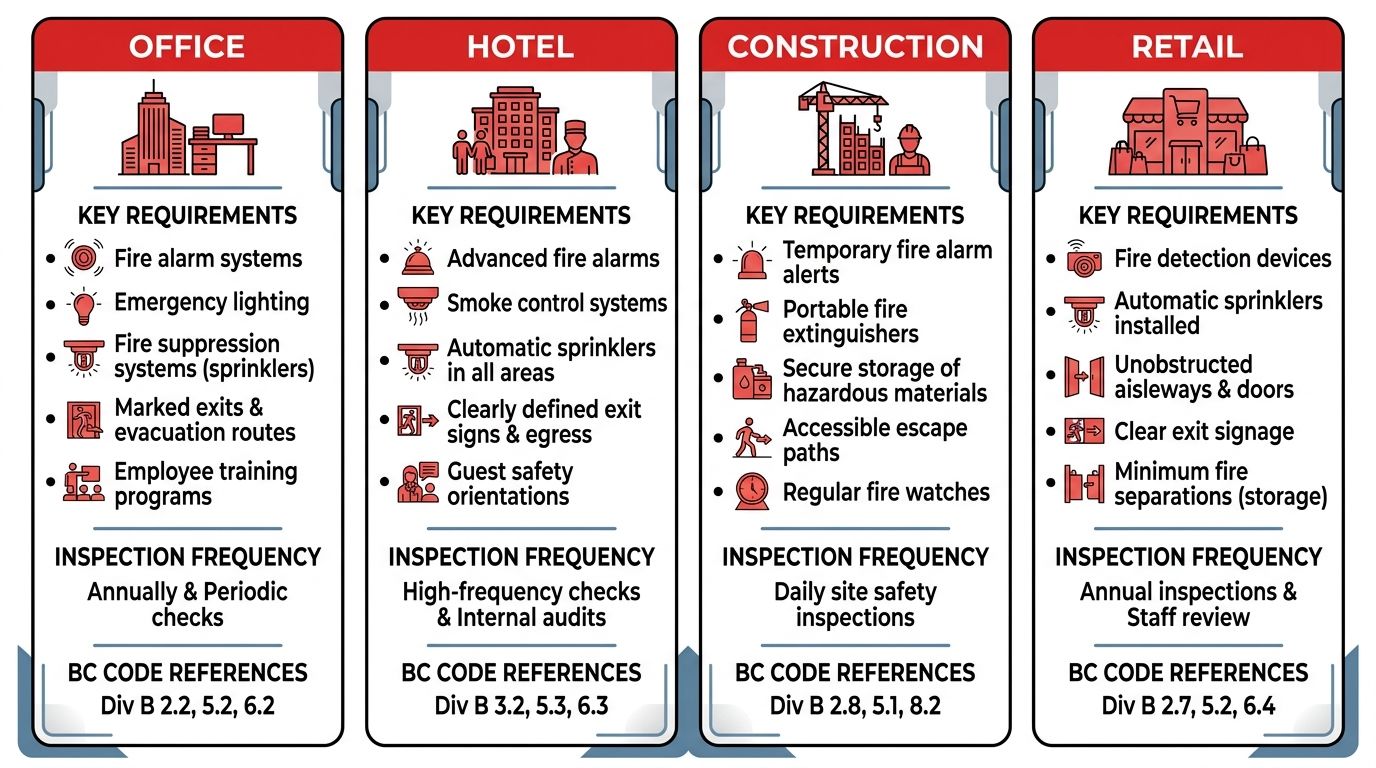
    Different commercial sectors face unique fire risks, so the code tailors requirements accordingly. An office building’s evacuation procedures differ markedly from a construction site’s need for hot work permits and weekly fire watch logs. Understanding these distinctions helps owners implement the right measures for their property type. The table below summarizes the key fire safety plan components, applicable BC Code references, and inspection frequencies for four common commercial sectors in Vancouver.

    Comparison of Fire Safety Plan Requirements by Commercial Sector
    SectorFire Safety Plan RequirementsKey BC Code ReferencesInspection Frequency
    Office Annual Drills & Warden Training Div B, Part 2 Annual
    Hotel Guest Briefings & Staff Training Div B, Part 2.8 Semi-Annual
    Construction Hot Work Permits & Daily Logs Div B, Part 5.6 Weekly

    These requirements illustrate the layered approach to fire safety: annual drills and warden training for offices, semi-annual checks and guest briefings for hotels, intensive weekly monitoring for construction sites, and rigorous monthly inspections for retail. By aligning with the BC Fire Code’s sector-specific standards, businesses maintain compliance and protect both people and property.

    comparative infographic showcasing fire safety plan requirements for office, hotel, construction site, and retail sectors in Vancouver with inspection frequencies and BC Code references

    Vancouver fire safety requirements comparison across four commercial sectors

    At Regent Security, we recognize that your peace of mind is paramount. Our team helps businesses in Vancouver navigate these regulations with confidence, developing fire safety plans that meet every code requirement. Welcome to Regent Security, where your safety is our story.

    Fire Watch and Security Services for Commercial Properties

    When a commercial building’s fire protection systems are impaired or inoperable, fire watch acts as a temporary safety measure to monitor fire hazards. A fire safety plan for commercial buildings in Vancouver must account for such situations, and our emergency fire watch services ensure that occupants and assets remain protected during system outages.

    Why Commercial Properties Need Fire Watch

    Fire watch is mandated by fire marshals, insurance companies, or local bylaws during system repairs, renovations, hot work activities, or when permits have expired. Common scenarios requiring fire watch include:

    • Impaired or non-functioning sprinkler/alarm systems
    • Hot work operations such as welding or cutting
    • Expired or revoked fire safety permits
    • System commissioning in new construction
    • Building renovations that disable fire protection

    We deploy BC-licensed guards trained in fire watch protocols to conduct hourly patrols, document inspections, and report directly to fire authorities if needed. These guards check critical areas like stairwells, mechanical rooms, and parking garages—maintaining a rigorous log that satisfies both fire department and insurer requirements.

    Compliance with Vancouver Fire Bylaws

    In Vancouver, compliance with the BC Fire Code and Vancouver Fire Bylaw 12472 is essential for any commercial property. When a building’s alarm or sprinkler system is offline, the bylaw requires that a qualified fire watch be implemented immediately. Our team responds within two hours of a request, with guards carrying $5 million in liability coverage to protect your interests. Every patrol is digitally tracked, verifying that all 24 checkpoints are addressed and producing a clear audit trail.

    In addition to fire watch, we offer comprehensive security solutions for commercial properties—your peace of mind, anytime, anywhere.

    Key Local Factors for Fire Safety Compliance in Vancouver

    While national codes provide a baseline, compliance for any fire safety plan commercial building Vancouver must address both municipal and provincial standards. Vancouver’s layered regulations require careful attention from property owners.

    Vancouver Fire Bylaw 12472

    Vancouver Fire Bylaw 12472 is the primary municipal rule governing fire safety for commercial buildings within city limits. Key obligations include:

    • Submitting a Fire Safety Plan for approval
    • Annual plan updates as building use changes
    • Posting emergency procedures on-site
    • Maintaining fire suppression and alarm systems

    Non-compliance can lead to fines, stop-work orders, or higher insurance costs.

    Beyond the bylaw, BC Fire Code compliance applies province-wide and is enforced locally, meaning buildings must meet both standards at once. Construction sites carry extra duties: temporary structures, flammable material storage, and site permits impose added fire safety responsibilities. Our construction site security services include dedicated fire watch patrols that address these site-specific needs, while our 24/7 building monitoring and rapid alarm response help occupied properties stay aligned with Bylaw 12472. From drafting a fire safety plan commercial building Vancouver to ongoing vigilance, we close compliance gaps. Understanding these local factors is the first step — our expertise helps you navigate Vancouver’s fire safety requirements with confidence, where your safety is our story.

    Steps to Develop a Site-Specific Fire Safety Plan

    Developing a fire safety plan for a commercial building in Vancouver requires a structured approach that aligns with local regulations and best practices.

    1. Conduct a site assessment. Identify fire hazards, building layout, occupancy type, existing fire protection systems, and emergency responder access. Document findings to guide every subsequent stage and prioritize risks.
    2. Draft plan components. Outline emergency procedures, evacuation routes, assembly points, fire warden roles, and communication protocols that meet BC Fire Code compliance. All documents should be clear and accessible.
    3. Ensure Vancouver Fire Bylaw 12472 compliance. Submit the plan to the local fire authority for approval; in Vancouver, complying with Vancouver Fire Bylaw 12472 is mandatory.
    4. Implement employee training. Train staff on using fire extinguishers, evacuation procedures, and assigned duties. Schedule regular drills—quarterly or annually—to reinforce readiness.
    5. Maintain and update the plan. Review the plan after renovations, occupancy changes, or regulatory updates. Your fire safety plan for a commercial building in Vancouver is a living document.

    Regent Security offers fire watch services and security consultation to support your plan. Contact us today for a custom quote — unmatched security expertise for your peace of mind.

    Your Next Steps Toward Fire Safety Compliance

    Now that you understand the key fire safety requirements, the next step is to implement a fire safety plan for your commercial building in Vancouver. We help you meet BC fire code compliance and Vancouver Fire Bylaw 12472 requirements with a tailored safety plan. Our licensed, insured guards provide 24/7 fire watch services, deploying rapidly to keep your property protected. Contact us today to learn more about our fire watch services in Vancouver and ensure your peace of mind anytime, anywhere.

    Resources

  • Commercial Property Security Cost: Get Vancouver’s Best Rates

    Commercial Property Security Cost: Get Vancouver’s Best Rates

    Table of Contents

    Understanding Commercial Property Security Cost in Vancouver, British Columbia

    If you manage a business in the Lower Mainland, understanding the factors behind commercial property security cost is essential before committing to a service. At Regent Security, we know that no two properties are alike. Your final investment depends on several key variables, including the size and location of your site, the required service level—such as on-site guards versus mobile patrol pricing—and the shift structure you need. Technology integrations like CCTV or access control also influence the overall budget, as does the need for 24/7 coverage or rapid, same-day deployment.

    We tailor every plan after a free consultation, ensuring your security guard service hourly rates reflect your actual risk profile, not a one-size-fits-all estimate. With over 1,000 clients served, our licensed, insured team delivers reliable protection that helps offset long-term losses from theft, vandalism, and liability. Contact us for a custom quote and experience your peace of mind, where your safety is our story.

    Preparing to Evaluate Commercial Property Security Cost

    Understanding the full scope of commercial property security cost is a critical step before investing in protection for your building or facility. Before you can accurately estimate security costs for your commercial property, our experience shows that a thorough assessment of several interrelated factors will produce the most realistic quote and ensure you receive the right level of coverage. At Regent Security, we guide every client through this evaluation to align our services with their precise operational needs.

    Key considerations that influence your security plan and its pricing include:

    • Property profile: The size, layout, number of entry points, and current occupancy of your commercial space directly shape staffing and technology requirements.
    • Risk history and location: Past incidents, neighbourhood crime trends, and proximity to high-traffic areas help us determine the appropriate deterrent posture.
    • Service type: Choosing between on-site building security, randomized mobile patrols, or remote video monitoring creates different cost structures — mobile patrol pricing varies based on route frequency and response protocols.
    • Coverage schedule: A 24/7 guard presence involves a different investment than night-shift-only or weekend coverage, which is where security guard service hourly rates become an important reference point.
    • Technology integration: Adding CCTV, access control, and intrusion detection systems can represent an upfront cost but often reduces long-term staffing expenses.

    In British Columbia, any security provider you engage must comply with British Columbia security legislation governing personnel licensing, training standards, and operational conduct. We handle all compliance requirements internally so that your property remains fully protected under provincial law. As you move toward a decision, remember that custom quotes reflect your property’s unique characteristics. We recommend requesting a free consultation for an accurate, obligation-free estimate before we explore the specific cost components in the next section.

    Assess Your Property’s Security Needs

    Every property has unique vulnerabilities, which is why a one-size-fits-all approach to security assessment often falls short. While many property managers begin by researching commercial property security cost, the first step is actually a thorough evaluation of your specific situation. Factors like your building’s type, size, location, and operational hours create a distinct risk factors profile that demands a tailored strategy. Our building security services are designed around your unique needs, built from a deep understanding of these foundational elements.

    Consider what you are protecting. High foot traffic, valuable assets on site, a history of incidents, or periods of low occupancy all influence the right approach. These variables can affect everything from security guard service hourly rates to mobile patrol pricing factors, so defining them is essential. With over 15 years of experience and more than 1,000 clients served, our team provides the professional guidance needed to navigate this evaluation. We invite you to contact Regent Security for a consultation that translates your property’s specific needs into a concrete, custom-quoted plan, delivering the unmatched security expertise that ensures your peace of mind.

    Understand Security Guard Hourly Rates for 2026

    Several key hourly rate factors determine your commercial property security cost, including the training and experience level of the guards, the specific type of service required, your property’s location, and the timing of the shifts. There is no one-size-fits-all price, as a tailored solution involves balancing these variables to meet your unique security needs.

    In British Columbia, all professional guards must complete provincially mandated security guard training in British Columbia through an approved institution like the Justice Institute of British Columbia. This rigorous training requirement ensures that every licensed guard understands legal protocols and incident response, which directly reduces your liability and guarantees a higher standard of service.

    The primary drivers behind security guard service hourly rates include the complexity of the post—such as a concierge versus construction site security—and mobile patrol pricing factors like vehicle maintenance and fuel. Other variables like night shift differentials and the need for specialized equipment will also shape your final cost of security guard services.

    • Service Type: A stationary concierge guard has different price determinants than a roving mobile patrol unit.
    • Shift Timing: Overnight and weekend coverage often involves different pricing variables due to shift differentials.
    • Property Complexity: A high-traffic urban site in Vancouver requires different resource allocation compared to a quiet suburban location.

    Regent Security never publishes a fixed rate card because we understand that every property is different. We provide a free, no-obligation custom quote after a detailed assessment of your site and a discussion about your expected scope of work. With these factors in mind, the next step is to get a personalized rate for your property—because Your peace of mind, anytime, anywhere begins with a security plan built precisely for you.

    Calculate 24/7 Coverage Staffing Requirements

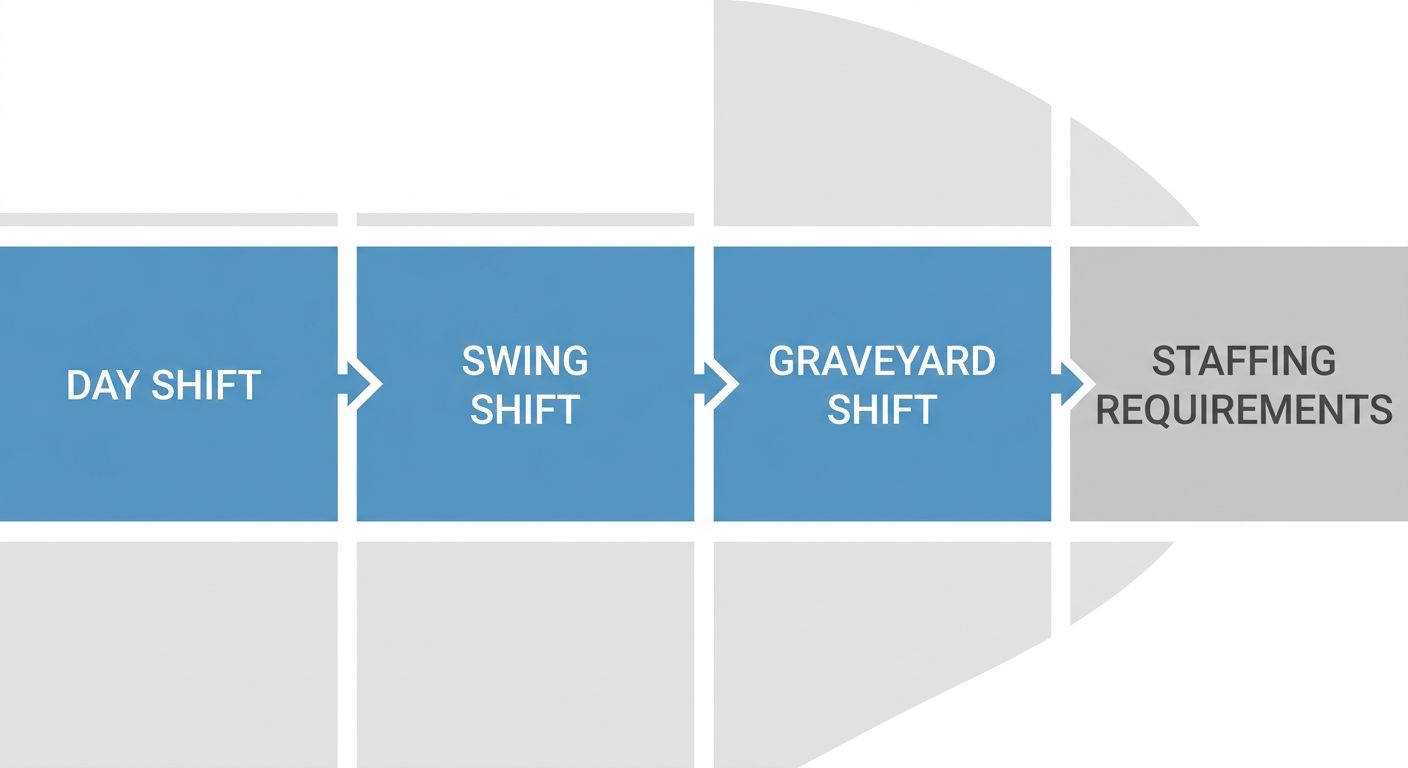
    Understanding your commercial property security cost starts with calculating the personnel needed for round-the-clock coverage. A single security post that must be staffed 24 hours a day, 7 days a week, typically requires 5 full-time equivalents (FTEs). This calculation accounts for three daily shifts, weekend coverage, and paid time off for your dedicated team.

    Process flow of Regent Security 24/7 staffing model showing day, swing, graveyard shifts and staffing requirements
    Calculate 24/7 coverage staffing requirements

    Several factors directly influence your final staffing plan and its associated expense. Common shift patterns, such as three 8-hour rotations or two 12-hour shifts, are selected based on your property’s operational rhythm. The need for overtime, shift differentials, and vacation relief all increase the base FTE count. At Regent Security, we customize these plans, as detailed in our hotel security approach, by assessing your property size, risk profile, and specific protocols. This tailored planning ensures proper staffing, which avoids coverage gaps and directly impacts the effectiveness of your safety strategy.

    More personnel will naturally increase your expense, but integrating technology like CCTV monitoring and mobile patrol pricing factors can optimize efficiency. Understanding these staffing drivers helps frame the security guard service hourly rates you will encounter. Contact us for a personalized assessment that balances rigorous protection with your budget, securing your peace of mind.

    Evaluate Mobile Patrol vs Static Guard Pricing

    When considering security for your commercial property, comparing the cost-effectiveness of our mobile patrol and static guard services is essential. Mobile patrols serve multiple properties through randomized visits, often costing less than full-time guards. We assess your commercial property security cost to find the best solution. Static guards provide continuous monitoring and immediate response; their security guard service hourly rates vary based on site size, personnel, and coverage hours. Understanding mobile patrol pricing factors is key: property dimensions, visit frequency, and specific risks influence your final estimate. Because every need is unique, we avoid standard pricing. We offer a free, no-obligation consultation instead. You’ll receive a quote tailored to your requirements, backed by our licensed, insured team and 24/7 availability. Contact us today. Discover why over 1,000 businesses in Vancouver and the Lower Mainland trust Regent Security. We deliver cost-effective, customized protection and your peace of mind.

    Identify Hidden Costs in Security Service Contracts

    When evaluating the hidden costs of a security engagement, the quoted rate for a service is rarely the final expense. Understanding the true commercial property security cost means looking beyond the base figure and scrutinizing every line item in your contract. As providers with experience in loss prevention in Vancouver, we know that businesses can encounter overtime premiums, holiday surcharges, and administrative dispatch fees that inflate an initially attractive quote.

    To avoid surprises, always request an itemized proposal that separates the hourly rate from equipment, uniform, and licensing costs. According to our internal FAQ, clarifying how security guard service hourly rates are structured for statutory holidays and after-hours coverage is a critical step in forecasting your true spend. We also recommend reviewing clauses tied to early termination or auto-renewal, which can lock you into pricing that shifts over time. A transparent provider will explain mobile patrol pricing factors such as vehicle maintenance, fuel, and reporting technology integration without hidden minimum-hour guarantees.

    Your peace of mind comes from partnering with a firm that believes a comprehensive, no-surprise proposal is the foundation of a trusted security relationship.

    Compare Security Service Rates Between Vancouver and Burnaby

    Comparing commercial property security cost between Vancouver and Burnaby reveals how regional factors shape pricing. Higher property density, varying crime rates, and local labour costs all influence what businesses pay. That’s why we at Regent Security never apply a standard rate—we assess each location individually to develop a quote that matches real conditions.

    The commercial property security cost also depends on job specifics. Security guard service hourly rates fluctuate with shift timing, required qualifications, and whether coverage is ongoing or event-based. Pricing for mobile patrols depends on coverage area, frequency, and technology integration. We tailor every engagement around your property’s unique profile.

    Rather than publish fixed numbers, we encourage you to request a personalized, no-obligation quote. As Regent Security’s internal FAQ explains, our custom-quote approach delivers unmatched security expertise and your peace of mind. Next, we’ll outline the specific service packages we offer across the Lower Mainland.

    Request a Custom Security Quote from a Licensed Provider

    Understanding that commercial property security cost varies widely is the first step toward protecting your assets. At Regent Security, we provide customized quotes based on your property’s size, risk profile, and desired coverage.

    When requesting a quote, consider preparing key details such as the number of access points, hours of operation, and any specific service requirements. Our comprehensive building security services can include concierge support, CCTV monitoring, access control, and mobile patrols. By evaluating real factors like security guard service hourly rates and mobile patrol pricing factors, we help you manage your overall commercial property security cost effectively.

    As a licensed and insured provider with over 100 trained professionals, we deliver your peace of mind, anytime, anywhere. Our 24/7 coverage and rapid same-day deployment mean our team is ready for any schedule — because where your safety is our story.

    Contact us today for a free consultation. Let us build a security plan that fits your budget and gives you the confidence that your property and people are in expert hands.

    Addressing Common Budgeting and Contract Pitfalls

    Understanding commercial property security cost is only the first step; the real challenge lies in the budgeting and contractual details that can quietly inflate your expenses. Many property managers focus narrowly on security guard service hourly rates without accounting for ancillary charges, which can lead to significant budget overruns. We at Regent Security believe transparent planning is the foundation of a successful partnership and your peace of mind.

    Several common pitfalls can derail even the most carefully planned security budget. When reviewing proposals, we advise our clients to watch for these critical issues:

    • Overtime and Holiday Surcharges: An attractive base rate can become costly when providers apply unannounced premiums for nights, weekends, or statutory holidays.
    • Auto-Renewal Clauses: Contracts that automatically renew for extended terms can lock you into unsatisfactory service or outdated rates, as our FAQ on contract terms explains.
    • Unclear Termination Conditions: Lengthy cancellation notice periods or penalties for early exit severely limit your flexibility, a trap we help clients avoid.
    • Scope Creep from Vague Agreements: Without a detailed written scope of work, tasks like alarm response or detailed reporting can be added later as costly, unbilled extras.

    Understanding mobile patrol pricing factors is equally crucial, as these services involve variables like vehicle maintenance, fuel, and response protocols that must be included in the base quote. We ensure our proposals comprehensively cover all necessary equipment and monitoring. Choosing a licensed, insured provider with unmatched security expertise inherently mitigates these risks, ensuring your contract is a shield, not a snare. In the next section, we will explain how to request a transparent, custom quote tailored to your specific needs.

    Your Path to Transparent Commercial Property Security Cost

    Understanding commercial property security cost begins with a tailored approach at Regent Security. We customize pricing based on your property type, size, location, and specific security needs. You won’t find standard security guard service hourly rates here because every site presents unique challenges and requirements.

    Our free consultation and custom quote include no hidden fees and tailored recommendations. We bundle services such as mobile patrols, on-site guards, CCTV monitoring, and access control to create a complete security solution. Mobile patrol pricing factors like route scope and scheduling are reviewed during your quote session.

    With 24/7 coverage, same-day deployment, licensed and insured guards, and a track record of over 1,000 clients and 100+ trained staff, we deliver value beyond cost. Request your personalized commercial property security cost quote today to secure your Vancouver property.

    Resources

  • Loss Prevention Strategies Retail: Essential Guide for 2026

    Loss Prevention Strategies Retail: Essential Guide for 2026

    Table of Contents

    Retail Loss Prevention Fundamentals

    Retail loss prevention is a systematic business strategy that protects assets, reduces inventory shrinkage, and maintains safe shopping environments. As Canadian retailers face increasing challenges from organized retail crime, effective loss prevention in Vancouver and other major metropolitan areas has become essential for protecting profitability.

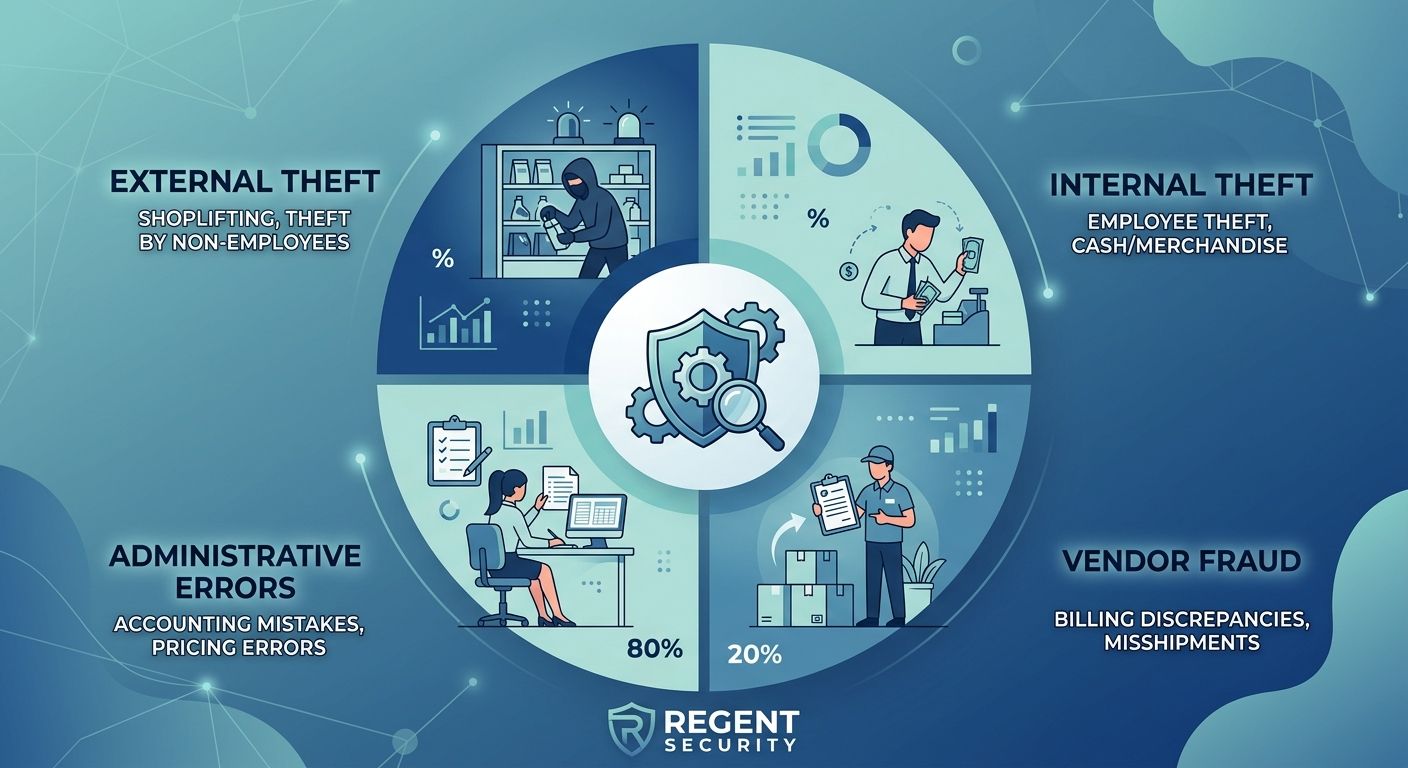
    At Regent Security, we understand that professional loss prevention represents a revenue protection investment rather than an operational cost. Every dollar recovered through prevention flows directly to the retailer’s bottom line, making inventory shrinkage control a critical financial priority. Industry standards set by the Canadian Security Association (CANASA) emphasize that comprehensive loss prevention strategies retail programs must address four primary causes of loss: external theft, internal theft, administrative errors, and vendor fraud. While external theft typically receives the most attention, internal loss often carries a higher average value per incident.

    Our approach balances proactive deterrence with reactive response capabilities. Visible guard presence, regular floor patrols, and employee training create effective shoplifting prevention strategies that discourage theft before it occurs. This stands in contrast to purely reactive security measures that only respond after incidents happen. Modern loss prevention integrates with CCTV surveillance, access control systems, and incident reporting to create complete protection strategies that safeguard merchandise, employee morale, customer experience, and brand reputation.

    The following sections explore specific loss prevention techniques and technologies that translate these fundamentals into actionable protection for your retail business.

    The Real Cost of Retail Shrinkage and Loss

    Retail inventory shrinkage is a silent but substantial profit leak that demands urgent attention. For Canadian businesses, crafting robust loss prevention strategies retail begins with quantifying the real financial and operational toll of missing merchandise. We understand that every lost item cuts directly into your bottom line, making a clear understanding of the four main drivers—external theft, internal theft, vendor fraud, and administrative errors—the foundation of an effective response.

    An infographic showing four main causes of retail shrinkage: external theft, internal theft, vendor fraud, and administrative errors, using a blue-green color palette.

    A professional infographic breaking down the primary sources of retail shrinkage into four clear segments for educational use.

    The Main Drivers of Inventory Shrinkage

    Inventory shrinkage—the loss of products between manufacture or shipment and the point of sale—disproportionately erodes retail profit margins. The Retail Council of Canada reports that shrinkage drains billions of dollars from the industry each year, with each driver contributing to that total in distinct ways. External and internal theft together account for the largest share. Shoplifting, defined under the Criminal Code as the unlawful taking of merchandise, remains a persistent challenge. Employee theft, whether through direct stealing or collusion, compounds these losses; as made accessible through BC Laws, both acts carry serious legal consequences. Implementing shoplifting prevention strategies that combine physical deterrents with vigilant staff practices is a critical early step, and standards from UL Canada help guide the placement of surveillance and access controls to reduce these criminal opportunities.

    Vendor fraud, such as short shipments or invoice manipulation, introduces another layer of risk that often goes undetected until financial audits expose discrepancies. Strong receiving protocols and verification—aligned with industry benchmarks from UL Canada—form a frontline defence against these losses. Administrative errors, including inaccurate inventory counts, mislabelled stock, or data entry mistakes, may lack criminal intent but still cause significant shrinkage. These errors can represent as much as 20–30% of total inventory variance in some Canadian stores. Tackling them demands rigorous inventory controls and regular reconciliation, reinforcing the case for standards-based operational checklists. Together, these four drivers underscore that theft deterrence approaches must address both human behaviour and systemic weaknesses

    Assessing Retail Vulnerabilities to Internal and External Theft

    A structured vulnerability assessment is the essential first step in any shrink reduction measures plan, moving from general awareness to targeted action. Begin with the physical layout. Blind spots, poor lighting, and cluttered product displays create inviting environments for shoplifters. We recommend auditing every aisle and entry point against UL Canada’s security system criteria, which specify optimal CCTV coverage, mirror placement, and sightline clearance. Even simple adjustments—repositioning high-value items away from exits and improving illumination—can yield immediate deterrence.

    Staff behaviours are equally critical. Low alertness, inconsistent adherence to security protocols, and unsafe routines open the door to both external theft and internal collusion. We find that gaps often stem from a lack of ongoing training rather than malicious intent. Formalizing clear expectations and encouraging proactive customer engagement significantly reduce opportunities for theft. Resources from the Canadian Security Association offer additional checklists for retail vulnerability assessments, helping managers build a culture of shared responsibility around inventory shrinkage control.

    Procedural gaps, such as irregular inventory counts, lax receiving verification, or the absence of employee background checks, leave the business exposed even when physical and staff defences are in place. Tightening these processes—for example, by mandating double-checks on inbound shipments and instituting cycle counting—closes the loop. While the legal framework outlined in BC Laws acts as a deterrent, it is never a substitute for proactive security measures. For a more thorough evaluation, our team at Regent Security provides professional vulnerability assessments that integrate these insights. Once these vulnerabilities are identified, selecting the right mix of protective measures becomes straightforward.

    Key Advantages of Professional Loss Prevention

    The advantages of partnering with a professional service like Regent Security are substantial. Our multi-layered approach combines immediate deterrence with long-term strategic planning, ensuring your business not only recovers from losses but actively prevents them.

    Reducing Financial Loss Through Prevention

    Effective loss prevention strategies retail professionals deploy go far beyond simply catching a thief in the act. Our proactive methodology integrates undercover security, advanced CCTV surveillance, and detailed customer behavior analysis to intercept theft, fraud, and internal shrinkage at the source. These shoplifting prevention strategies are designed to protect your profit margins directly. By employing sophisticated inventory shrinkage control tactics, we identify vulnerabilities in your operational workflow, from the point of sale to the stockroom. These approaches to prevent shoplifting create a hostile environment for internal and external theft, directly safeguarding your bottom line without disrupting the genuine customer experience.

    Enhancing Customer and Staff Safety

    A visible security presence is one of the most powerful tools for creating a safe retail environment. Our uniformed guards and regular patrols serve as an immediate deterrent to potential criminals, significantly reducing the opportunity for theft and violent incidents. For your staff and shoppers, this presence fosters a tangible sense of your peace of mind. When employees know that trained, licensed, and insured professionals are on-site, their focus naturally returns to customer service and sales. This commitment to a safer atmosphere is a core element of our shoplifting prevention strategies, ensuring that everyone within the store feels secure. The result is a more positive shopping experience where visitors linger longer and employees perform with greater confidence, knowing their well-being is a top priority.

    Cost-Effective Solutions Tailored to Your Business

    We understand that every retail operation has a unique budget and risk profile, which is why we never apply a one-size-fits-all pricing model. The cost of our service is influenced by several key factors, including store square footage, required hours of coverage, the number of guards assigned, and the degree of technology integration, such as CCTV monitoring. To ensure you receive maximum value, we begin with a free, comprehensive consultation to assess these exact needs. This allows us to provide a custom quote, ensuring you pay only for the services essential for your protection. All our loss prevention strategies are designed to comply with rigorous security standards in Canada, ensuring both effectiveness and regulatory alignment. Understanding these benefits, the next step is exploring how Regent Security tailors these solutions to your specific retail environment.

    This methodical strategy, backed by our 24/7 availability, licensed personnel, and rapid deployment capabilities, ensures that your tailored security plan provides robust protection without unnecessary expenditure. We believe that professional security should be an accessible and scalable asset for businesses across Vancouver, Burnaby, and Surrey.

    Implementing Loss Prevention: Strategies and Technology

    Effective loss prevention strategies for retail require a coordinated blend of human expertise, surveillance technology, and operational protocols. Below we outline how Regent Security designs multi-layered systems that protect commercial assets in Vancouver’s busiest districts.

    Layered Security: Combining Personnel and Technology

    Retail businesses in Vancouver face theft from both external shoplifters and internal sources. A layered security approach is the most effective countermeasure. Regent Security designs integrated systems where each layer reinforces the next:

    • Uniformed security guards provide visible deterrence and immediate intervention.
    • Trained undercover officers observe covertly to catch internal theft or organized shoplifting.
    • CCTV surveillance covers all zones, capturing evidence and feeding live feeds to our monitoring centre.
    • Access control systems restrict entry to sensitive areas, such as stockrooms, and log every instance.
    • Intrusion detection secures the property after hours with sensors and alarms.

    Our personnel are licensed in accordance with the BC Security Services Act, ensuring all activities meet provincial standards. Before implementation, we conduct site assessments to identify vulnerabilities, then tailor the solution to each location. By combining these layers, we create a seamless defense that detects and deters loss at multiple points, significantly reducing opportunities for theft.

    Monitoring and Reporting: The Backbone of Loss Prevention

    Even the best-layered defenses need oversight. When staff are occupied, suspicious activity can slip through. Real-time monitoring fills this gap. Our 24/7 command centre uses AI-driven video analytics to detect anomalies like loitering or hiding merchandise the moment they occur. Every event is flagged for immediate review.

    Beyond live surveillance, our checkpoint reporting software captures guard reports, incident logs, and time-stamped patrol data. Over weeks and months, this creates a rich dataset that reveals patterns of inventory shrinkage—whether it’s a specific shift with higher losses or a particular product line being targeted. These insights feed into strategies for shoplifting prevention and controlling inventory shrinkage, enabling proactive adjustments such as repositioning cameras or increasing undercover presence at certain times. Our retail loss prevention strategies evolve with the data, staying ahead of emerging theft tactics.

    Incident Response and Follow-Up Procedures

    When a theft occurs, a disorganized reaction can escalate danger. Our structured incident response protocol begins with immediate alarm verification. Our team rapidly deploys to the site, secures the area, and preserves physical and digital evidence. Where safe, our guards detain the suspect until law enforcement arrives—strictly in compliance with provincial security legislation and our internal protocols.

    After the police handover, we launch a post-incident review. We examine CCTV footage, access logs, and witness statements to identify the root cause—whether it was a procedural gap, equipment blind spot, or insider collusion. This analysis drives corrective actions: updating patrol routes, enhancing training, or fine-tuning sensor placements. We share a comprehensive report with management, demonstrating patterns and recommending long-term fixes.

    By closing the loop between detection, response, and analysis, we strengthen the overall loss prevention framework and make recurrence less likely. This integrated approach goes beyond presence, evolving into a true partnership. In the next section, we’ll explore the benefits of outsourcing these functions to a dedicated provider. With Regent Security, your peace of mind comes from knowing that each layer works together to protect your property, anytime and anywhere.

    Proven Best Practices to Strengthen Loss Prevention

    To address the prevalent theft challenges, implementing effective loss prevention in Vancouver requires a blend of proactive staff training, integrated technology, and rigorous audits.

    Training Staff to Recognize and Deter Theft

    Loss prevention strategies retail centre on equipping staff with the skills to identify and deter theft. Frontline employees should be trained to recognize behavioral indicators such as excessive loitering, avoidance of eye contact, and attempts to conceal items in bags or clothing. Proactive engagement is a hallmark of effective shoplifting prevention strategies: greet each customer, offer assistance, and maintain a visible floor presence. We also recommend establishing confidential internal reporting protocols so staff can flag suspicious activity without fear of reprisal, using a standardized incident log to capture incident details. Role-playing exercises reinforce these skills under realistic scenarios. We further advise that store layouts be arranged to eliminate blind spots, enabling staff to monitor customer movements more effectively, while regular briefings on recent theft trends keep the team vigilant. All training must align with industry-recognized standards from the Canadian Security Association and respect legal limits defined by BC Laws on detention and apprehension. Empowered employees become active participants in loss prevention, directly impacting shrinkage reduction.

    Integrating Technology for Real-Time Alerts

    To amplify loss prevention strategies retail, we integrate technology that delivers instantaneous alerts. Modern video analytics, when connected to point-of-sale systems, automatically flag irregular transactions such as voided sales, excessive discounts, or no-sale drawer openings. Electronic article surveillance tags deactivate at checkout and trigger real-time alarms if merchandise passes sensors without purchase. Mobile alerts notify management immediately when multiple high-risk events occur within a short window. Such real-time alerts also enable remote monitoring and rapid dispatch of security personnel, ensuring no incident goes unnoticed. Our team at Regent Security leverages these advanced surveillance tools to give retailers in Vancouver a decisive edge. This layered approach, aligned with best practices from the Canadian Security Association, transforms reactive security into proactive deterrence. By minimising the window between incident and response, integrated technology supports overall inventory shrinkage control and measurably reduces theft.

    Conducting Regular Audits and Inventory Checks

    Rigorous audits and inventory checks are indispensable for inventory shrinkage control. We recommend weekly cycle counts on high-theft items, comparing physical stock against system records to rapidly identify discrepancies. Surprise cash register audits on random shifts detect internal theft patterns such as sweethearting and procedural non-compliance. Immediate reconciliation of variances through a documented root-cause analysis prevents losses from compounding; linking findings to corrective action closes the loop. The unpredictable nature of surprise audits serves as a powerful deterrent against internal theft, keeping honest employees protected. All audit protocols should comply with the documentation standards set by BC Laws, ensuring that every step of the loss prevention process remains lawful and defensible. Regent Security’s inventory management solutions incorporate these rigorous checks to help Vancouver businesses maintain accurate stock levels and reduce shrinkage. Regular audits not only catch theft but also reinforce a culture of accountability throughout the organization.

    By integrating these practices, retailers build a resilient loss prevention framework that adapts to evolving threats.

    A Proactive Approach to Long-Term Retail Security

    Addressing modern retail theft requires shifting your focus from reactive responses to loss prevention strategies for retail in BC that emphasize comprehensive and protective planning. In contrast to simply reacting to incidents, partnering with a professional security provider like Regent Security allows businesses to systematically identify vulnerabilities and build a sustained, protective barrier.

    A foundational risk assessment begins this journey by evaluating store layout, inventory handling, and staffing procedures. By integrating our on-site on-site security guards (including undercover loss prevention specialists) with modern technology such as CCTV monitoring, we design a layered layer of deterrence and detection tailored to your specific operation. This allows us to deploy effective shoplifting prevention strategies in Vancouver while addressing inventory shrinkage control through data-driven store management.

    Ensuring that any research-backed approach adheres to provincial legislation is critical. Our experts ensure every plan aligns with the Government of British Columbia’s legal framework for detention and privacy, as well as the Canadian Security Association (CANASA) professional standards for ethical security deployment. The same proactive principles apply across industries, and our expertise extends to construction site security, ensuring every business asset is protected.

    Through ongoing reviews and security audits provided by Regent Security, your retail loss prevention strategies evolve to meet new trends and threats. This sustained partnership not only reduces theft but increases employee and customer confidence, delivering the reliable peace of mind that comes from knowing your operations are secure for the long term.

    This article was researched and written with the assistance of AI tools.

    Resources