

Tag: Security Career Vancouver

  • How to Write a Security Guard Resume: Step-by-Step Guide for 2026

    How to Write a Security Guard Resume: Step-by-Step Guide for 2026

    Table of Contents

    How to Write a Security Guard Resume in British Columbia

    If you’re wondering how to write a security guard resume for British Columbia, it’s important that you tailor it to meet BC’s licensing and training standards. BC employers and licensing bodies want to see that you have a BC security worker licence, industry-specific training and relevant experience to prove your eligibility to work in this field. how to write a security guard resume in British Columbia

    Your resume needs to show your mandatory Basic Security Training (BST), and any additional credentials that you have earned. These will be listed as requirements for licensure. Display your licence status prominently and include details of your experience that align with BC’s regulated security categories (i.e. Guard services, mobile patrols). This way your application will meet the criteria set out by the province right from the start.

    The first step is to get your BC credentials and licences together, so your resume reflects your qualifications correctly and you stand out to potential employers.

    Key Takeaways

    • Before learning how to write a security guard resume in British Columbia, get to know the licence details that employers will check on.
    • Each security worker in British Columbia needs to have a valid licence issued by the provincial Security Programs Division; BC employers will not accept credentials from another province instead.
    • After your licence and certifications have been added, employers will be looking at your practical experience.
    • When you’ve written out all your essential security duties, highlight the software platforms that you’ve worked on and reframe your concierge experience in security terms.
    • While technical duties and site-specific experience are important, employers who hire for security and concierge jobs also value general people skills applicable to most industries.

    Before You Begin: BC Credentials and Licence Details You Need Ready

    Before learning how to write a security guard resume in British Columbia, get to know the licence details that employers will check on. Every security worker in this province needs to have a valid BC security worker licence, even if they already hold another licence elsewhere in Canada. This licence is mandatory for you to be legally employed as a security guard.

    Make sure you’re eligible first: you need to be 19 or older, live in Canada and speak English fluently. Do any necessary training for your licence category and then gather up all required documentation. You will need to provide a criminal record check and be fingerprinted on your initial application as well as any renewal that has not been verified via a BC Services Card account. Use the online Security Services Platform with your BC Services Card to make your application easier.

    Incomplete applications may lead to delays in processing, so clean up your paperwork prior to starting your job search. Employers frequently verify professional licences, so make sure the information on your resume is correct and honest.
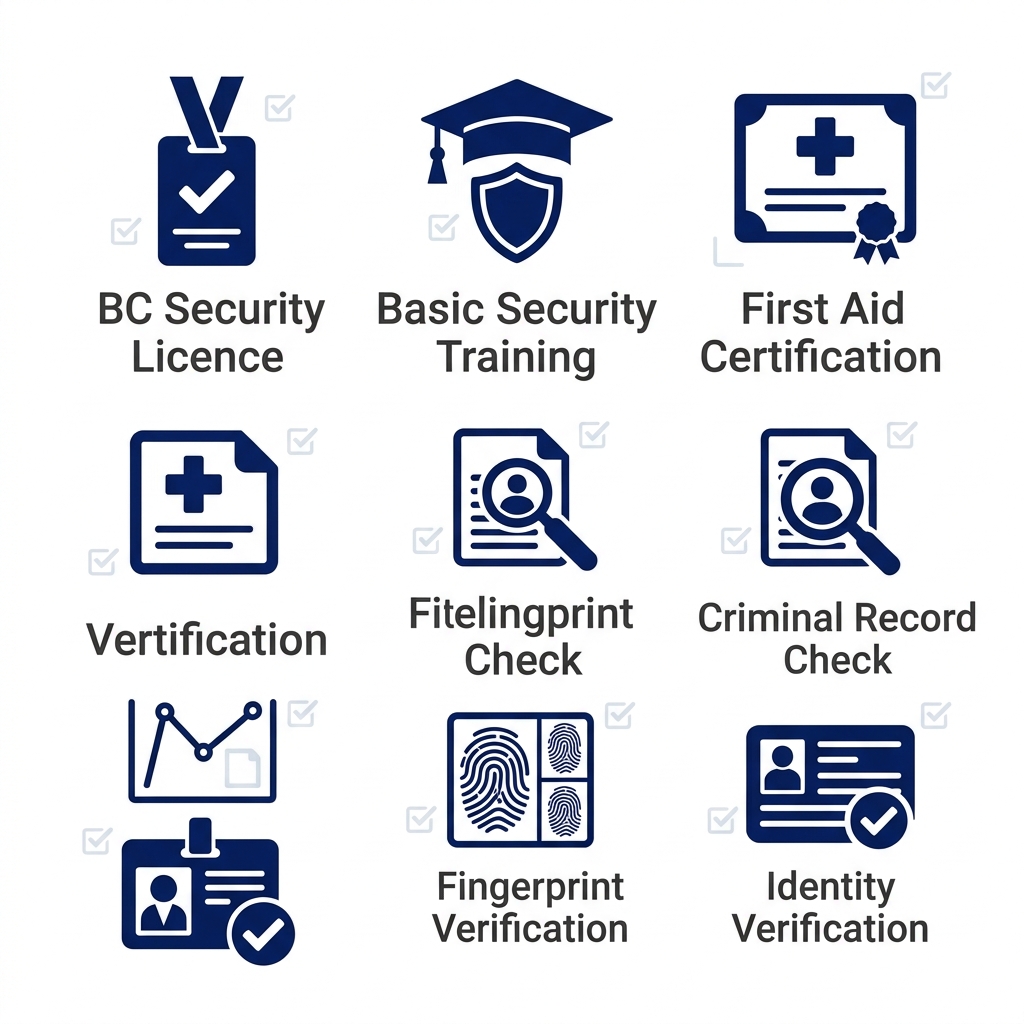
    A set of six outline icons in navy blue on a white background, each with a charcoal grey label beneath, representing security credentials: BC Security Licence, Basic Security Training, First Aid Certification, Criminal Record Check, Fingerprint Verification, and Identity Verification.
    BC security credentials icon set for resume preparation checklist

    Step 1: Choose the Right Resume Format

    Once you’ve got your British Columbia security badge on your lanyard, the next task in learning how to write a security guard resume is to choose a clear and employer-friendly layout. There are three most common formats available: reverse-chronological, functional and combination styles. Reverse-chronological lays out your most recent work experience first, allowing the reader to skim easily through your employment history. Functional style lists your skills first rather than the dates, this works well for those with breaks in their career or who are trying to make a transition from another field. Combination style blends both to strike a balance between listing skills and timing.

    For most BC security guard positions, we advise using the reverse-chronological format. Employers want to see your full work history, and this layout will show them your most current and relevant experiences first. It also places your licences and certificates at the top of your resume for easy verification, which is important because recruiters commonly check this information when making a decision on job candidates.

    Now that you have selected your format, your next task is to structure the credentials section to make sure each license and certification is easily recognizable.

    Step 2: List Your BC Security Licence and Certifications

    Each security worker in British Columbia needs to have a valid licence issued by the provincial Security Programs Division; BC employers will not accept credentials from another province instead. Format each credential with your name, the issuing organization, and completion date, for example:

    • Basic Security Training (BST) – Justice Institute of British Columbia – 2023-05-15
    • Advanced Security Training (AST) – Justice Institute of British Columbia – 2024-02-20
    • Occupational First Aid Level 2 (OFA 2) – Canadian Red Cross – 2022-11-10

    List any pending certifications along with the expected date of achievement. Employers frequently verify credentials, so make sure they’re correct. You can verify your current licence status via the provincial government’s online registry that hiring managers will use to verify candidates. Refer to the keyword how to put a security guard license on a resume to guide your formatting.

    Step 3: Highlight Your Security Work Experience

    After your licence and certifications have been added, employers will be looking at your practical experience. Include the employer name, dates, and site type (hotel, strata building, construction site, etc.) for each security role in order to show what environment needs protecting.

    For duties, try using the same language found in job postings, like "monitoring," "patrols," and "access control." If you can, quantify your impact as much as possible: mention how many posts you monitored, the number of shifts you managed, and reports that you filed. So instead of a vague phrase like "responsible for security," this turns it into clear, demonstrable proof of what you were able to do.

    Don’t forget to include experience you gained while working under BC’s Security Services Act license, as the Government of British Columbia requires all security workers to have completed industry-specific training and hold a valid licence even if you already have out-of-province credentials.

    Step 4: Showcase Software and Concierge Duty Experience

    When you’ve written out all your essential security duties, highlight the software platforms that you’ve worked on and reframe your concierge experience in security terms. List out the particular tools that you have used such as Pro-Watch, Genetec Security Center or Brivo to show the kind of technical skills that employers are looking for in BC security guard positions.

    Concierge roles can easily be rebranded into security by adding the proper wording: front desk access control, visitor screening, keys, and patrol log. Add that with your Basic Security Training (BST), and a background check (as BC licensing requires both). Employers will be looking for these things before they hire you, so include them on your resume to prove yourself as qualified and ready to work.

    This step will make sure that your resume reflects the technical as well as professional standards expected of a security professional.

    Step 5: Highlight Transferable Customer Service Skills

    While technical duties and site-specific experience are important, employers who hire for security and concierge jobs also value general people skills applicable to most industries. These include being able to greet guests in a professional manner, calmly addressing any concerns that arise, and remaining approachable when under pressure. All of these can be utilized in front-desk and security roles.

    Pull over applicable experience from other jobs, be it in a hotel, retail, or guard role, and then describe these experiences as achievements, rather than a list of what you did. Instead of describing what you did, explain the outcomes: “Resolved guest complaints with a 95% satisfaction follow up rate at high-volume hotel front desk,” or “Monitored building entries while remaining welcoming, reducing unauthorized access by 30%.”

    Align each phrase exactly as written on the job posting to help your resume pass applicant tracking systems. This makes sure that your experience reads as customized, not generic, which helps hiring managers see that you are a fit for the role.

    Step 6: Tailor Your Resume to Each Role

    Once your transferable skills have been identified on the resume, the next step is tailoring your resume to each application. A generic resume is usually not enough to get you the desired result; therefore, adapt the resume to match what each job application is looking for.

    Include the credential name, issuing organization, and completion date in your resume when you list licenses and certifications. Separate licenses from voluntary certifications: licenses are those mandated by the government and required to be working, while certifications show professional expertise that is not. Both should be described properly to fit the wording of the job post, as these credentials serve as important keywords to draw employers’ attention and increase the chances for receiving higher salary offer.

    If you have a pending certification, put this with the date when you expect to receive the certification. For expired certificates, be honest about your situation. These claims are frequently verified, so make sure they are true. And make sure your credentials appear the same everywhere on your resume and LinkedIn profile to stay consistent and credible.

    Step 7: Proofread, Verify, and Finalize Your Resume

    Before you hit the submit button, review your resume once more to make sure all your hard work was successful. A good looking resume shows professionalism and attention to detail, which employers love. The resume experts tell us that employers often check to see if resumes match up with actual degrees, certifications, or job experience. So you must be accurate here.

    We recommend three focused passes through: once for spelling and grammar, then once for consistent formatting (dates, spaces, bullets), and one final pass where you read aloud to catch awkward phrasing. Go back and double check all of the licenses and certifications entries to make sure names, issuing bodies, and dates are correct, and put any credentials that you are still working on with expected completion date instead of saying that you’ve already finished them. Make sure that your contact information, references, and employment dates are up to date before saving the final draft, giving it a professional filename, and submitting it.

    Your document is now clean and verified, and it stands out for the right reasons.

    Fixing Common Resume Problems Before You Apply

    We’re security hiring managers and we see the same issues on resumes time after time. The vast majority have to do with unclear or missing credentials that get vetted out before an interview occurs.

    Start by checking these four areas:

    • Licence accuracy: Confirm your BC security licence is current and listed with the exact name and expiry date. Employers cross-check licences against the BC government’s online registry, so any mismatch raises red flags. In British Columbia, a valid security worker licence is legally required regardless of credentials earned in other provinces.
    • Training and certifications: Include your 40-hour Basic Security Training completion and Occupational First Aid Level 1 certification with the issuing organization and date. These are mandatory for BC security roles and must appear prominently.
    • Consistency and placement: Ensure dates, job titles, and credential names match across your resume and LinkedIn. Place credentials in a dedicated section or early in your summary so reviewers spot them immediately. Employers verify every claim, so accuracy and consistency are essential.
    • Honesty in claims: Never list expired or pending licences as active, and avoid vague phrases like “security experience.” Every claim should be verifiable through your licence number or training certificate. Maintain transparency and accuracy throughout the application process to avoid red flags.

    Frequently Asked Questions

    What specific certifications should I include on a security guard resume to stand out in British Columbia?

    Include your BC security worker licence, Basic Security Training (BST), Advanced Security Training (AST) if applicable, and Occupational First Aid Level 2 (OFA 2). List the issuing organization and completion date for each to show compliance with BC’s Security Services Act requirements.

    How can I effectively highlight my experience with incident reporting software and concierge duties on my resume?

    List the specific software platforms you have used, such as Pro-Watch or Genetec Security Center, under a technical skills section. For concierge duties, reframe them using security terms like access control, visitor screening, and patrol logs to align with security job expectations.

    Should I list my BC security worker licence and expiry date at the top of my resume?

    Yes, place your BC security worker licence, including the expiry date, near the top of your resume. Employers verify licences through the provincial registry, so clear visibility ensures compliance and trust.

    What are the best ways to showcase transferable customer service skills for a hotel security guard role?

    Highlight skills such as greeting guests professionally, addressing concerns calmly, and remaining approachable under pressure. Use outcomes like reducing unauthorized access or improving guest satisfaction to demonstrate the impact of these skills.

    How should I structure my work history if I have experience in both construction site security and commercial property monitoring?

    Use a reverse-chronological format, listing your most recent roles first. Include the employer name, dates, and site type for each role. Focus on duties like monitoring, patrols, and access control, using language from job postings to tailor your experience.

    Take the Next Step in Your Security Career

    Now that you have learned how to write a security guard resume, your completed resume is prepared to make a good first impression on your prospective employer. The following crucial step is acquiring a BC Security Worker Licence because it is required to work as a security guard in BC – even if you already have a license from another province.

    Apply online through Security Programs Division using your BC Services Card for identity verification. Complete required fingerprinting and 40 hour Basic Security Training course, then submit your application to avoid any delay. After you have been licensed, we invite qualified candidates to apply their resume to positions within our team in Vancouver and Lower Mainland.

    Results and pricing may vary depending on site-specific requirements and assessments.

    Put Your Resume to Work

    You now have a complete roadmap for writing a security guard resume in British Columbia, from gathering your licence details to tailoring each application and verifying every credential. With your BC security worker licence confirmed and your 40-hour Basic Security Training documented, your application is ready to stand out. Employers in Vancouver and across the Lower Mainland look for exactly the accurate, verifiable details this guide helped you present. The next step is simply putting that polished resume in front of the right team. Our licensed professionals at Regent Security Services Ltd. work throughout Vancouver and the Lower Mainland, and qualified candidates are welcome to reach out. Remember to confirm current licensing requirements with official BC government sources, since requirements may change. Take that first step and connect with a team that values properly prepared applicants.
    Put Your Resume to Work

  • Certified Security Guard Training BC Explained: Requirements

    Certified Security Guard Training BC Explained: Requirements

    Table of Contents

    Certified Security Guard Training in British Columbia

    To ensure the highest level of professionalism, every Regent Security guard undergoes certified security guard training in BC. This mandatory training equips our personnel with the essential skills to protect your property and maintain a safe environment.

    All security guards in British Columbia must complete the 40-hour Basic Security Training (BST) program. This foundational course, regulated by the BC Ministry of Public Safety and Solicitor General, covers critical topics such as legal authorities, emergency procedures, and effective communication skills. In addition to the BST, specialized roles may require advanced certifications in use of force or standard first aid, enhancing a guard’s ability to manage complex situations.

    After successfully completing the BST through an approved provider, individuals must apply for a BC security worker license from the provincial government. The application process includes a criminal record check and ensures that every licensed professional meets strict security license requirements in BC. At Regent Security, we manage all compliance details, ensuring our more than 100 professionals have fulfilled every mandatory step before their first assignment.

    The importance of certified training cannot be overstated. Adherence to these provincial standards is our commitment to delivering “Unmatched security expertise.” When you need to hire security guards for your property, you can trust that our fully licensed and insured team has undergone this rigorous preparation. We believe this training is the bedrock of “Your peace of mind.”

    Understanding BC Security Worker License Requirements

    To work as a security guard in British Columbia, individuals must meet specific licensing prerequisites set by the province. Understanding certified security guard training BC requirements is the first step toward a professional career in this field. We know that navigating the path to a bc security worker license can seem complex, but breaking down the training components makes it manageable. Here we outline the mandatory courses every applicant must complete and the optional certifications that can help you advance.

    Mandatory Training for BC Security Guards

    Before you can apply for your license, you must finish three mandatory training components. These core courses are non-negotiable and form the foundation of your security license requirements bc. The primary requirement is the Basic Security Training (BST) program. This comprehensive 40-hour course is issued by the Justice Institute of British Columbia and covers essential topics like legal responsibilities, professional ethics, patrolling, and emergency procedures.

    In addition to the BST, you are required to complete an 8-hour Use-of-Force training module. This course is offered by the Justice Institute of BC or another approved provider and ensures you understand the legal parameters around physical intervention. Finally, you must hold a valid Emergency First Aid certificate. This 8-hour program needs to be from a WorkSafeBC-approved provider. Together, these three certifications prove you have the baseline knowledge required for public safety and professional conduct in British Columbia. It is important to note that while completing this training is a critical step, final license approval is subject to additional criteria set by the provincial government.

    Optional Advanced Certifications

    Once you hold your foundational certifications, you might consider pursuing optional training to expand your capabilities and career opportunities. Advanced Security Training (AST) is a 40-hour program offered by the Justice Institute of BC. This course delves into more specialized subject matter, giving you hands-on knowledge of tools and techniques like handcuffing and firearms handling, which are not covered in the basic curriculum. Earning an AST certification demonstrates a higher level of commitment to the profession and can prepare you for more specialized security assignments in the field.

    The following table provides a clear comparison of mandatory and optional training components for security professionals in British Columbia:

    Mandatory vs. Optional Training for BC Security Guards
    Training TypeMandatory/OptionalHoursIssuing Body
    Basic Security Training (BST)Mandatory40Justice Institute of BC
    Use-of-ForceMandatory8JIBC or approved provider
    Emergency First AidMandatory8WorkSafeBC approved
    Advanced Security Training (AST)Optional40JIBC

    The table highlights that while 56 hours of mandatory training are required for all applicants, adding the optional 40-hour AST program allows individuals to differentiate themselves further. Understanding these distinctions is vital for planning your career path in security.

    Advanced Certifications and Specialized Training for BC Security Guards

    The security industry in British Columbia demands continuous professional development. While obtaining a bc security worker license is the foundational step for any guard, advanced certifications distinguish professionals who are committed to excellence. Regent Security views these qualifications as essential, not optional, because they directly translate to Unmatched security expertise for our clients. From complex physical intervention protocols to emergency medical response, advanced training ensures our team is prepared for any scenario, truly embodying our ethos that your safety is our story.

    Beyond the Basic License: Why Advanced Certifications Matter

    In British Columbia, the security license requirements bc provide a baseline competency, but modern security roles require far more specialized knowledge. Advanced certifications demonstrate a guard’s dedication to their craft and significantly enhance their employability and effectiveness on site. These credentials bridge the gap between basic monitoring and proactive, professional protection. They equip security personnel with the skills to handle medical emergencies, de-escalate volatile situations, and manage specialized environments like construction zones or luxury hotels. When you hire security guards from Regent Security, you benefit from our team’s advanced certifications and specialized training, ensuring a higher standard of service wherever we operate.

    Key Advanced Certifications for BC Security Guards

    Pursuing advanced security training in BC opens doors to diverse and rewarding roles. While the basic license permits a person to work, specialized certifications define their career path. Regent Security actively supports our personnel in obtaining these qualifications, which align with WorkSafeBC standards and best practices outlined by institutions like the Justice Institute of British Columbia. The following certifications represent the core training that elevates our guards from standard officers to specialized security professionals, ready to serve with confidence anytime, anywhere.

    Use-of-Force Certification

    This certification is considered mandatory for all security guards at Regent Security, reflecting the critical nature of safe physical intervention. The comprehensive program requires an initial 8-hour course followed by an annual refresher to maintain validity. Training focuses on legal responsibilities, de-escalation techniques, and controlled physical control tactics. This ensures that if a situation ever requires hands-on intervention, our guards act lawfully and effectively, minimizing risk to themselves and the public.

    Emergency Response (First Aid/CPR)

    Emergency response training is a non-negotiable requirement for security professionals, equipping them to manage medical incidents until first responders arrive. Standard certification involves an 8-hour initial course, with a 4-hour annual recertification to stay current with WorkSafeBC regulations. Whether responding to a slip-and-fall at a hotel or a cardiac event at a construction site, our guards serve as crucial first responders. For our clients, knowing that our team holds these life-saving credentials provides genuine Your peace of mind every day.

    Fire Watch Certification

    For guards stationed at construction sites or large-scale public events, fire watch certification is a critical asset. This focused training, typically condensed into a 4-hour initial session, teaches guards to identify fire hazards, monitor hot work operations, and execute evacuation protocols. While renewal is generally employer-driven, the skills are vital for maintaining site safety during vulnerable periods, such as when sprinkler systems are offline.

    Concierge and Hotel Security Training

    Specialized training for concierge and hotel security roles represents the intersection of security and hospitality. These 8-hour certification courses emphasize customer service skills, professional access control procedures, and loss prevention strategies. Guards learn to balance a welcoming presence with stringent security protocols, managing visitor logs, monitoring luggage, and handling guest disturbances discreetly. For Vancouver’s high-end residential towers and busy hotels, this training ensures that security personnel enhance the guest experience while maintaining an uncompromising safety standard.

    Steps to Obtain Your BC Security Worker License and Deploy with Confidence

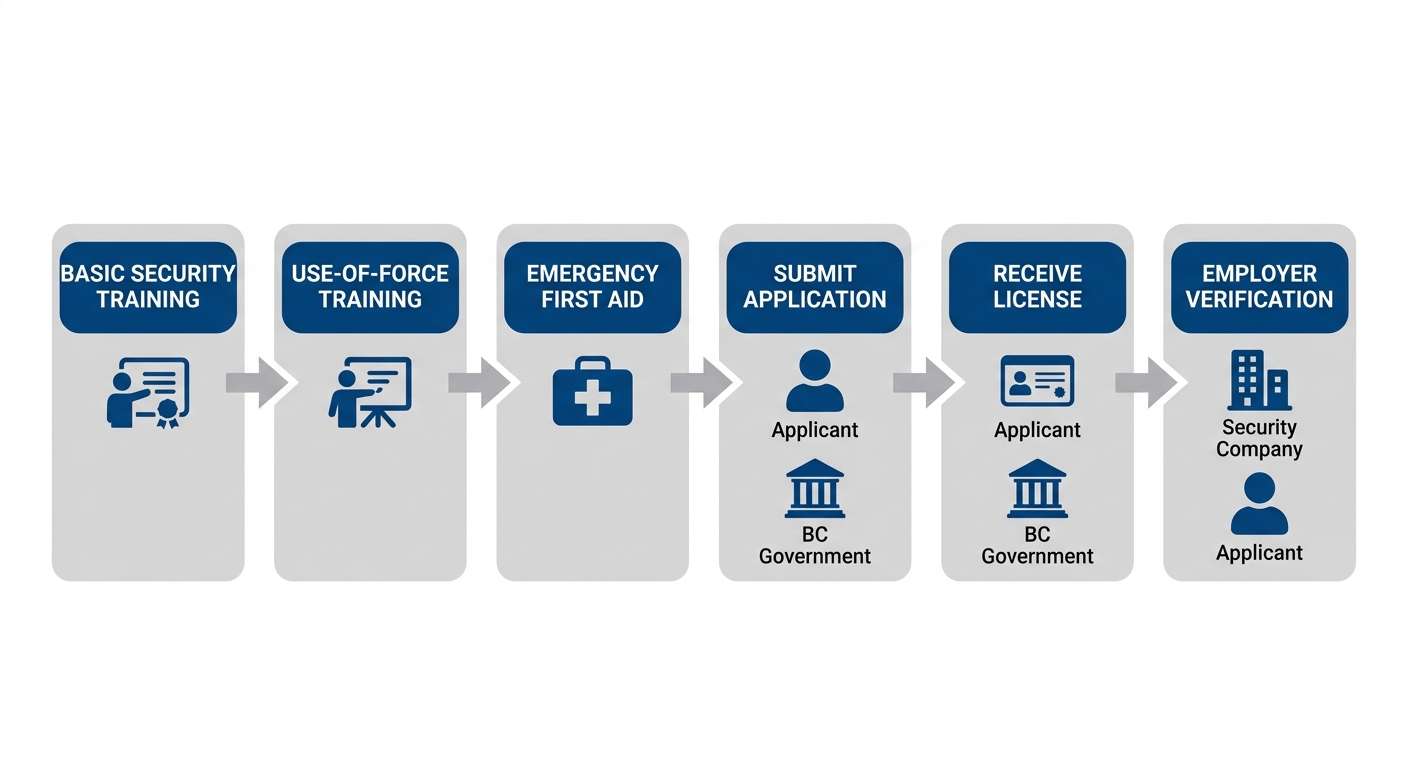
    Now that you understand why licensing matters, let’s walk through the exact steps to obtain your BC Security Worker License and get deployed with confidence. The certified security guard training BC requires combines mandatory coursework, a government application, and verification by a reputable employer. The following table outlines every stage of the process at a glance.

    Advanced Certifications for BC Security Guards
    CertificationFocus AreaDurationRenewal PeriodTypical Roles
    Use-of-ForcePhysical intervention & control8 hours initial + annual refresher1 yearAll security guards
    Emergency Response (First Aid/CPR)Medical emergencies8 hours initial + 4 hours annual1 yearAll security guards
    Fire WatchFire prevention & response4 hours initialNo renewal (employer-specific)Construction & event security
    Concierge SecurityCustomer service & access control8 hours initialNo renewal (employer-specific)Building & hotel security
    Hotel SecurityGuest safety & loss prevention8 hours initialNo renewal (employer-specific)Hotel security guards
    Six-step horizontal process flow for obtaining a BC Security Worker License in British Columbia, with stages from basic training through employer verification.

    Six steps to obtain your BC Security Worker License and deploy.

    Mandatory Training Prerequisites

    Before you can apply for a bc security worker license, you must complete three mandatory training components. The cornerstone is Basic Security Training, a 40-hour course that covers legal authorities, communication skills, report writing, and emergency procedures. According to our internal training guidelines, this program ensures every candidate understands the legal boundaries and professional standards required in British Columbia. Most applicants complete BST within one to two weeks through an approved training provider.

    The second requirement is an 8-hour Use-of-Force training course, which teaches physical intervention and control techniques. This training emphasizes proportional response and aligns with the de-escalation principles we reinforce at Regent Security. The third prerequisite is an 8-hour WorkSafeBC-approved Emergency First Aid certification. Together, these three components form the foundation of certified security guard training BC employers expect, and our team verifies each certificate before moving candidates forward.

    Submitting Your License Application

    Once you have completed your training, the next phase addresses the security license requirements bc enforces. You must submit your application to the BC Security Programs Division, providing proof of all completed training, undergoing a criminal record check, and paying the required application fee. Processing typically takes two to four weeks, after which the province issues your Security Worker License.

    Verifying Company Licensing and Insurance

    When you are ready to work, or if you are a business hiring security personnel, verifying a security company’s licensing and insurance is essential. Start by requesting the company’s license number and then cross-reference it with the BC Security Programs Division to confirm the firm is in good standing. You should also ask for proof of insurance, which reputable providers keep current and readily available.

    From Training to Deployment: Regent Security’s Approach

    Once a guard holds a valid bc security worker license, our focus shifts to preparing them for the field. We verify each individual’s license and insurance, then layer on site-specific training that reflects the unique demands of concierge, building, construction, and event security roles. With over 15 years of experience and a team of more than 100 licensed professionals, we understand what it takes to transition from classroom learning to real-world deployment.

    Beyond Basic Training: Use-of-Force and Emergency Response Certifications

    While a basic security worker license is the foundation for any career in this field, advanced certifications in use-of-force and emergency response elevate a guard’s capabilities far beyond the core requirements. For those pursuing certified security guard training in BC, these specialized programs represent a commitment to professional excellence and operational readiness. They complement the BC security worker license and ensure guards meet evolving security license requirements in BC while being prepared for the complex, dynamic situations they may encounter in the line of duty.

    Frequently Asked Questions About Security Guard Training in British Columbia

    Here are answers to common questions about security guard training in British Columbia.

    What does certified security guard training in BC involve?

    Certified security guard training in BC covers the Basic Security Training (BST) course mandated by the province. According to Regent Security’s internal guidelines, this program typically requires about 40 hours to complete and includes essential topics like legal responsibilities, report writing, and emergency procedures.

    What are the prerequisites for security guard training in BC?

    The primary security license requirements BC mandates include a clean criminal record check and meeting a minimum age threshold, which is generally 19 years old. We ensure all our team members meet or exceed these foundational criteria before they begin their field preparation.

    Your Partner in Certified Security Guard Training and Deployment

    As a leading provider of certified security guard training BC, we ensure every candidate is prepared to meet the requirements for their BC security worker license. Our comprehensive programs cover all security license requirements BC, giving recruits the skills needed for real-world challenges. From hotels and construction sites to high-profile events, we deploy our trained professionals to safeguard what matters most. For details on our competitive pricing, see our FAQ on security guard cost in British Columbia. Contact us today for a custom quote and experience unmatched security expertise.

    Resources