
Hotel Emergency Response Plan: Complete Guide for 2026
Table of Contents
- The Foundation of Hotel Emergency Preparedness in British Columbia
- Key Components of a Compliant Hotel Emergency Response Plan in British Columbia
- Protecting Guests, Property, and Reputation with a Structured Emergency Plan
- Developing and Implementing Your Hotel Emergency Response Plan
- Best Practices for Sustaining Hotel Emergency Preparedness
- Elevating Your Hotel’s Safety with a Comprehensive Emergency Plan
The Foundation of Hotel Emergency Preparedness in British Columbia
A robust hotel emergency response plan is the cornerstone of safety and compliance in British Columbia. For hotels across Vancouver and the Lower Mainland, regulatory codes such as the BC Fire Code and WorkSafeBC requirements set the minimum baseline for emergency planning. These regulations demand more than just a document; they require a living framework that protects guests, staff, and assets. With over 25 years of experience, we know that a written emergency plan must address risk assessment, evacuation procedures, communication protocols, and regular staff training to meet provincial expectations.
While provincial regulations provide a floor, industry standards elevate preparedness. Hotels in BC should base their emergency plans on recognized security industry standards and guidelines to ensure comprehensive coverage. ASIS International’s ORM.1 risk management framework, for example, helps properties identify vulnerabilities and implement layered security measures. Understanding the national context of hotel security protocols Canada also informs local BC requirements. Moreover, hotel access control systems play a vital role in locking down areas during an emergency, while professional licensed security guards deliver coordinated emergency responses 24/7 to maintain safety. By investing in accredited training and third-party standards, hotels ensure that their security personnel are prepared to manage any crisis. Regular plan reviews and security audits, conducted at least annually, help hotels adapt to evolving threats.
With these foundations in place, hotels can now turn to the specific components that make up an effective emergency plan.
Information is for general guidance and not a substitute for professional or legal advice.
Key Components of a Compliant Hotel Emergency Response Plan in British Columbia
Canadian and British Columbia Regulatory Requirements
A comprehensive hotel emergency response plan must align with broader hotel security protocols in Canada, particularly to meet the BC Fire Code and the Safety Standards Act. These regulations mandate a written emergency plan that details evacuation routes, staff roles, and communication with local emergency services. In our experience, many hotel properties also reference ASIS International guidelines, which emphasize site-specific risk assessments and layered defenses, as a benchmark. The BC Security Services Act further requires that security personnel working in hotels hold valid provincial licenses, including Basic Security Training and first aid certification. Operating without licensed staff can expose a hotel to administrative penalties of up to $25,000 under the Act and may invalidate insurance coverage. Additionally, the Safety Standards Act obligates hotels to review and update their emergency procedures annually. Our team at Regent Security helps hotel operators in the Lower Mainland meet these standards through site-specific audits, staff training, and provision of licensed security personnel. By integrating these regulatory requirements into a cohesive emergency response plan, hotel operators in British Columbia can meet legal duties and protect guests and assets.
Essential Components of a Hotel Emergency Response Plan
A comprehensive hotel emergency response plan must also include a suite of operational measures that address everything from evacuation to post-incident accountability. To ensure full readiness, the plan should cover the following nine core areas:
- Evacuation routes and assembly points clearly marked and communicated to guests.
- Communication protocols for contacting staff, emergency services, and guests.
- Medical response procedures, including first aid stations and automated external defibrillators (AEDs).
- Lockdown and shelter-in-place directives, often supported by hotel access control systems to secure entry and elevator access.
- Utility shut-off and gas leak procedures for water, electricity, and natural gas.
- Bomb threat and suspicious package protocols, including search and reporting procedures.
- Severe weather and earthquake response measures, critical in BC’s seismically active region.
- Active threat response procedures (e.g., active shooter) tailored to the property’s layout.
- Post-incident coordination with first responders and documentation of actions taken.
These nine elements form the backbone of a BC-compliant emergency strategy. We recommend integrating them into a single, accessible document that staff across all shifts can reference during any crisis.
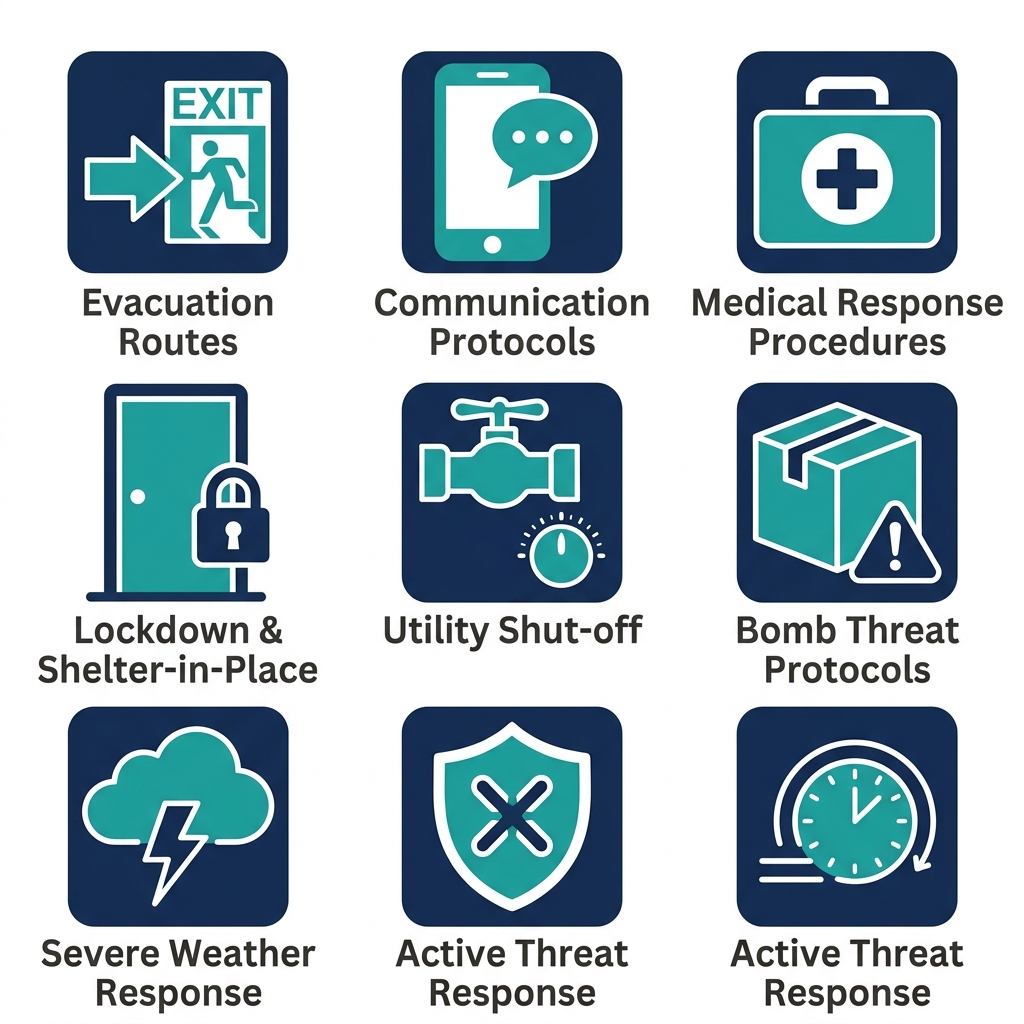
Nine essential components for BC hotel emergency response plans
Privacy Law Considerations for Hotel Surveillance and Visitor Management
While assembling these operational components, hotels must also consider how privacy laws shape the use of surveillance and guest information. In British Columbia, the Personal Information Protection Act (PIPA) sets strict rules for how CCTV footage and access logs must be handled. Hotels must limit camera collection to what is necessary for security, post clear signage, and restrict recording access to authorized individuals. Visitor management systems that log guest names and government ID information fall under PIPA’s definition of personal data. During emergencies, hotel staff cannot indiscriminately share registration records or access logs with authorities unless a warrant or imminent threat exception applies. A hotel emergency response plan that respects these privacy boundaries demonstrates a commitment to guest trust and regulatory compliance. Our security audits include PIPA compliance checks to help hotels align their emergency plans with provincial privacy law; however, services are subject to site assessment and custom quotation, and results and pricing may vary. Additionally, PIPA mandates that surveillance footage be stored securely and not retained longer than necessary, requiring careful review of retention schedules and off-site backup procedures in BC’s Lower Mainland. This information is for general guidance and not a substitute for professional or legal advice.
With these components in place, the next step is to ensure staff are trained and the plan is regularly tested.
Protecting Guests, Property, and Reputation with a Structured Emergency Plan
A structured emergency plan is the cornerstone of responsible hotel management in British Columbia. We help hotels develop a comprehensive hotel emergency response plan that integrates proactive security measures with clear response protocols, ensuring the safety of everyone on property while safeguarding the hotel’s reputation and assets.
Legal Compliance and Liability Reduction
Hotels in British Columbia must meet specific regulatory obligations, including the BC Fire Code and provincial security licensing requirements. A documented and regularly practiced emergency plan demonstrates due diligence and can significantly reduce liability when incidents occur. Our approach draws on Professional licensed security guards who are fully licensed and trained to support fire watch duties, evacuations, and other urgent needs 24/7.
Understanding hotel security protocols in Canada is essential for compliance. By aligning with BC regulations and guidelines from organizations like ASIS International, a hotel not only meets legal obligations but also protects its reputation. Key practices include:
- Conducting regular emergency drills and updating the plan as needed.
- Ensuring on-site or on-call licensed security personnel are available for fire system failures.
- Documenting all training and incident response activities to demonstrate compliance.
This proactive compliance framework helps hotels in British Columbia maintain guest trust and operational continuity.
The Night Manager’s Role and Coordination with Local First Responders
During off-hours, the night manager typically assumes the role of incident commander. We emphasize that a well-prepared night manager should be trained to coordinate directly with local first responders—police, fire, and ambulance—and activate the hotel’s emergency team. This includes directing guest evacuation, communicating with the front desk to track room status, and liaising with security personnel on the ground.
A hotel emergency response plan must clearly define this chain of command. Our experience shows that when night managers are empowered with decision-making authority and reliable communication tools, response times improve, confusion decreases, and guest safety is prioritized. By fulfilling this role, the night manager becomes the critical link between on-site staff and external emergency services, which ultimately protects property and upholds the hotel’s reputation.
Medical Emergency Response and Guest Communication Protocols
Medical incidents can occur at any time, and a swift, organized response is crucial. Our recommended medical emergency protocol for hotels includes:
- Recognize symptoms and assess the guest’s condition without delay.
- Call 911 and provide precise location details within the hotel.
- Deploy an AED if available and trained staff are on hand.
- Document the incident thoroughly according to hotel policy.
Equally important is guest communication. We advise notifying affected guests discreetly and providing timely updates to prevent misinformation and reduce anxiety. Transparent communication not only supports those directly involved but also safeguards the hotel’s reputation by demonstrating a commitment to guest welfare.
How Access Control Systems Support Emergency Response
Modern hotel access control systems play a proactive role in emergency preparedness. Keycard-restricted elevators and mobile key integration prevent unauthorised access and allow staff to lock down specific floors or zones during a crisis. These electronic access control systems can be integrated with fire alarm panels to automate elevator recall and door release, facilitating rapid evacuation while maintaining security.
In a lockdown situation, such systems help contain threats and direct first responders to the correct location. Our monitoring services ensure that access control data is continuously evaluated, providing real-time insight during emergencies and strengthening overall safety.
Developing and Implementing Your Hotel Emergency Response Plan
Developing and implementing a tailored hotel emergency response plan is the logical next step once you recognize the need for preparedness. This systematic process—spanning audit, documentation, training, and technology integration—helps ensure your property is ready for any crisis.
Conducting a Site-Specific Security Audit
We recommend starting with a site-specific security audit that identifies hazards including fire, medical emergencies, lockdowns, and natural disasters, and assesses vulnerabilities. Following established hotel security protocols in Canada, evaluate perimeters, access points, CCTV, and emergency procedures. Key steps include assessing physical barriers, reviewing surveillance, interviewing staff, and analyzing incident logs. The audit should also examine lighting, alarm systems, and visitor management processes to identify gaps. We recommend using the findings to define clear response priorities for each hazard type and assign responsibilities. A thorough audit forms the foundation of your entire emergency response plan, ensuring that every subsequent step addresses real-world risks specific to your hotel.
Drafting the Emergency Plan Document
With audit findings in hand, draft your written hotel emergency response plan. The document must include printed evacuation maps in all guest rooms and common areas, an emergency contact list, a clear communication tree, and role assignments for every shift. Align the plan with the BC Safety Standards Act and the BC Security Services Act to ensure all security personnel hold valid licenses. We advise having the document reviewed by a licensed security professional, such as our team at Regent Security, to verify compliance. Including 24/7 emergency contact numbers and the names of assigned professional security guards ensures rapid response. Incorporate detailed evacuation routes and assembly points, and specify how communication is escalated during a crisis. This written plan becomes the central reference for training and drills, so it must be clear and actionable.
Staff Training and Emergency Drill Schedules
Even the best plan requires regular practice. We recommend quarterly drills including tabletop exercises and full-scale evacuations. Your night manager must hold a valid BC-licensed security certification, and all front-line staff should receive first aid and CPR training. Drills must cover day and night shifts to ensure 24/7 readiness, and after-action reviews should identify gaps. Training should also cover digital visitor management, ID verification, and alarm response specific to your property. All concierge and security staff must participate, and training records should be maintained for compliance. By building muscle memory, you help provide guests with the peace of mind that comes from a well-trained team and unmatched security expertise.
Integrating Access Control Systems into the Response Plan
Modern hotels rely on keycard, biometric, or mobile-key technologies to secure guest floors and back-of-house areas. Integrating these hotel access control systems into your emergency plan means establishing protocols for distributing master keycards during evacuation, auditing electronic access logs after an incident, and preventing unauthorized back-of-house entry. A clear chain of custody for master keys and a designated security officer for lockdown supports a swift, controlled evacuation. We recommend including these details to maintain security without impeding emergency response.
With your plan developed and staff trained, regular updates and post-incident reviews will keep your response effective.
Information is for general guidance and not a substitute for professional or legal advice. Consult a licensed security professional for site-specific advice.
Best Practices for Sustaining Hotel Emergency Preparedness
Sustaining a robust hotel emergency response plan requires continuous refinement. We outline four key practices — routine audits, advanced technology, and a 24/7 security partnership — that keep your emergency protocols current and effective across British Columbia.
Regular Audits, Drills, and Plan Review Cycles
Annual third-party security audits, quarterly internal drills, and monthly plan reviews form the backbone of a living emergency program. Our security audits, performed by professional licensed security guards, follow ASIS International standards and assess your property’s compliance with hotel security protocols Canada requires, specifically the BC Security Services Act and privacy legislation such as PIPA. During a site walkthrough, we evaluate physical barriers, access control effectiveness, visitor management processes, and staff readiness through scenario-based exercises. Quarterly internal drills test evacuation routes and communication chains under simulated stress, while monthly plan reviews keep emergency call lists, alarm testing procedures, and crisis management checklists aligned with operational changes. These drills also test interdepartmental coordination and the use of emergency equipment such as fire extinguishers and first-aid kits. This structured review cycle not only meets regulatory expectations in British Columbia but also builds staff confidence and reduces incident response times.
Leveraging Emerging Technology: Biometric Access and Contactless Entry
Modern hotel access control systems have evolved well beyond basic keycards. We recommend integrating biometric access control for high-value areas, such as back-of-house storage, liquor rooms, and server closets, where fingerprint or facial-recognition readers add an extra layer of security. For guest floors, contactless mobile key entry via smartphone apps streamlines check-in and eliminates the risk of lost or cloned cards. Combining these access upgrades with AI-driven CCTV analytics enables real-time threat detection; our 24/7 remote monitoring service uses intelligent video analysis to flag tailgating, unauthorized area entry, and suspicious loitering, instantly alerting on-site staff or our emergency response centre. These technology layers work together to strengthen your preparedness posture without disrupting the guest experience.
Partnering with a Professional Security Provider for 24/7 Readiness
Even the best plans depend on rapid, reliable execution when an emergency escalates outside business hours. Regent Security provides around-the-clock emergency guard deployment across Vancouver, Surrey, Burnaby, and throughout the Lower Mainland. When a fire alarm failure, break-in, or medical crisis strikes, our 24/7 hotline dispatches professional licensed security guards, often on the same day, to secure the site, manage evacuations, or provide emergency fire watch. We monitor alarms, dispatch mobile patrols, and coordinate with local fire services to contain threats before they disrupt operations. All deployments are based on a custom site assessment, ensuring the response aligns with your property’s unique risks and existing protocols. With over 25 years of unmatched security expertise and a team of more than 200 licensed professionals, we provide the 24/7 partnership that hoteliers need; your peace of mind is our priority.
Learning from Incidents: Auditing Access Logs and Continuous Improvement
Every security incident offers an opportunity to strengthen your hotel emergency response plan. A structured post-incident review that audits access control logs, especially when integrated with visitor management and BAC systems, reveals how vulnerabilities were exploited. For instance, analyzing badge-in records after an unauthorized access incident can spotlight gaps in off-hours staffing. These insights directly inform updates to response protocols, staff training, and technology configurations. By making this feedback loop a standard practice, you drive continuous improvement that keeps your emergency preparedness plan ahead of evolving threats.
Elevating Your Hotel’s Safety with a Comprehensive Emergency Plan
A holistic security program is incomplete without a comprehensive emergency plan. An effective hotel emergency response plan—built around evacuation procedures, emergency communication protocols, and coordination with local first responders in Vancouver and the Lower Mainland—helps reduce confusion and improve outcomes. ASIS International standards affirm that such plans must be tailored to each property’s layout and risk profile, and comply with hotel security protocols in Canada and British Columbia’s building and fire codes.
In our work across British Columbia, professional licensed security guards are central to plan execution. They direct evacuations, manage access points, and liaise with fire, police, and EMS. Integrating hotel access control systems further secures exits and prevents unauthorized entry, allowing only authorised personnel to move freely during an emergency.
Regent Security’s site assessments combine 24/7 monitoring, trained personnel, and integrated technology to design a custom plan for your hotel. While no plan eliminates all risk, consistent training and real-time oversight reduce vulnerability and speed response. 24/7 vigilance helps detect threats early, keeping your property safer.
Your peace of mind comes from knowing your hotel emergency response plan is both actionable and compliant. We invite you to build your security quote—our tailored assessments are the first step. These plan components are reinforced by access control and live CCTV monitoring, which we will explore next.

