
Category: Security Industry Requirements

  • How to Write a Security Guard Resume: Step-by-Step Guide for 2026

    How to Write a Security Guard Resume: Step-by-Step Guide for 2026

    Table of Contents

    How to Write a Security Guard Resume in British Columbia

    If you’re wondering how to write a security guard resume for British Columbia, it’s important that you tailor it to meet BC’s licensing and training standards. BC employers and licensing bodies want to see that you have a BC security worker licence, industry-specific training and relevant experience to prove your eligibility to work in this field. how to write a security guard resume in British Columbia

    Your resume needs to show your mandatory Basic Security Training (BST), and any additional credentials that you have earned. These will be listed as requirements for licensure. Display your licence status prominently and include details of your experience that align with BC’s regulated security categories (i.e. Guard services, mobile patrols). This way your application will meet the criteria set out by the province right from the start.

    The first step is to get your BC credentials and licences together, so your resume reflects your qualifications correctly and you stand out to potential employers.

    Key Takeaways

    • Before learning how to write a security guard resume in British Columbia, get to know the licence details that employers will check on.
    • Each security worker in British Columbia needs to have a valid licence issued by the provincial Security Programs Division; BC employers will not accept credentials from another province instead.
    • After your licence and certifications have been added, employers will be looking at your practical experience.
    • When you’ve written out all your essential security duties, highlight the software platforms that you’ve worked on and reframe your concierge experience in security terms.
    • While technical duties and site-specific experience are important, employers who hire for security and concierge jobs also value general people skills applicable to most industries.

    Before You Begin: BC Credentials and Licence Details You Need Ready

    Before learning how to write a security guard resume in British Columbia, get to know the licence details that employers will check on. Every security worker in this province needs to have a valid BC security worker licence, even if they already hold another licence elsewhere in Canada. This licence is mandatory for you to be legally employed as a security guard.

    Make sure you’re eligible first: you need to be 19 or older, live in Canada and speak English fluently. Do any necessary training for your licence category and then gather up all required documentation. You will need to provide a criminal record check and be fingerprinted on your initial application as well as any renewal that has not been verified via a BC Services Card account. Use the online Security Services Platform with your BC Services Card to make your application easier.

    Incomplete applications may lead to delays in processing, so clean up your paperwork prior to starting your job search. Employers frequently verify professional licences, so make sure the information on your resume is correct and honest.
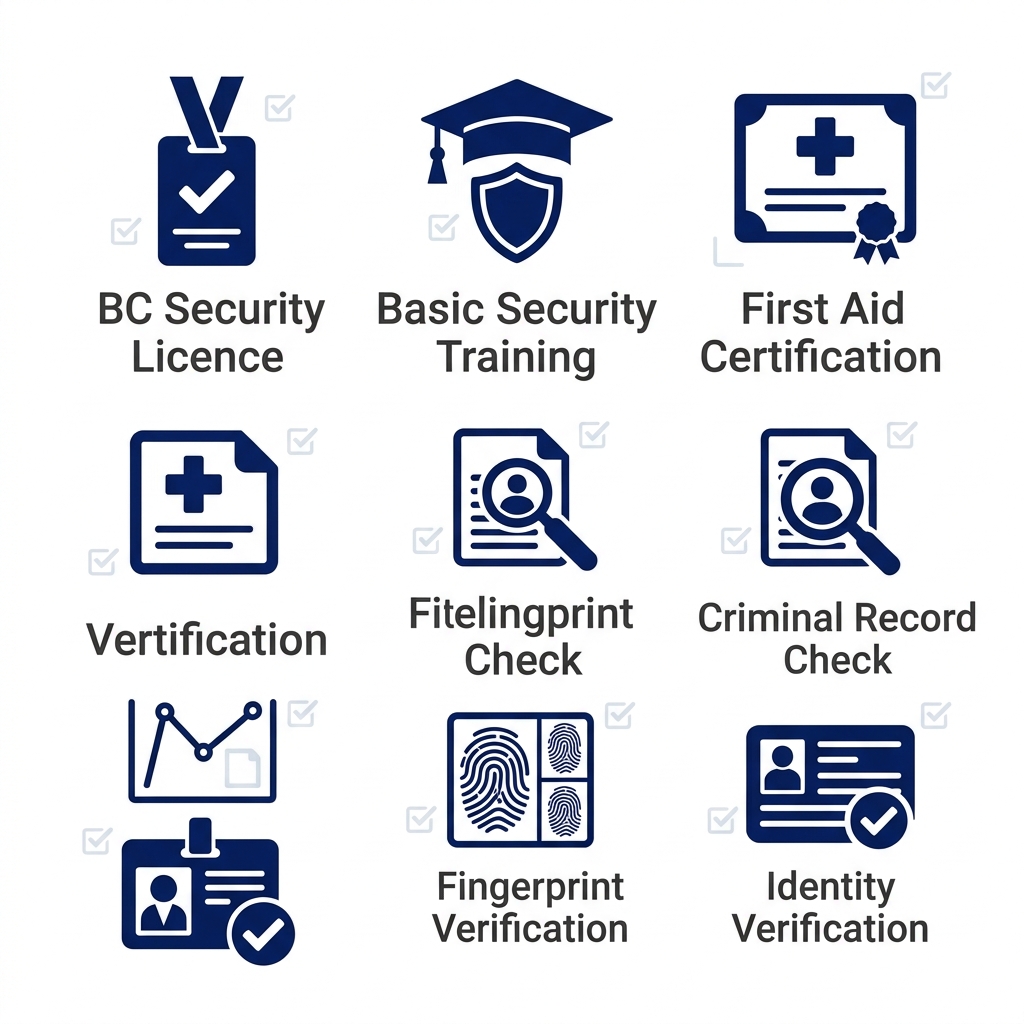
    A set of six outline icons in navy blue on a white background, each with a charcoal grey label beneath, representing security credentials: BC Security Licence, Basic Security Training, First Aid Certification, Criminal Record Check, Fingerprint Verification, and Identity Verification.
    BC security credentials icon set for resume preparation checklist

    Step 1: Choose the Right Resume Format

    Once you’ve got your British Columbia security badge on your lanyard, the next task in learning how to write a security guard resume is to choose a clear and employer-friendly layout. There are three most common formats available: reverse-chronological, functional and combination styles. Reverse-chronological lays out your most recent work experience first, allowing the reader to skim easily through your employment history. Functional style lists your skills first rather than the dates, this works well for those with breaks in their career or who are trying to make a transition from another field. Combination style blends both to strike a balance between listing skills and timing.

    For most BC security guard positions, we advise using the reverse-chronological format. Employers want to see your full work history, and this layout will show them your most current and relevant experiences first. It also places your licences and certificates at the top of your resume for easy verification, which is important because recruiters commonly check this information when making a decision on job candidates.

    Now that you have selected your format, your next task is to structure the credentials section to make sure each license and certification is easily recognizable.

    Step 2: List Your BC Security Licence and Certifications

    Each security worker in British Columbia needs to have a valid licence issued by the provincial Security Programs Division; BC employers will not accept credentials from another province instead. Format each credential with your name, the issuing organization, and completion date, for example:

    • Basic Security Training (BST) – Justice Institute of British Columbia – 2023-05-15
    • Advanced Security Training (AST) – Justice Institute of British Columbia – 2024-02-20
    • Occupational First Aid Level 2 (OFA 2) – Canadian Red Cross – 2022-11-10

    List any pending certifications along with the expected date of achievement. Employers frequently verify credentials, so make sure they’re correct. You can verify your current licence status via the provincial government’s online registry that hiring managers will use to verify candidates. Refer to the keyword how to put a security guard license on a resume to guide your formatting.

    Step 3: Highlight Your Security Work Experience

    After your licence and certifications have been added, employers will be looking at your practical experience. Include the employer name, dates, and site type (hotel, strata building, construction site, etc.) for each security role in order to show what environment needs protecting.

    For duties, try using the same language found in job postings, like "monitoring," "patrols," and "access control." If you can, quantify your impact as much as possible: mention how many posts you monitored, the number of shifts you managed, and reports that you filed. So instead of a vague phrase like "responsible for security," this turns it into clear, demonstrable proof of what you were able to do.

    Don’t forget to include experience you gained while working under BC’s Security Services Act license, as the Government of British Columbia requires all security workers to have completed industry-specific training and hold a valid licence even if you already have out-of-province credentials.

    Step 4: Showcase Software and Concierge Duty Experience

    When you’ve written out all your essential security duties, highlight the software platforms that you’ve worked on and reframe your concierge experience in security terms. List out the particular tools that you have used such as Pro-Watch, Genetec Security Center or Brivo to show the kind of technical skills that employers are looking for in BC security guard positions.

    Concierge roles can easily be rebranded into security by adding the proper wording: front desk access control, visitor screening, keys, and patrol log. Add that with your Basic Security Training (BST), and a background check (as BC licensing requires both). Employers will be looking for these things before they hire you, so include them on your resume to prove yourself as qualified and ready to work.

    This step will make sure that your resume reflects the technical as well as professional standards expected of a security professional.

    Step 5: Highlight Transferable Customer Service Skills

    While technical duties and site-specific experience are important, employers who hire for security and concierge jobs also value general people skills applicable to most industries. These include being able to greet guests in a professional manner, calmly addressing any concerns that arise, and remaining approachable when under pressure. All of these can be utilized in front-desk and security roles.

    Pull over applicable experience from other jobs, be it in a hotel, retail, or guard role, and then describe these experiences as achievements, rather than a list of what you did. Instead of describing what you did, explain the outcomes: “Resolved guest complaints with a 95% satisfaction follow up rate at high-volume hotel front desk,” or “Monitored building entries while remaining welcoming, reducing unauthorized access by 30%.”

    Align each phrase exactly as written on the job posting to help your resume pass applicant tracking systems. This makes sure that your experience reads as customized, not generic, which helps hiring managers see that you are a fit for the role.

    Step 6: Tailor Your Resume to Each Role

    Once your transferable skills have been identified on the resume, the next step is tailoring your resume to each application. A generic resume is usually not enough to get you the desired result; therefore, adapt the resume to match what each job application is looking for.

    Include the credential name, issuing organization, and completion date in your resume when you list licenses and certifications. Separate licenses from voluntary certifications: licenses are those mandated by the government and required to be working, while certifications show professional expertise that is not. Both should be described properly to fit the wording of the job post, as these credentials serve as important keywords to draw employers’ attention and increase the chances for receiving higher salary offer.

    If you have a pending certification, put this with the date when you expect to receive the certification. For expired certificates, be honest about your situation. These claims are frequently verified, so make sure they are true. And make sure your credentials appear the same everywhere on your resume and LinkedIn profile to stay consistent and credible.

    Step 7: Proofread, Verify, and Finalize Your Resume

    Before you hit the submit button, review your resume once more to make sure all your hard work was successful. A good looking resume shows professionalism and attention to detail, which employers love. The resume experts tell us that employers often check to see if resumes match up with actual degrees, certifications, or job experience. So you must be accurate here.

    We recommend three focused passes through: once for spelling and grammar, then once for consistent formatting (dates, spaces, bullets), and one final pass where you read aloud to catch awkward phrasing. Go back and double check all of the licenses and certifications entries to make sure names, issuing bodies, and dates are correct, and put any credentials that you are still working on with expected completion date instead of saying that you’ve already finished them. Make sure that your contact information, references, and employment dates are up to date before saving the final draft, giving it a professional filename, and submitting it.

    Your document is now clean and verified, and it stands out for the right reasons.

    Fixing Common Resume Problems Before You Apply

    We’re security hiring managers and we see the same issues on resumes time after time. The vast majority have to do with unclear or missing credentials that get vetted out before an interview occurs.

    Start by checking these four areas:

    • Licence accuracy: Confirm your BC security licence is current and listed with the exact name and expiry date. Employers cross-check licences against the BC government’s online registry, so any mismatch raises red flags. In British Columbia, a valid security worker licence is legally required regardless of credentials earned in other provinces.
    • Training and certifications: Include your 40-hour Basic Security Training completion and Occupational First Aid Level 1 certification with the issuing organization and date. These are mandatory for BC security roles and must appear prominently.
    • Consistency and placement: Ensure dates, job titles, and credential names match across your resume and LinkedIn. Place credentials in a dedicated section or early in your summary so reviewers spot them immediately. Employers verify every claim, so accuracy and consistency are essential.
    • Honesty in claims: Never list expired or pending licences as active, and avoid vague phrases like “security experience.” Every claim should be verifiable through your licence number or training certificate. Maintain transparency and accuracy throughout the application process to avoid red flags.

    Frequently Asked Questions

    What specific certifications should I include on a security guard resume to stand out in British Columbia?

    Include your BC security worker licence, Basic Security Training (BST), Advanced Security Training (AST) if applicable, and Occupational First Aid Level 2 (OFA 2). List the issuing organization and completion date for each to show compliance with BC’s Security Services Act requirements.

    How can I effectively highlight my experience with incident reporting software and concierge duties on my resume?

    List the specific software platforms you have used, such as Pro-Watch or Genetec Security Center, under a technical skills section. For concierge duties, reframe them using security terms like access control, visitor screening, and patrol logs to align with security job expectations.

    Should I list my BC security worker licence and expiry date at the top of my resume?

    Yes, place your BC security worker licence, including the expiry date, near the top of your resume. Employers verify licences through the provincial registry, so clear visibility ensures compliance and trust.

    What are the best ways to showcase transferable customer service skills for a hotel security guard role?

    Highlight skills such as greeting guests professionally, addressing concerns calmly, and remaining approachable under pressure. Use outcomes like reducing unauthorized access or improving guest satisfaction to demonstrate the impact of these skills.

    How should I structure my work history if I have experience in both construction site security and commercial property monitoring?

    Use a reverse-chronological format, listing your most recent roles first. Include the employer name, dates, and site type for each role. Focus on duties like monitoring, patrols, and access control, using language from job postings to tailor your experience.

    Take the Next Step in Your Security Career

    Now that you have learned how to write a security guard resume, your completed resume is prepared to make a good first impression on your prospective employer. The following crucial step is acquiring a BC Security Worker Licence because it is required to work as a security guard in BC – even if you already have a license from another province.

    Apply online through Security Programs Division using your BC Services Card for identity verification. Complete required fingerprinting and 40 hour Basic Security Training course, then submit your application to avoid any delay. After you have been licensed, we invite qualified candidates to apply their resume to positions within our team in Vancouver and Lower Mainland.

    Results and pricing may vary depending on site-specific requirements and assessments.

    Put Your Resume to Work

    You now have a complete roadmap for writing a security guard resume in British Columbia, from gathering your licence details to tailoring each application and verifying every credential. With your BC security worker licence confirmed and your 40-hour Basic Security Training documented, your application is ready to stand out. Employers in Vancouver and across the Lower Mainland look for exactly the accurate, verifiable details this guide helped you present. The next step is simply putting that polished resume in front of the right team. Our licensed professionals at Regent Security Services Ltd. work throughout Vancouver and the Lower Mainland, and qualified candidates are welcome to reach out. Remember to confirm current licensing requirements with official BC government sources, since requirements may change. Take that first step and connect with a team that values properly prepared applicants.
    Put Your Resume to Work

  • How Hard Is It to Get Hired as a Security Guard: Career Guide

    How Hard Is It to Get Hired as a Security Guard: Career Guide

    Table of Contents

    How Hard Is It to Get Hired as a Security Guard in British Columbia?

    How hard is it to get hired as a security guard in British Columbia? The process is moderately competitive, but demand for licensed and trained professionals remains consistent across the Lower Mainland. With over 15 years of experience in BC security, we at Regent Security know that candidates who complete mandatory Basic Security Training and hold a valid security worker licence have a clear advantage. Licensed and insured applicants receive stronger consideration. Employers value thorough preparation, strong communication skills, and a professional presentation. This article explores the key factors that influence hiring difficulty—including training, licensing, and experience—so you can approach the application process with confidence. Understanding the basic eligibility requirements is the first step to building a strong, competitive application.

    Key Takeaways

    • As a security services provider operating across British Columbia, we know that understanding the regulatory baseline is essential to evaluating how hard it is to get hired as a security guard.
    • The Security Worker Licence is mandatory when working as a security worker in BC.
    • A good clean criminal record is just one requirement that must be met before you can become a security guard in BC.

    Basic Eligibility Requirements for Security Guard Jobs in BC

    As a security services provider operating across British Columbia, we know that understanding the regulatory baseline is essential to evaluating how hard it is to get hired as a security guard. The BC Security Services Licensing Office requires that every security guard hold a valid security worker licence before starting work. This mandatory licensing framework ensures all personnel meet provincial standards for safety and competence.

    Applicants need to go through a course called Basic Security Training (BST) with an approved provider and then get certified by the Justice Institute of British Columbia (JIBC). However, alternative pathways may satisfy the training prerequisite for qualified individuals who have gaming security training or a background in Canadian police services. Beyond this, they must provide proof of Canadian citizenship or valid work authorization, along with a government-issued photo ID. Every candidate must be at least 19 years old, or 16 years old for specific supervised roles. They are also required to reside in Canada and demonstrate fluency in English. Candidates have to hand in a criminal record check and be fingerprinted for all initial applications; fingerprinting is also required for renewals unless the applicant uses a BC Services Card account for identity verification.

    All applications must be made online via the Security Services Platform. The Security Programs Division recommends using a BC Services Card account to streamline identity verification, though support is available for those unable to use the digital system. Applicants should know their application fee is non-refundable whether they receive a licence or are denied. After December 2025, the JIBC and other approved training providers stopped issuing physical training completion certificates. Instead, proof of completion is submitted directly to the registrar.

    At Regent Security, we see that meeting these eligibility requirements signals a candidate’s dedication and ensures they can legally perform security work in British Columbia. Completing Basic Security Training (BST) stands as the single most critical requirement for aspiring guards, and we’ll explore next how this foundational training directly improves hiring prospects and aligns with employer expectations.

    How Basic Security Training (BST) Improves Your Hiring Prospects

    The Security Worker Licence is mandatory when working as a security worker in BC. The Basic Security Training (BST) course is the only government approved way to get this licence. When candidates complete the course, they gain a clear advantage: it signals to employers that they are licence-ready and have absorbed the essential knowledge required to perform the role safely and effectively. This includes how to communicate effectively and follow the necessary procedures in case of emergencies. All guards who have their own licences must know these things.

    BC government requires training providers, such as the Justice Institute of British Columbia (JIBC), to conduct BST for learners. Once a candidate passes the course, the provider reports completion directly to the provincial registrar. This creates a straightforward verification path for employers, replacing the need to chase paper documents. This digital-first approach aligns with modern hiring practices, where background and credential checks happen quickly.

    As a licensed security company serving Vancouver and the Lower Mainland, our firm relies on BST certification as a minimum hiring standard. When we review applications, a verified BST record immediately sets a candidate apart from those who have not yet completed this foundational step. It tells us the individual understands use-of-force principles, legal responsibilities, and basic emergency response—topics that every security guard needs from day one. We, like all licensed security firms in BC, value this standardized training because it creates a consistent baseline of knowledge across every new hire.

    Two practical ways BST improves hiring prospects stand out:

    • Immediate licence eligibility: Without BST, an applicant cannot legally work as a security guard in British Columbia. Completing the training removes this barrier and makes the candidate hireable on the spot.
    • Demonstrated commitment: Investing time and effort in BST shows employers that the candidate is serious about the profession, not just casually exploring options.

    While a BST isn’t a job guarantee, it’s the single most important credential a new security worker can earn in this province. It moves a candidate to the front of the hiring queue. It shows that you’re ready and able to take up the responsibility that comes with working as a security worker. While the BST does meet the training requirement for licensing, a clean criminal record is equally critical. That is another non-negotiable requirement in order to get your security worker license.

    The Importance of a Clean Criminal Record in Security Hiring

    These records make up part of the application procedure when securing a license for this type of profession and have a lot of weight on whether or not someone will get the job as well as their chances to obtain work at all within the province. All applicants must pass a background screening conducted by the Security Programs Division before a license can be granted. That requirement makes a clean record a critical step in getting hired in the province.

    The BC Security Programs Division requires every security worker applicant to undergo a criminal record check as part of the licensing process. Fingerprinting is mandatory for identity verification and initial background screening; the division performs these checks on each candidate to confirm they meet provincial eligibility standards. Applicants submit fingerprints electronically through accredited services, and results are reviewed against law enforcement databases. Fingerprinting links the applicant’s identity to the background check, preventing errors and fraudulent applications. To apply, individuals must be at least 19 years old, reside in Canada, and hold relevant security training, as well as provide a passport-quality photo and valid government identification. All application materials are processed through the BC Security Services Platform, and the division only issues licences to those who meet these rigorous standards, emphasizing that a clean criminal history is non-negotiable. For licence renewals, applicants can use a BC Services Card account for identity verification, potentially avoiding a second fingerprint submission. The criminal record check reviews the applicant’s history for any convictions that would disqualify them from holding a security position, ensuring public trust.

    A clear criminal record means something more than just a license. It’s also about having a good enough background that the employer can feel comfortable putting someone in charge of protecting individuals or assets. When a candidate does have a clean record, he or she will be perceived to be a low risk hire which increases his chances of being offered employment. The licence is proof that the candidate was vetted, but the clean background tells the prospective employer that he or she is a law abiding citizen, trustworthy, reliable and able to meet all legal requirements. This helps the employer to offer the job to the candidate.

    Now that they have a solid background and proper licenses, would-be professionals should aim for extra training to make their resumes more competitive against other applicants.

    Certifications and Skills That Set Security Guard Candidates Apart

    A good clean criminal record is just one requirement that must be met before you can become a security guard in BC. But most security agencies like Regent Security ask candidates to meet more criteria.

    Security guards need this basic course in order to become licensed workers according to BC law. Basic Security Training has two primary focuses. First off, he must learn legal and other necessary rules for a job under the provincial Security Services Act and then demonstrate his understanding of how to use force appropriately, proper ways to write reports and abide by standards expected from him as a professional working as a security guard. Any unlicensed applicants will have their applications rejected for failing to complete basic security training and lacking a legitimate security worker licence. Therefore, BST is non-negotiable when it comes time to obtaining your security licence.

    The Advanced Security Training (AST), along with the Occupational First Aid Level 2 (OFA2) adds on the minimum standards required, and makes security guards more employable. The AST provides guard training that can be utilised to handle more risky circumstances, whilst OFA2 certifies the guard’s ability to deliver emergency medical intervention before first responders arrive. In any case, this is another credential that is valued because it allows the guard to deal better with the conditions found in the active site.

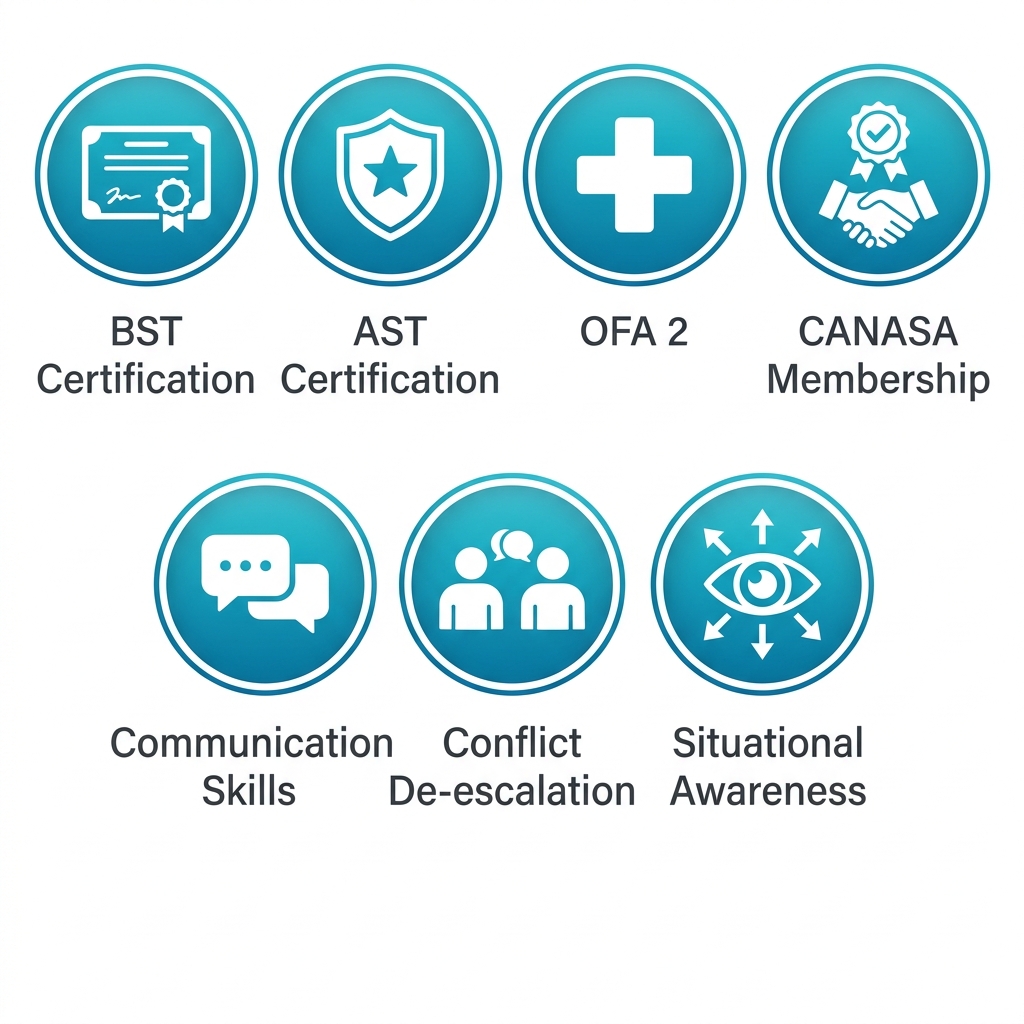
    Set of seven icons representing security guard certifications and skills, including BST and AST certifications, OFA 2 first aid, CANASA membership, communication, conflict de-escalation, and situational awareness.
    Seven icon set for BC security guard certifications and essential skills.

    A membership with a professional body like the Canadian Security Association (CANASA), for example, signals that the person has made a commitment to professional standards and ongoing development. Our company is a member of CANASA. As a result, we can say the candidate takes their career seriously and keeps up with new practices and tools. We continue this tradition because over 15 years later, our company remains committed to serving Vancouver, Surrey, Burnaby, and the Lower Mainland.

    Apart from the usual certifications required, soft skills are just as important. The ability to talk things down during a confrontation is critical in diffusing tension between individuals involved. Conflict de-escalation, which entails reading a situation and defusing it, can be what stands between someone getting hurt and the whole thing blowing up. The ability to recognize signs of trouble coming and being able to anticipate potential risks is what sets apart a reactive guard from a proactive professional.

    Get a BST certificate, pursue AST and OFA 2 qualifications, join a relevant trade body, and develop communication and de-escalation skills. These steps represent the first concrete steps toward landing a security role.

    Steps to Landing a Security Guard Role in British Columbia

    After completing your security training, the official licensing application in British Columbia is the next step,if you’re wondering how hard it is to get hired as a security guard in BC, this process is your entry point.

    1. Begin by gathering three essential documents: evidence of approved security training, proof of Canadian citizenship or valid work authorization, and a current government-issued photo ID. The BC Security Programs Division requires these to confirm that you meet the province’s eligibility requirements and have successfully completed the mandatory training necessary for a security worker licence.
    2. Next, complete the fingerprint submission for identity verification and a mandatory initial background screening. According to the BC Security Programs Division, this step is non-negotiable for initial licence applications to ensure a thorough criminal record check before a licence can be issued.
    3. Access the online application through the BC Security Services Platform and log in with your BC Services Card to securely verify your identity. This government digital portal streamlines the process by linking your verified identity to the licence submission and reduces the likelihood of delays when your information is complete.
    4. Pay the non-refundable application fee through the platform when you submit your application. The fee covers processing costs, but it is strictly non-refundable under any circumstances, regardless of whether your licence is ultimately approved, denied, or withdrawn.
    5. After you submit your payment, the Security Programs Division will conduct a criminal record check. Processing times are not fixed; they vary based on how complete your application is and the results of the security risk assessment, so ensure you have provided all required documents accurately.
    6. Once your background check is satisfactory and your application is approved, the Security Programs Division will issue your security worker licence, enabling you to work legally in British Columbia.

    Once you satisfy the requirements set forth above, not only will you be eligible to work as a security guard in BC, but you will also signal to employers that you have met the province’s official standards, positioning you to step confidently into your new career.

    FAQ

    Is it difficult to get hired as a security guard in BC if I have no prior experience?

    It is moderately competitive, but candidates without prior experience can get hired if they complete Basic Security Training and obtain a security worker licence. Employers value the standardized knowledge this training provides, and holding a verified BST record immediately sets an applicant apart. Strong communication skills and a professional presentation further improve hiring prospects.

    What are the primary eligibility requirements to be hired as a security guard in British Columbia?

    The primary eligibility requirements are completing Basic Security Training, being at least 19 years old, residing in Canada, and passing a criminal record check. Applicants must also provide proof of Canadian citizenship or valid work authorization, a government-issued photo ID, and undergo fingerprinting for identity verification. Fluency in English is required.

    How does completing Basic Security Training (BST) improve my chances of being hired by a security company?

    Completing BST makes you immediately licence-eligible, which is a legal requirement for any security guard job in BC. It signals to employers that you understand use-of-force principles, legal responsibilities, and emergency response. A verified BST record sets a candidate apart from those who have not completed this mandatory step, demonstrating commitment and readiness.

    Does having a clean criminal record significantly affect how hard it is to get hired as a security guard?

    Yes, a clean criminal record is critical. The BC Security Programs Division conducts a criminal record check for every applicant, and a licence cannot be granted without passing this screening. Employers view a clean record as evidence of trustworthiness and reliability, making the candidate a lower-risk hire and significantly improving the chance of receiving a job offer.

    What skills or certifications besides the security license make me a more competitive candidate for security jobs?

    Advanced Security Training, Occupational First Aid Level 2, and membership in the Canadian Security Association make a candidate more competitive. AST qualifies guards for higher-risk situations, while OFA2 certifies emergency medical skills. Strong communication and de-escalation skills are also highly valued by employers.

    Start Your Security Guard Career with Confidence

    If you have been wondering how hard it is to get hired as a security guard in British Columbia, the steps we have covered show that it is very achievable with the right training, licensing, and a professional attitude. At our firm, we have seen this firsthand throughout our more than two decades of serving clients across the Lower Mainland,we have operated since 2001 and built a team of over 200 dedicated professionals who understand exactly what employers look for. That deep industry presence confirms that preparation and persistence consistently pay off for motivated candidates. Begin your journey today by applying for positions that match your qualifications. Information in this article is for general guidance and is not a substitute for professional or legal advice; CCTV and surveillance services must comply with applicable privacy laws, including PIPA in BC. Services are subject to site assessment and custom quotation, and results, response times, and alarm outcomes may vary.

    Prepare for Your Security Interview

    Now that you’ve learned the essential steps to becoming a security guard in British Columbia, including the mandatory Basic Security Training and licensing process, you’re ready to prepare for your interview. Regent Security’s interview preparation resource provides expert insights from over 15 years of experience. With more than 200 dedicated professionals, the company knows what BC employers look for. This guide helps you practice common questions and improve your confidence. Thorough preparation is a key advantage in a competitive field. Use this free resource to build the interview skills that make you stand out. Start your security career with the confidence of being fully prepared.

    Prepare for Your Security Interview

    Resources

  • Security Guard Interview Questions: Complete Guide for Success 2026

    Security Guard Interview Questions: Complete Guide for Success 2026

    Table of Contents

    Preparing for Your Security Guard Interview

    When researching security guard interview questions, candidates should focus on demonstrating reliability, communication, and sound judgement. These are the soft skills that employers weigh above technical knowledge.

    The type of security role can vary drastically from location to location. Hotel lobbies will be quite different as compared with construction sites. Therefore, research the kind of job site being applied for thoroughly before writing your resume.

    Experts in career development at CareerTestPrep suggest answering behavioral interview questions based upon the STAR strategy (Situation, Task, Action, and Result). The STAR technique forces a candidate to prove past action with hard facts. Generally, interviews are brief, 20 to 40 minutes, and focus on situational and behavioral responses. Candidates should prepare using this format, confirm license information ahead of time, and dress professionally to show reliability and attention to detail.

    To get into work as a security guard in BC, you will need to hold an active license under the BC Security Services Act. Since we’re a licensed provider with more than 200 security guards serving Vancouver and the Lower Mainland, we at Regent Security Services know that verifying licence status is one of the first checks employers make before an interview.

    Candidates can concentrate their efforts on the basics of the interview if they prepare accordingly and use STAR examples tailored to the site, which lets them focus on the interview fundamentals that set professional licensed security guards apart.

    Key Takeaways

    • Hiring managers in the security industry consistently rank reliability, communication, and observation above technical certifications when assessing interview candidates.
    • Beyond job-related information and training, interview questions also measure values, observational judgment, and calm reactions to incidents.
    • Having addressed all of those questions, you can now focus on the next steps that strengthen your candidacy.

    Fundamentals of Security Guard Interviews

    Hiring managers in the security industry consistently rank reliability, communication, and observation above technical certifications when assessing interview candidates. According to a leading career preparation resource, the typical security guard interview lasts only 20 to 40 minutes and focuses on situational and behavioral competencies rather than rote knowledge. This emphasis on soft skills reflects the reality of the job: guards are expected to observe, report, deter, and de-escalate, not act heroically.

    Security employers need staff who can remain calm under pressure, deter incidents through a professional presence, and communicate clearly with both the public and supervisors. Attendance and a solid work history signal the dependability that is essential for any post, from a hotel lobby to a construction site requiring 24/7 coverage. During the interview, candidates should frame their experiences to highlight these qualities, often using the STAR method to structure answers that provide context and concrete results.

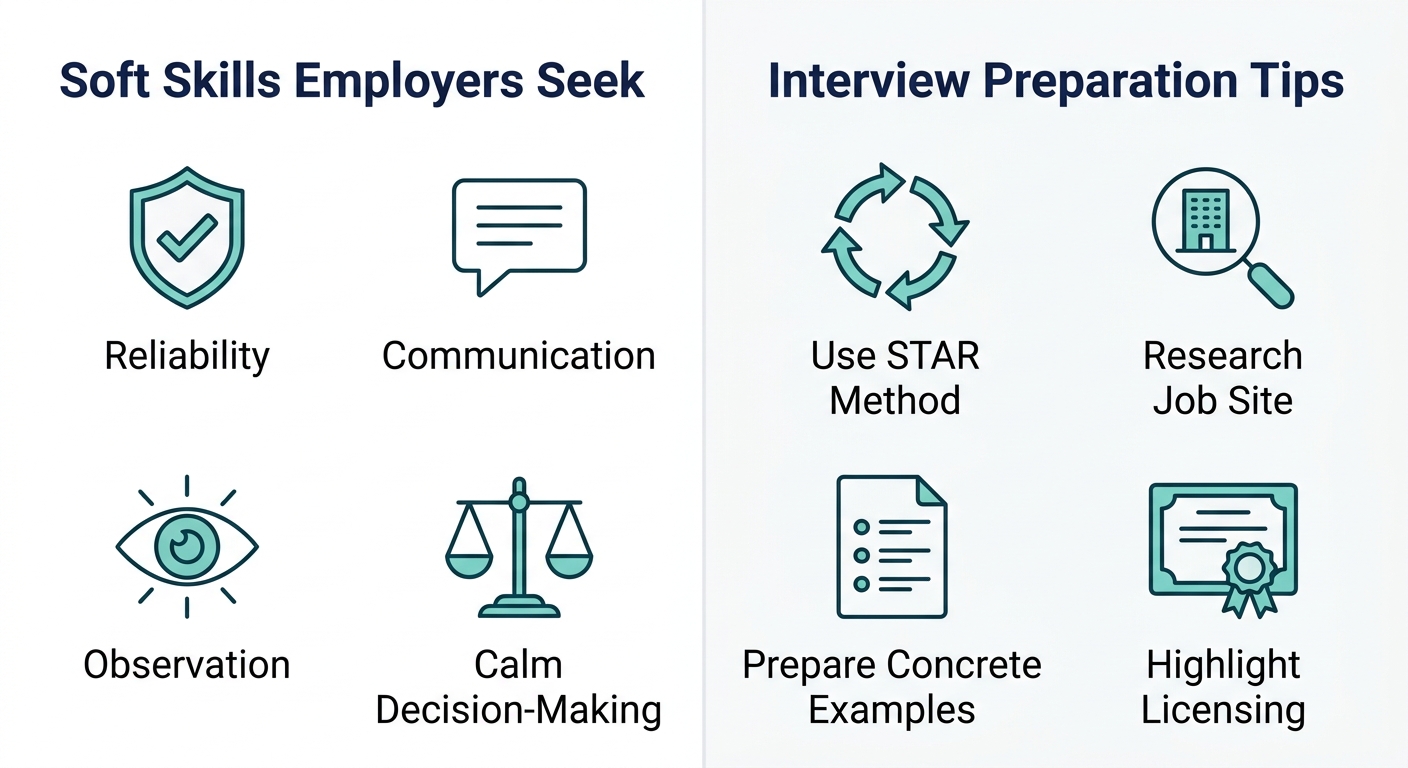
    Infographic comparing soft skills employers seek in security guards and interview preparation tips, with icons for reliability, communication, observation, calm decision-making, STAR method, researching job site, concrete examples, and licensing.
    Key attributes and interview strategies for security guard candidates.

    The STAR method, Situation, Task, Action, Result, is a straightforward formula that helps interviewers understand exactly how a candidate handled a real-world challenge. We recommend preparing a few concise stories in advance, each illustrating a core competency such as de-escalating a tense interaction or following a detailed post order. By keeping the focus on actions taken and the outcome that followed, you demonstrate the judgment and restraint that security roles demand.

    Beyond soft skills, recruiters look for awareness of the environment in which the guard will work. A retail loss-prevention role requires different instincts than a corporate concierge desk or a construction site overnight watch. Before the interview, study the job posting and the client’s business, and prepare questions that show you understand the unique risks of that setting. For example, a hotel security interview might call for insights on guest privacy and access control, while a warehouse role emphasizes perimeter checks and material protection. This preparation conveys genuine interest and proactive thinking, traits that separate memorable candidates from the rest.

    With these fundamentals in place, candidates can approach their interviews knowing what is truly being evaluated and how to present their strengths effectively. From there, it becomes easier to tackle the specific questions that commonly arise.

    Deep Dive into Interview Questions and Answers

    Beyond job-related information and training, interview questions also measure values, observational judgment, and calm reactions to incidents. Labour data from British Columbia indicates that employers across the province consistently value candidates who can demonstrate calm decision-making and accountability, qualities the data identifies as essential for the profession. As such, learning how to properly answer through using the STAR format (situation, task, action, results) should help ensure that you can successfully incorporate all these things into your responses.

    Common Situational Questions and How to Tackle Them

    In this section we examine common security guard interview questions and effective response strategies that emphasize soft skills. Interviewers frequently ask how you would handle aggressive individuals, respond to an alarm activation, or manage patrol routines. These prompts evaluate your judgment and adherence to procedure rather than physical prowess. A strong answer uses the STAR method and stresses de-escalation, maintaining a safe distance, and reporting incidents. For instance, you might describe a hotel lobby confrontation where you used verbal techniques to calm the person, contacted the supervisor according to post orders, and documented a resolution. Security Force USA’s guide reinforces that explaining the actions you took and the concrete result—such as a situation resolved without injury—reflects the calm professionalism that BLS and O*NET data ties to the role. Practicing two or three STAR-based scenarios drawn from your own experience will help you recall them naturally under interview pressure.

    Role-Specific Questions for Different Security Settings

    From our experience staffing properties like hotels, stratas, construction sites, and commercial buildings across British Columbia, interviewers adapt questions to the environment. A hotel security interview probes guest service and conflict resolution, with questions about handling noise complaints or medical incidents while maintaining a welcoming atmosphere. Construction site interviews emphasize access control and worksite safety, asking how you would verify subcontractor credentials or respond after discovering an open gate at night. Strata community interviews centre on resident privacy and community safety, testing your approach to noise complaints within bylaw processes. Commercial property interviews focus on loss prevention and asset protection, exploring how you monitor entry points or spot suspicious behaviour. Matching your examples to these distinct priorities shows you have researched the role and can contribute immediately.

    Addressing the ‘Tell Me About Yourself’ Question

    This common opener is your chance to frame your background as a security professional. We suggest a three-part structure: first, state your current role or primary security experience; second, highlight two key skills directly aligned with the job—such as observational reporting and quick decision-making—with a brief real-world example; third, connect your career goals to the employer’s needs, perhaps expressing interest in specializing in hotel or strata security. This format delivers a concise, credible narrative that builds rapport in the first minutes of the interview. As this guide shows, real security guard interview questions and answers succeed when they reflect researched, calm, and site-specific examples. Mastering these question categories equips you with the confidence needed for the practical preparation steps that follow.

    Practical Preparation for Freshers and Experienced Candidates

    What really gives them a competitive edge, is having prepared systematically, turning mere general knowledge into well thought out, assured replies which reflect their judgement, presence and the confidence of a person whom an employer would feel comfortable to trust.

    Developing Your STAR Method Responses

    STAR stands for Situation, Task, Action & Result and provides a nice structure on which answers can be put rather than going too vague and leaving it at intentions only.

    • Situation: Set the context. Describe where you were and what was happening.
    • Task: Identify your specific responsibility in that moment.
    • Action: Explain the steps you took, emphasizing calm decision-making and protocol adherence.
    • Result: Close with the outcome, ideally a measurable or observable positive result.

    For a security-specific example, consider a candidate describing how they de-escalated a disturbance at a building entrance. The situation involved an agitated individual refusing to sign in. The task was to maintain lobby safety while upholding access procedures. The action included speaking in a low, steady voice, acknowledging the visitor’s frustration, and offering a solution that respected both the visitor’s time and the site’s rules. The result was a peaceful resolution with the visitor complying voluntarily, and a detailed incident report that gave the property manager a clear record of what occurred. According to the industry-focused interview resource from Security Force USA, employers consistently prefer candidates who present authentic, experience-based narratives over rehearsed scripts.

    If you practice the STAR pattern for some scenarios beforehand, it can turn nervous, rambling replies into crisp, professional stories.

    Addressing Common Concerns for Entry-Level Candidates

    Applicants at first-timer level tend to feel concerned about their lack of employment experience during security guard job interviews. But actually, most security guard interview questions asked of new hires revolve around skills such as communication, punctuality, observation, and staying calm under pressure. These qualities are often developed in past roles like retail, customer service, volunteering, or sports. In short, applicants can change how they’ve viewed previous role, demonstrating past jobs through the perspective of guarding – having worked at a busy counter to manage and balance many responsibilities, dealing with angry customers to resolve complaints effectively.

    One way we try to narrow the experience gap is with a Basic Security Training course. BST covers Legal Responsibilities, Patrol Procedures, Emergency Response and Report Writing. This will help a prospective employee answer the question on their interview form for security jobs "what to do about the job." and make them look prepared for employment. When someone completes BST, they have taken the first steps towards being ready and know what it takes to work in the province of BC and be able to step right in to a worksite if needed.

    When a newbie pairs honest self-evaluation with BST-backed knowledge, the conversation shifts from “lack of experience” to “demonstrated preparation.”

    Leveraging PDF Resources and Online Guides

    Live practice combined with written material provides another edge. The Security Force USA guide outlines 25 common interview questions and offers "strong angle" frameworks that encourage authentic, situation-specific answers rather than memorized lines. The guide has strong angle questions that the examinee must answer using true life circumstances instead of memorizing information. It’s good for the applicant to review things like response to an incident, what type of language you’d use if talking to someone, problems dealing with an ethical situation as well as career goals. This can help fill any holes in your own story before going into the interview.

    Searching online will surface many materials on the web that feature years of publishing, and those published in 2022 remain widely circulated. However, when candidates come across these documents, they should treat them as examples from which to derive ideas, not to be copied word-for-word. Also, our own career page provides company-specific insights into what we look for during the hiring process, helping applicants align their preparation with the actual expectations of the team they hope to join.

    Creating a personal answer bank that includes a candidate’s own responses based on past experiences, BST skills and knowledge, and the exercises we’ve performed during this course helps a candidate respond quickly to standard questions. However, this approach can be even more effective as the interview moves into advanced topics such as specific site conditions, the technology used at sites, or how the client expects people to behave in certain circumstances.

    Advanced Interview Strategies for Specialized Security Roles

    This type of preparation builds up the skills that we need for hotel, construction, and event security, including how we practice our stories, role play situations, and deliver them as professional presentations to convince interviewers about why we should be hired. We need to also tell our stories effectively in a way which conveys something practical rather than abstract.

    Employ the STAR strategy for describing what happened: Situation, Task, Action, Result. A leading career prep guide says STAR can be used as a means to structure behavioral responses. For example, suppose you’re applying at a hotel and your experience involves noticing that someone looked suspicious inside the lobby. In this case, your task would have been to prevent the guest from coming to any harm but avoid conflict. Your action should have involved approaching them calmly, and asking some non-accusational questions, thereby attempting to dissuade their bad behavior. Finally, the result was that the behavior was deterred without incident and supervision was notified. It must remain professional and stick to the site’s policies.

    To avoid using industry jargon, describe your concrete behaviours and skills—how you maintained situational awareness on a busy shift, what you said to de-escalate tension, and how you ensured consistent attendance and punctuality. Security Force USA reinforces that calm decision-making and a professional, non-confrontational demeanour are signals interviewers actively seek.

    Writing reports isn’t always given due credit, yet it is incredibly crucial. Write out some examples which include time, place, observations and actions taken. Explain how objective language and timestamping assist in protecting against liability problems while keeping operations going. Talk about your knowledge with templates for incident reports, or if you’ve worked on reports that clients would see during their shifts. Summarise what happened with the incident for a mock up scenario, demonstrating verbal as well as written skills.

    Make sure you mention the Basic Security Training (BST) and Advanced Security Training (AST) courses as soon as possible, and include any compliance information relating to the BC Security Services Act if applicable. Being upfront about having a licence also makes things easier for everyone involved. In closing, ask some well-thought-out, specific questions about the site, such as who handles incidents, and whether there’s any onsite training available to you. After you’ve done all this, candidates will have their own common questions about the interview, which we’ll get onto next.

    Frequently Asked Questions About Security Guard Interviews

    How do you handle conflict or de-escalation in a tense situation?

    Interviewers typically present a scenario involving an agitated visitor or a disturbance and evaluate whether a candidate can de-escalate calmly, using clear communication and a composed presence before considering physical intervention.

    Are you familiar with basic security protocols such as patrol procedures and incident reporting?

    Expect questions that explore your knowledge of routine patrol habits, logbook accuracy, and timely incident documentation, all of which demonstrate the ability to maintain a safe, transparent environment.

    Are you available for shifts that include nights, weekends, and statutory holidays?

    Security coverage runs around the clock, so hiring managers consistently confirm a candidate’s willingness to accept non-traditional hours and remain dependable across a rotating schedule.

    Having addressed all of those questions, you can now focus on the next steps that strengthen your candidacy.

    Short FAQ

    How do you introduce yourself in an interview as a security guard?

    To introduce yourself in a security guard interview, state your current role or primary security experience, then highlight two key skills like observational reporting and quick decision-making with a brief real-world example. Finally, connect your career goals to the employer’s needs, such as expressing interest in specializing in hotel or strata security.

    What is security guard interview questions and answers pdf

    It is a preparatory guide that provides common interview questions and “strong angle” answer frameworks, such as the resource from Security Force USA covering 25 questions. Candidates should use these PDFs as examples for ideas, not as scripts to memorize.

    Security guard interview questions and answers pdf

    A security guard interview questions and answers PDF is a resource that outlines common interview questions and strong angle frameworks, such as the guide from Security Force USA covering 25 questions, to help candidates form authentic, specific responses.

    Security guard interview questions and answers PDF 2022

    A security guard interview questions and answers PDF from 2022 remains widely circulated online and provides interview question frameworks. Candidates should treat these documents as examples to generate ideas, not word-for-word scripts, to ensure their responses stay authentic and tied to their own experience.

    Next Steps for Your Security Career

    Having explored the most common security guard interview questions, you can now prepare concrete STAR-method examples that demonstrate your reliability and keen observation skills. Employers value soft skills like dependability, so highlight those in your application. We encourage you to research job sites and explore career opportunities with Regent Security Services in Vancouver and the Lower Mainland. Services require site assessment and custom quotation; response times, results, and pricing vary. Please consult a licensed security professional for site-specific advice. CCTV and surveillance services must comply with BC privacy laws (PIPA).

    Take the Next Career Step

    You have now explored the most common security guard interview questions and learned how to use the STAR method to showcase your reliability and communication skills. Employers consistently value these soft skills over technical expertise, so your preparation will set you apart from other candidates. As you move from preparation to application, consider connecting with a professional security firm that invests in its people. Our company is a licensed provider in Vancouver, British Columbia, offering Basic Security Training (BST) and Advanced Security Training (AST) to help you meet industry standards. With over 15 years of experience and a dedicated team of licensed guards, we are always looking for reliable professionals to join our team. Take the next step toward a rewarding security career by visiting our website or calling us at 1-866-603-1303 to learn about current opportunities. Your journey from interview preparation to a fulfilling role starts here.

    Take the Next Career Step

    Resources

  • Certified Security Guard Training BC Explained: Requirements

    Certified Security Guard Training BC Explained: Requirements

    Table of Contents

    Certified Security Guard Training in British Columbia

    To ensure the highest level of professionalism, every Regent Security guard undergoes certified security guard training in BC. This mandatory training equips our personnel with the essential skills to protect your property and maintain a safe environment.

    All security guards in British Columbia must complete the 40-hour Basic Security Training (BST) program. This foundational course, regulated by the BC Ministry of Public Safety and Solicitor General, covers critical topics such as legal authorities, emergency procedures, and effective communication skills. In addition to the BST, specialized roles may require advanced certifications in use of force or standard first aid, enhancing a guard’s ability to manage complex situations.

    After successfully completing the BST through an approved provider, individuals must apply for a BC security worker license from the provincial government. The application process includes a criminal record check and ensures that every licensed professional meets strict security license requirements in BC. At Regent Security, we manage all compliance details, ensuring our more than 100 professionals have fulfilled every mandatory step before their first assignment.

    The importance of certified training cannot be overstated. Adherence to these provincial standards is our commitment to delivering “Unmatched security expertise.” When you need to hire security guards for your property, you can trust that our fully licensed and insured team has undergone this rigorous preparation. We believe this training is the bedrock of “Your peace of mind.”

    Understanding BC Security Worker License Requirements

    To work as a security guard in British Columbia, individuals must meet specific licensing prerequisites set by the province. Understanding certified security guard training BC requirements is the first step toward a professional career in this field. We know that navigating the path to a bc security worker license can seem complex, but breaking down the training components makes it manageable. Here we outline the mandatory courses every applicant must complete and the optional certifications that can help you advance.

    Mandatory Training for BC Security Guards

    Before you can apply for your license, you must finish three mandatory training components. These core courses are non-negotiable and form the foundation of your security license requirements bc. The primary requirement is the Basic Security Training (BST) program. This comprehensive 40-hour course is issued by the Justice Institute of British Columbia and covers essential topics like legal responsibilities, professional ethics, patrolling, and emergency procedures.

    In addition to the BST, you are required to complete an 8-hour Use-of-Force training module. This course is offered by the Justice Institute of BC or another approved provider and ensures you understand the legal parameters around physical intervention. Finally, you must hold a valid Emergency First Aid certificate. This 8-hour program needs to be from a WorkSafeBC-approved provider. Together, these three certifications prove you have the baseline knowledge required for public safety and professional conduct in British Columbia. It is important to note that while completing this training is a critical step, final license approval is subject to additional criteria set by the provincial government.

    Optional Advanced Certifications

    Once you hold your foundational certifications, you might consider pursuing optional training to expand your capabilities and career opportunities. Advanced Security Training (AST) is a 40-hour program offered by the Justice Institute of BC. This course delves into more specialized subject matter, giving you hands-on knowledge of tools and techniques like handcuffing and firearms handling, which are not covered in the basic curriculum. Earning an AST certification demonstrates a higher level of commitment to the profession and can prepare you for more specialized security assignments in the field.

    The following table provides a clear comparison of mandatory and optional training components for security professionals in British Columbia:

    Mandatory vs. Optional Training for BC Security Guards
    Training TypeMandatory/OptionalHoursIssuing Body
    Basic Security Training (BST)Mandatory40Justice Institute of BC
    Use-of-ForceMandatory8JIBC or approved provider
    Emergency First AidMandatory8WorkSafeBC approved
    Advanced Security Training (AST)Optional40JIBC

    The table highlights that while 56 hours of mandatory training are required for all applicants, adding the optional 40-hour AST program allows individuals to differentiate themselves further. Understanding these distinctions is vital for planning your career path in security.

    Advanced Certifications and Specialized Training for BC Security Guards

    The security industry in British Columbia demands continuous professional development. While obtaining a bc security worker license is the foundational step for any guard, advanced certifications distinguish professionals who are committed to excellence. Regent Security views these qualifications as essential, not optional, because they directly translate to Unmatched security expertise for our clients. From complex physical intervention protocols to emergency medical response, advanced training ensures our team is prepared for any scenario, truly embodying our ethos that your safety is our story.

    Beyond the Basic License: Why Advanced Certifications Matter

    In British Columbia, the security license requirements bc provide a baseline competency, but modern security roles require far more specialized knowledge. Advanced certifications demonstrate a guard’s dedication to their craft and significantly enhance their employability and effectiveness on site. These credentials bridge the gap between basic monitoring and proactive, professional protection. They equip security personnel with the skills to handle medical emergencies, de-escalate volatile situations, and manage specialized environments like construction zones or luxury hotels. When you hire security guards from Regent Security, you benefit from our team’s advanced certifications and specialized training, ensuring a higher standard of service wherever we operate.

    Key Advanced Certifications for BC Security Guards

    Pursuing advanced security training in BC opens doors to diverse and rewarding roles. While the basic license permits a person to work, specialized certifications define their career path. Regent Security actively supports our personnel in obtaining these qualifications, which align with WorkSafeBC standards and best practices outlined by institutions like the Justice Institute of British Columbia. The following certifications represent the core training that elevates our guards from standard officers to specialized security professionals, ready to serve with confidence anytime, anywhere.

    Use-of-Force Certification

    This certification is considered mandatory for all security guards at Regent Security, reflecting the critical nature of safe physical intervention. The comprehensive program requires an initial 8-hour course followed by an annual refresher to maintain validity. Training focuses on legal responsibilities, de-escalation techniques, and controlled physical control tactics. This ensures that if a situation ever requires hands-on intervention, our guards act lawfully and effectively, minimizing risk to themselves and the public.

    Emergency Response (First Aid/CPR)

    Emergency response training is a non-negotiable requirement for security professionals, equipping them to manage medical incidents until first responders arrive. Standard certification involves an 8-hour initial course, with a 4-hour annual recertification to stay current with WorkSafeBC regulations. Whether responding to a slip-and-fall at a hotel or a cardiac event at a construction site, our guards serve as crucial first responders. For our clients, knowing that our team holds these life-saving credentials provides genuine Your peace of mind every day.

    Fire Watch Certification

    For guards stationed at construction sites or large-scale public events, fire watch certification is a critical asset. This focused training, typically condensed into a 4-hour initial session, teaches guards to identify fire hazards, monitor hot work operations, and execute evacuation protocols. While renewal is generally employer-driven, the skills are vital for maintaining site safety during vulnerable periods, such as when sprinkler systems are offline.

    Concierge and Hotel Security Training

    Specialized training for concierge and hotel security roles represents the intersection of security and hospitality. These 8-hour certification courses emphasize customer service skills, professional access control procedures, and loss prevention strategies. Guards learn to balance a welcoming presence with stringent security protocols, managing visitor logs, monitoring luggage, and handling guest disturbances discreetly. For Vancouver’s high-end residential towers and busy hotels, this training ensures that security personnel enhance the guest experience while maintaining an uncompromising safety standard.

    Steps to Obtain Your BC Security Worker License and Deploy with Confidence

    Now that you understand why licensing matters, let’s walk through the exact steps to obtain your BC Security Worker License and get deployed with confidence. The certified security guard training BC requires combines mandatory coursework, a government application, and verification by a reputable employer. The following table outlines every stage of the process at a glance.

    Advanced Certifications for BC Security Guards
    CertificationFocus AreaDurationRenewal PeriodTypical Roles
    Use-of-ForcePhysical intervention & control8 hours initial + annual refresher1 yearAll security guards
    Emergency Response (First Aid/CPR)Medical emergencies8 hours initial + 4 hours annual1 yearAll security guards
    Fire WatchFire prevention & response4 hours initialNo renewal (employer-specific)Construction & event security
    Concierge SecurityCustomer service & access control8 hours initialNo renewal (employer-specific)Building & hotel security
    Hotel SecurityGuest safety & loss prevention8 hours initialNo renewal (employer-specific)Hotel security guards
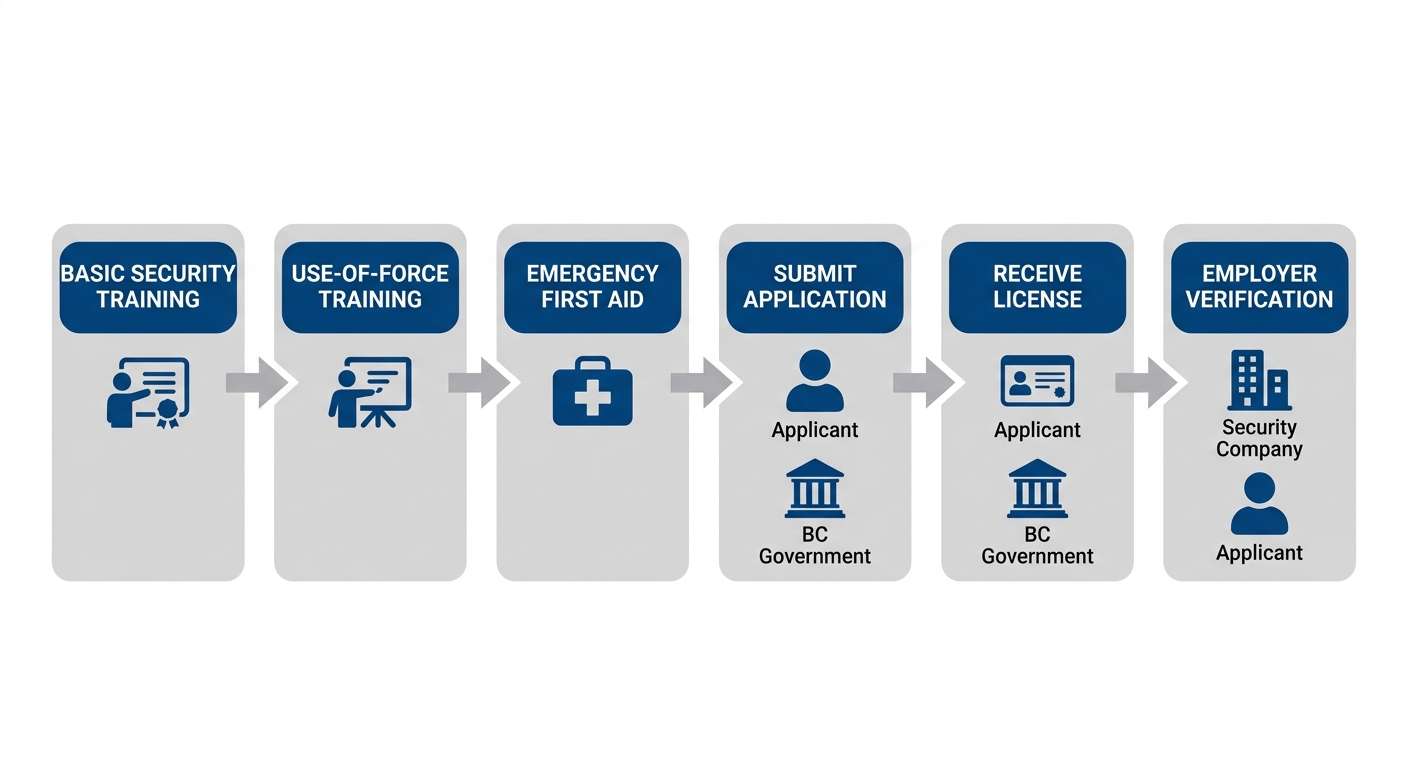
    Six-step horizontal process flow for obtaining a BC Security Worker License in British Columbia, with stages from basic training through employer verification.

    Six steps to obtain your BC Security Worker License and deploy.

    Mandatory Training Prerequisites

    Before you can apply for a bc security worker license, you must complete three mandatory training components. The cornerstone is Basic Security Training, a 40-hour course that covers legal authorities, communication skills, report writing, and emergency procedures. According to our internal training guidelines, this program ensures every candidate understands the legal boundaries and professional standards required in British Columbia. Most applicants complete BST within one to two weeks through an approved training provider.

    The second requirement is an 8-hour Use-of-Force training course, which teaches physical intervention and control techniques. This training emphasizes proportional response and aligns with the de-escalation principles we reinforce at Regent Security. The third prerequisite is an 8-hour WorkSafeBC-approved Emergency First Aid certification. Together, these three components form the foundation of certified security guard training BC employers expect, and our team verifies each certificate before moving candidates forward.

    Submitting Your License Application

    Once you have completed your training, the next phase addresses the security license requirements bc enforces. You must submit your application to the BC Security Programs Division, providing proof of all completed training, undergoing a criminal record check, and paying the required application fee. Processing typically takes two to four weeks, after which the province issues your Security Worker License.

    Verifying Company Licensing and Insurance

    When you are ready to work, or if you are a business hiring security personnel, verifying a security company’s licensing and insurance is essential. Start by requesting the company’s license number and then cross-reference it with the BC Security Programs Division to confirm the firm is in good standing. You should also ask for proof of insurance, which reputable providers keep current and readily available.

    From Training to Deployment: Regent Security’s Approach

    Once a guard holds a valid bc security worker license, our focus shifts to preparing them for the field. We verify each individual’s license and insurance, then layer on site-specific training that reflects the unique demands of concierge, building, construction, and event security roles. With over 15 years of experience and a team of more than 100 licensed professionals, we understand what it takes to transition from classroom learning to real-world deployment.

    Beyond Basic Training: Use-of-Force and Emergency Response Certifications

    While a basic security worker license is the foundation for any career in this field, advanced certifications in use-of-force and emergency response elevate a guard’s capabilities far beyond the core requirements. For those pursuing certified security guard training in BC, these specialized programs represent a commitment to professional excellence and operational readiness. They complement the BC security worker license and ensure guards meet evolving security license requirements in BC while being prepared for the complex, dynamic situations they may encounter in the line of duty.

    Frequently Asked Questions About Security Guard Training in British Columbia

    Here are answers to common questions about security guard training in British Columbia.

    What does certified security guard training in BC involve?

    Certified security guard training in BC covers the Basic Security Training (BST) course mandated by the province. According to Regent Security’s internal guidelines, this program typically requires about 40 hours to complete and includes essential topics like legal responsibilities, report writing, and emergency procedures.

    What are the prerequisites for security guard training in BC?

    The primary security license requirements BC mandates include a clean criminal record check and meeting a minimum age threshold, which is generally 19 years old. We ensure all our team members meet or exceed these foundational criteria before they begin their field preparation.

    Your Partner in Certified Security Guard Training and Deployment

    As a leading provider of certified security guard training BC, we ensure every candidate is prepared to meet the requirements for their BC security worker license. Our comprehensive programs cover all security license requirements BC, giving recruits the skills needed for real-world challenges. From hotels and construction sites to high-profile events, we deploy our trained professionals to safeguard what matters most. For details on our competitive pricing, see our FAQ on security guard cost in British Columbia. Contact us today for a custom quote and experience unmatched security expertise.

    Resources