
Category: Property Management Services

  • Fire Safety Plan Commercial Building Vancouver: BC Code Guide

    Fire Safety Plan Commercial Building Vancouver: BC Code Guide

    Table of Contents

    Fire Safety Planning for Commercial Buildings in Vancouver, British Columbia

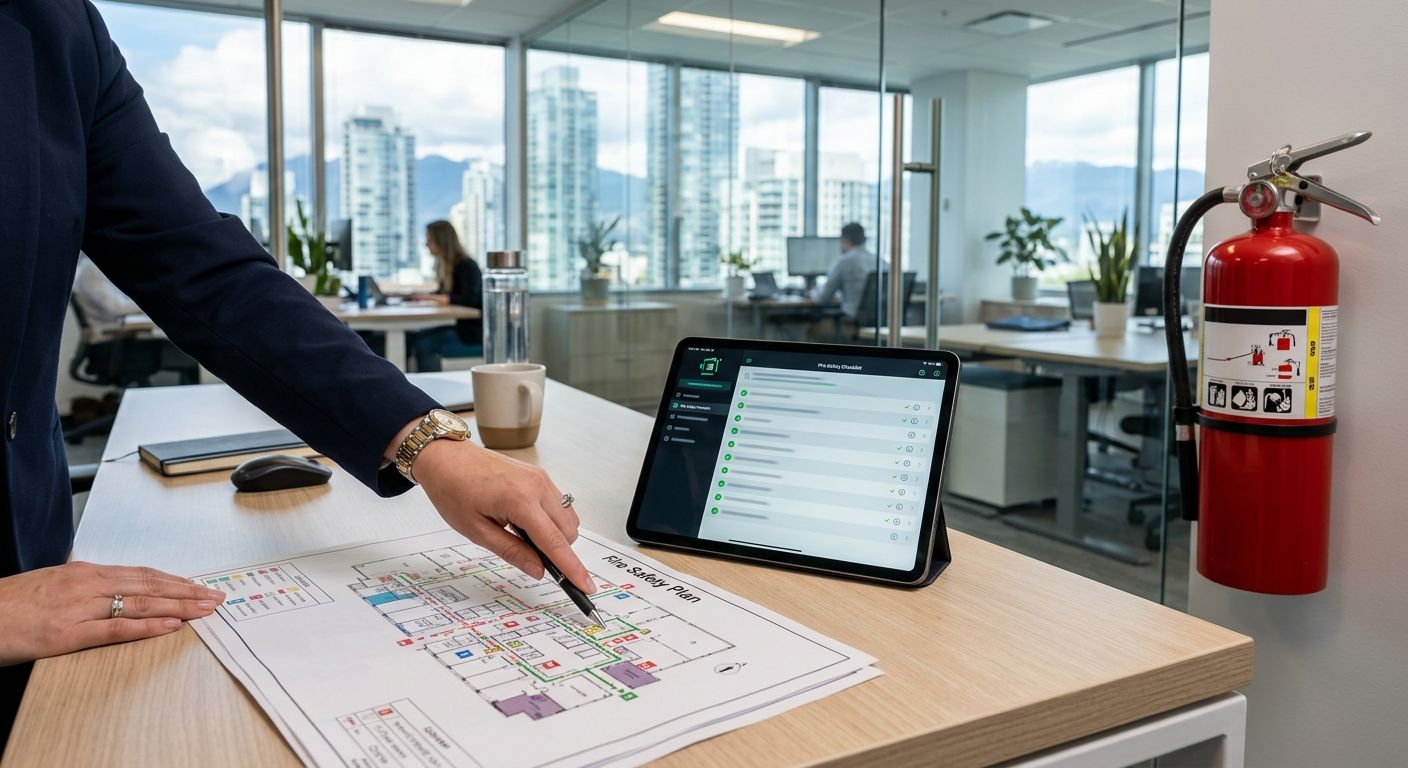
    Developing a fire safety plan commercial building Vancouver requires compliance with both municipal and provincial regulations. Commercial building owners must follow fire safety regulations in Vancouver and the BC Fire Code. Vancouver Fire Bylaw 12472, administered by the City of Vancouver, mandates that every commercial property have an approved fire safety plan on file with the Vancouver Fire Department and update it annually. The BC Fire Code (Division B, Part 2) further requires that these plans include emergency procedures, detailed floor plans with evacuation routes, and documented maintenance schedules for fire protection systems such as alarms and sprinklers. We assist building owners in preparing and submitting compliant fire safety plans, supporting your BC fire code compliance with professional oversight. A thorough fire safety plan not only meets legal obligations but also protects occupants and property, giving you peace of mind.

    Understanding Vancouver’s Fire Safety Regulations and Codes

    For commercial property managers in Vancouver, understanding the fire safety regulations that affect their operations is crucial. The BC Fire Code (Division B) defines the provincial baseline for fire code compliance in British Columbia, establishing mandatory fire safety plan standards. Complemented by Vancouver Fire Bylaw 12472, which adds municipal-specific requirements, these codes create a comprehensive compliance framework for businesses across the city.

    Different commercial sectors face unique fire risks, so the code tailors requirements accordingly. An office building’s evacuation procedures differ markedly from a construction site’s need for hot work permits and weekly fire watch logs. Understanding these distinctions helps owners implement the right measures for their property type. The table below summarizes the key fire safety plan components, applicable BC Code references, and inspection frequencies for four common commercial sectors in Vancouver.

    Comparison of Fire Safety Plan Requirements by Commercial Sector
    SectorFire Safety Plan RequirementsKey BC Code ReferencesInspection Frequency
    Office Annual Drills & Warden Training Div B, Part 2 Annual
    Hotel Guest Briefings & Staff Training Div B, Part 2.8 Semi-Annual
    Construction Hot Work Permits & Daily Logs Div B, Part 5.6 Weekly

    These requirements illustrate the layered approach to fire safety: annual drills and warden training for offices, semi-annual checks and guest briefings for hotels, intensive weekly monitoring for construction sites, and rigorous monthly inspections for retail. By aligning with the BC Fire Code’s sector-specific standards, businesses maintain compliance and protect both people and property.
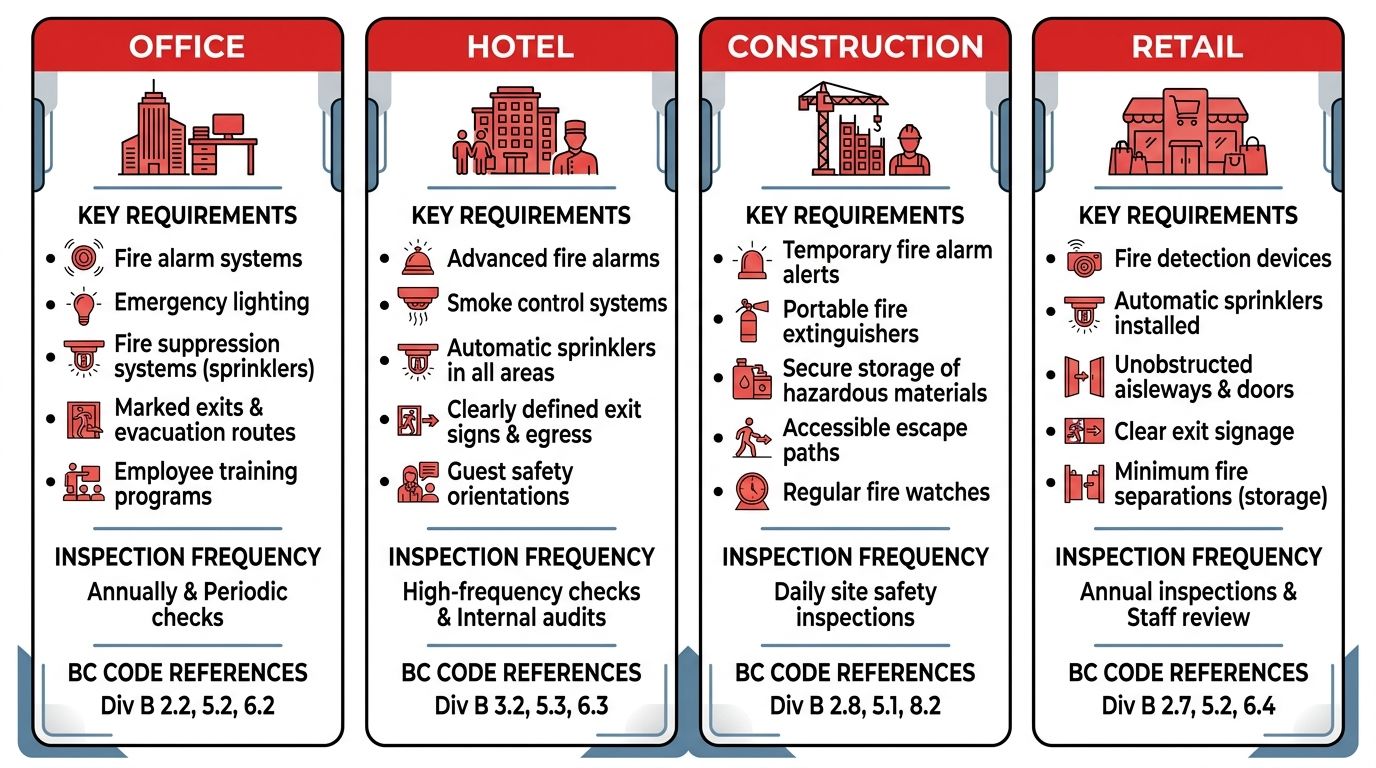
    comparative infographic showcasing fire safety plan requirements for office, hotel, construction site, and retail sectors in Vancouver with inspection frequencies and BC Code references

    Vancouver fire safety requirements comparison across four commercial sectors

    At Regent Security, we recognize that your peace of mind is paramount. Our team helps businesses in Vancouver navigate these regulations with confidence, developing fire safety plans that meet every code requirement. Welcome to Regent Security, where your safety is our story.

    Fire Watch and Security Services for Commercial Properties

    When a commercial building’s fire protection systems are impaired or inoperable, fire watch acts as a temporary safety measure to monitor fire hazards. A fire safety plan for commercial buildings in Vancouver must account for such situations, and our emergency fire watch services ensure that occupants and assets remain protected during system outages.

    Why Commercial Properties Need Fire Watch

    Fire watch is mandated by fire marshals, insurance companies, or local bylaws during system repairs, renovations, hot work activities, or when permits have expired. Common scenarios requiring fire watch include:

    • Impaired or non-functioning sprinkler/alarm systems
    • Hot work operations such as welding or cutting
    • Expired or revoked fire safety permits
    • System commissioning in new construction
    • Building renovations that disable fire protection

    We deploy BC-licensed guards trained in fire watch protocols to conduct hourly patrols, document inspections, and report directly to fire authorities if needed. These guards check critical areas like stairwells, mechanical rooms, and parking garages—maintaining a rigorous log that satisfies both fire department and insurer requirements.

    Compliance with Vancouver Fire Bylaws

    In Vancouver, compliance with the BC Fire Code and Vancouver Fire Bylaw 12472 is essential for any commercial property. When a building’s alarm or sprinkler system is offline, the bylaw requires that a qualified fire watch be implemented immediately. Our team responds within two hours of a request, with guards carrying $5 million in liability coverage to protect your interests. Every patrol is digitally tracked, verifying that all 24 checkpoints are addressed and producing a clear audit trail.

    In addition to fire watch, we offer comprehensive security solutions for commercial properties—your peace of mind, anytime, anywhere.

    Key Local Factors for Fire Safety Compliance in Vancouver

    While national codes provide a baseline, compliance for any fire safety plan commercial building Vancouver must address both municipal and provincial standards. Vancouver’s layered regulations require careful attention from property owners.

    Vancouver Fire Bylaw 12472

    Vancouver Fire Bylaw 12472 is the primary municipal rule governing fire safety for commercial buildings within city limits. Key obligations include:

    • Submitting a Fire Safety Plan for approval
    • Annual plan updates as building use changes
    • Posting emergency procedures on-site
    • Maintaining fire suppression and alarm systems

    Non-compliance can lead to fines, stop-work orders, or higher insurance costs.

    Beyond the bylaw, BC Fire Code compliance applies province-wide and is enforced locally, meaning buildings must meet both standards at once. Construction sites carry extra duties: temporary structures, flammable material storage, and site permits impose added fire safety responsibilities. Our construction site security services include dedicated fire watch patrols that address these site-specific needs, while our 24/7 building monitoring and rapid alarm response help occupied properties stay aligned with Bylaw 12472. From drafting a fire safety plan commercial building Vancouver to ongoing vigilance, we close compliance gaps. Understanding these local factors is the first step — our expertise helps you navigate Vancouver’s fire safety requirements with confidence, where your safety is our story.

    Steps to Develop a Site-Specific Fire Safety Plan

    Developing a fire safety plan for a commercial building in Vancouver requires a structured approach that aligns with local regulations and best practices.

    1. Conduct a site assessment. Identify fire hazards, building layout, occupancy type, existing fire protection systems, and emergency responder access. Document findings to guide every subsequent stage and prioritize risks.
    2. Draft plan components. Outline emergency procedures, evacuation routes, assembly points, fire warden roles, and communication protocols that meet BC Fire Code compliance. All documents should be clear and accessible.
    3. Ensure Vancouver Fire Bylaw 12472 compliance. Submit the plan to the local fire authority for approval; in Vancouver, complying with Vancouver Fire Bylaw 12472 is mandatory.
    4. Implement employee training. Train staff on using fire extinguishers, evacuation procedures, and assigned duties. Schedule regular drills—quarterly or annually—to reinforce readiness.
    5. Maintain and update the plan. Review the plan after renovations, occupancy changes, or regulatory updates. Your fire safety plan for a commercial building in Vancouver is a living document.

    Regent Security offers fire watch services and security consultation to support your plan. Contact us today for a custom quote — unmatched security expertise for your peace of mind.

    Your Next Steps Toward Fire Safety Compliance

    Now that you understand the key fire safety requirements, the next step is to implement a fire safety plan for your commercial building in Vancouver. We help you meet BC fire code compliance and Vancouver Fire Bylaw 12472 requirements with a tailored safety plan. Our licensed, insured guards provide 24/7 fire watch services, deploying rapidly to keep your property protected. Contact us today to learn more about our fire watch services in Vancouver and ensure your peace of mind anytime, anywhere.
    Resources

  • Commercial Access Control Systems 2026: Complete Guide for Vancouver

    Commercial Access Control Systems 2026: Complete Guide for Vancouver

    Table of Contents

    The Future of Commercial Access Control Systems in Vancouver, BC for 2026

    The landscape of access control systems for businesses in Vancouver is poised for a significant transformation by 2026. Many industry leaders point to a future where security is not just a barrier but an intelligent, integrated layer of building management. We at Regent Security are seeing a clear shift driven by the demand for both heightened protection and streamlined operational efficiency.

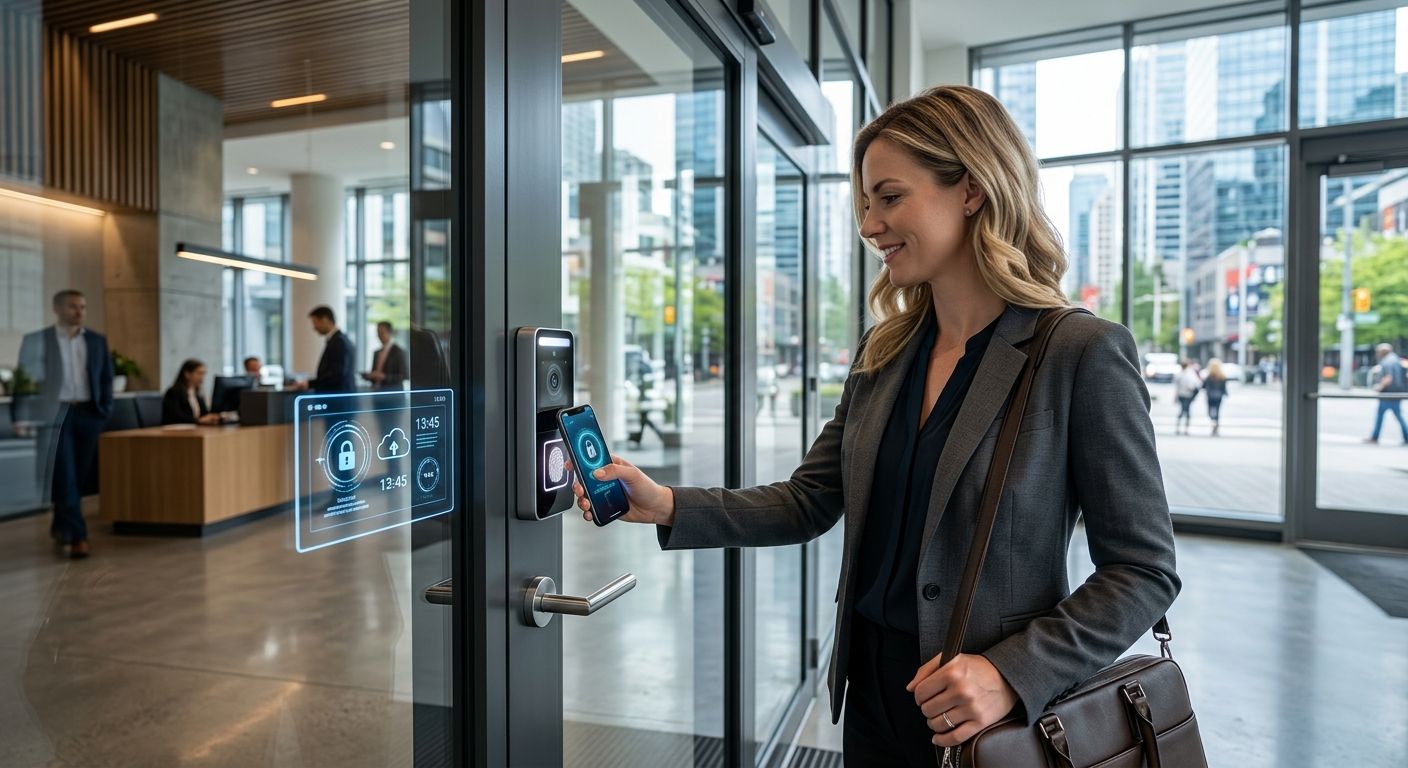
    A major trend expected to see increased adoption is the move from traditional key cards to mobile access control credentials. For Vancouver businesses, this offers greater convenience and reduces the risks associated with lost or cloned physical keys. Alongside this, biometric security integration is moving from high-security government buildings into mainstream commercial use. Features like multi-factor authentication combining mobile credentials with facial recognition are set to become more prevalent, providing a robust audit trail and eliminating the possibility of credential sharing. In planning these next-generation upgrades, the Canadian Security Association provides essential guidelines for ensuring technology enhances, rather than complicates, your security posture.

    Cloud-based management platforms are another cornerstone of future security systems, enabling remote monitoring and instant access management, anytime and anywhere. This capability is crucial for Vancouver’s flexible commercial market, allowing property managers to scale access instantly. These advanced credentialing solutions promise to bring greater convenience and proactive security, ensuring your peace of mind. For guidance on how these innovations can be tailored into a custom solution for your specific needs, we encourage you to consult with our experts at Regent Security to discuss a personalized security quote.

    Biometric Access Control Systems for Vancouver Office Buildings

    Overview

    As we move toward 2026, commercial access control systems 2026 trends show a marked shift toward biometric authentication in Vancouver office buildings. Regent Security has observed growing demand for these advanced solutions that replace traditional keys and cards with unique biological identifiers, offering enhanced protection for sensitive corporate environments. Your peace of mind comes from knowing exactly who accesses your facility at all times.

    Key Features

    Biometric access control systems in Vancouver integrate several sophisticated technologies with existing door hardware including electric strikes and magnetic locks. Regent Security follows best practices from the Canadian Security Association to ensure compliant biometric installations.

    • Fingerprint scanning provides rapid, reliable identity verification by analyzing unique ridge patterns
    • Facial recognition enables touchless entry by mapping facial geometry against authorized user databases
    • Biometric security integration allows seamless connection with current access control infrastructure without replacing core door components
    • Integration capabilities extend to CCTV monitoring systems for comprehensive security management
    • Mobile access control credentials offer complementary functionality where biometric-only solutions may not be practical

    Pricing

    Regent Security provides custom-quote pricing for all commercial biometric installations. Every Vancouver office building has unique security requirements, entry points, and user volumes that influence the final investment. Contact our team for a personalized estimate tailored to your facility’s specific needs.

    Pros & Cons

    Biometric systems deliver substantial benefits alongside considerations that Vancouver businesses should evaluate before implementation.

    • High security comes from authentication based on unique biological traits that cannot be shared or stolen like access cards
    • Convenience eliminates the need for employees to carry keys or remember PIN codes
    • Audit trail capability provides detailed records of every access event for compliance and investigation purposes
    • Privacy concerns require transparent data storage policies and employee communication about biometric information handling
    • Higher upfront costs compared to traditional keycard systems, though these often offset through reduced credential replacement expenses over time

    Best For

    Regent Security recommends biometric access control for specific commercial environments where identity verification demands exceed typical office requirements.

    • Server rooms and data centers containing sensitive infrastructure or client information
    • Executive floors where leadership privacy and corporate confidentiality are paramount
    • Research laboratories with valuable intellectual property or regulated materials
    • Facilities with large rotating staff where managing physical credentials becomes administratively burdensome

    Mobile Access Control Credentials for Commercial Properties

    Overview

    As part of commercial access control systems 2026, mobile access control credentials are rapidly becoming the standard for modern building entry. These smartphone-based solutions replace traditional RFID cards, allowing users to unlock doors with their phones using Bluetooth Low Energy or NFC technology.

    Key Features

    Mobile credentials use Bluetooth/NFC technology that meets product safety certification in Canada, ensuring compliance with national standards. Our digital keys work seamlessly on both iOS and Android devices, and temporary guest access can be issued remotely through a mobile app without needing a physical credential.

    Pricing

    Mobile credential systems typically follow a software-based licensing model charged per user. For a custom quote tailored to your property’s specific needs, contact our team directly.

    Pros & Cons

    Mobile credentials offer clear advantages: convenience since your phone is always with you, reduced card replacement costs, and the ability to revoke access remotely. However, they do rely on battery life and introduce potential security concerns if a phone is lost or stolen. Looking ahead, biometric security integration promises to address some of these vulnerabilities.

    Best For

    These systems are ideal for modern offices, co-working spaces, and properties where user convenience and remote management are top priorities. Your peace of mind comes from knowing that access can be managed anytime, anywhere.

    Cloud-Based Entry Management Systems for Strata Buildings

    Unlike traditional standalone systems, cloud-based entry management is a modern evolution of access control systems that allows strata managers to oversee building entry remotely. As we approach 2026, commercial access control systems are shifting toward cloud-native platforms that deliver real-time monitoring without on-site servers.

    Integrating Access Control with Elevator Systems

    Beyond securing doors, access control can also be extended to elevators, creating a fully layered security environment. As commercial access control systems 2026 trends show, modern deployments now send signals from the access controller to the elevator system, granting or denying floor access based on a user’s credential. This prevents unauthorized movement between floors and keeps sensitive areas protected.

    Multi-Factor Authentication for Enhanced Security

    Multi-factor authentication (MFA) represents a critical evolution in commercial access control systems 2026, moving beyond single credentials to require two or more verification methods before granting entry. This approach combines something you know like a PIN, something you have such as a mobile access control credential, and something you are through biometric security integration like fingerprint or facial recognition.

    Side-by-Side Comparison of Leading Access Control Solutions

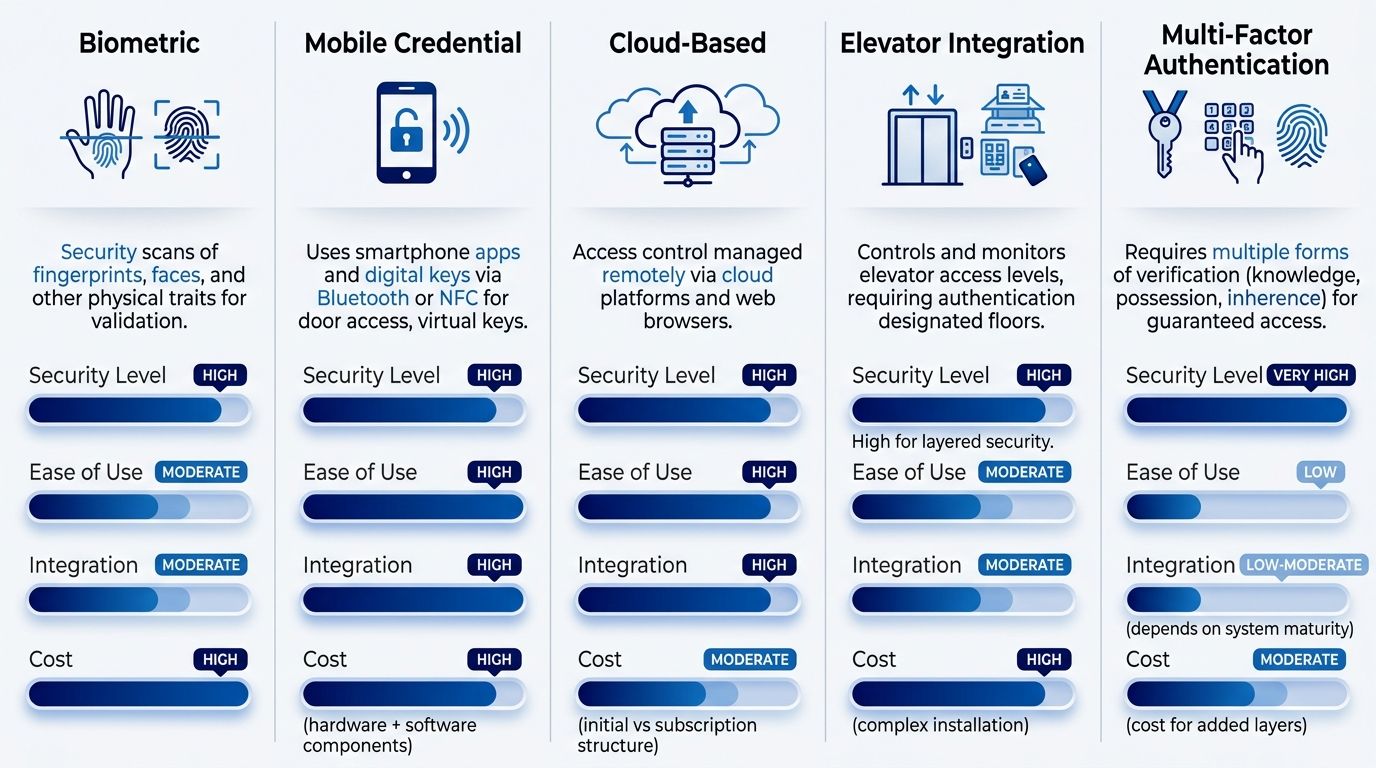
    Now that we’ve looked at each system individually, here is a side-by-side comparison to help you evaluate them at a glance. When comparing commercial access control systems 2026, seeing the key differences in security level, ease of use, integration, and cost makes the decision clearer. Biometric security integration adds another layer of protection, while mobile access control credentials offer both convenience and security for staff.

    Quick Comparison of Commercial Access Control Systems

    Quick Comparison of Commercial Access Control Systems
    SystemSecurity LevelEase of UseIntegrationCost
    BiometricVery HighModerateModerate (hardware upgrades)High
    Mobile CredentialHighVery HighHigh (API-ready)Moderate
    Cloud-BasedHighHighVery High (multi-vendor)Low–Moderate (subscription)
    Elevator IntegrationVery HighModerateModerate (elevator-specific)High
    Multi-Factor AuthenticationHighestLow (slower entry)Moderate (combines technologies)Very High

    Security levels based on industry-recognized standards defined by the Canadian Security Association (CANASA). All equipment meets product safety certification requirements for Canadian installations validated by UL Standards & Engagement. Costs are estimates; actual pricing depends on building size, number of doors, and required integrations.

    Comparison infographic of five access control systems with qualitative bars for security level, ease of use, integration, and cost

    Side-by-side comparison of leading access control solutions

    Unmatched Security Expertise for Your Building’s Access Control

    As commercial access control systems 2026 evolve, Regent Security delivers unmatched security expertise that keeps your building protected around the clock. We combine licensed guards, 24/7 monitoring, and the latest access technology to create integrated solutions tailored to commercial properties across Canada.

    Resources