Category: Professional Security Services

  • What Are the 5 C’s for Security Guards: A Comprehensive Guide

    What Are the 5 C’s for Security Guards: A Comprehensive Guide

    Table of Contents

    Why the 5 C’s Shape Professional Security Guard Conduct

    One of the most common questions we hear is: what are the 5 C’s for security guards? The 5 C’s are Context, Consistency, Culture, Congruence, and Clusters. They form an analytical framework used in surveillance observation and analysis to guide licensed security personnel in British Columbia. This structured approach helps professionals maintain operational accuracy while preventing overcomplication by providing a clear lens for focused observations. Each C reinforces the ethical pillars that underpin professional conduct—integrity, objectivity, competence, and confidentiality—ensuring security personnel meet the standards expected of their role. Together, these elements shape day-to-day conduct and decision-making in security operations, making the 5 C’s essential for ethical, lawful, and accurate field work. This framework ensures that every observation and response aligns with both operational goals and the highest standards of professional behavior.

    Key Takeaways

    • Security experts who ask what are the 5 C’s for security guards will usually get an answer based on five key aspects of observation and response they need to be mindful about.
    • Putting the 5 C’s into action transforms routine hotel security into trusted protection.
    • The five c’s depend upon the ethical values which each security guard should adhere to while making all decisions and doing his job.
    • What ethical standards guide our guards’ day-to-day work?
    • We bring the 5 C’s of professionalism and accountability to your Vancouver hotel, with well-trained and licensed personnel covering 24/7.

    The 5 C’s for Security Guards Defined

    Security experts who ask what are the 5 C’s for security guards will usually get an answer based on five key aspects of observation and response they need to be mindful about. They include Context, Consistency, Culture, Congruence, and Clusters. The principles behind these ideas have been taken from the existing material related to surveillance-level training, which is something the guard could then use when assessing situations and making decisions without having too many thoughts clouding his mind.

    Context

    Context is fundamental to any observation because it helps us ask what’s going on and why does it matter. A guard needs to understand where things happen and what they mean. They might observe a customer acting up in the lobby of a hotel, or see that a delivery man has to go all over the building in order to get his stuff inside. Without this contextual understanding, a harmless behavior would become suspicious, thus generating an unfounded incident. As such, this idea works together well with the objective ethics guideline. In other words, we want to make sure our guards base their observations strictly on facts instead of assumptions.

    Consistency

    Guards must also consistently apply the same standard across similar events over the course of time. If the procedure specifies that all entries need to be logged at 10 p.m., then this has got to happen on every single night. This will prevent inConsistency and ensure that there aren’t any gaps in documentation which can harm the process of investigation if some kind of incident happens later. This principle helps uphold professional competence, thereby making sure that every guard is reliable when performing his duties.

    Culture

    Culture recognizes that security practices must be respectful of the way things work where they’re being protected. So in a hotel you want to show security at the same time as you make people feel welcome but in a strata building, you have to understand how the residents expect their surroundings to function. Security guards have to act accordingly because they may come off as arrogant if they’re completely oblivious to what its like there. This is why ethics are associated with our behaviour since our actions affect others behavior.

    Congruence

    The idea is to ensure there is consistency between what was seen and what should have been happening according to policy. When a guest says they’re on the list, but does something wrong per house protocol, a guard’s responsibility is simply to identify this fact for record keeping, without making assumptions about why things may have gone south. It upholds the principle of integrity because if you don’t understand where the issue came from, you can’t get mad about it. Congruence

    Clusters

    Clustered behavior means certain actions, when viewed collectively, become significant. One guest who loitered around restricted areas might not be unusual. However, if he repeatedly lingered across different shifts, those occurrences could indicate a security concern. This helps enforce confidentiality for security personnel because they have to report any observed Clusters while refraining from making assumptions against anyone specifically.

    This will provide some degree of framework that can assist in keeping the guard within the bounds set forth by law and profession when making observations. This should not eliminate risk, but allow them to make judicious decisions based on their training.
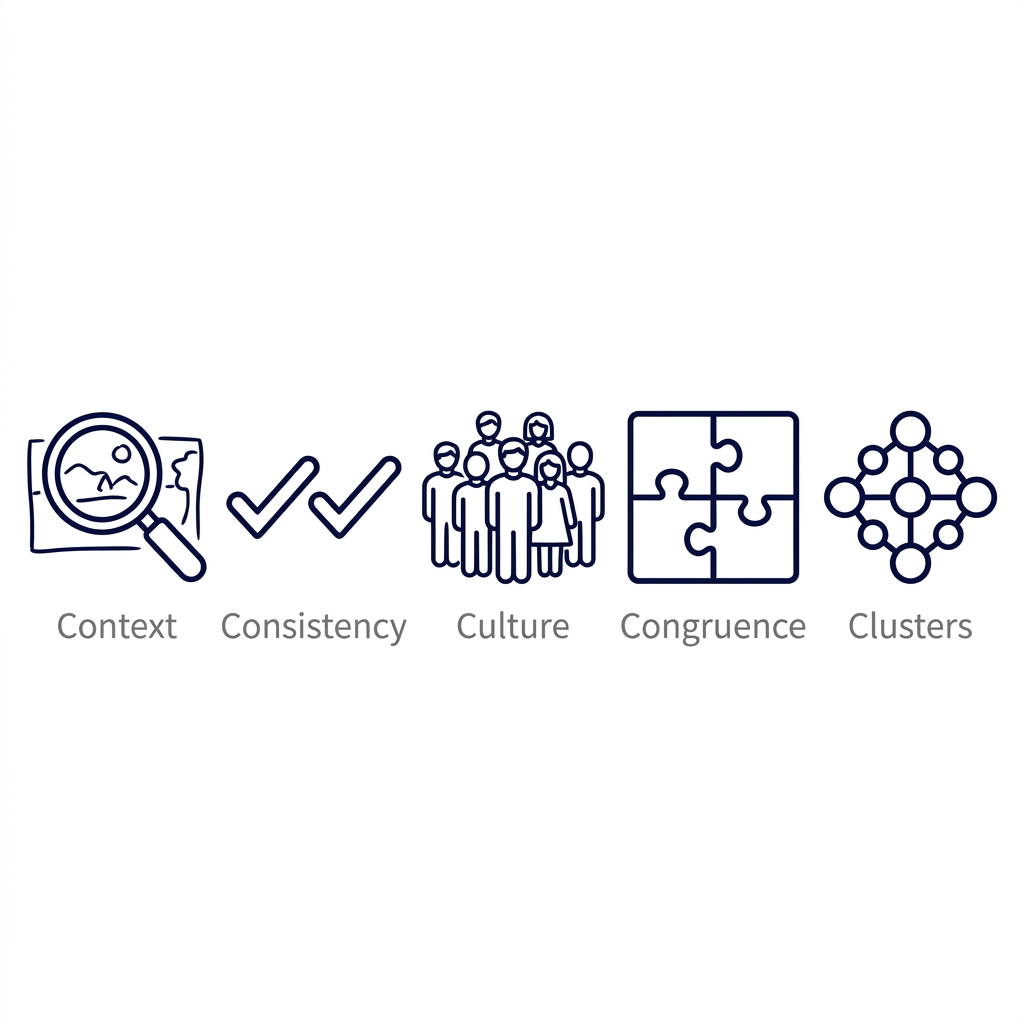
    Five outline icons in deep navy representing the 5 C's for security guards: Context, Consistency, Culture, Congruence, Clusters, with gray sans-serif labels beneath each icon.
    5 C's for Security Guards: Context, Consistency, Culture, Congruence, Clusters.

    How Each C Guides Guards Through a Hotel Shift

    Putting the 5 C’s into action transforms routine hotel security into trusted protection. In Vancouver hotels, our guards lean on communication, cautiousness, and compassion to shape every shift, ensuring guests feel safe and cared for from the moment they arrive.

    Communication and Confidence in Guest and Concierge Interactions

    Front-desk and concierge responsibilities should include clear, simple instructions. This makes each transaction reassuring for all concerned parties. Guards relay their check-in details in a quiet voice, calmly, so the guest leaves with proper knowledge before they get on the elevator. The constant tone at the front desk can make you feel like this is exactly where you need to be. Guards inform guests about safety and hospitality because the property values those two things.

    Our security personnel answer their questions or direct them efficiently with warmth while creating confidence in the first greeting. Security personnel’s self-confidence emanates from rigorous training that emphasizes clarity under pressure, ensuring every interaction—whether with a first-time visitor or a returning guest—feels intentional and reassuring. Thus, each conversation with either new or old visitors is treated intentionally and convincingly, rather than haphazardly and uncertainly. Communication between guards and other people helps reduce any misunderstandings that may arise and can create unnecessary concerns over safety or service.

    Cautiousness and Courage Under Pressure

    For example, situational awareness means paying attention and observing a building, including its lobbies, hallways and guest floors without jumping to a hasty conclusion. The guards are trained to observe subtle cues: a guest lingering too long in a restricted area, unfamiliar faces lingering near service entrances, or inconsistencies in behavior that might indicate a potential issue. This deliberate approach minimizes false positives while ensuring that real concerns are addressed promptly.

    However, should disturbances or theft attempts arise on-site, our security personnel pause to assess the scene, weighing risks before acting. Courage can’t be reckless. It results from training that guides measured responses aligned with site protocols. Their aim is to protect guests, employees, and property whilst avoiding any inappropriate actions which may cause conflict to rise. By being observant and deliberate in how they respond, our security personnel ensure that order is maintained, yet at no time is this done at the expense of a guest’s experience.

    Compassion in Guest Care and Incident Handling

    Most of all, compassion turns tense encounters into positive resolutions. Whether supporting a distressed guest after a lost item or respecting privacy during an incident investigation, our guards balance empathy with firmness. A calm voice and attentive listening de-escalate conflicts, while clear boundaries preserve order.

    When a guest reports a missing item, our guards approach the situation with patience, ask open-ended questions to gather details without making assumptions, document the report thoroughly, and reassure the guest that we’re taking the matter seriously. This human element is needed because the guest should feel like security was not only here for enforcement but also there to provide care. As such, we want to reassure the guest of our willingness to help look into his issue, which will increase the loyalty to the property.

    It all comes down to that moment where the guards put all their training into play using the 5 C’s. They turn those theories and ideals into something useful for protecting people inside the hotel.

    Applying the 5 C’s to De-escalation, Risk Management, and Training

    After reviewing each of the 5 C’s individually, the practical question becomes how they function together under pressure to defuse aggression, reduce liability, and support sound risk-management decisions in real-world hotel and strata incidents.

    De-escalation and Risk Management in Real Incidents

    In Vancouver, a hotel guest gets verbally aggressive with the guard at the front desk after having been told she can’t get into some restricted area. Context helps him to know that although the guest is angry, he has no reason to believe her anger was because she intended any harm. Consistency makes sure that all guests and contractors are treated according to the same rules and standards. That reinforces both equity and predictability. Culture guides him to align his responses with the property’s values of respect and professionalism, even when emotions run high. Congruence tells him whether what he is saying matches the words taught to him. Clusters of related behaviors, like how a guard maintains his posture and how he uses his language, together work against escalating this incident further.

    The actions performed are rooted within the six ethical pillars: Integrity, Objectivity, Expectation of Privacy, Professional Competence, Professional Behavior, and Confidentiality. By adhering to these principles, the guard not only defuses the incident but also reduces liability exposure for the property.

    How Licensed Providers Train Guards for Concierge and Site-Specific Roles

    Trainees learn about all 5 C’s through specialized training including BST and AST programs focused on concierge responsibilities at Vancouver hotels and specific site-based positions. Training helps them gain a better understanding of Context by having trainees analyze real-world situations and explore why events happened as they did prior to taking action. Consistency is reinforced through standardized drill routines that ensure every guard applies the same protocols whether managing a hotel lobby or a construction site in Burnaby. Culture is embedded by aligning training with the client’s values and the guard’s professional identity.

    During Congruence training, participants learn to perform assigned tasks exactly according to documentation without variations. Trainees also practice Clusters of related skills in parallel to prepare for shifts on duty, such as observation techniques alongside communication strategies. While conducting ethics-based training focused on integrity and confidentiality, instructors ensure that trainees understand how their conduct standards extend beyond de-escalation into surveillance-adjacent duties.

    A Day-in-the-Life View: Conduct Standards Across Assignments

    In a hotel lobby, guards start working shifts, as the contractor has asked to have the access required for later. By applying Context, they verify the contractor’s credentials against the property’s access list before granting entry. On the construction site, which lies in the city of Burnaby, the same guard encounters an unauthorized visitor; here Consistency ensures the response mirrors the hotel lobby protocol, with a polite but firm request to leave and an offer to assist with proper access procedures.

    Then later, in a commercial building after hours, the guard spots a maintenance worker without proper identification. Culture guides a respectful but firm interaction. Congruence then dictated how he should respond according to what the company policy said.

    The 5 C’s Applied: Scenario to Standard

    The CTypical On-Shift ScenarioProfessional Standard of ConductRisk It Mitigates
    ContextGuest disputes hotel policy in a lobbyAssess underlying motivation before actingPrevents misinterpretation and escalation
    ConsistencyContractor requests access after hoursApply the same standard to every requestReduces liability from inconsistent enforcement
    CultureWorker becomes frustrated during a routine checkAlign responses with property valuesPreserves professional reputation
    CongruenceGuard improvises a response to an unfamiliar situationMatch actions to documented proceduresMinimizes errors and maintains accountability
    ClustersCombining communication, observation, and documentationUse related skills as an integrated responseEnsures comprehensive incident handling
    The 5 C’s Applied: Scenario to Standard

    These standards are anchored in the ethical and professional principles that persist across assignments. By grounding conduct in integrity, objectivity, and confidentiality, we ensure our guards deliver consistent, professional service whether in a Vancouver hotel lobby, a Surrey construction site, or a commercial building after hours.

    Ethics, Structured Frameworks, and Continuous Improvement

    The five c’s depend upon the ethical values which each security guard should adhere to while making all decisions and doing his job. Our guards operate within six core ethical pillars: integrity, objectivity, expectation of privacy, professional competence, professional behavior, and confidentiality, each reinforced by the 5 C’s. The 5 C’s are context, consistency, culture, congruence, and clusters. Together, these principles define what the 5 C’s for security guards mean in ethical terms.

    Ethical Pillars That Underpin Guard Conduct

    The four pillars support good business conduct within difficult situations. We stay true through integrity on all occasions. Objectivity helps avoid opinions that may prevent accurate insight. Under BC’s Personal Information Protection Act (PIPA), our need to be mindful of confidentiality and privacy affects how open we are about being visible or private. Professional competency requires continuing education; professional behavior reflects respect and responsibility. Confidentiality safeguards sensitive information, reinforcing trust with every client.

    Structured Observation and Incident Review

    Field accuracy hinges on disciplined observation. Avoiding "smoking guns," keeping the process simple, and never overextending efforts prevent overcomplication and maintain operational clarity. Having a structured framework ensures our guards focus on essential data, reducing errors and supporting lawful surveillance practices that align with provincial privacy standards. Regularly reviewing incidents will show that the experience becomes valuable when it is turned into improved performance.

    Choosing a Provider Whose Guards Live the 5 C’s

    When selecting a security provider in Vancouver or the Lower Mainland, prioritize licensing under BC’s Security Services Act, depth of training, and site-specific audits. Look for 24/7 responsiveness and a commitment to ethical conduct, not fixed response windows, but reliable, accountable service. Our guards embody these standards, delivering peace of mind through professionalism and adherence to the 5 C’s.

    Build Your Security Quote today to discuss how we can tailor a solution for your property.

    Common Questions About Security Guard Conduct

    What ethical standards guide our guards’ day-to-day work?

    In other words, we base how we behave upon these six values – truthfulness, objectivity, respect for privacy, expertise, professionalism in acting towards others, and confidentiality. By adhering to that code of ethics, we stay true to both the law and all of those whom we serve in the area of Vancouver as well as throughout the entire Lower Mainland.

    How do guards maintain objective and lawful observations?

    We don’t take any shortcut that leaves us with the proverbial smoking gun; we are as straightforward as possible, focusing only on what we have to focus on; and, finally, we will never go beyond anything which is really needed. And that makes sure that our structured approach keeps surveillance accurate, lawful, and professionally sound, without unnecessary complexity.

    What prevents guards from overreaching during surveillance?

    This approach enables us to make our analysis fit the bill, without overextending ourselves. In this manner, we achieve an ideal combination of precision and restraint. We stay mindful that everything we observe must be in line with the limits of legality as well as ethics, while still getting meaningful information back.

    Frequently Asked Questions

    What are the 5 C’s of professional security guard conduct?

    The 5 C’s are Context, Consistency, Culture, Congruence, and Clusters. These principles guide licensed security personnel in British Columbia to maintain operational accuracy and ethical standards during observations and responses.

    How does the ‘5 C’s’ framework help security guards during their shifts?

    The 5 C’s framework helps guards assess situations accurately, apply consistent standards, respect site-specific norms, align actions with policies, and recognize patterns that indicate risks or incidents during their shifts.

    Why are communication cautiousness confidence courage and compassion essential for hotel security staff?

    Communication ensures clear instructions, cautiousness prevents assumptions, confidence maintains professionalism under pressure, and compassion de-escalates conflicts while balancing firmness in guest interactions.

    Do security companies use the 5 C’s to train guards for concierge and site-specific roles?

    Licensed providers incorporate the 5 C’s into training programs such as BST and AST, teaching guards to apply Context, Consistency, Culture, Congruence, and Clusters in concierge and site-specific assignments.

    How do the 5 C’s of security contribute to better incident de-escalation and risk management?

    The 5 C’s guide guards to assess situations accurately, apply consistent responses, respect property values, follow documented procedures, and recognize behavioral patterns, reducing escalation and liability risks.

    Where Your Safety Is Our Story

    We bring the 5 C’s of professionalism and accountability to your Vancouver hotel, with well-trained and licensed personnel covering 24/7. You can rely on us whether it be having concierge in addition to your front desk, specific site security measures or anything else. We are able to build security programs to include people, processes and technology which will ensure guest safety as well as asset security for all of Lower Mainland.

    Your security needs are unique, so results and pricing may vary based on site assessment and custom requirements. This is due to a variety of factors and some may be unpredictable. Response times and alarm outcomes may vary depending on circumstances.

    Choose Guards Who Live the 5 C’s

    You now understand what the 5 C’s for security guards are and how Context, Consistency, Culture, Congruence, and Clusters shape professional conduct on every hotel shift. Conduct, not just presence, is what separates a quality security team from an ordinary one. When you evaluate providers in Vancouver and the Lower Mainland, weigh licensed, trained personnel and 24/7 responsiveness against those same standards. Regent Security Services Ltd. builds these principles into its concierge, hotel, and site-specific guard programs. Our team offers licensed and insured guards, BST and AST training, and 24/7 reliable service backed by rapid response. All services are subject to site assessment and custom quotation, so reach out for a quote tailored to your property. Call (+1) 866-603-1303 to discuss how professional guard conduct can support your hotel’s peace of mind.

    Choose Guards Who Live the 5 C’s
    Resources

  • What Are the 4 P’s in Security Guard: A Complete Guide

    What Are the 4 P’s in Security Guard: A Complete Guide

    Table of Contents

    What Sets a Professional Security Guard Apart

    The 4 P’s in security guard work are a framework that separates professional licensed security guards from untrained or informal presence: training, licensing, presentation, judgment, and accountability. A professional guard brings specialized skills and adherence to standards that protect people and property.

    Our team of 200+ trained, licensed and insured professionals in Vancouver and the Lower Mainland delivers site-specific security programs tailored to each client’s needs. With 15+ years of experience serving 1,000+ clients, we combine people, process, and technology to reduce risk and provide peace of mind. Professional guards are not only certified under BC’s Security Services Act but also equipped to assess situations, communicate clearly, and act decisively, qualities that define the difference between a basic presence and a true security solution. This focus on professionalism sets the stage for understanding the four core qualities that shape effective security work.

    Understanding the 4 P’s in Security Guard Work

    If you wonder what the 4 P’s in security guard are, you’re asking about a concept that guides licensed guards in Vancouver and the Lower Mainland. The 4 p’s can help our trained guards perform their job better every day by helping them reduce risks before incidents occur. All of them are designed to deter trouble, spot hazards early, and act decisively.

    The following table compares each pillar at a glance:

    PillarCore MeaningTypical Site Example
    PresenceVisible, positioned deterrence that discourages trouble before it startsA uniformed guard stationed at the hotel lobby entrance during peak hours
    PreventionRoutine patrols, access checks, and hazard spotting that stop issues from developingA guard conducting a systematic patrol through a parkade and back-of-house corridors every hour
    ProfessionalismLicensed training, conduct, appearance, and clear communication aligned with BC standardsA guard calmly directing a distressed guest while maintaining a polished uniform and respectful tone
    ProactivityActing on early warning signs and reporting before small issues escalateReporting a propped-open service door to maintenance before it becomes a security breach
    The 4 P’s of Security Guard Work at a Glance

    Every pillar has value due to what it keeps from occurring. Being visible can be enough to stop opportunistic behaviour simply because would-be trouble makers know that someone could catch them in the act. Being able to spot things turns routine observations into actionable safeguards, catching vulnerabilities before they’re exploited. By professionalising their job so every interaction reflects the training and standards expected in British Columbia, guards reinforce trust with guests and staff. Proactively preventing problems means having people react fast so the problem does not become a larger one in the end.

    Presence matters as the first line of defense. Guards in places like the entrances of hotels and lobbies of strata buildings send a message that their building is being watched over, which helps avoid loitering, crime, or vandalism. Placing guards near busy traffic spots in Vancouver’s commercial buildings can reduce potential points of unauthorized entry and maintain order when there are too many people present or during busy hours.

    Prevention is based on presence via controlled observations and movements. Routine patrols throughout parking lots, staircases, and loading docks enable security guards to detect potential dangers such as unlocked doors, inadequate illumination, or unusual activities in their vicinity. At strata properties, this approach can aid in discovering any maintenance issues which may lead to unauthorized access to a building or damages to property. This ensures potential threats are addressed before they escalate.

    Professionalism is what makes everything fit together. Our licensed guards in British Columbia complete Basic Security Training and adhere to our province’s standards, ensuring every interaction is conducted with competence and respect. This holds true whether they are directing a lost guest or responding to a noise complaint. In either scenario, the guard will act more like a trusted resource rather than simply responding to a disruption.

    Finally, Proactivity turns awareness into action. A guard noticing a propped-open door doesn’t just log it, they report it immediately, allowing maintenance to secure the area. In hotel settings, proactivity might mean adjusting patrol routes based on recent incidents or coordinating with front-desk staff to monitor high-risk zones during events.

    Together, these pillars form a cohesive approach to security that reduces risk without relying on reactive measures. For property managers in Vancouver and the Lower Mainland, understanding the 4 P’s clarifies how professional security isn’t just about responding to incidents, it’s about preventing them through visible, trained, and attentive care.

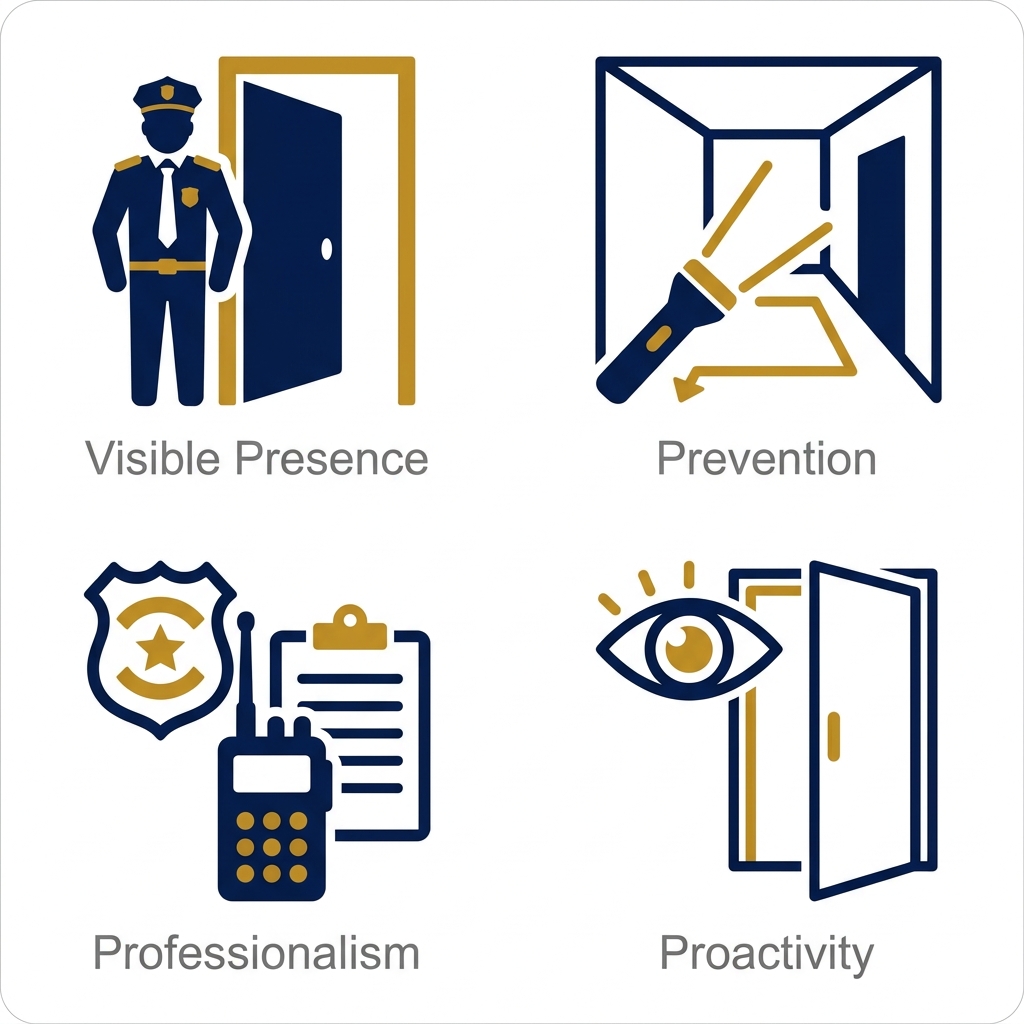
    Icon set representation of the four pillars of security guard work: Visible Presence, Prevention, Professionalism, Proactivity.
    Icon set symbolizing four pillars of professional security guard work.

    How Each Pillar Prevents Incidents on Site

    These four pillars matter only if each one demonstrably prevents incidents before they escalate. The polished presentation and courteous communication of our guards immediately signal competence and calm, reducing the chance a tense guest interaction turns confrontational. De-escalating language and a professional uniform communicate respect for visitors and staff, reducing the likelihood that a visitor will attempt to push at these boundaries. Finally, the accurate record keeping allows us to take any action necessary should an observation prove true. When logs consistently flag repeat trespassers, faulty doors, or dimly lit corridors, property managers can schedule repairs or adjust patrols before minor issues become major incidents. This layer of documentation ensures no irregularity slips through the cracks, reinforcing the deterrent effect of our presence.

    Professionalism That Builds Trust and Deters Trouble

    The way a guard stands presents authority but not aggressiveness, and proper etiquette can stop small things from turning into large problems. In Vancouver lobbies and strata foyers, our team’s polished uniforms and calm tone reassure guests and tenants that their safety is in capable hands, which discourages troublemakers from escalating minor disturbances. But being polite isn’t only about how you look on the outside. It’s about ensuring that everyone who goes through the doors knows they can be safe and treated with respect.

    Preparedness Through Training, Drills, and Emergency Planning

    Licensed personnel in British Columbia hold Basic Security Training and Advanced Security Training credentials, equipping them to act correctly in the first critical moments of an emergency. They also have site-specific emergency plans and regular drills that ensure guards know evacuation routes, alarm protocols, and fire watch procedures, so they respond with confidence rather than hesitation when seconds count. This type of preparation turns potential chaos into controlled actions that minimize the chance of injury and property damage.

    Proactiveness: Patrols, CCTV Monitoring, and Early Intervention

    In Lower Mainland areas, our team conducts deliberate patrol routes as well as live CCTV monitoring so that problems can be detected right away – like if there is an open door in a commercial area or someone loitering outside around midnight. We also conduct access control checks at building entrances in order to catch any suspicious behaviour before anything happens. This gives us enough time to deal with issues as they arise without waiting for things to get out of hand.

    Physical Fitness for Long Shifts and Rapid Response

    Overnight Shifts Need Stamina and Mobility. Guards who work patrol and mobile security work in both cities must be fit enough to run to an alarm, get into position and respond as necessary if there’s any kind of disturbance. They might have to escort guests around the premises, or investigate noise complaints near a construction perimeter. Fitness isn’t optional—it’s the foundation that keeps every other pillar effective when it matters most, ensuring guards can perform at their best throughout their entire shift.

    Applying the 4 P’s Across Hotels, Stratas, and Commercial Sites

    Understanding why each pillar matters becomes clearer once you see them at work during a real shift around the hotels, stratas, and other commercial sites here in the Vancouver area and the Lower Mainland. From professionalism through to physical fitness, our officers and our concierge team members make good use of all of these skills as shifts progress.

    The 4 P’s of Security Patrol in Practice

    Start of shift: our mobile patrol officer checks equipment, reviews the site map, and confirms the patrol route with the on-site guard. Professionalism shows in the uniform, the clear radio communication, and the courteous greeting to arriving staff. Preparedness means verifying flashlights, first-aid kits, and emergency contact lists before stepping onto the property. Mid-patrol: proactiveness kicks in as the officer adjusts the irregular route to focus on dimly lit corridors in the hotel and the rear parkade of the strata building, scanning for hazards before they escalate. By the final hour, sustained physical fitness keeps alertness high during routine checks of commercial perimeters, where uneven terrain demands extra vigilance. Throughout the shift, our officers maintain a visible presence that reassures guests, residents, and staff while deterring potential incidents before they occur. This consistent application of the four pillars ensures every property receives the same high standard of protection.

    Do the 4 P’s Apply to Concierge and Front-Desk Staff?

    Yes. Concierge and front-desk staff operate from the same four pillars except that they’re focused more on hospitality than security here. Professionalism shines in the form of warm greetings, attentive listening, and polished guest interactions. Preparedness covers a variety of topics including being able to handle emergencies, knowing the right protocols for controlling access into the facility as well as assisting guests should they need help exiting the building in case of evacuation. Being proactive shows when staff notice unusual lobby behavior or package-handling irregularities before they become incidents. Keeping fit enough to stand and endure shifts for extended periods, particularly during check-in surges, is important when every guest deserves prompt, courteous service. This blend ensures that the concierge not only meets security expectations but also enhances the guest experience.

    Site Audits That Turn the Framework Into a Custom Program

    The site specific security audit starts out with a walk through of the location itself looking at which aspects need to be reinforced. When dealing with a hotel – this might include the lobby and hallway traffic. For a strata building, it may include which doors people can enter from or the parkade’s visibility. With a commercial site perhaps we will look at the fence around the perimeter of the facility as well as any contractors that may be working there. We take all these different aspects together along with our guards, mobile patrol vehicles, and CCTV monitoring and make them work with the environment around us, creating a tailored program that turns the four pillars into measurable protection for guests, residents, and assets across Vancouver and the Lower Mainland. Each custom program is designed specifically for their unique needs but follows the basic framework of our four pillars.

    By implementing this practical application of all four principles, the same high standard of security and service is delivered consistently. Whether they’re checking into a hotel, returning to their strata building, or opening their business in the morning, people will experience that same high standard of security and service consistently.

    The 4 P’s and the 5 D’s: Two Frameworks Compared

    When readers ask what the 4 P’s in security guard work are, the answer begins with people. Our earlier examples across hotels, stratas, and commercial sites in Vancouver relied on two distinct frameworks that balance human oversight with strategic design. Understanding both helps property managers choose the right emphasis for their site.

    The 4 P’s center on the human element: People, Policy, Procedure, and Physical security. These pillars ensure every team member understands their role, follows consistent protocols, and maintains visible presence that deters threats. In contrast, the 5 D’s focus on strategic layers: Deter, Detect, Delay, Deny, and Defend. This model prioritizes technology and process to create multiple barriers that slow or stop unauthorized access before incidents escalate.

    The following table compares key dimensions across both frameworks:

    DimensionThe 4 P’s (People-Focused)The 5 D’s (Strategy-Focused)
    FocusHuman oversight and accountabilityLayered barriers and technology integration
    Core elementsPeople, Policy, Procedure, Physical securityDeter, Detect, Delay, Deny, Defend
    Best used forSites where direct engagement and visible presence are prioritiesSites prioritizing automation, remote monitoring, and rapid response
    Where they meetBoth frameworks reduce risk by combining human vigilance with strategic planning
    4 P’s vs. the 5 D’s of Security

    Choosing between the 4 P’s and the 5 D’s depends on the property’s unique needs. Hotels and stratas in Vancouver often benefit from the 4 P’s because guest interaction and visible staff presence build trust and deter opportunistic threats. Commercial sites and construction zones may lean toward the 5 D’s, where technology-driven detection and automated barriers align with operational efficiency and 24/7 coverage. In practice, most sites blend both models: trained personnel enforce policies while cameras and access controls execute the strategic layers.

    Quick Answers About the 4 P’s

    To wrap up the framework, here are the distilled answers to what the 4 P’s protect and prioritize.

    What do the 4 P’s protect?

    The 4 P’s framework protects people, property, premises, and the protective measures themselves. Each priority ensures no aspect of security is overlooked in Vancouver properties.

    How do the 4 P’s guide security decisions?

    They provide security program priorities that focus on the specific risk profile of sites within this region. These make their way from general guidelines for guards as well as other monitoring systems that can be applied at those locations.

    Use these answers to analyze your present security situation and identify where adjustments are needed before implementing the framework on your property.

    Frequently Asked Questions

    What are the 4 P’s of a professional security guard?

    The 4 P’s of a professional security guard are Presence, Prevention, Professionalism, and Proactivity. Presence means visible deterrence; Prevention involves routine patrols and hazard spotting; Professionalism covers licensed training and courteous conduct; Proactivity means acting on early warning signs before issues escalate.

    How does the ‘4 P’s’ framework help security guards prevent incidents?

    The 4 P’s framework helps security guards prevent incidents by combining visible deterrence with proactive checks, licensed training, and early intervention. Presence discourages troublemakers, Prevention spots hazards before they develop, Professionalism ensures respectful and competent interactions, and Proactivity turns awareness into immediate action.

    Do the 4 P’s of security guard work apply to concierge and on-site staff?

    Yes. The 4 P’s apply to concierge and on-site staff, focusing on Professionalism in guest interactions, Preparedness for emergencies, Proactiveness in spotting irregularities, and Physical fitness to maintain service quality during long shifts.

    How do the 4 P’s (Professionalism Preparedness Proactiveness Physical Fitness) improve site security?

    Professionalism ensures guards act with competence and respect, reducing confrontations. Preparedness through training and drills allows quick, confident responses in emergencies. Proactiveness turns routine patrols and monitoring into early interventions. Physical fitness keeps guards alert and mobile throughout demanding shifts.

    Are there differences between the 4 P’s and the 5 D’s of security?

    Yes. The 4 P’s focus on people and their actions: Presence, Prevention, Professionalism, and Proactivity. The 5 D’s emphasize strategy and technology: Deter, Detect, Delay, Deny, and Defend. The 4 P’s center on human oversight while the 5 D’s prioritize layered barriers and process.

    Put the 4 P’s to Work on Your Property

    Now that you understand what the 4 P’s in security guard work really are, walk your Vancouver property and assess each element against your site’s unique needs. Our team can help you evaluate these factors during a no-obligation security audit tailored to your building’s layout and risks.

    If you need a tailor-made security plan covering all three aspects – people, process, and technology – then give us a call on (+1) 866-603-1303 or stop down to see us at Regent Security Services Ltd., located right downtown in Vancouver. Don’t forget to talk to an accredited security professional if you want specifics about your particular location.

    Put the 4 P’s to Work

    You now understand what the 4 P’s in security guard work are — Presence, Prevention, Professionalism, and Proactivity — and how each one prevents incidents before they escalate. You’ve also seen how these pillars come together across hotels, stratas, and commercial sites, and how a site audit turns the framework into a custom program. The next step is walking your own property and assessing each pillar against what you’ve learned here. If you’d like expert support, our team of 200+ trained, licensed and insured professionals is ready to help in Vancouver and the Lower Mainland. With 15+ years of experience serving 1,000+ clients, we can shape a program built around your site’s specific needs. request a custom quote by calling (+1) 866-603-1303 or visiting our team online. Professional security starts with a conversation about your property.

    Put the 4 P’s to Work

  • Security Guard Duties and Responsibilities PDF: Complete Guide

    Security Guard Duties and Responsibilities PDF: Complete Guide

    Table of Contents

    Security Guard Duties and Responsibilities PDF: The Complete Guide

    A security guard duties & responsibilities PDF consolidates the essential tasks and duties performed by licensed security officers in accordance with BC’s security training framework. The downloadable PDF contains the fundamental skills necessary for these officers, ranging from access controls and patrol activities through to emergency responses, which are all in line with provincial certification requirements. This guide can be used as a reference point for either new staff members or those already working in the security field in BC.

    This document provides guidelines to support mandatory Basic Security Training (BST) and Advanced Security Training (AST) courses for licensing within British Columbia. It helps security firms and guard personnel understand the scope of lawful duties, including those authorized for armed guards and handlers of restraints, while emphasizing the importance of ongoing professional development. this document becomes a useful tool for guarding agencies and guards alike to comply with current laws and deliver their professional services uniformly and effectively.

    In practice, these duties translate into daily protocols such as monitoring CCTV systems, conducting patrols, and managing access control. At Regent Security Services, we integrate these standards into our Vancouver and Lower Mainland operations to guarantee our licensed guards are prepared for any assignment. These responsibilities are documented in and across professional post orders templates, which detail site-specific instructions for every shift.

    Key Takeaways

    • The post orders template transforms high-level security regulations into concrete tasks for every day at individual facilities.
    • Hotel and concierge security guards have greater than basic patrol obligations when compared to security positions elsewhere.
    • A key aspect in site safety is the transformation of general task orders into precise checklists that can be effectively implemented in day-to-day tasks.
    • Commercial security guard contracts in British Columbia are used to detail exactly what security guards are expected to accomplish through their employment according to the terms established under provincial law.
    • We answer common questions about BC security guard licensing and training.

    Core Duties in Security Guard Post Orders Templates

    The post orders template transforms high-level security regulations into concrete tasks for every day at individual facilities. Instead of a template per se, the document acts as a guide that modifies basic types of duties based on industry-specific needs: access control, patrol methods, monitoring, incident reporting, licenses, etc., which then become detailed tasks that must be carried out accordingly. All guards receive detailed guidance about how to meet their responsibilities within each of these duty categories according to provincial law.

    Duty CategoryHotelCommercialConstruction
    Access ControlKey card management, guest access restrictions, lobby screeningVisitor management systems, employee credential verification, loading dock accessPerimeter check-in/out of workers and vehicles, material delivery logging
    Patrol MethodsGPS-tracked patrols covering underground parking, mechanical rooms, and guest floorsScheduled interior and exterior patrols focused on asset protectionSite patrols including material laydown areas, equipment storage, and after-hours checks
    CCTV MonitoringIntegrated CCTV with real-time monitoring and recordingMonitoring of common areas, parking facilities, and entry pointsSurveillance of perimeter, temporary fencing, and equipment storage zones
    Incident ReportingDigital incident logs with software-enabled shift reports for transparencyDetailed incident documentation for liability and trend analysisImmediate documentation of safety incidents, theft, and site condition changes
    Licensing RequirementsBST certification, criminal record check, authorizations for restraints or guard dogs as neededSame mandatory BST and background checksSame mandatory BST and background checks
    Guest/Customer InteractionConcierge-level guest assistance, fire watch duties, emergency coordinationProfessional interaction with tenants and visitors, maintaining a visible security presenceLiaison with contractors and site supervisors, reporting safety hazards
    Comparison of Core Security Guard Duties by Sector

    The hotel post order places equal importance on providing for the comfort and wellbeing of its guests whilst also ensuring that staff conduct themselves in a safe manner at all times. In addition to this, each type of environment uses the latest technological methods to monitor guards’ activity, including GPS-tracked patrol systems and online incident logbooks which help them keep track of what goes on when they’re out on duty. Across all three environments, every guard must hold a valid Basic Security Training (BST) certificate and pass criminal record checks as mandated by the British Columbia government’s security industry licensing framework, ensuring a uniform baseline of competence and accountability.

    In addition, improvements in hotel-related security include concierge-style duties, lobby access procedures, and emergency assembly tasks, which help form a complete strategy on how to approach such issues.

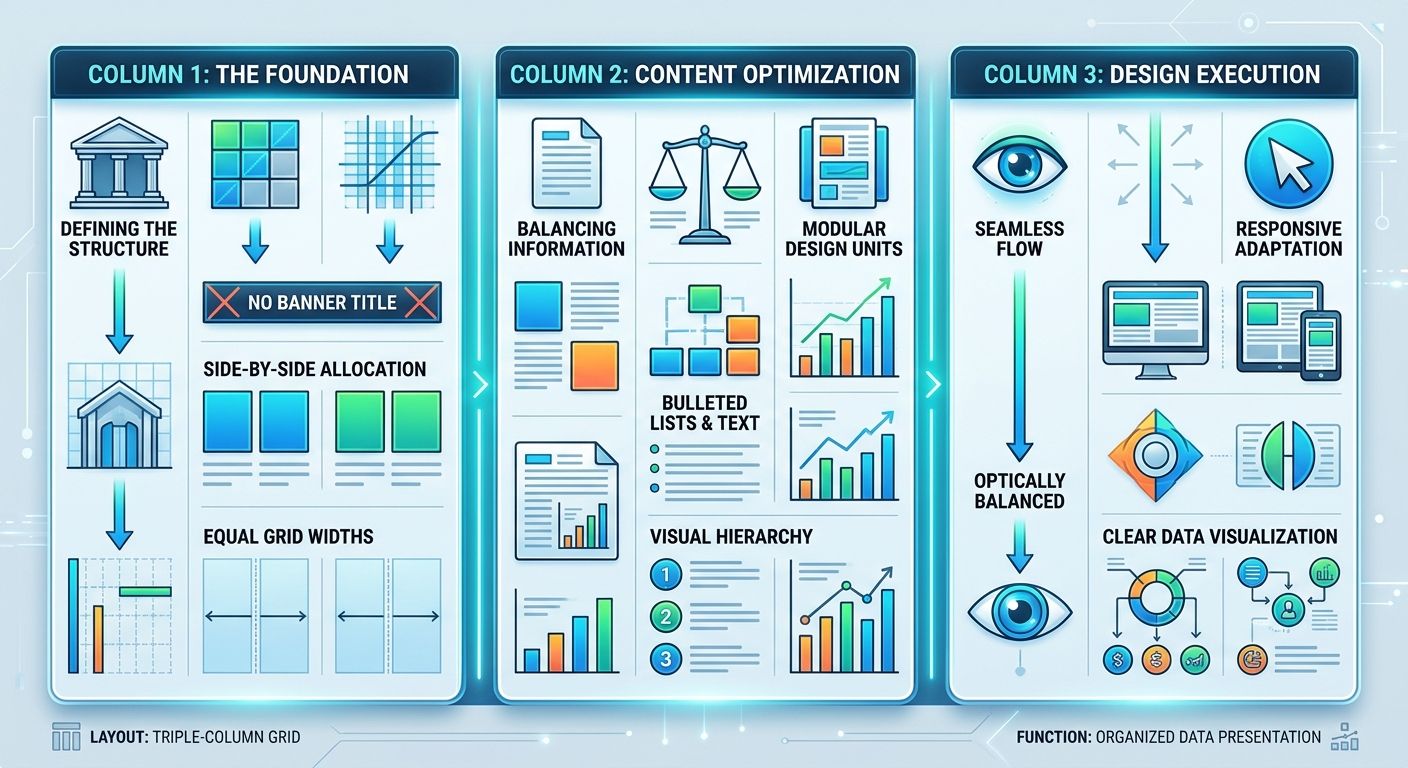
    Infographic showing three columns of security guard duties: Hotel (Guest Hospitality, CCTV Monitoring, Patrol Tracking, Incident Logs), Commercial (Asset Protection, Visitor Management, Access Control, 24/7 Coverage), and Construction (Perimeter Monitoring, Equipment Checks, Site Patrol, Emergency Response).
    Security guard duties sector comparison: Hotel hospitality, Commercial asset protection, Construction site security.

    Customizing Security Guard Responsibilities for Hotels and Concierge Services

    Hotel and concierge security guards have greater than basic patrol obligations when compared to security positions elsewhere. Their obligations involve protecting the property as well as providing guests’ services. Post regulations just can give them some instruction about the basic functions they should be performing at their posts. These workers must employ these skills along with additional expertise to ensure they fulfill their main purposes on the job. Assignments must suit the need for hospitality and safety.

    Tailoring Post Orders for Hospitality Environments

    A comprehensive post order template for hotel employees might contain instructions to welcome customers, help them carry bags and other items in their possession, watch the lobby area and public spaces, etc. When developing hotel security guard duties and responsibilities pdf you need to adjust standard protocols to the property layout and guest traffic. Security Force USA has an incident report writing guide that specifies the incident report should include the objective language, chronological event account, documentation of de-escalation attempts, and a brief two- to three-sentence conclusion. Also guards shouldn’t use their own gadgets for taking pictures, photos or videos and need to rely only on company’s systems to preserve the evidence chain of custody.

    Here’s how some key parts from a hotel’s security staff job duty list look compared to what would be included for concierges in hotels:

    SectionHotel SecurityConcierge Service
    Primary ObjectiveProtect guests, staff, and property; deter crime; monitor access points.Provide a welcoming presence, assist guests with requests, while maintaining discreet oversight.
    DocumentationDetailed incident reports with objective language, chronological narrative, de-escalation notes, and brief summary. Evidence captured via official devices.Log guest interactions, service requests, and any unusual observations in a daily activity report.
    Technology IntegrationGPS-tracked patrols, CCTV monitoring, digital incident logs for real-time reporting to management.Same surveillance technology used to support guest assistance and oversight.
    Training RequirementsBasic Security Training (BST), Advanced Security Training (AST), Occupational First Aid Level 2, and criminal record check under BC Security Services Act.Same BST and licensing, with additional emphasis on customer service, communication, and hospitality protocols.
    Guest InteractionMaintain visible security presence; respond to incidents; enforce hotel policies discreetly.Engage with guests, offer directions, handle luggage, and provide a friendly yet observant demeanor.
    Essential Sections of a Hotel Security Guard Duty Checklist vs Concierge Checklist

    Both positions require identical regulatory licensing under the BC Security Services Act, but the role of a concierge requires heightened hospitality skills. The difference in tasks forms the basis for our site specific post orders that keep security personnel both safe as well as providing great services to our guests.

    Concierge-Like Security Roles in Vancouver Hotels

    In Vancouver’s hospitality sector, security personnel often adopt a concierge-like role, blending oversight with guest relations. Our team members are trained to assist with directions, manage luggage, and respond to inquiries. All our guards hold Basic Security Training and Advanced Security Training certifications, with many also obtaining Occupational First Aid Level 2, which exceeds the minimum requirements set by the BC Security Services Act.

    Integrating Technology for Enhanced Guest Safety

    With GPS-tracked patrol systems in place, managers have access to real-time information about their staff when they are on duty, allowing them to see whether all parts of the building are monitored by security personnel – from underground car parks to guests’ rooms. Digital incident logs then produce timestamped records which, following relevant reporting procedures for incidents, are kept as per the chain of custody process. The software allows shift reports for clients to be set up to suit individual sites, enabling managers to ensure your peace of mind.

    These specific job responsibility duties serve as a blueprint when setting up a site-specific task checklist for each property. This makes certain that both hotel and the concierge desk run effectively to ensure that guests are well looked after.

    Building Site-Specific Security Guard Duty Checklists

    A key aspect in site safety is the transformation of general task orders into precise checklists that can be effectively implemented in day-to-day tasks. An excellent checklist assigns each guard their particular set of duties based upon the dangers and requirements of the property under protection, offering a framework for everyday operation whilst making sure all obligations are satisfied by adhering to local regulations of the state of BC.

    Key Components of a Comprehensive Guard Duty Checklist

    A complete security patrol checklist should start with the guards’ credentials being verified including confirming that all guards have a valid Basic Security Training (BST) license and have passed any required Advanced Security Training(AST), or OFA 2 certifications, and must also include checks for equipment readiness, such as functioning radios, flashlights, CCTV monitoring stations, and access control systems. Then specify what procedures occur once they arrive at their post; whether this includes checking the post log for any updates, inspect the site perimeter prior to assuming duties. Once the guards assume duties the checklist should outline how patrols are carried out, verifying if the correct patrol routes were used, how many times each route was travelled on, and did the officers use the proper tour tracking system if available. Finally the checklist should also contain clearly outlined procedures for incident documentation to ensure reports are completed promptly.

    POPProbe’s staffing coverage review checklist provides a practical template based on 35 key inspection points across seven categories, including shift coverage, officer licensing, patrol route verification, equipment readiness, supervisory oversight, incident reporting, and contingency planning. We adapt this format into weekly site-specific audits so that every guard fulfills their duties as required by the British Columbia Security Services Act. Our unmatched security expertise informs how we integrate backup resource identification—such as emergency standby officer contacts—directly into each site checklist, ensuring ULA02050 compliance and rapid continuity in any emergency.

    Incident Reporting: Best Practices and Documentation Templates

    Incident reports are legal documents that may be scrutinized by authorities. In British Columbia, the Security Services Act mandates objective, accurate documentation that clearly distinguishes observations from assumptions. Security Force USA’s guide suggests starting with a 2-to-5-sentence summary and then a chronological account that includes any de-escalation attempts. Guards should never use personal devices to capture evidence images.

    MethodManual LogbookDigital SoftwareHybrid Approach
    ReliabilitySimple, no power; risk of illegibility or lossTimestamped, cloud backup; requires deviceCombines paper capture with digital backup
    SearchabilitySlow, manual scanKeyword search and filtersSearchable after digitization
    Legal DefensibilityLacks timestamps, may be challengedAutomated audit trail, tamper evidenceOriginal paper plus digital audit
    Incident Reporting Methods Comparison

    The mixed approach often suits sites with unreliable connectivity or client mandates for paper records. We supplement any method with in-house reporting software that standardizes documentation and delivers professional client-facing shift reports.

    Using Technology to Streamline Daily Activity Logs

    Instead of relying on handwritten logs that are often open to interpretation and inconsistencies due to poor handwriting, digital tools can capture time-stamped observations, photo evidence, and patrol confirmations as they happen. With security software, security guards can record their duties using their smartphone or tablet, and these entries will be converted into organized shift reports for each property.

    Our custom-built software allows supervisors to view guards’ check-in times, monitor patrols, be alerted immediately when a stop is missed, and review pictures and notes about environmental hazards that may arise. This information can then be used to address problems prior to them becoming critical. By integrating duty checklists with digital reporting, we ensure that every arrival, patrol, and equipment check is recorded in a searchable, auditable format. This integration supports compliance with B.C. regulations and builds a defensible record for liability management.

    They provide the foundation for all the services that we perform on our BC commercial security contracts. They serve as checklists to help ensure consistency across clients.

    Scope of Services for Commercial Security Guard Contracts in BC

    Commercial security guard contracts in British Columbia are used to detail exactly what security guards are expected to accomplish through their employment according to the terms established under provincial law. Each contract must ensure that all assigned guards hold a valid Basic Security Training (BST) certificate and have passed a criminal record check, as mandated by the BC Security Services Act. As far as what the scope contains, it typically encompasses a mix of physical presence and technology, including on-site patrolling (foot or vehicle). Another component could involve software-enabled incident reporting, CCTV monitoring, and access control integration (such as keyless entry and biometric verification).

    Service ComponentStandardPremiumEnterprise
    Guard Licensing & Background ChecksLicensed guards with BST and criminal record checkLicensed guards with BST and criminal record checkLicensed guards with BST and criminal record check
    On-site PatrolFoot patrol, random checksGPS-tracked patrol with real-time verificationMobile patrol integrated with access control and CCTV
    Incident ReportingBasic written logsDigital, software-based incident reportsAdvanced, client-facing shift reports with customization
    CCTV MonitoringNot includedActive on-site CCTV monitoringComprehensive monitoring with integrated alarms and access control
    Access ControlPhysical key managementBasic electronic access (PIN code entry)Keyless, biometric access control systems
    24/7 CoverageAvailable upon requestDedicated overnight coverageFull 24/7 team with rapid escalation and emergency response
    Scope of Services Components for Commercial Security Guard Contracts

    In case we’re talking about hotels situated on the territory of Vancouver then in the Premium tier they’ll be using GPS-tracked patrolling of their underground car parks, mechanical rooms as well as their guests’ floors. With real-time digital incident logging and active CCTV surveillance they provide management with up-to-date records. Higher-risk places can go for the Enterprise tier which provides them with biometric access control system and integrated alarm management system.

    It’s important that we have a clearly defined scope to eliminate uncertainty over the duties that security guards should perform each day, and transform job functions into measurable contract deliverables such that clients will be able to hold service providers accountable for their performance and modify coverage based on risk factors.

    Common Questions About Security Guard Duties and Responsibilities

    We answer common questions about BC security guard licensing and training.

    What basic training does BC require for security guards?

    The ministry says the guards have gone through Basic Security Training (BST) either at the Justice Institute of BC or some other approved training course. They can be ex-police officers or those who have worked in corrections, and they have all completed the certification program.

    What authorizations are needed for restraints or guard dogs?

    If guards utilize restraints then they must have completed Advanced Security Training (AST) which needs to be repeated at least once every three years. The dog handlers must possess Canine Security Validation, and we maintain these authorizations for relevant assignments.

    Do armoured car guards need firearms authorization?

    Armoured car guards require an Authorization to Carry Restricted Firearms and Prohibited Handguns (ATC) under BC regulations. We confirm this credential for all armed roles.

    Frequently Asked Questions

    What core duties should be included in a security guard post orders template?

    A security guard post orders template should include access control, patrol methods, CCTV monitoring, incident reporting, licensing verification and guest or customer interaction duties. These categories are adapted to each site, and every guard must hold a valid Basic Security Training certificate under British Columbia’s licensing framework.

    How can I customize security guard responsibilities for hotel and concierge services?

    Customize responsibilities by adjusting standard protocols to the property layout and guest traffic, then adding concierge-style tasks like welcoming guests, assisting with luggage and monitoring lobbies and public spaces. Both hotel security and concierge guards require BST licensing, while concierge staff need heightened hospitality skills and technology such as GPS-tracked patrols for real-time oversight.

    What are the essential sections for a site-specific security guard duty checklist?

    Essential sections include guard credential verification (BST, AST, OFA 2 certifications), equipment readiness checks, post arrival procedures, patrol route specifications and incident documentation protocols. A thorough checklist may also incorporate supervisory oversight and contingency planning, mirroring the 35-point POPProbe template used for weekly site-specific audits.

    How do professional security guard companies document incident reports and daily activity logs?

    Professional companies use digital software to produce timestamped, objective incident reports. Each report begins with a 2-5 sentence summary, followed by a chronological narrative and documentation of any de-escalation attempts. Evidence is captured only on company devices to preserve chain of custody, and shift reports are customized per property for transparent client review.

    What should be included in the scope of services for a commercial security guard contract?

    The scope of services should detail the specific guard duties for the site, including visitor and loading dock access control, scheduled interior and exterior patrols focused on asset protection, CCTV monitoring of common areas and entry points, detailed incident documentation and professional interaction with tenants. All guards assigned must hold a valid BST license.

    Implementing Professional Security Guard Services for Your Property

    A security programme needs trained guards that have done the basic training in British Columbia. Regent Security will make sure all their staff are licensed, insured and comply with the BC Security Services Act. The guards use GPS-tracked patrol systems and incident reporting. We offer 24/7 protection and fast response time. Since then for over 15 years we’ve been able to train more than 200 people. Every single security project is different which means we need a site assessment before being able to quote you on our services. Response time, outcome of your project and costs are variables. Surveillance and cctv has to be made in accordance to privacy laws (pipa). This is general information and is not legal advice.

    Get Your Custom Security Plan

    Now that you have a thorough understanding of security guard duties and responsibilities, it’s time to translate that knowledge into a robust protection plan for your property. We have been serving clients in Vancouver and the Lower Mainland for over 15 years, with a team of 200+ licensed and insured professionals. Our guards are trained in BST, AST, and OFA 2 standards, ensuring compliance with BC regulations and delivering the highest level of vigilance. We offer custom, site-specific security solutions backed by GPS-tracked patrols, CCTV monitoring, and detailed incident reporting. Whether you need hotel security, commercial guard contracts, or construction site protection, we tailor our services to your unique requirements. Contact us today at (+1) 866-603-1303 for a consultation and quote. Your peace of mind is just a call away.

    Get Your Custom Security Plan

    Resources

  • After Hours Business Security Vancouver: 24/7 Professional Protection

    After Hours Business Security Vancouver: 24/7 Professional Protection

    Table of Contents

    After Hours Business Security in Vancouver, British Columbia

    After-hours business security in Vancouver, British Columbia is provided by Regent Security Services Ltd. through site-specific assessments and 24/7 monitoring. With over 15 years of experience and AI-equipped licensed guards, we deliver tailored solutions with response times averaging under 30 minutes.

    Key Takeaways

    • Recognizing the signs your business needs after-hours protection after hours business security in Vancouver is the first step toward complete protection.
    • Providing after-hours protection for Vancouver-based firms requires more than a locked door; it requires a tailored mix of mobile patrols, static guards, and rapid-response services.
    • With these services in mind, focusing on provider credentials, customization, and local knowledge helps you choose the right partner.
    • For urban properties across the Lower Mainland, our emergency deployment model can achieve typical response times of under 30 minutes because we base every engagement on a thorough site assessment.
    • We provide rapid after-hours security deployment across British Columbia, available 24/7.

    Signs Your Business Needs After-Hours Security

    Recognizing the signs your business needs after-hours protection after hours business security in Vancouver is the first step toward complete protection. With over 15 years of experience, we’ve identified clear signs:

    • Your current security arrangement ends at close of business hours, leaving your property unattended and vulnerable to theft overnight.
    • Your property lacks 24/7 CCTV monitoring or after-hours mobile patrols.
    • Previous break-ins, vandalism, or trespassing in Vancouver occurred after your business closed.
    • Your insurance provider recommends documented after-hours monitoring to manage risk and potentially reduce premiums.

    When you recognize these signs, dedicated after-hours security services become the logical next step.

    After Hours Security Services for Vancouver Businesses

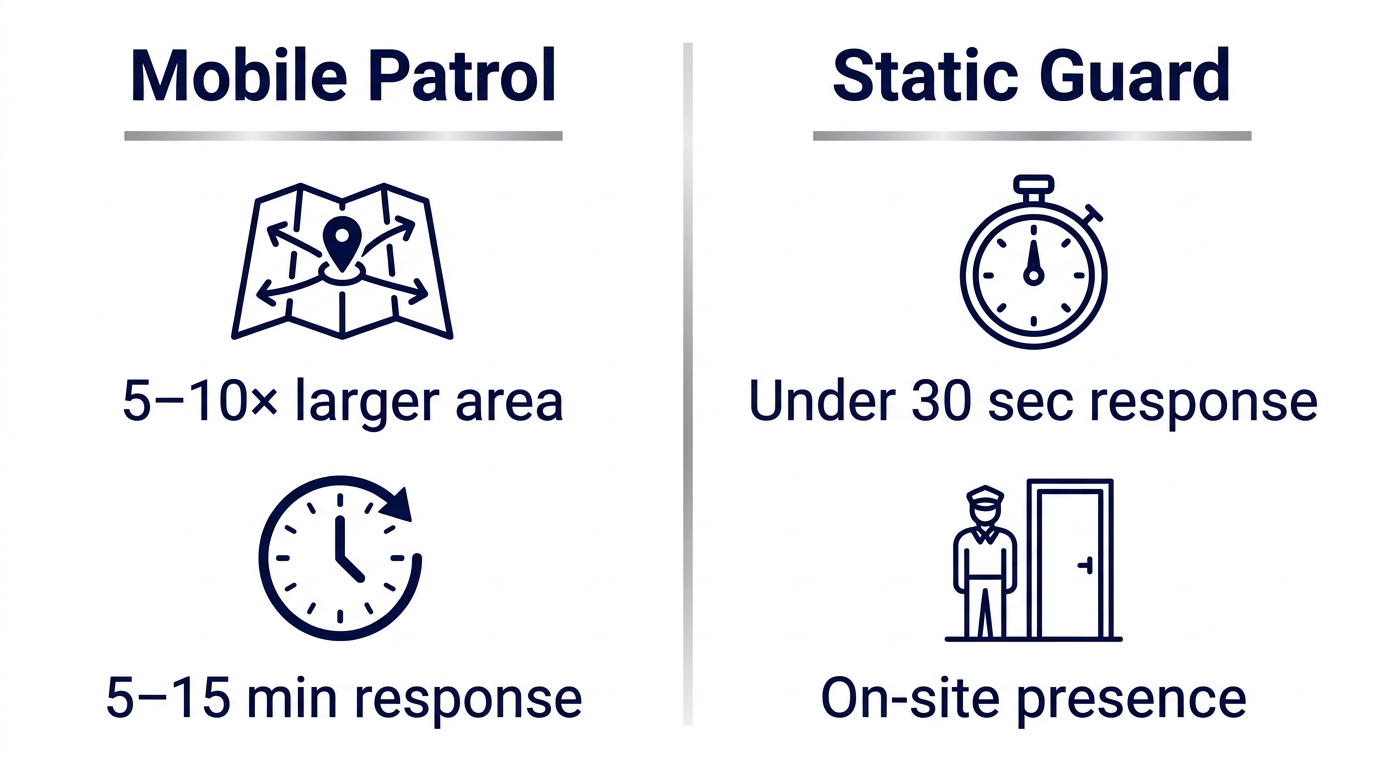
    Providing after-hours protection for Vancouver-based firms requires more than a locked door; it requires a tailored mix of mobile patrols, static guards, and rapid-response services. Mobile units from our company can cover a geographic area five to ten times larger than fixed personnel. We assign static guards who remain on-site throughout the night.

    Infographic comparing mobile patrol and static guard security services with area coverage and response times
    Mobile patrol vs static guard: coverage area and response time comparison

    Our loss prevention services combine uniformed and plainclothes officers with AI-integrated video monitoring to deter theft and vandalism after business hours. For urgent needs, we deploy emergency security guards across the Lower Mainland, with a typical arrival time of under 30 minutes for Vancouver locations, offering fire watch and static guard options. Every after-hours security plan begins with a site assessment that ensures the coverage is tailored precisely to your property’s risks, giving you peace of mind.

    Choosing the Right After-Hours Security Provider

    With these services in mind, focusing on provider credentials, customization, and local knowledge helps you choose the right partner. Verify that guards hold Basic Security Training (BST) certification under BC’s Security Services Act. A thorough site assessment enables a layered defense—combining on-site patrols or mobile units with AI-powered cameras that use motion detection, facial recognition, and behavioral analytics—to secure your business after hours. Additionally, AI-powered cameras can alert our monitoring center to suspicious activity even when your premises are unstaffed. Local experience matters: our 15+ years serving over 1,000 Vancouver-area clients means we understand the region’s unique risks and tailor solutions accordingly. After you narrow your options, request a custom consultation to meet Vancouver’s regulations and your budget, backed by unmatched security expertise.

    Vancouver-Specific After Hours Security Considerations

    For urban properties across the Lower Mainland, our emergency deployment model can achieve typical response times of under 30 minutes because we base every engagement on a thorough site assessment. This evaluation accounts for neighborhood layout, traffic patterns, and the unique vulnerabilities of each property, leading to a deployment strategy that is tailored.

    Our emergency services for after-hours scenarios include fire watch, static on-site guards, mobile patrols, and event security, each configured to address the specific risks an unoccupied facility faces. All deployed personnel hold Basic Security Training (BST), Advanced Security Training (AST), and Occupational First Aid Level 2 (OFA 2) certifications as mandated by the BC Security Services Act, ensuring that every responder is fully licensed and prepared for the demands of overnight and weekend operations. With over 200 trained professionals stationed in the region, we maintain the readiness to dispatch licensed guards.

    Please feel free to give us a call so that we can build your security quote for your site in Vancouver.

    Understanding After-Hours Security Costs

    With more than 15 years’ experience providing after-hours security for local businesses, we’ve found that these rates will depend on the specific risks identified when conducting your site assessment, the types of certifications necessary, as well as any technology you decide to employ. The security firm conducts a site assessment on-site at each location. Our guards all hold required provincial security certification under the BC Security Services Act. Some opt to integrate cameras equipped with artificial intelligence capabilities or deploy mobile patrols with various levels of technology. In general, a significant after-hours presence can actually reduce insurance premiums, saving money while also increasing security. Contact our licensed Vancouver security team to get a customized quote based on your business’ requirements.

    How Quickly You Can Get After-Hours Security

    We provide rapid after-hours security deployment across British Columbia, available 24/7. In Vancouver, our response times are typically under 30 minutes, with zone-based deployment models ensuring coverage across the Lower Mainland. Every service begins with a professional site assessment to tailor the solution to your property’s urgent needs, ensuring our 24/7 commitment delivers reliable protection without sacrificing appropriateness.

    Our Service Commitment for After-Hours Protection

    Our after-hours protection service is grounded in reliability and local expertise, featuring licensed, BST-certified guards, site-specific plans, and AI-powered monitoring with 24/7 rapid response by over 200 professionals across Vancouver.

    Frequently Asked Questions About After Hours Security

    Common after-hours questions.

    • Are your after-hours security guards licensed? All our security guards hold the provincial security certification required by the BC Security Services Act.
    • How quickly can you respond to an incident in Vancouver? Typical emergency response is under 30 minutes in Vancouver, and every deployment plan begins with a professional site assessment.
    • What security approach do you use after hours? We combine physical patrols, AI-powered monitoring, and access control in a layered defense model that complies with provincial regulations.

    Need help organizing an after-hours plan tailored to your property? Contact us for a custom quote.

    Get Your After Hours Security Quote

    To get a custom after-hours business security quote for Vancouver, call (+1) 866-603-1303 or email admin@regentsecurity.ca; we bring 15+ years’ experience, 1,000+ clients. Services are subject to site assessment and custom quotation; results and pricing may vary; not a substitute for professional or legal advice.

    Resources

  • Integrated Security Solutions: Access Control & Video Monitoring Guide

    Integrated Security Solutions: Access Control & Video Monitoring Guide

    Table of Contents

    Integrated Security Solutions for Multi-Site Businesses in Canada

    Managing security across multiple locations presents unique challenges for Canadian businesses. Inconsistent protocols, fragmented reporting, and a lack of centralized visibility can create vulnerabilities. Integrated security solutions provide a unified approach, consolidating these disparate elements into a single, manageable platform. For operations spread across Vancouver, Burnaby, or the broader Lower Mainland, an integrated security solutions multi-site operations are essential for maintaining consistent protection.

    We address these challenges by designing customized security plans that blend professional on-site guards with advanced technology. This integration offers significant advantages for multi-site management:

    • Centralized access control and intrusion detection for all facilities
    • Unified remote video monitoring, providing real-time visibility from one dashboard
    • Streamlined incident response protocols and consolidated reporting
    • Consistent application of security standards across every location

    By leveraging our licensed and insured professionals alongside advanced access control systems and remote video monitoring, we ensure your properties are protected anytime, anywhere. This connected strategy eliminates gaps between sites and provides a comprehensive view of your entire operation.

    Our capability to deliver 24/7 monitoring and rapid, same-day deployment ensures your peace of mind. We understand that a security breach at one site can impact the entire organization, and our integrated model is designed to provide swift, coordinated responses. For a personalized quote on a multi-site security strategy that combines mobile patrols, alarm response, and technology, contact our team today.

    PACOM Integrated Security Platform

    To deliver these services reliably, we rely on an integrated security software platform that merges access control, intrusion detection, and remote video monitoring into a single pane of glass. This unified architecture gives our team a comprehensive view of your site in real time, enabling instant, coordinated responses to any incident. Centralizing these technologies eliminates the gaps that exist when systems operate in isolation. Your peace of mind, anytime, anywhere, is the direct result of this streamlined approach. This platform enables our rapid-response process, which we’ll detail next.

    C4 Portal Unified Command

    Our C4 Portal Unified Command serves as the nerve center for our integrated security solutions, merging access control systems and remote video monitoring into one intuitive, centralized dashboard. This real-time visibility allows us to coordinate every layer of protection with precision. Through the portal we efficiently manage our multifamily security patrol service, ensuring seamless coordination for Vancouver properties.

    American Security Perimeter Detection

    For properties requiring integrated security solutions, a specialist provider may deploy buried cable sensors, fence-mounted detection, and microwave barriers that link with access control systems and CCTV for secure, centralized awareness across utilities and industrial sites. While that model suits high-risk U.S. facilities, you can get remote video monitoring services in Canada through our own 24/7 team.

    Regent Security Remote Video Monitoring

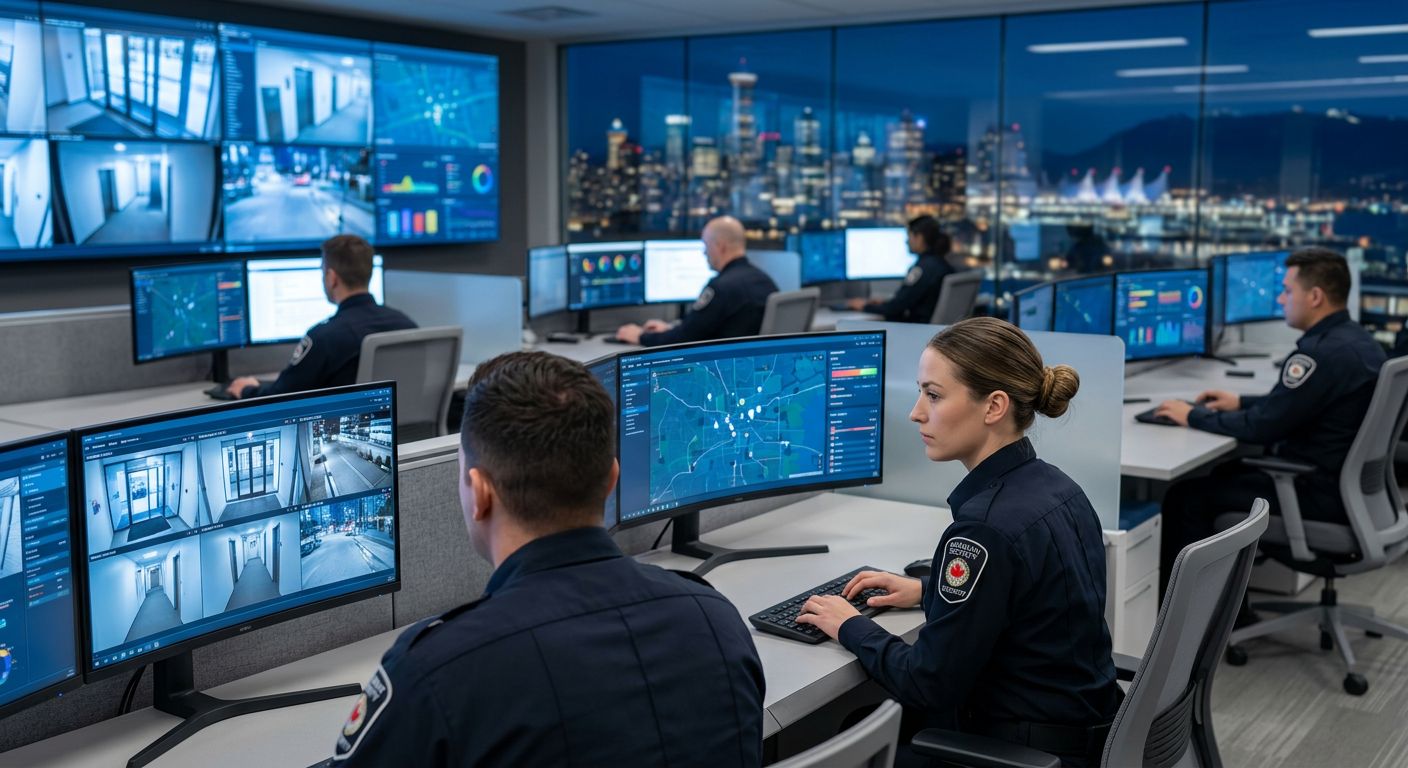
    As part of our integrated security solutions, Regent Security provides remote video monitoring services in Canada that deliver 24/7 surveillance from a central station. It supports hotels, commercial sites and multi-site portfolios, offering scalable proactive coverage across BC. Our real-time monitoring integrates with on-site guards for rapid incident response, providing your peace of mind anytime, anywhere.

    Genetec Security Center

    Genetec Security Center is the core of an Integrated Security Solution that merges access control systems with remote video monitoring into one intuitive platform. For our team at Regent Security, it provides a real-time, unified view of your property, enabling swift detection and response. This is built on principles drawn from SSRG security guidelines, which advocate for integrated system design to deliver Unmatched security expertise and truly Your peace of mind.

    Avigilon Control Center

    Avigilon Control Center is a cornerstone of our integrated security solutions, offering remote video monitoring and access control integration. The RCMP’s crime prevention guidance recognizes video surveillance as a proven deterrent against theft and vandalism. ACC’s built-in analytics—motion detection and people counting—improve incident response and reduce false alarms.

    Scalable to enterprise networks, it supports our 100+ trained security personnel. This foundation for our technology-enabled monitoring—from mobile patrols to alarm response—delivers unmatched security expertise and your peace of mind, anytime, anywhere.

    Milestone XProtect

    At Regent Security, Milestone XProtect is the video management backbone of our integrated security solutions. This open-platform system seamlessly connects with IP cameras and access control, enabling real-time monitoring and 24/7 recording plus secure centralized archive access for investigations and audit trails. Designed for hotel security, it scales to any property size, providing Your peace of mind, anytime, anywhere.

    Bosch Building Integration System

    A true integrated security solution, the Bosch Building Integration System unifies access control and video surveillance into one centralized, intelligent platform. We use this unified security platform to manage everything from a single interface, enabling real-time alerts and remote video monitoring. Designed for scalability, this integrated access and video system simplifies hotel and commercial property protection, ensuring our team can act on critical threats anytime, anywhere, for your peace of mind.

    Honeywell Pro-Watch

    As part of our integrated security solutions, we deploy Honeywell Pro-Watch, a comprehensive platform that unifies access control systems with remote video monitoring. In hotel environments, this technology enables real-time surveillance and centralised access management, significantly enhancing guest safety and operational efficiency. It is one of the scalable, technology-enabled tools we rely on to deliver Your peace of mind.

    LenelS2 OnGuard

    LenelS2 OnGuard is a scalable access control platform within our integrated security solutions. It combines access control systems with remote video monitoring and alarm integration for centralized control. With remote access management, teams can secure premises and respond to incidents in real time. This makes it ideal for hotel environments to enhance guest and staff safety.

    We provide deployment, configuration, and ongoing support, delivering unmatched security expertise for your peace of mind. Beyond access control, our full technology suite extends your protection.

    Comparing Leading Integrated Security Platforms

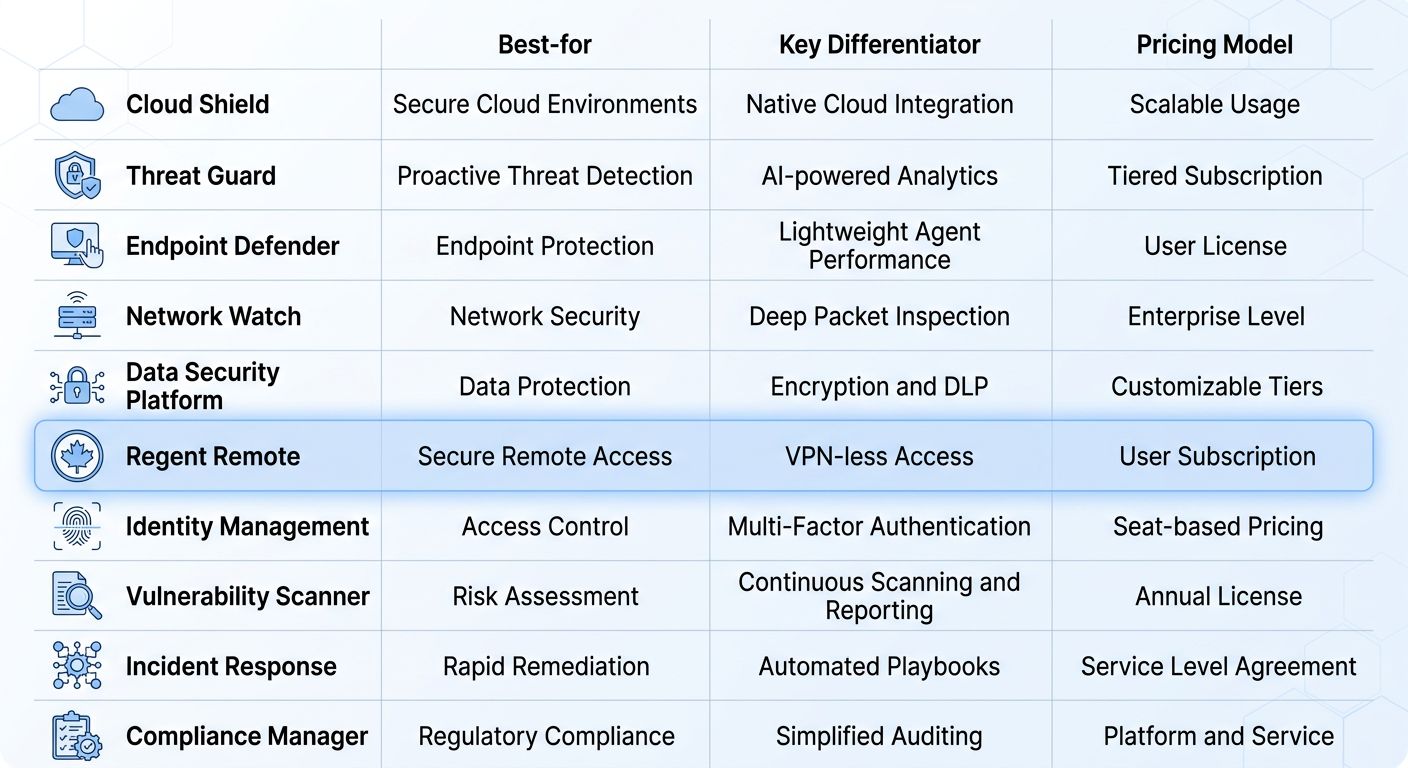
    When evaluating integrated security solutions, decision-makers must consider the specific needs of their facilities and the capabilities each platform offers. The table below provides a concise overview of ten leading systems, highlighting their ideal applications and key strengths to support a more informed selection process.

    Solution Best For Key Differentiator Pricing Model
    PACOM Large enterprises Unifies hardware and software Custom quote
    C4 Portal Property managers Cloud-first command center Per-site subscription
    American SPD Perimeter-focused security Advanced outdoor detection Project-based
    Regent Remote Multi-site live monitoring 24/7 Canadian operations center Monthly service fee
    Genetec Unified security ecosystem Open platform integrations License + maintenance
    Avigilon High-definition video Self-learning analytics Hardware + software
    Milestone Open platform VMS Freedom of hardware choice Per-channel license
    Bosch Building management integration BMS convergence System-wide quote
    Honeywell Enterprise access control Scalable across regions System-wide quote
    LenelS2 High-security facilities FIPS 201 compliant Custom negotiation

    Pricing models vary considerably, from custom project quotes to per-channel licensing, making it essential to align system capabilities with operational budgets and security priorities. Platforms like Genetec offer open ecosystems that integrate seamlessly with existing access control systems, while solutions like Avigilon bring advanced analytics to high-definition video management.

    Comparison matrix of ten integrated security platforms with columns for solution name, best-for, key differentiator, and pricing model, with soft blue accents and Regent Remote highlighted.

    Comparison matrix of ten integrated security platforms highlighting Regent Remote with maple leaf icon.

    Ultimately, the best choice is the one that aligns with your facility’s unique risk profile and operational demands. We are here to help you navigate these options with clarity. For more on the evolution of these platforms, explore our coverage on commercial building security trends 2026, and contact us for a tailored consultation—your peace of mind.

    Choosing the Right Integrated Security Partner in Canada

    Selecting the right partner for integrated security solutions is a critical decision for protecting your people and property. In the Canadian market, you should look for a provider that brings together multiple protective measures into one seamless, technology-enabled strategy. As your security needs grow more complex, choosing a partner with local expertise and a comprehensive service range becomes essential. With over 100 trained staff serving more than 1,000 clients, we bring unmatched security expertise to every engagement.

    When evaluating potential partners, consider these key criteria:

    • Service range: Can they deliver access control systems, remote video monitoring, and on-site personnel through a single point of contact?
    • Technology capabilities: Do they offer modern CCTV, intrusion detection, and software-enabled reporting?
    • Local knowledge: Are they familiar with Canadian security regulations and the unique operating environments across Vancouver, Surrey, and Burnaby?
    • Response time: Do they provide 24/7 coverage with rapid, same-day deployment when urgent needs arise?
    • Customization: Will they design a tailored plan around your specific site, rather than offering a generic package?

    Our approach centres on providing integrated security systems that combine concierge services, mobile patrols, and alarm response under one coordinated umbrella. This eliminates gaps caused by working with multiple vendors and ensures a consistent quality standard. We believe your peace of mind comes from knowing that trained professionals are watching over your site anytime, anywhere.

    Ultimately, the best partner is one that listens carefully to your concerns and builds a solution around them. Every facility, construction project, and retail environment presents its own challenges, and cookie-cutter plans rarely deliver lasting results. We invite you to reach out for a custom consultation that reflects our commitment to unparalleled excellence in every facet of security solutions, so you can move forward with confidence.

    Resources