Category: AI & Surveillance

  • AI-Powered Video Surveillance for Hotels: Proactive Detection 2026

    AI-Powered Video Surveillance for Hotels: Proactive Detection 2026

    Table of Contents

    AI-Powered Video Surveillance for Hotels in Vancouver, British Columbia

    Our AI-powered video surveillance for hotels in Vancouver is revolutionizing the industry beyond traditional CCTV. At Regent Security Services, we have advanced our analytics to provide hotel surveillance in Vancouver with real-time behavior recognition, license plate recognition, and proactive notifications to address hotel safety challenges in lobbies, parking areas, loading docks, and back of house passageways. In addition to the smart systems, our professional licensed security guards assist in improving on-site security and integrate speed and focus in responses, all while maintaining a balance with the judgment and service essential to the hotel industry. This technology turns routine monitoring into actionable oversight, helping ensure guest comfort and staff safety. True security events are differentiated from general motion, and this allows AI to dramatically reduce the amount of false alarms. In the next section, we discuss false alarms in depth.

    Reducing False Alarms with AI Analytics in Hospitality

    False alarm reduction in hospitality settings is a critical focus for hotel security teams in Vancouver, where conventional motion-based surveillance often generates an overwhelming number of unnecessary alerts. Shifting shadows, passing vehicles, and wildlife near perimeter cameras can trigger notifications that pull staff away from protective duties and contribute to operator desensitization, increasing the risk that real threats are overlooked.

    AI-powered video analytics addresses this challenge by adding a discrimination layer that traditional motion sensors lack. According to industry technology overviews from Example Company, AI analytics algorithms continuously analyze video feeds to classify objects based on attributes such as size, velocity, and movement trajectory. A swaying branch produces a different motion signature than a person approaching a service entrance, and that distinction helps the system suppress benign triggers. This contextual analysis filters out routine events while maintaining vigilant surveillance over actual security concerns, supporting 24/7 monitoring without requiring additional staffing resources.

    When a motion event occurs, the AI engine classifies the source and applies rules before notifying staff. Wildlife crossing a peripheral lot can be logged as nonthreatening and stored for audit without an immediate alert, while a delivery vehicle’s brief stop at a loading dock is treated as normal activity and filtered. If the system detects a human figure near a guests-only corridor entrance during overnight hours, it flags the event as a potential threat and dispatches a verified alert. That notification, with a timestamped image captured by the camera, reaches the appropriate response team — including the hotel’s Concierge Services staff, who can decide whether to escalate to on-site security or management.

    This intelligent filtering reduces operator fatigue and sharpens response readiness. Security teams at hotels receive fewer notifications and can act faster on verified incidents.
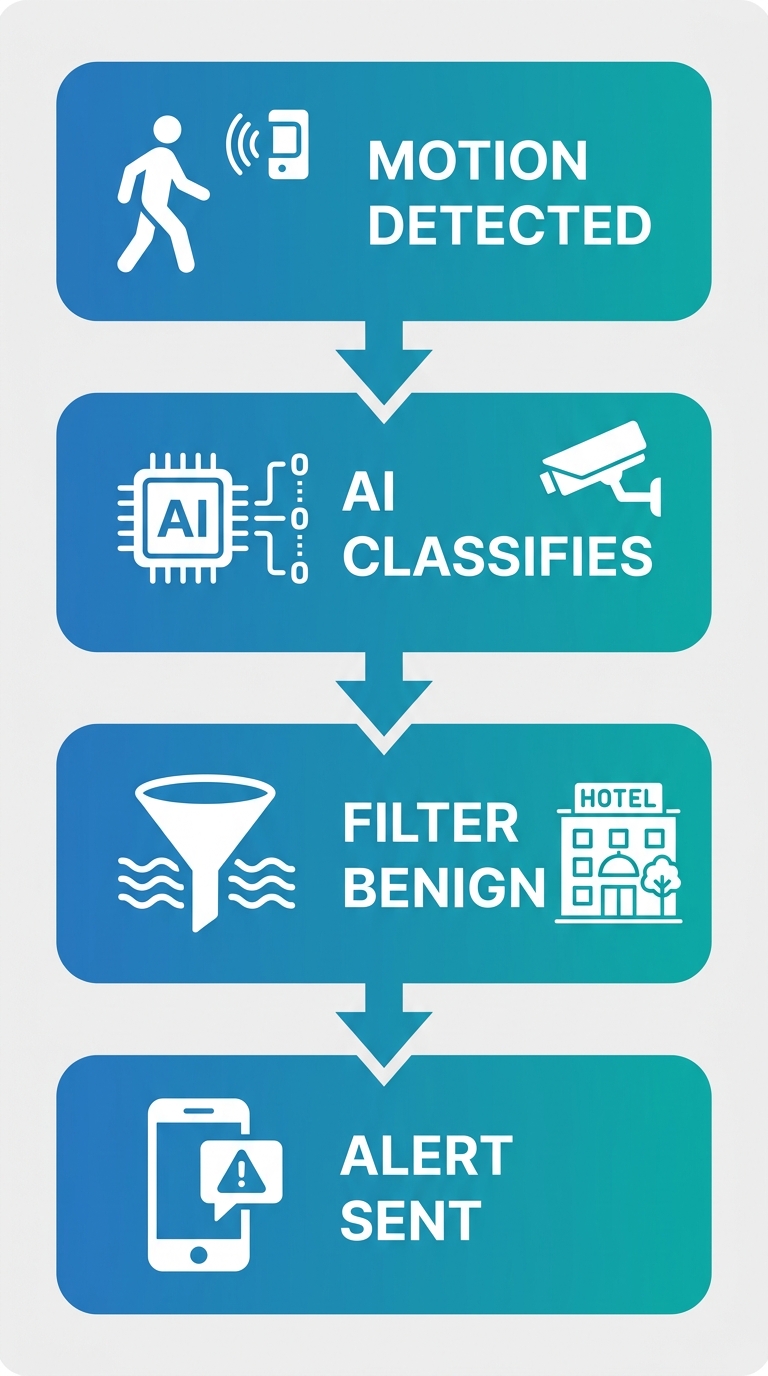
    Four-step process flow for AI-based alarm verification: motion detection, AI classification, benign trigger filtering, and alert dispatch.
    Four-step AI-driven alarm verification process for hotel security.

    This analytical foundation extends to interior monitoring, where corridor cameras apply the same detection framework to enhance guest safety without introducing new alert fatigue. By applying consistent classification logic from building perimeter to hallways, hotels create a seamless security posture that protects occupants while preserving the quiet, welcoming atmosphere hospitality demands.

    Building on the AI analytics that reduce false alarms and free hotel security teams for meaningful response, the same intelligent technology transforms hotel corridors into actively protected spaces. AI cameras in hotel corridors operate as a continuous safety presence, scanning for unusual patterns and alerting staff the moment a potential concern arises. This shifts corridor monitoring from a passive record of events to a proactive layer of guest protection, one that reflects the property’s commitment to duty of care around the clock.

    Unlike traditional CCTV that merely captures footage for later review, AI-powered cameras interpret movement in real time. They can detect a guest who has fallen or appears disoriented, recognize an individual entering a restricted floor without authorization, or identify gathering patterns that suggest a disturbance before it escalates. The system immediately notifies on-site security personnel, who can respond within moments rather than discovering the incident hours later on recorded video. Drawing on our deployments across Vancouver and the Lower Mainland, we have seen this rapid-response capability deliver meaningful safety outcomes for hotel guests and staff alike.

    These monitoring systems operate within strict privacy regulations, positioned exclusively in common corridors where guests have no reasonable expectation of seclusion. The cameras are configured to protect personal dignity while maintaining vigilant oversight of shared spaces at every hour of the day and night. For guests returning late or families traveling with children, knowing that trained professionals are watching over hallways provides a genuine sense of security. Your peace of mind is the direct result of surveillance technology applied with both intelligence and restraint.

    With false alarms now filtered and corridor safety monitoring fully active, the focus naturally extends to behavior that precedes an incident. AI analytics that detect prolonged loitering near guest room doors or repeated passes through sensitive zones allow security teams to intervene before a situation develops. This behavior-based detection represents the next logical enhancement of hotel security, transforming corridors from simple passageways into intelligently guarded environments.

    Real-Time Detection of Loitering and Unauthorized Access

    For Canadian hotels considering AI security cameras, real-time loitering detection means a shift from passive recording to active threat prevention. These cameras use intelligent systems that continuously analyze movement patterns across monitored zones, flagging behaviors that warrant security attention long before an incident materializes.

    Loitering detection is based on behavioral analysis and determines norms for activity for different monitored areas. It then establishes parameters for how long individuals or groups should remain in specific zones. Once those parameters are met, the system generates an alert. In a hotel, this system could identify individuals surveilling or loitering in hotel corridors, or loitering in guest room floors. Unauthorized access, on the other hand, identifies entry into explicitly restricted spaces such as back offices, storage rooms, service corridors, and mechanical rooms, where guest presence is never legitimate, while loitering detection focuses on temporal anomalies in otherwise permitted areas.

    When either detection mechanism identifies a threat, alerts reach security personnel immediately through designated monitoring stations or mobile devices. Staff can review live camera feeds, determine the nature of the threat, and summon the appropriate response personnel. These systems provide security personnel the means to respond to threats in a proactive manner rather than being required to review the footage after property damage or guest complaints have already occurred. Security staff can assess live camera feeds correlated with the specific alert, verify the nature of the intrusion, and dispatch response personnel with complete situational awareness.

    The system integrates directly with existing access control and CCTV infrastructure, correlating real-time alerts with live footage to provide a comprehensive security picture. Rather than requiring a complete hardware overhaul, the AI analytics layer enhances the capabilities of already-deployed cameras by adding intelligent interpretation to continuous video streams. This integration ensures that every alert includes contextual visual information, allowing security teams to make informed decisions about appropriate responses.

    Unmatched security expertise in deploying and configuring detection systems ensures that sensitivity thresholds are calibrated to each property’s unique layout and traffic patterns. This minimizes false alerts while maintaining vigilant coverage of genuine threats to guest safety and hotel operations.

    Cost-Effectiveness: AI Monitoring vs. On-Site Guards

    At Regent Security Services Ltd., we have built a model where we combine continuous AI monitoring with the rapid response of our trained guards. Our solution allows our clients to protect their assets without sacrificing budget predictability.

    Three approaches vary in threat detection, service level, and monthly cost.

    Hotel Security Model Comparison: AI vs. Guards vs. Integrated Solution
    Feature AI-Only Surveillance On-Site Guard Service Regent Integrated Model
    Real-Time Threat Detection Detects anomalies via video analytics; alerts are generated automatically Guards notice visible threats but may miss subtle, non-visible events AI analytics scan continuously; guards verify and act on validated alerts
    Response Speed & Escalation Alerts facility staff or a remote monitoring center; no physical response included Guards can physically intervene but may be delayed by patrol duties or site layout Immediate alert-to-guard handoff; mobile and on-site personnel respond without lag
    24/7 Coverage Consistency Consistent, never fatigues; requires reliable power and network Shift changes and fatigue can create coverage gaps; staffing shortages may reduce presence 24/7 tech plus 200+ licensed personnel ensure seamless coverage across all shifts
    Human Judgement Lacks contextual reasoning; may misclassify innocent activity Guards assess situations in real time and de-escalate professionally Technology flags incidents; guards apply discretion and handle guests with care
    False Alarm Management High false-positive rate without human verification; can erode staff trust Guards filter out non-threats intuitively AI simply screens; guards confirm, dramatically lowering unnecessary escalations
    Monthly Cost Profile Lower subscription fee but no physical response component Higher ongoing staffing expense, especially for 24/7 posts Balanced cost structure that pairs technology efficiency with targeted guard deployment

    The model creates a balance that maximizes uptime, minimizes liability, and aligns with the guest experience—all without the unpredictability of a guards-only schedule or the risks of an unattended camera system.

    For a more detailed analysis reflecting your specific needs and concerns, we ask that you contact us to build your security quote.

    Behavioral Analytics for Hotel Perimeter Protection

    Behavioral analytics for hotel perimeter protection has advanced to the point where it creates an always-on, pattern-recognition system that identifies normal behavior and alerts security personnel when it notices suspicious activities. Rather than rely on reactive CCTV (closed-circuit television) systems that capture events after the fact, the security system continuously analyzes video streams and alerts the security personnel to potential issues before they happen. This system can detect if an individual is loitering near guest room balconies, if a vehicle is circling the porte-cochère, or if an individual is testing the doors along a corridor.

    The system can learn typical movement patterns and issue an alert when deviations occur: loitering beyond a set dwell time, reverse-flow movement past entry-only points, tailgating into access-controlled staff doors, and after-hours roaming in restricted zones. Because the platform can be calibrated to the layout of each hotel, it can learn the normal flow of foot traffic and distinguish if an individual is loitering near an empty guest room block or if an individual is really pausing to read a map. Because the system can be programmed to know what is normal, it minimizes the number of false alarms, which allows responders to focus on real threats. The system integrates easily with a hotel’s existing CCTV and security infrastructure. This adds a proactive intelligence layer without forcing a complete hardware replacement.

    Practical limits remain. Privacy regulations demand thoughtful camera placement and data handling; poor lighting or severe weather can lower detection accuracy; and the system’s effectiveness depends on training data that reflects the property’s unique layout and guest flow. Recognizing these constraints, Regent Security Services Ltd. incorporates behavioral analytics output into a broader hotel security response plan. We never treat analytics as a standalone solution; every suspicious activity alert is verified by a licensed monitoring professional, and only then does our team dispatch an on-site guard or take appropriate action.

    A behavioral alert, coupled with professional monitoring and a rapid guard response, enables a layered and swift security response. This, in combination with access control, facilitates the smooth transition from the virtual to the physical domain. Through this innovative model, AI-based behavioral analytics and full-service security are paired to protect hotel staff and guests around the clock.

    Creating a Comprehensive Hotel Security Strategy with AI and Professional Services

    True hotel security relies on multiple layered technologies, and we’ve integrated AI-powered behavioral analytics with professional services to identify threats in a timely manner while significantly reducing false alarms. Using this advanced technology, in conjunction with professional services, reduces false alarms by analyzing genuine anomalies and enables earlier threat detection, all while improving the guest experience through unobtrusive vigilance. Our approach is like having a concierge. It’s there when you need it, and focused on the little things that assist and provide comfort to guests. It’s not static; we continuously refine measures based on evolving threats and guest requirements. To move forward, we recommend a thorough review of your current hotel security posture and engaging our professional security consultants to tailor an implementation roadmap that evolves with your property’s needs. Our team of 200+ dedicated professionals supports tailored program delivery locally.

    Explore Hotel Security Solutions

    AI-powered video surveillance has demonstrated clear value for proactive threat detection, from cutting false alarms to ensuring guest corridor safety. The insights you’ve gained on behavioral analytics and loitering detection form a solid foundation for upgrading your hotel’s security posture. We bring over 15 years of experience providing licensed and insured security guards alongside integrated technology throughout Vancouver, British Columbia. Our professional team combines advanced AI monitoring with 24/7 human oversight to create a layered defense that adapts to your property’s unique needs. By integrating real-time alerts with proactive response, we help protect your guests, staff, and assets without overwhelming your team. Now that you’ve explored the technologies, consider a personalized security assessment to see how they fit your specific hotel layout and risk profile. See how our integrated model can safeguard your Vancouver property.

    Explore Hotel Security Solutions
    Resources

  • Vancouver Proactive Threat Detection: AI Video Analytics for 2026

    Vancouver Proactive Threat Detection: AI Video Analytics for 2026

    Table of Contents

    Proactive Threat Detection for Vancouver Businesses: A Strategic Approach

    Beyond reactive monitoring, a truly resilient security strategy employs proactive threat detection for Vancouver businesses, where we anticipate and mitigate risks before they escalate into costly incidents. Traditional passive systems merely record events for later review, but our approach actively identifies anomalies in real time. At Regent Security, we design proactive security measures that address unauthorized access and perimeter breaches common to Vancouver commercial properties, allowing our team to intervene swiftly.

    Central to this strategy is the use of AI video analytics, which applies intelligent software to your existing camera infrastructure. According to the Canadian Security Association, risk-based security planning should integrate such advanced monitoring tools. This technology reduces false alarms and provides immediate alerts on suspicious behavior, effectively complementing our on-site guard services. Another critical component is automated license plate recognition, a powerful access control tool that identifies vehicles of interest before they enter your property, adding a proactive layer to your perimeter defense.

    Our own research into commercial building security trends 2026 confirms a significant industry shift toward these proactive technologies. Rather than offering generic, one-size-fits-all packages, we assess your unique risk profile through on-site consultation. We then custom-design a unified security ecosystem that connects video, access control, and alarm systems into a centralized dashboard, providing you with unmatched security expertise, anytime, anywhere. This strategic alignment ensures your peace of mind, knowing a tailored defense is in place before a threat materializes.

    In the following section, we explore how we deploy these technologies to protect your business around the clock.

    Understanding Proactive Threat Detection in Vancouver, British Columbia

    Security challenges facing businesses in Vancouver have evolved dramatically, demanding smarter, faster responses to potential threats. Your peace of mind depends on moving beyond outdated approaches that merely document incidents after they occur. Proactive threat detection represents a fundamental shift in how we protect properties, using advanced technology to identify and neutralize risks before they escalate into costly events.

    What Sets Proactive Detection Apart from Traditional Monitoring

    Traditional security monitoring operates on a reactive model. Cameras record footage continuously, but that footage only gets reviewed after an incident has already happened. This approach leaves businesses vulnerable, as the damage has been done by the time anyone notices.

    In contrast, proactive detection leverages behavioral analysis and artificial intelligence to identify potential threats in real-time. Rather than passively recording, our systems actively scan for patterns that indicate suspicious activity. AI-driven surveillance can filter out up to 95% of false alarms, ensuring that security personnel focus only on genuine risks. This forward-looking approach transforms security from a passive record-keeper into an active deterrent, intervening while a situation is still developing rather than simply documenting the aftermath.

    The Role of AI Video Analytics in Proactive Security

    AI video analytics technology has fundamentally changed what business security systems can achieve. AI video analytics for business applications now analyze video feeds continuously, detecting specific behaviors that human operators might miss during long monitoring shifts. The system identifies loitering in restricted areas, unauthorized access attempts, perimeter breaches, and other suspicious behaviors the moment they occur. Automated license plate recognition adds another layer of intelligence, allowing the system to identify vehicles of interest or track patterns of unauthorized entry. Our technology processes these inputs simultaneously across multiple cameras, maintaining consistent vigilance that human operators alone cannot sustain.

    Integration with Professional Guard Services

    Technology alone cannot provide complete protection. The true strength of proactive security emerges when AI-driven detection integrates seamlessly with professional response capabilities. When our remote video monitoring services in Canada detect a verified threat, automated alerts immediately notify licensed security professionals who can assess the situation and take appropriate action. Trained agents use two-way audio to issue verbal warnings, deterring crime in progress before it escalates. This layered defense combines the tireless vigilance of AI analytics with the judgment and authority of trained personnel.

    Security professionals in British Columbia receive rigorous training through institutions such as the Justice Institute of British Columbia, ensuring that response teams possess the skills needed for effective intervention. When technology identifies a threat, a trained professional evaluates the situation and coordinates with mobile patrols or on-site guards as needed. This integrated approach delivers unmatched security expertise, providing comprehensive protection tailored to each client’s specific requirements.

    Benefits of Proactive Threat Detection for Vancouver Properties

    For commercial properties in Vancouver, shifting from reactive security measures to proactive threat detection is the most effective strategy for mitigating risk. Instead of simply recording incidents for later review, modern systems use intelligent analysis to stop threats before they escalate. This approach delivers tangible financial, operational, and psychological benefits for property managers and business owners.

    Reducing Insurance Premiums Through Risk Mitigation

    A robust proactive detection strategy directly impacts your bottom line by reducing the frequency and severity of security incidents. Insurers recognize that properties with AI-driven surveillance experience fewer theft and vandalism claims, which are driven by the system’s ability to verify and deter threats in real time. By filtering out false alarms and enabling immediate intervention before a crime is completed, these systems demonstrably lower a property’s risk profile. As a result, business owners often qualify for reduced commercial property insurance premiums, turning a security upgrade into a long-term financial asset. This demonstrable risk mitigation provides clear, quantifiable value, not just added safety. Features like automated license plate recognition create a complete audit trail that further supports claims and deters unauthorized vehicles from entering secured perimeters.

    Enhancing Response Times with Real-Time AI Alerts

    The true power of AI-driven threat detection lies in its speed. Traditional systems require a person to notice an event, but AI acts in milliseconds. When ai video analytics for business identifies a verified threat—such as a person loitering in a restricted zone after hours—it instantly alerts our 24/7 monitoring center. This immediate notification allows trained security professionals to assess the live feed, issue a verbal warning through two-way audio speakers, and, if necessary, dispatch mobile patrol units within seconds. This rapid intervention cycle minimizes the window of opportunity for criminal activity, stopping damage and loss before they can occur. A system that cuts response times from minutes to seconds fundamentally changes the security posture of your Vancouver property, aligning with our commitment to providing you with ‘Your peace of mind’.

    Cost-Effectiveness Compared to Traditional Surveillance

    While on-site guards and older CCTV systems have their place, a modern proactive threat detection platform is often the more cost-effective solution. The primary driver of these savings is the drastic reduction in false alarms, a capability we achieve through industry-leading AI. By cutting false alarms by up to 95%, you avoid the operational drain of chasing shadows and the potential fines from nuisance dispatches. This efficiency is a core advantage of remote video monitoring services in Canada, effectively combining the vigilance of a full-time security team with the scalability of cloud-based technology at a fraction of the cost. Rather than paying for on-site guards to observe every inactive corner of your property, you invest in a system that only escalates verified events. This model reduces overall personnel hours and extends the lifespan of your equipment by focusing all resources on genuine, high-priority threats, making it a predictable and budget-friendly operational expense. These strategic benefits culminate in a single, invaluable outcome for you: true ‘Your peace of mind’, knowing your property is protected by a smart, efficient, and proactive security partner.

    How Proactive Threat Detection Works with AI and Guard Monitoring

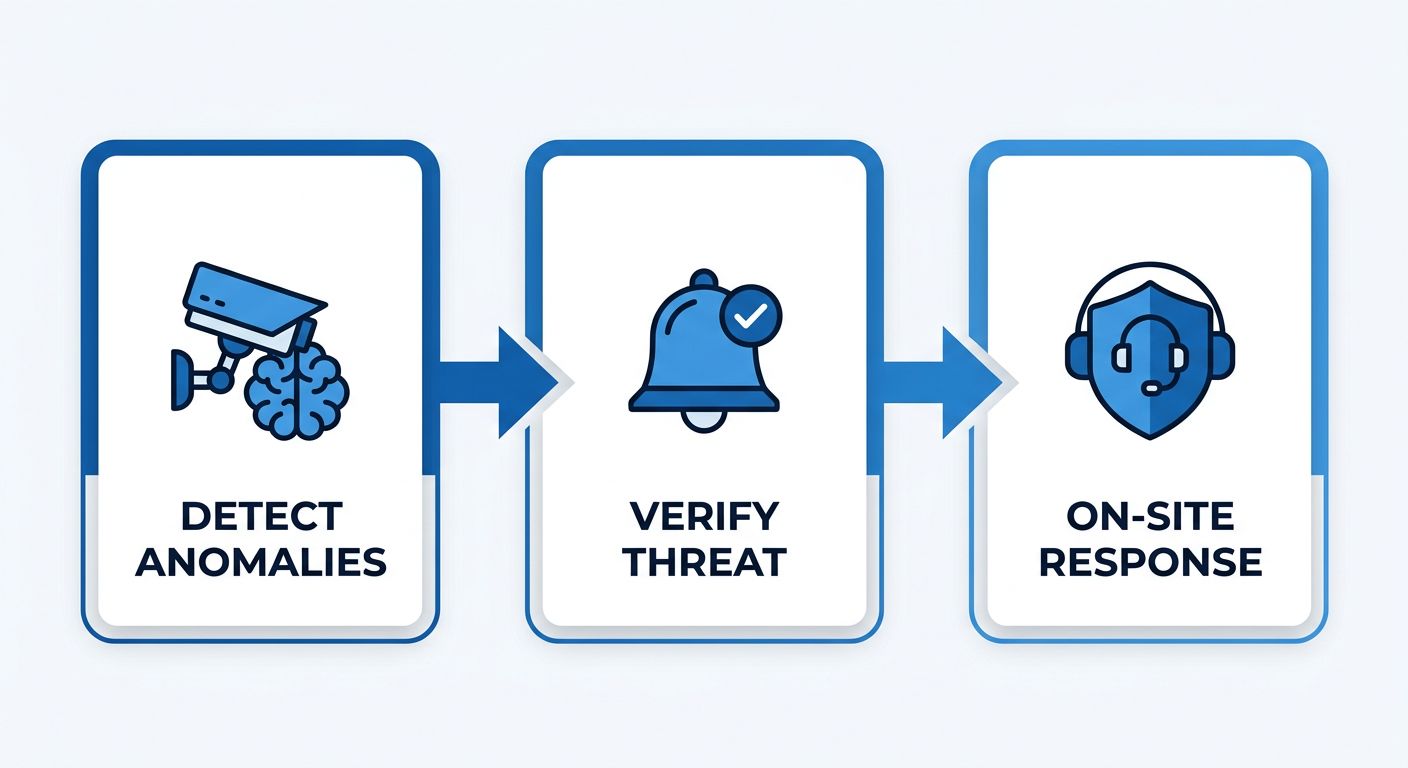
    Proactive threat detection represents a layered security approach where intelligent systems identify potential risks before they escalate into incidents. At Regent Security, we integrate advanced AI video analytics with professional guard monitoring to create a seamless, three-step workflow that provides real-time protection for your facility. By combining technology with human expertise, and following guidelines set by the Canadian Security Association, we deliver security solutions that prioritize prevention over reaction, ensuring your peace of mind anytime, anywhere.

    Three-step process flow for proactive threat detection showing AI video analytics detecting anomalies, automated alerts verifying threats, and coordinated guard dispatch for on-site response, using a clean blue and white design.
    Proactive threat detection workflow from AI analytics to on-site response.

    Step 1: AI Video Analytics Detect Anomalies

    The first layer of our defense involves sophisticated ai video analytics for business applications that continuously scan live camera feeds. These algorithms are trained to distinguish between normal activity and suspicious behavior by analyzing movement patterns, dwell times, and object trajectories. Unlike passive systems that simply record footage, our active monitoring identifies anomalies such as loitering in restricted areas, unauthorized access attempts, or unusual congregation patterns the moment they occur.

    A key capability within this layer is automated license plate recognition, which allows the system to instantly flag vehicles associated with known threats or those not registered for site access. The AI engine filters out benign environmental movements—like tree branches swaying or shifting shadows—which dramatically reduces false alarms and ensures operators focus only on genuine human threats. This intelligent video monitoring approach transforms raw footage into actionable intelligence, creating a complete audit trail for property management.

    Step 2: Automated Alerts and Verification

    When the AI identifies a potential threat, it triggers automated alerts that are immediately routed to our central monitoring station. Here, trained security operators step in to verify the situation before any physical response is initiated. This human verification step is critical: operators review the flagged footage in real time, assess the severity of the incident, and determine whether the alert represents a true emergency or a false positive.

    During verification, operators can leverage two-way audio systems to issue verbal warnings directly to intruders, often deterring criminal activity without the need for on-site deployment. Our standard alarm response protocol ensures that each alert is categorized, time-stamped, and documented, creating a reliable chain of evidence. This layer blends machine efficiency with human judgment, ensuring that resources are deployed only when genuinely needed.

    Step 3: Coordinated Guard Dispatch and Response

    Once a threat is verified, our professional security teams spring into action using mobile patrols and on-site guard resources. The monitoring center communicates incident details—nature of the threat, precise location, and suspect description—directly to responding units, enabling a rapid and informed arrival. Regent Security’s guard services include both scheduled mobile patrols and immediate alarm response, ensuring coverage gaps are eliminated.

    Our mobile patrols serve as a scalable, cost-effective layer that bridges the gap between remote monitoring and full-time on-site personnel. Guards follow established response protocols, conducting site sweeps, engaging with suspects when safe, and coordinating with law enforcement if the situation requires escalation. The entire process—from AI detection to on-the-ground intervention—unfolds with speed and precision, reflecting our unmatched security expertise.

    This three-step workflow demonstrates how technology and human vigilance work in concert to protect what matters most. Now that we understand how proactive threat detection operates, let’s explore the tangible benefits this approach delivers to property managers and business owners across Vancouver, Surrey, and the Lower Mainland.

    Best Practices for Implementing Proactive Threat Detection in BC

    Successful proactive threat detection in British Columbia begins with a structured approach that moves beyond reactive security measures. For property managers and strata councils across the Lower Mainland, implementing these best practices transforms security from a cost center into a strategic asset. The combination of thorough risk assessment, intelligent access control technology, and partnerships with qualified professionals creates a security posture that identifies and mitigates threats before they escalate. Our experience serving over 1,000 clients has demonstrated that integrating AI video analytics for business applications into daily operations significantly reduces incident response times and false alarm rates.

    Assessing Your Property’s Risk Profile

    Developing a clear risk profile is the essential first step toward meaningful proactive threat detection. This evaluation examines your property’s location, physical layout, existing access points, and any history of security incidents to identify specific vulnerabilities. By applying frameworks refined through our hotel security expertise, we help clients understand exactly where threats are most likely to emerge, whether from unauthorized parking garage access, unmonitored service entrances, or after-hours common area activity.

    A comprehensive risk assessment also considers operational patterns unique to your facility. Commercial properties with high tenant turnover present different challenges than established strata complexes, and construction sites require entirely distinct monitoring approaches. Once your risk profile is clear, integrating license plate recognition further strengthens access control and creates a layered defense against unauthorized entry.

    Integrating License Plate Recognition for Access Control

    Automated license plate recognition serves as a powerful tool for strata councils seeking to enhance parking lot security and building access management. ALPR systems capture and analyze vehicle plate data in real time, automatically comparing credentials against authorized resident and visitor databases. When integrated with AI video analytics for business environments, these platforms filter out routine traffic and alert personnel only to unrecognized or flagged vehicles, dramatically reducing the monitoring burden on security staff.

    This technology proves particularly effective for mixed-use buildings where distinguishing between resident, visitor, and commercial parking is essential. The system logs every entry and exit, creating an auditable trail that supports incident investigations and resolves parking disputes with objective evidence. Combined with centralized access control dashboards, ALPR data enables security teams to initiate immediate responses when unauthorized vehicles attempt entry, turning parking areas from vulnerable blind spots into monitored perimeters.

    Working with a Licensed Security Provider

    Partnering with a licensed and insured security provider ensures that proactive threat detection strategies are executed by qualified professionals. According to the Canadian Security Association, adherence to industry standards and proper certification remains fundamental to delivering reliable security outcomes. When evaluating providers, verify their licensing under BC’s Security Services Act and confirm they carry adequate liability coverage. Training credentials matter equally; many of British Columbia’s top security professionals complete programs through the Justice Institute of British Columbia, which offers recognized certification pathways for the province’s security workforce.

    Beyond credentials, operational capabilities distinguish effective partners. Look for providers offering 24/7 monitoring and same-day deployment, ensuring continuous coverage without gaps that threats can exploit. A technology-enabled approach that combines trained personnel with real-time analytics delivers the proactive threat detection results that property stakeholders expect. Contact our team at Regent Security to discuss a personalized security assessment tailored to your property’s unique requirements.

    Taking the Next Step with Proactive Threat Detection

    Proactive threat detection represents a fundamental shift in how businesses approach security. Instead of merely responding to incidents after they occur, this forward-looking strategy identifies and neutralizes risks before they escalate into costly disruptions. At Regent Security, we integrate this philosophy into every layer of our service delivery, combining advanced technology with vigilant human oversight to protect your assets around the clock.

    This approach relies on a powerful technological foundation. AI video analytics for business transforms standard surveillance into an intelligent monitoring system that flags unusual behavior in real time, while automated license plate recognition tracks vehicle movement across your property perimeter. Integrated access control systems further strengthen your defenses by ensuring only authorized personnel enter sensitive areas. These tools do not operate in isolation—our 24/7 monitoring center, mobile patrol units, and on-site guards form a unified response network that acts on the intelligence these systems provide.

    Industry standards reinforce the value of this methodology. The Canadian Security Association advocates for proactive frameworks that prioritize prevention over reaction, and the Justice Institute of British Columbia ensures security personnel receive training aligned with recognized professional benchmarks. These credentials matter because they translate directly into fewer incidents, faster response times, and genuine peace of mind for business owners across the Greater Vancouver area.

    Your peace of mind is our priority. With over 100 trained professionals and more than 1,000 clients served, we deliver unmatched security expertise anytime, anywhere. Contact Regent Security today for a no-obligation consultation and a custom quote tailored to your facility’s unique requirements.

    Resources