
What Are the 4 P’s in Security Guard: A Complete Guide
Table of Contents
- What Sets a Professional Security Guard Apart
- Understanding the 4 P's in Security Guard Work
- How Each Pillar Prevents Incidents on Site
- Applying the 4 P's Across Hotels, Stratas, and Commercial Sites
- The 4 P's and the 5 D's: Two Frameworks Compared
- Quick Answers About the 4 P's
- Put the 4 P's to Work on Your Property
What Sets a Professional Security Guard Apart
The 4 P’s in security guard work are a framework that separates professional licensed security guards from untrained or informal presence: training, licensing, presentation, judgment, and accountability. A professional guard brings specialized skills and adherence to standards that protect people and property.
Our team of 200+ trained, licensed and insured professionals in Vancouver and the Lower Mainland delivers site-specific security programs tailored to each client’s needs. With 15+ years of experience serving 1,000+ clients, we combine people, process, and technology to reduce risk and provide peace of mind. Professional guards are not only certified under BC’s Security Services Act but also equipped to assess situations, communicate clearly, and act decisively, qualities that define the difference between a basic presence and a true security solution. This focus on professionalism sets the stage for understanding the four core qualities that shape effective security work.
Understanding the 4 P’s in Security Guard Work
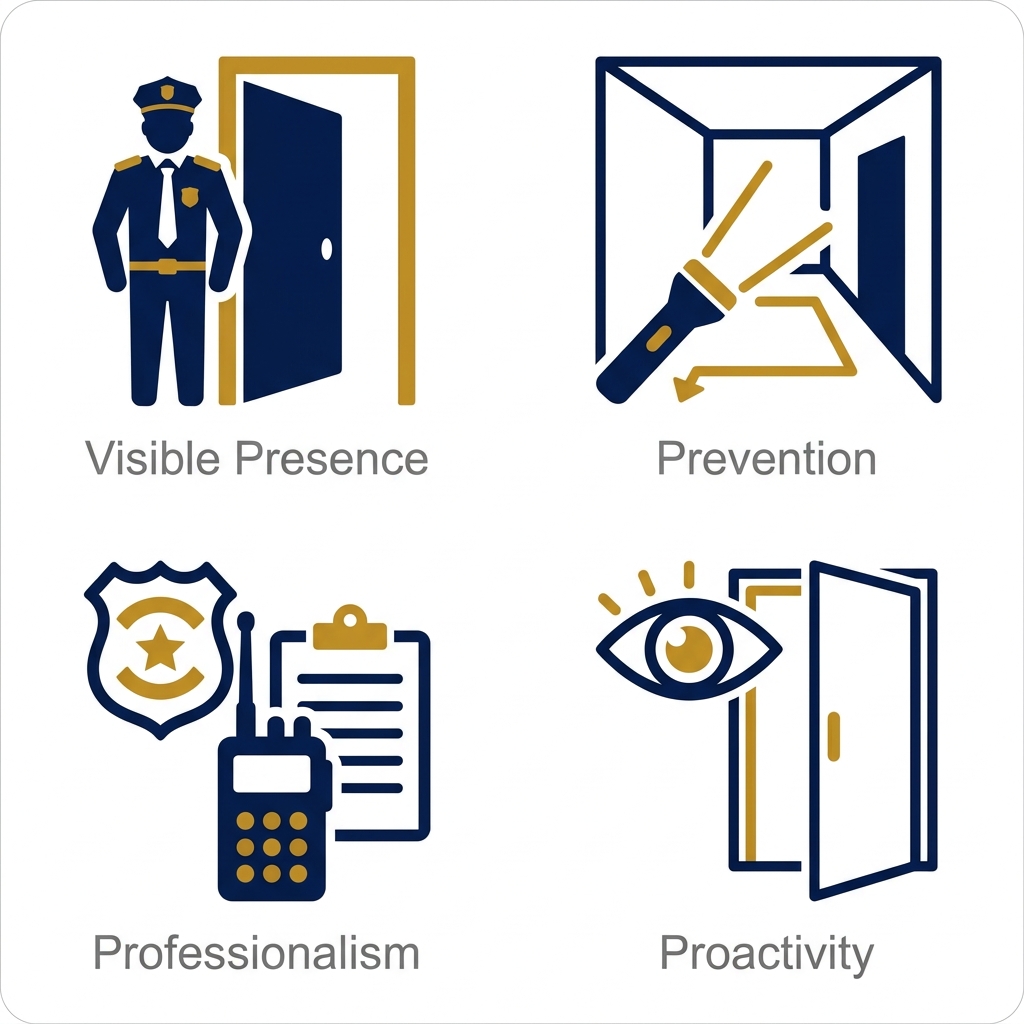
If you wonder what the 4 P’s in security guard are, you’re asking about a concept that guides licensed guards in Vancouver and the Lower Mainland. The 4 p’s can help our trained guards perform their job better every day by helping them reduce risks before incidents occur. All of them are designed to deter trouble, spot hazards early, and act decisively.
The following table compares each pillar at a glance:
| Pillar | Core Meaning | Typical Site Example |
|---|---|---|
| Presence | Visible, positioned deterrence that discourages trouble before it starts | A uniformed guard stationed at the hotel lobby entrance during peak hours |
| Prevention | Routine patrols, access checks, and hazard spotting that stop issues from developing | A guard conducting a systematic patrol through a parkade and back-of-house corridors every hour |
| Professionalism | Licensed training, conduct, appearance, and clear communication aligned with BC standards | A guard calmly directing a distressed guest while maintaining a polished uniform and respectful tone |
| Proactivity | Acting on early warning signs and reporting before small issues escalate | Reporting a propped-open service door to maintenance before it becomes a security breach |
Every pillar has value due to what it keeps from occurring. Being visible can be enough to stop opportunistic behaviour simply because would-be trouble makers know that someone could catch them in the act. Being able to spot things turns routine observations into actionable safeguards, catching vulnerabilities before they’re exploited. By professionalising their job so every interaction reflects the training and standards expected in British Columbia, guards reinforce trust with guests and staff. Proactively preventing problems means having people react fast so the problem does not become a larger one in the end.
Presence matters as the first line of defense. Guards in places like the entrances of hotels and lobbies of strata buildings send a message that their building is being watched over, which helps avoid loitering, crime, or vandalism. Placing guards near busy traffic spots in Vancouver’s commercial buildings can reduce potential points of unauthorized entry and maintain order when there are too many people present or during busy hours.
Prevention is based on presence via controlled observations and movements. Routine patrols throughout parking lots, staircases, and loading docks enable security guards to detect potential dangers such as unlocked doors, inadequate illumination, or unusual activities in their vicinity. At strata properties, this approach can aid in discovering any maintenance issues which may lead to unauthorized access to a building or damages to property. This ensures potential threats are addressed before they escalate.
Professionalism is what makes everything fit together. Our licensed guards in British Columbia complete Basic Security Training and adhere to our province’s standards, ensuring every interaction is conducted with competence and respect. This holds true whether they are directing a lost guest or responding to a noise complaint. In either scenario, the guard will act more like a trusted resource rather than simply responding to a disruption.
Finally, Proactivity turns awareness into action. A guard noticing a propped-open door doesn’t just log it, they report it immediately, allowing maintenance to secure the area. In hotel settings, proactivity might mean adjusting patrol routes based on recent incidents or coordinating with front-desk staff to monitor high-risk zones during events.
Together, these pillars form a cohesive approach to security that reduces risk without relying on reactive measures. For property managers in Vancouver and the Lower Mainland, understanding the 4 P’s clarifies how professional security isn’t just about responding to incidents, it’s about preventing them through visible, trained, and attentive care.
How Each Pillar Prevents Incidents on Site
These four pillars matter only if each one demonstrably prevents incidents before they escalate. The polished presentation and courteous communication of our guards immediately signal competence and calm, reducing the chance a tense guest interaction turns confrontational. De-escalating language and a professional uniform communicate respect for visitors and staff, reducing the likelihood that a visitor will attempt to push at these boundaries. Finally, the accurate record keeping allows us to take any action necessary should an observation prove true. When logs consistently flag repeat trespassers, faulty doors, or dimly lit corridors, property managers can schedule repairs or adjust patrols before minor issues become major incidents. This layer of documentation ensures no irregularity slips through the cracks, reinforcing the deterrent effect of our presence.
Professionalism That Builds Trust and Deters Trouble
The way a guard stands presents authority but not aggressiveness, and proper etiquette can stop small things from turning into large problems. In Vancouver lobbies and strata foyers, our team’s polished uniforms and calm tone reassure guests and tenants that their safety is in capable hands, which discourages troublemakers from escalating minor disturbances. But being polite isn’t only about how you look on the outside. It’s about ensuring that everyone who goes through the doors knows they can be safe and treated with respect.
Preparedness Through Training, Drills, and Emergency Planning
Licensed personnel in British Columbia hold Basic Security Training and Advanced Security Training credentials, equipping them to act correctly in the first critical moments of an emergency. They also have site-specific emergency plans and regular drills that ensure guards know evacuation routes, alarm protocols, and fire watch procedures, so they respond with confidence rather than hesitation when seconds count. This type of preparation turns potential chaos into controlled actions that minimize the chance of injury and property damage.
Proactiveness: Patrols, CCTV Monitoring, and Early Intervention
In Lower Mainland areas, our team conducts deliberate patrol routes as well as live CCTV monitoring so that problems can be detected right away – like if there is an open door in a commercial area or someone loitering outside around midnight. We also conduct access control checks at building entrances in order to catch any suspicious behaviour before anything happens. This gives us enough time to deal with issues as they arise without waiting for things to get out of hand.
Physical Fitness for Long Shifts and Rapid Response
Overnight Shifts Need Stamina and Mobility. Guards who work patrol and mobile security work in both cities must be fit enough to run to an alarm, get into position and respond as necessary if there’s any kind of disturbance. They might have to escort guests around the premises, or investigate noise complaints near a construction perimeter. Fitness isn’t optional—it’s the foundation that keeps every other pillar effective when it matters most, ensuring guards can perform at their best throughout their entire shift.
Applying the 4 P’s Across Hotels, Stratas, and Commercial Sites
Understanding why each pillar matters becomes clearer once you see them at work during a real shift around the hotels, stratas, and other commercial sites here in the Vancouver area and the Lower Mainland. From professionalism through to physical fitness, our officers and our concierge team members make good use of all of these skills as shifts progress.
The 4 P’s of Security Patrol in Practice
Start of shift: our mobile patrol officer checks equipment, reviews the site map, and confirms the patrol route with the on-site guard. Professionalism shows in the uniform, the clear radio communication, and the courteous greeting to arriving staff. Preparedness means verifying flashlights, first-aid kits, and emergency contact lists before stepping onto the property. Mid-patrol: proactiveness kicks in as the officer adjusts the irregular route to focus on dimly lit corridors in the hotel and the rear parkade of the strata building, scanning for hazards before they escalate. By the final hour, sustained physical fitness keeps alertness high during routine checks of commercial perimeters, where uneven terrain demands extra vigilance. Throughout the shift, our officers maintain a visible presence that reassures guests, residents, and staff while deterring potential incidents before they occur. This consistent application of the four pillars ensures every property receives the same high standard of protection.
Do the 4 P’s Apply to Concierge and Front-Desk Staff?
Yes. Concierge and front-desk staff operate from the same four pillars except that they’re focused more on hospitality than security here. Professionalism shines in the form of warm greetings, attentive listening, and polished guest interactions. Preparedness covers a variety of topics including being able to handle emergencies, knowing the right protocols for controlling access into the facility as well as assisting guests should they need help exiting the building in case of evacuation. Being proactive shows when staff notice unusual lobby behavior or package-handling irregularities before they become incidents. Keeping fit enough to stand and endure shifts for extended periods, particularly during check-in surges, is important when every guest deserves prompt, courteous service. This blend ensures that the concierge not only meets security expectations but also enhances the guest experience.
Site Audits That Turn the Framework Into a Custom Program
The site specific security audit starts out with a walk through of the location itself looking at which aspects need to be reinforced. When dealing with a hotel – this might include the lobby and hallway traffic. For a strata building, it may include which doors people can enter from or the parkade’s visibility. With a commercial site perhaps we will look at the fence around the perimeter of the facility as well as any contractors that may be working there. We take all these different aspects together along with our guards, mobile patrol vehicles, and CCTV monitoring and make them work with the environment around us, creating a tailored program that turns the four pillars into measurable protection for guests, residents, and assets across Vancouver and the Lower Mainland. Each custom program is designed specifically for their unique needs but follows the basic framework of our four pillars.
By implementing this practical application of all four principles, the same high standard of security and service is delivered consistently. Whether they’re checking into a hotel, returning to their strata building, or opening their business in the morning, people will experience that same high standard of security and service consistently.
The 4 P’s and the 5 D’s: Two Frameworks Compared
When readers ask what the 4 P’s in security guard work are, the answer begins with people. Our earlier examples across hotels, stratas, and commercial sites in Vancouver relied on two distinct frameworks that balance human oversight with strategic design. Understanding both helps property managers choose the right emphasis for their site.
The 4 P’s center on the human element: People, Policy, Procedure, and Physical security. These pillars ensure every team member understands their role, follows consistent protocols, and maintains visible presence that deters threats. In contrast, the 5 D’s focus on strategic layers: Deter, Detect, Delay, Deny, and Defend. This model prioritizes technology and process to create multiple barriers that slow or stop unauthorized access before incidents escalate.
The following table compares key dimensions across both frameworks:
| Dimension | The 4 P’s (People-Focused) | The 5 D’s (Strategy-Focused) |
|---|---|---|
| Focus | Human oversight and accountability | Layered barriers and technology integration |
| Core elements | People, Policy, Procedure, Physical security | Deter, Detect, Delay, Deny, Defend |
| Best used for | Sites where direct engagement and visible presence are priorities | Sites prioritizing automation, remote monitoring, and rapid response |
| Where they meet | Both frameworks reduce risk by combining human vigilance with strategic planning |
Choosing between the 4 P’s and the 5 D’s depends on the property’s unique needs. Hotels and stratas in Vancouver often benefit from the 4 P’s because guest interaction and visible staff presence build trust and deter opportunistic threats. Commercial sites and construction zones may lean toward the 5 D’s, where technology-driven detection and automated barriers align with operational efficiency and 24/7 coverage. In practice, most sites blend both models: trained personnel enforce policies while cameras and access controls execute the strategic layers.
Quick Answers About the 4 P’s
To wrap up the framework, here are the distilled answers to what the 4 P’s protect and prioritize.
What do the 4 P’s protect?
The 4 P’s framework protects people, property, premises, and the protective measures themselves. Each priority ensures no aspect of security is overlooked in Vancouver properties.
How do the 4 P’s guide security decisions?
They provide security program priorities that focus on the specific risk profile of sites within this region. These make their way from general guidelines for guards as well as other monitoring systems that can be applied at those locations.
Use these answers to analyze your present security situation and identify where adjustments are needed before implementing the framework on your property.
Frequently Asked Questions
What are the 4 P’s of a professional security guard?
The 4 P’s of a professional security guard are Presence, Prevention, Professionalism, and Proactivity. Presence means visible deterrence; Prevention involves routine patrols and hazard spotting; Professionalism covers licensed training and courteous conduct; Proactivity means acting on early warning signs before issues escalate.
How does the ‘4 P’s’ framework help security guards prevent incidents?
The 4 P’s framework helps security guards prevent incidents by combining visible deterrence with proactive checks, licensed training, and early intervention. Presence discourages troublemakers, Prevention spots hazards before they develop, Professionalism ensures respectful and competent interactions, and Proactivity turns awareness into immediate action.
Do the 4 P’s of security guard work apply to concierge and on-site staff?
Yes. The 4 P’s apply to concierge and on-site staff, focusing on Professionalism in guest interactions, Preparedness for emergencies, Proactiveness in spotting irregularities, and Physical fitness to maintain service quality during long shifts.
How do the 4 P’s (Professionalism Preparedness Proactiveness Physical Fitness) improve site security?
Professionalism ensures guards act with competence and respect, reducing confrontations. Preparedness through training and drills allows quick, confident responses in emergencies. Proactiveness turns routine patrols and monitoring into early interventions. Physical fitness keeps guards alert and mobile throughout demanding shifts.
Are there differences between the 4 P’s and the 5 D’s of security?
Yes. The 4 P’s focus on people and their actions: Presence, Prevention, Professionalism, and Proactivity. The 5 D’s emphasize strategy and technology: Deter, Detect, Delay, Deny, and Defend. The 4 P’s center on human oversight while the 5 D’s prioritize layered barriers and process.
Put the 4 P’s to Work on Your Property
Now that you understand what the 4 P’s in security guard work really are, walk your Vancouver property and assess each element against your site’s unique needs. Our team can help you evaluate these factors during a no-obligation security audit tailored to your building’s layout and risks.
If you need a tailor-made security plan covering all three aspects – people, process, and technology – then give us a call on (+1) 866-603-1303 or stop down to see us at Regent Security Services Ltd., located right downtown in Vancouver. Don’t forget to talk to an accredited security professional if you want specifics about your particular location.
Put the 4 P’s to Work
You now understand what the 4 P’s in security guard work are — Presence, Prevention, Professionalism, and Proactivity — and how each one prevents incidents before they escalate. You’ve also seen how these pillars come together across hotels, stratas, and commercial sites, and how a site audit turns the framework into a custom program. The next step is walking your own property and assessing each pillar against what you’ve learned here. If you’d like expert support, our team of 200+ trained, licensed and insured professionals is ready to help in Vancouver and the Lower Mainland. With 15+ years of experience serving 1,000+ clients, we can shape a program built around your site’s specific needs. request a custom quote by calling (+1) 866-603-1303 or visiting our team online. Professional security starts with a conversation about your property.

