
Security Guard Interview Questions: Complete Guide for Success 2026
Table of Contents
- Preparing for Your Security Guard Interview
- Fundamentals of Security Guard Interviews
- Deep Dive into Interview Questions and Answers
- Practical Preparation for Freshers and Experienced Candidates
- Advanced Interview Strategies for Specialized Security Roles
- Frequently Asked Questions About Security Guard Interviews
- Next Steps for Your Security Career
Preparing for Your Security Guard Interview
When researching security guard interview questions, candidates should focus on demonstrating reliability, communication, and sound judgement. These are the soft skills that employers weigh above technical knowledge.
The type of security role can vary drastically from location to location. Hotel lobbies will be quite different as compared with construction sites. Therefore, research the kind of job site being applied for thoroughly before writing your resume.
Experts in career development at CareerTestPrep suggest answering behavioral interview questions based upon the STAR strategy (Situation, Task, Action, and Result). The STAR technique forces a candidate to prove past action with hard facts. Generally, interviews are brief, 20 to 40 minutes, and focus on situational and behavioral responses. Candidates should prepare using this format, confirm license information ahead of time, and dress professionally to show reliability and attention to detail.
To get into work as a security guard in BC, you will need to hold an active license under the BC Security Services Act. Since we’re a licensed provider with more than 200 security guards serving Vancouver and the Lower Mainland, we at Regent Security Services know that verifying licence status is one of the first checks employers make before an interview.
Candidates can concentrate their efforts on the basics of the interview if they prepare accordingly and use STAR examples tailored to the site, which lets them focus on the interview fundamentals that set professional licensed security guards apart.
Key Takeaways
- Hiring managers in the security industry consistently rank reliability, communication, and observation above technical certifications when assessing interview candidates.
- Beyond job-related information and training, interview questions also measure values, observational judgment, and calm reactions to incidents.
- Having addressed all of those questions, you can now focus on the next steps that strengthen your candidacy.
Fundamentals of Security Guard Interviews
Hiring managers in the security industry consistently rank reliability, communication, and observation above technical certifications when assessing interview candidates. According to a leading career preparation resource, the typical security guard interview lasts only 20 to 40 minutes and focuses on situational and behavioral competencies rather than rote knowledge. This emphasis on soft skills reflects the reality of the job: guards are expected to observe, report, deter, and de-escalate, not act heroically.
Security employers need staff who can remain calm under pressure, deter incidents through a professional presence, and communicate clearly with both the public and supervisors. Attendance and a solid work history signal the dependability that is essential for any post, from a hotel lobby to a construction site requiring 24/7 coverage. During the interview, candidates should frame their experiences to highlight these qualities, often using the STAR method to structure answers that provide context and concrete results.
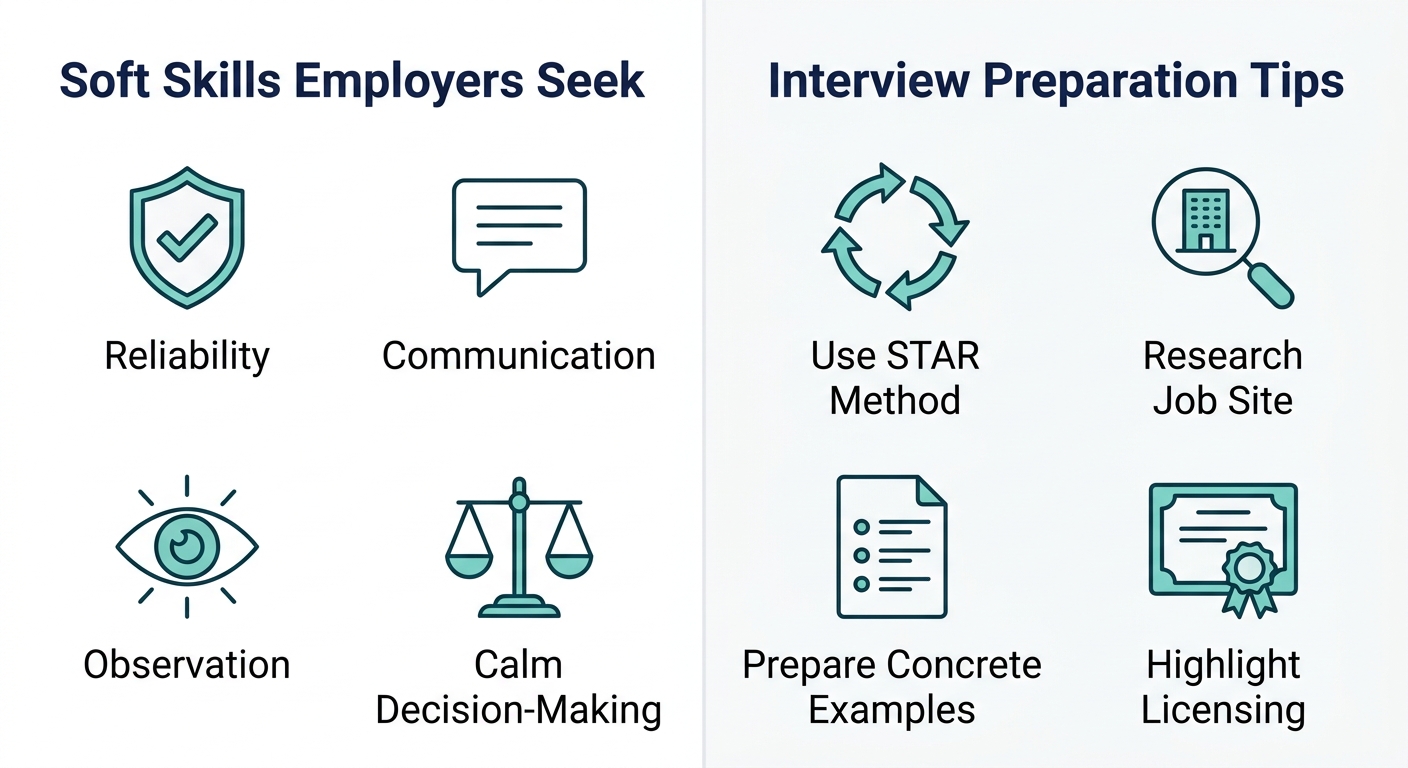
The STAR method, Situation, Task, Action, Result, is a straightforward formula that helps interviewers understand exactly how a candidate handled a real-world challenge. We recommend preparing a few concise stories in advance, each illustrating a core competency such as de-escalating a tense interaction or following a detailed post order. By keeping the focus on actions taken and the outcome that followed, you demonstrate the judgment and restraint that security roles demand.
Beyond soft skills, recruiters look for awareness of the environment in which the guard will work. A retail loss-prevention role requires different instincts than a corporate concierge desk or a construction site overnight watch. Before the interview, study the job posting and the client’s business, and prepare questions that show you understand the unique risks of that setting. For example, a hotel security interview might call for insights on guest privacy and access control, while a warehouse role emphasizes perimeter checks and material protection. This preparation conveys genuine interest and proactive thinking, traits that separate memorable candidates from the rest.
With these fundamentals in place, candidates can approach their interviews knowing what is truly being evaluated and how to present their strengths effectively. From there, it becomes easier to tackle the specific questions that commonly arise.
Deep Dive into Interview Questions and Answers
Beyond job-related information and training, interview questions also measure values, observational judgment, and calm reactions to incidents. Labour data from British Columbia indicates that employers across the province consistently value candidates who can demonstrate calm decision-making and accountability, qualities the data identifies as essential for the profession. As such, learning how to properly answer through using the STAR format (situation, task, action, results) should help ensure that you can successfully incorporate all these things into your responses.
Common Situational Questions and How to Tackle Them
In this section we examine common security guard interview questions and effective response strategies that emphasize soft skills. Interviewers frequently ask how you would handle aggressive individuals, respond to an alarm activation, or manage patrol routines. These prompts evaluate your judgment and adherence to procedure rather than physical prowess. A strong answer uses the STAR method and stresses de-escalation, maintaining a safe distance, and reporting incidents. For instance, you might describe a hotel lobby confrontation where you used verbal techniques to calm the person, contacted the supervisor according to post orders, and documented a resolution. Security Force USA’s guide reinforces that explaining the actions you took and the concrete result—such as a situation resolved without injury—reflects the calm professionalism that BLS and O*NET data ties to the role. Practicing two or three STAR-based scenarios drawn from your own experience will help you recall them naturally under interview pressure.
Role-Specific Questions for Different Security Settings
From our experience staffing properties like hotels, stratas, construction sites, and commercial buildings across British Columbia, interviewers adapt questions to the environment. A hotel security interview probes guest service and conflict resolution, with questions about handling noise complaints or medical incidents while maintaining a welcoming atmosphere. Construction site interviews emphasize access control and worksite safety, asking how you would verify subcontractor credentials or respond after discovering an open gate at night. Strata community interviews centre on resident privacy and community safety, testing your approach to noise complaints within bylaw processes. Commercial property interviews focus on loss prevention and asset protection, exploring how you monitor entry points or spot suspicious behaviour. Matching your examples to these distinct priorities shows you have researched the role and can contribute immediately.
Addressing the ‘Tell Me About Yourself’ Question
This common opener is your chance to frame your background as a security professional. We suggest a three-part structure: first, state your current role or primary security experience; second, highlight two key skills directly aligned with the job—such as observational reporting and quick decision-making—with a brief real-world example; third, connect your career goals to the employer’s needs, perhaps expressing interest in specializing in hotel or strata security. This format delivers a concise, credible narrative that builds rapport in the first minutes of the interview. As this guide shows, real security guard interview questions and answers succeed when they reflect researched, calm, and site-specific examples. Mastering these question categories equips you with the confidence needed for the practical preparation steps that follow.
Practical Preparation for Freshers and Experienced Candidates
What really gives them a competitive edge, is having prepared systematically, turning mere general knowledge into well thought out, assured replies which reflect their judgement, presence and the confidence of a person whom an employer would feel comfortable to trust.
Developing Your STAR Method Responses
STAR stands for Situation, Task, Action & Result and provides a nice structure on which answers can be put rather than going too vague and leaving it at intentions only.
- Situation: Set the context. Describe where you were and what was happening.
- Task: Identify your specific responsibility in that moment.
- Action: Explain the steps you took, emphasizing calm decision-making and protocol adherence.
- Result: Close with the outcome, ideally a measurable or observable positive result.
For a security-specific example, consider a candidate describing how they de-escalated a disturbance at a building entrance. The situation involved an agitated individual refusing to sign in. The task was to maintain lobby safety while upholding access procedures. The action included speaking in a low, steady voice, acknowledging the visitor’s frustration, and offering a solution that respected both the visitor’s time and the site’s rules. The result was a peaceful resolution with the visitor complying voluntarily, and a detailed incident report that gave the property manager a clear record of what occurred. According to the industry-focused interview resource from Security Force USA, employers consistently prefer candidates who present authentic, experience-based narratives over rehearsed scripts.
If you practice the STAR pattern for some scenarios beforehand, it can turn nervous, rambling replies into crisp, professional stories.
Addressing Common Concerns for Entry-Level Candidates
Applicants at first-timer level tend to feel concerned about their lack of employment experience during security guard job interviews. But actually, most security guard interview questions asked of new hires revolve around skills such as communication, punctuality, observation, and staying calm under pressure. These qualities are often developed in past roles like retail, customer service, volunteering, or sports. In short, applicants can change how they’ve viewed previous role, demonstrating past jobs through the perspective of guarding – having worked at a busy counter to manage and balance many responsibilities, dealing with angry customers to resolve complaints effectively.
One way we try to narrow the experience gap is with a Basic Security Training course. BST covers Legal Responsibilities, Patrol Procedures, Emergency Response and Report Writing. This will help a prospective employee answer the question on their interview form for security jobs "what to do about the job." and make them look prepared for employment. When someone completes BST, they have taken the first steps towards being ready and know what it takes to work in the province of BC and be able to step right in to a worksite if needed.
When a newbie pairs honest self-evaluation with BST-backed knowledge, the conversation shifts from “lack of experience” to “demonstrated preparation.”
Leveraging PDF Resources and Online Guides
Live practice combined with written material provides another edge. The Security Force USA guide outlines 25 common interview questions and offers "strong angle" frameworks that encourage authentic, situation-specific answers rather than memorized lines. The guide has strong angle questions that the examinee must answer using true life circumstances instead of memorizing information. It’s good for the applicant to review things like response to an incident, what type of language you’d use if talking to someone, problems dealing with an ethical situation as well as career goals. This can help fill any holes in your own story before going into the interview.
Searching online will surface many materials on the web that feature years of publishing, and those published in 2022 remain widely circulated. However, when candidates come across these documents, they should treat them as examples from which to derive ideas, not to be copied word-for-word. Also, our own career page provides company-specific insights into what we look for during the hiring process, helping applicants align their preparation with the actual expectations of the team they hope to join.
Creating a personal answer bank that includes a candidate’s own responses based on past experiences, BST skills and knowledge, and the exercises we’ve performed during this course helps a candidate respond quickly to standard questions. However, this approach can be even more effective as the interview moves into advanced topics such as specific site conditions, the technology used at sites, or how the client expects people to behave in certain circumstances.
Advanced Interview Strategies for Specialized Security Roles
This type of preparation builds up the skills that we need for hotel, construction, and event security, including how we practice our stories, role play situations, and deliver them as professional presentations to convince interviewers about why we should be hired. We need to also tell our stories effectively in a way which conveys something practical rather than abstract.
Employ the STAR strategy for describing what happened: Situation, Task, Action, Result. A leading career prep guide says STAR can be used as a means to structure behavioral responses. For example, suppose you’re applying at a hotel and your experience involves noticing that someone looked suspicious inside the lobby. In this case, your task would have been to prevent the guest from coming to any harm but avoid conflict. Your action should have involved approaching them calmly, and asking some non-accusational questions, thereby attempting to dissuade their bad behavior. Finally, the result was that the behavior was deterred without incident and supervision was notified. It must remain professional and stick to the site’s policies.
To avoid using industry jargon, describe your concrete behaviours and skills—how you maintained situational awareness on a busy shift, what you said to de-escalate tension, and how you ensured consistent attendance and punctuality. Security Force USA reinforces that calm decision-making and a professional, non-confrontational demeanour are signals interviewers actively seek.
Writing reports isn’t always given due credit, yet it is incredibly crucial. Write out some examples which include time, place, observations and actions taken. Explain how objective language and timestamping assist in protecting against liability problems while keeping operations going. Talk about your knowledge with templates for incident reports, or if you’ve worked on reports that clients would see during their shifts. Summarise what happened with the incident for a mock up scenario, demonstrating verbal as well as written skills.
Make sure you mention the Basic Security Training (BST) and Advanced Security Training (AST) courses as soon as possible, and include any compliance information relating to the BC Security Services Act if applicable. Being upfront about having a licence also makes things easier for everyone involved. In closing, ask some well-thought-out, specific questions about the site, such as who handles incidents, and whether there’s any onsite training available to you. After you’ve done all this, candidates will have their own common questions about the interview, which we’ll get onto next.
Frequently Asked Questions About Security Guard Interviews
How do you handle conflict or de-escalation in a tense situation?
Interviewers typically present a scenario involving an agitated visitor or a disturbance and evaluate whether a candidate can de-escalate calmly, using clear communication and a composed presence before considering physical intervention.
Are you familiar with basic security protocols such as patrol procedures and incident reporting?
Expect questions that explore your knowledge of routine patrol habits, logbook accuracy, and timely incident documentation, all of which demonstrate the ability to maintain a safe, transparent environment.
Are you available for shifts that include nights, weekends, and statutory holidays?
Security coverage runs around the clock, so hiring managers consistently confirm a candidate’s willingness to accept non-traditional hours and remain dependable across a rotating schedule.
Having addressed all of those questions, you can now focus on the next steps that strengthen your candidacy.
Short FAQ
How do you introduce yourself in an interview as a security guard?
To introduce yourself in a security guard interview, state your current role or primary security experience, then highlight two key skills like observational reporting and quick decision-making with a brief real-world example. Finally, connect your career goals to the employer’s needs, such as expressing interest in specializing in hotel or strata security.
What is security guard interview questions and answers pdf
It is a preparatory guide that provides common interview questions and “strong angle” answer frameworks, such as the resource from Security Force USA covering 25 questions. Candidates should use these PDFs as examples for ideas, not as scripts to memorize.
Security guard interview questions and answers pdf
A security guard interview questions and answers PDF is a resource that outlines common interview questions and strong angle frameworks, such as the guide from Security Force USA covering 25 questions, to help candidates form authentic, specific responses.
Security guard interview questions and answers PDF 2022
A security guard interview questions and answers PDF from 2022 remains widely circulated online and provides interview question frameworks. Candidates should treat these documents as examples to generate ideas, not word-for-word scripts, to ensure their responses stay authentic and tied to their own experience.
Next Steps for Your Security Career
Having explored the most common security guard interview questions, you can now prepare concrete STAR-method examples that demonstrate your reliability and keen observation skills. Employers value soft skills like dependability, so highlight those in your application. We encourage you to research job sites and explore career opportunities with Regent Security Services in Vancouver and the Lower Mainland. Services require site assessment and custom quotation; response times, results, and pricing vary. Please consult a licensed security professional for site-specific advice. CCTV and surveillance services must comply with BC privacy laws (PIPA).
Take the Next Career Step
You have now explored the most common security guard interview questions and learned how to use the STAR method to showcase your reliability and communication skills. Employers consistently value these soft skills over technical expertise, so your preparation will set you apart from other candidates. As you move from preparation to application, consider connecting with a professional security firm that invests in its people. Our company is a licensed provider in Vancouver, British Columbia, offering Basic Security Training (BST) and Advanced Security Training (AST) to help you meet industry standards. With over 15 years of experience and a dedicated team of licensed guards, we are always looking for reliable professionals to join our team. Take the next step toward a rewarding security career by visiting our website or calling us at 1-866-603-1303 to learn about current opportunities. Your journey from interview preparation to a fulfilling role starts here.

