
Concierge vs Security Guard Differences: A Complete Guide
Table of Contents
Understanding Concierge and Security Guard Roles
The concierge vs security guard differences depend primarily on a property’s design and risk profile: high-rise residential buildings typically benefit from concierge services that balance hospitality with access control, while townhouse and mid-rise developments often need dedicated security guards for active perimeter monitoring and alarm response. We recommend property managers start with a formal security audit to pinpoint their building’s specific vulnerabilities and determine the most effective staffing model. Adopting this assessment framework allows property managers to objectively determine whether their building’s layout and resident expectations are better served by a hospitality-driven concierge or a security-focused guard. Understanding these fundamental differences is the first step; the following comparison explores the key contrasts between concierge and security guard responsibilities.
Key Takeaways
- Concierge services and security guards each focus on a particular area.
- One major difference is the formal training and licensing of security guards, compared to concierges.
- In British Columbia, concierges provide critical front-desk services, but are legally prohibited from performing security functions without a valid security license.
- Balancing front desk duties between hospitality and security relies heavily on your building’s layout and the types of risks you face.
- Modern hotel lobbies in Vancouver handle constant foot traffic that demands both welcoming hospitality and vigilant security.
1. Concierge vs. Security Guard: Key Differences
Concierge services and security guards each focus on a particular area. Concierge services typically manage packages and greet residents. On the other hand, security guards manage the safety and patrol the perimeter of a location. In a high-rise residential tower in a downtown area, a concierge service to manage the front desk would likely be of best value. On the other hand, townhouse complexes and mid-rise residential towers require uniformed guards who can monitor fences, gates, and entry points.
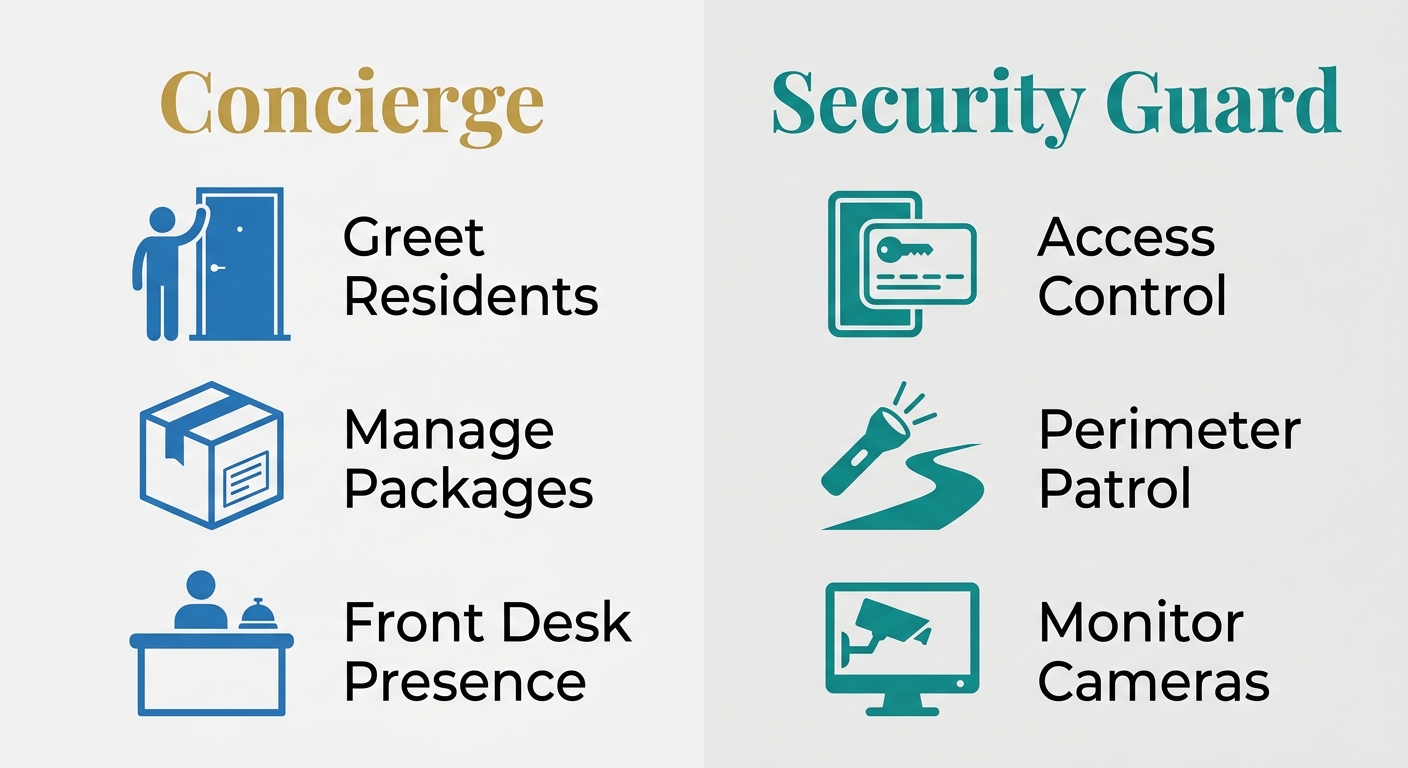
At Regent Security Services, we recommend beginning with a formal security audit to identify a site’s unique exposures, enabling us to address those exposures specifically with a guard mix, rather than taking a one-size-fits-all approach. We pride ourselves on being able to take a concierge staffing and a security staffing approach to serve our clients. This naturally leads to training and licensing standards for staffing and security guard services.
2. Training and Licensing that Set Them Apart
One major difference is the formal training and licensing of security guards, compared to concierges. In British Columbia, the Security Services Act requires all security guards to have a license and, to earn the license, guards must have completed a basic training course (BST) and, for many assignments, advanced training (AST), in addition to Occupational First Aid Level 2 (OFA 2). All Regent Security staff are licensed and insured guards who have completed this rigorous training, ensuring full compliance with provincial standards.
This structured preparation equips our team to manage emergencies, conduct surveillance, and protect property at a level that concierge staff, who lack equivalent credentials, cannot match. Your peace of mind comes from knowing that trained professionals are handling your site’s safety rather than relying on unlicensed personnel whose qualifications stop at guest services. Because security guards hold these legislated certifications, they are legally and practically qualified to perform protective duties that a concierge is not authorized or trained to carry out.
3. Can a Concierge Perform Security Duties?
In British Columbia, concierges provide critical front-desk services, but are legally prohibited from performing security functions without a valid security license. Without a security license, concierges cannot detain individuals or use force to respond to incidents—a function reserved for licensed security personnel.
According to a legal guide from LawyerInfo.ca, tenants’ right to peaceful enjoyment under the Residential Tenancy Act prohibits concierges from opening mail or interfering with parcel deliveries without explicit authority. Under the Personal Information Protection Act, concierges cannot log daily tenant movements or conduct persistent surveillance unless a specific security threat requires it. These restrictions apply to protect the privacy of residents and help define the extent of the concierge’s functions.
Knowledge of these legal boundaries helps property managers decide whether to hire a concierge, a licensed security guard, or a combination of both. With our unrivalled security industry experience and expertise, our team supports clients in staffing properties with the right personnel while respecting all applicable laws.
4. Hiring a Concierge or a Security Guard for Your Front Desk
Balancing front desk duties between hospitality and security relies heavily on your building’s layout and the types of risks you face. In the case of many high rise residential towers in downtown Vancouver, the concierge model provides the right balance. Resident service and package control, coupled with lobby presence provide the guest service amenity that many residents’ expectations have come to include. Elsewhere in the Lower Mainland, townhouse complexes and low-rise developments are better served by licensed security guards who focus on perimeter monitoring, alarm response, and active patrols.
We suggest having a formal security audit completed prior to making any new hires. The right professionals can identify your greatest risks and security exposures based on site inspections and assessments. An audit would consider entry and exit points, resident volume, and surveillance to determine the right front desk solution or patrol configuration to provide the greatest deterrent. No one-size-fits-all model works. The right configuration for front-desk service relies on the nature of the property and the clear definition of security and service needs.
5. Effectiveness in High-Traffic Hotel Lobbies
Modern hotel lobbies in Vancouver handle constant foot traffic that demands both welcoming hospitality and vigilant security. When weighing concierge vs security guard differences for a high-traffic hotel lobby, we look at how each role meets the unique pressures of a 24-hour guest environment.
A concierge focuses primarily on guest experience and front-of-house management. They greet arrivals, handle luggage, provide local recommendations, and create a polished first impression. A security guard, by contrast, oversees access verification, monitors entry points, and conducts surveillance to prevent unauthorized access. Our industry guidance emphasizes that the best choice depends on a property’s architecture, location, and specific risk profile.
The effectiveness of either role hinges on a site-specific security audit. Where your safety is our story, we help hotels assess their lobby traffic patterns and security goals before recommending a staffing model. Understanding how each function performs under lobby conditions clarifies the combined responsibilities a concierge security officer would handle.
6. The Concierge Security Officer Job Description
Staffing high-traffic hotel lobbies to provide security and guest service requires a unique blend of skills. We look for this balance in concierge security officer candidates in Vancouver.
Key responsibilities and qualifications for the role include:
- Welcoming guests, answering inquiries, and providing directions while maintaining a visible deterrent to unauthorized behaviour.
- Monitoring live CCTV feeds across the property to promptly detect and respond to suspicious activity.
- Managing keycard access systems and entry points, ensuring only authorized individuals gain entry.
- Holding full licensure under the BC Security Services Act, including Basic Security Training (BST) and Advanced Security Training (AST) certifications.
- Drawing on our 15+ years of industry experience and a team of over 200 trained professionals to deliver consistent, reliable service.
Because this position demands a presence that integrates both security and guest services, we assign concierge security officers to hotels throughout the Lower Mainland and Vancouver.
7. How Regent Security Integrates Both Roles
Regent Security’s integrated security and concierge services provide property-specific solutions based on layout and risk factors.
For one high rise in Vancouver, we lean toward a concierge-heavy deployment. Recommended in our guidance for strata property managers, concierge services control access, greet visitors and manage deliveries. Our solution prioritizes residents’ convenience while effectively managing controlled access.
An example in the Lower Mainland would be a townhouse complex, where our solution includes more security guard services. Guards on patrol monitor all access points and provide a visible deterrent. Our solution takes an open-air and suburban layout into consideration by providing pro-active security services.
A formal security audit ultimately drives our integrated solution. The audit identifies the overall risk exposure of the property, and based on the findings, appropriately integrates concierge, security services, or a combination of the two. Our solution ensures that the strategies property managers utilize are not one-size-fits-all. By understanding our integration, property managers can implement best practices that strengthen both safety and day-to-day resident experience.
8. Best Practices for Property Managers
Integrated solutions like Regent Security’s dual-role model exist, but property managers need a clear framework for choosing between a concierge and a security guard for their property.
- Conduct a formal security audit. Our team recommends mapping your property’s risks, incident history, and resident expectations before deciding on a staffing model. This process helps determine whether front-desk concierge hospitality or patrol-based guard coverage fits your layout.
- Match the service to your building type. For high-rise towers, a concierge provides guest welcoming, package handling, and access control. Townhouse and mid-rise complexes are better served by mobile security guards who focus on perimeter monitoring and alarm response.
- Uphold tenant privacy rights. British Columbia’s Residential Tenancy Act and privacy laws prohibit security staff from opening private mail, arbitrarily logging daily movements, or detaining guests. As LawyerInfo.ca highlights, property managers are legally responsible for ensuring staff compliance.
With these best practices in hand, you’ll be prepared to make the choice that protects your property and respects your residents.
Frequently Asked Questions
What are the main functional differences between a hotel concierge and a security guard?
A hotel concierge focuses on guest services such as greeting, luggage handling and local recommendations, while a security guard concentrates on access control, surveillance and perimeter patrols. Concierges manage packages and create a polished first impression; guards monitor entry points and prevent unauthorized access.
Should my property hire a concierge or a security guard for the front desk?
The choice depends on your property type: high-rise residential towers typically benefit from a concierge for hospitality and package management, while townhouse complexes need a licensed security guard for perimeter monitoring and alarm response. A formal security audit is recommended to identify the right fit.
Can a concierge perform the same security duties as a licensed security guard?
No, a concierge cannot perform security duties without a valid security license. Under BC law, unlicensed concierges are prohibited from detaining individuals, using force, conducting surveillance, logging tenant movements or opening private mail. Only licensed guards may carry out protective functions.
Is it more effective to have a dedicated security guard or a concierge in a high-traffic hotel lobby?
Effectiveness depends on a property-specific security audit that assesses architecture, location and risk. A concierge delivers guest hospitality, while a security guard ensures access control and surveillance; the best model balances both based on the lobby’s unique traffic patterns and security needs.
How do the training requirements differ for concierge staff compared to on-site security guards?
Security guards must be licensed under BC’s Security Services Act, requiring Basic Security Training (BST), often Advanced Security Training (AST) and Occupational First Aid Level 2 (OFA 2). Concierge staff have no such mandated training; their qualifications focus on guest services without the legislated protective skills.
Making the Right Choice for Your Property
Selecting the right service model depends on your property’s architecture and risk profile. High-rise strata buildings in Vancouver benefit from concierge services that combine hospitality, package management, and controlled access, while townhouse complexes need security guards for perimeter monitoring and access control. Understanding the concierge vs security guard differences helps property managers align service selection with their building’s needs. A formal security audit identifies the most effective risk mitigation strategy. We respect tenants’ rights to quiet enjoyment, mail privacy, and PIPA-compliant CCTV use. To determine the fit, contact us for a site assessment and custom quote. Services are subject to site assessment and custom quotation; response times and results may vary. This article is for general guidance and does not constitute legal advice.
Find Your Perfect Security Solution
Now that you understand the key differences between concierges and security guards, you are well-prepared to make the right choice for your property. Our guide highlighted how high-rise buildings benefit from concierge hospitality, while townhouse complexes require security-focused perimeter patrols. A formal security audit, as recommended throughout the comparison, is the critical next step to identify your building’s unique risks. Moving from insight to action is where real protection begins. We blend both roles seamlessly, drawing on over 15 years of experience serving properties across the Lower Mainland. Schedule your personalized site assessment today and take the first step toward a safer, well-managed property.
Find Your Perfect Security Solution

