
Construction Site Loss Prevention Strategies: Essential 2026 Guide
Table of Contents
- Construction Site Loss Prevention Essentials
- Construction Site Loss Prevention Fundamentals
- Detailed Fall Protection Standards and Strategies
- Implementing Cost-Effective Loss Prevention Measures
- Advanced Security Integration for Construction Sites
- Frequently Asked Questions About Construction Site Safety
- Securing Construction Sites for Long-Term Success
Construction Site Loss Prevention Essentials
Effective construction site loss prevention strategies are critical for projects across the Lower Mainland, where tool and equipment theft, copper wire stripping, and after-hours trespassing can stall timelines and erode budgets. At Regent Security Services Ltd., we understand that these threats escalate without a comprehensive, layered security approach. A robust plan integrates professional licensed security guards for a 24/7 on-site presence, mobile patrols for perimeter checks, and advanced live video monitoring to catch incidents in real time.
That’s why we begin each engagement with a custom site assessment: evaluating vulnerabilities, identifying high-value zones, and tailoring the mix of guards, patrols, and surveillance to the project’s phase. With over two decades of experience protecting sites across Vancouver, Surrey, Burnaby, and Richmond, we have refined a methodology that adapts to each development’s risks.
Regulatory compliance is non-negotiable. WorkSafeBC requires site operators to integrate hazard prevention alongside physical security, including earthquake risk planning for the seismically active Lower Mainland. Our surveillance solutions are designed to comply with the Personal Information Protection Act (PIPA), ensuring that privacy is never compromised.
The core components, visible physical presence, continuous surveillance, compliance with provincial laws, and site-specific assessments, work together to create a proactive shield against losses. With these foundational principles in mind, we now examine the core components that form the basis of a robust loss prevention approach.
Construction Site Loss Prevention Fundamentals
Building on the core loss prevention essentials, a robust security program for construction sites requires multiple overlapping measures. Effective construction site loss prevention strategies blend 24/7 on-site guards, mobile patrols, and live video monitoring to protect tools and materials from theft, vandalism, and intrusion.
We begin with a professional security assessment to pinpoint site-specific vulnerabilities. Our licensed on-site guards provide 24/7 physical deterrence, while mobile patrols conduct random perimeter checks to disrupt predictable patterns. Live CCTV monitoring, compliant with BC’s Personal Information Protection Act, adds continuous oversight and recorded evidence. Our team of over 200 trained and insured professionals delivers these measures across Vancouver, Burnaby, Surrey, and the Lower Mainland.
Every security deployment begins with a comprehensive site audit to identify exact risks. All security personnel are licensed under the BC Security Services Act. Fire watch services, required by BC fire safety codes, add a specialised loss-prevention component, while WorkSafeBC guidelines reinforce hazard identification and equipment stabilization, especially in earthquake-prone areas.
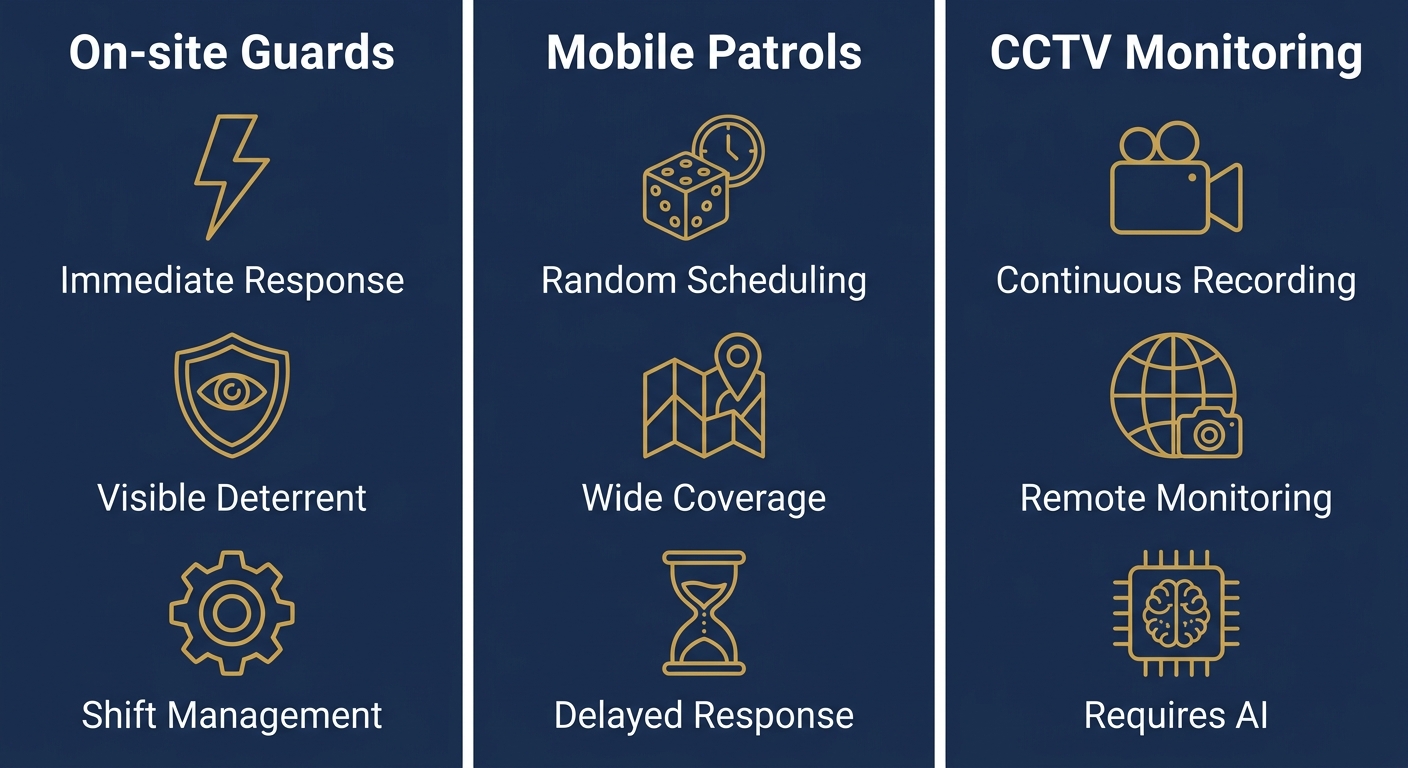
The table compares the three primary security measures used on construction sites.
| Security Measure | Description | Strengths | Limitations | Suitability for Construction Sites |
|---|---|---|---|---|
| On-site Security Guards | Licensed guards providing 24/7 on-site presence and direct physical intervention. | Immediate on-site response, highly visible deterrent, hands-on access control. | Higher cost per hour; requires shift coordination and personnel for full coverage. | Best for high-value sites, after-hours, and locations needing constant physical presence. |
| Mobile Patrols | Scheduled perimeter checks by uniformed personnel in marked vehicles, with random timing to prevent predictability. | Cost-effective coverage of large or multiple sites; random scheduling disrupts pattern observation. | Delayed response to incidents, less constant deterrence than on-site guards. | Suitable for expansive sites, multiple projects, or as a supplement to guards. |
| CCTV Monitoring | Live or remote video surveillance with recorded footage, enhanced by AI analytics to reduce false alarms. | Continuous observation, real-time alerts, recorded evidence for investigations, wide-area coverage. | Requires dedicated monitoring operators or AI analytics; blind spots possible without careful camera placement. | Effective for all construction sites as a complementary layer, providing persistent oversight. |
A thorough loss prevention program extends beyond theft deterrence to include hazard prevention and worker safety measures such as fall protection. Construction site damage prevention measures also form a key part of the overall strategy, helping maintain site integrity and regulatory compliance.
Detailed Fall Protection Standards and Strategies
Effective construction site loss prevention strategies encompass worker safety from falls alongside asset protection. Beyond securing materials and tools from theft, managing fall hazards is one of the most critical components of a comprehensive site protection plan in Vancouver and across the Lower Mainland.
The 5 Levels of Fall Protection
A structured hierarchy guides fall protection measures, starting with the most effective method and descending to the least reliable. The preferred approach begins with elimination, such as redesigning tasks to avoid working at heights entirely. When elimination is not possible, passive fall protection systems like guardrails create physical barriers that require no active participation from workers. Next, fall restraint systems prevent workers from reaching an edge through lanyards and anchors. Fall arrest systems catch a worker after a fall, minimizing injury. At the lowest level, administrative controls such as safety training and warning signs rely on consistent human behavior. Elimination offers the greatest preventive impact by removing the hazard, while administrative controls only influence worker actions.
The 5 P’s of Fall Prevention
The Plan, Prepare, Pothole, Protect, and Proceed framework, drawn from Australian construction safety guidelines published by Get Building, offers a systematic method for identifying concealed hazards. Planning involves lodging formal utility enquiries at least two business days before excavation. Preparation includes reviewing asset plans, but because these documents only indicate presence and not exact locations, the Pothole step—physically exposing buried infrastructure—becomes essential. Workers then protect exposed assets and proceed with caution, verifying that all uncovered areas remain undamaged. This five-step process reduces the risk of striking underground utilities, protecting both workers and site continuity.
Understanding the ABC of Fall Protection
Personal fall arrest systems rely on three interconnected components: Anchorage, Body Support, and Connecting Device. Anchorage provides a secure attachment point capable of supporting the forces generated during a fall. Body Support refers to a full-body harness that distributes impact forces across the thighs, pelvis, chest, and shoulders. The Connecting Device, such as a lanyard or self-retracting lifeline, links the harness to the anchorage. For this system to work effectively, all components must be compatible, properly inspected before each use, and rated for the intended application. Even the best equipment fails if any one element is compromised, making rigorous inspection routines as vital as the gear itself.
Damage Prevention Strategies Beyond Fall Protection
Physical site security forms another pillar of loss prevention on Lower Mainland construction sites. We recommend a multi-layered approach that combines 24/7 on-site security guards, live video monitoring, and mobile patrols to deter copper theft and vandalism. Before deploying any protection plan, a customized site audit identifies specific vulnerabilities—such as unsecured copper storage areas—and ensures all surveillance complies with British Columbia’s Personal Information Protection Act (PIPA). These layered programs also discourage tool theft and unauthorized access, safeguarding workers and assets around the clock. Your peace of mind comes from knowing that both fall hazards and external threats are systematically managed.
Once these protective layers are understood, the next step is to evaluate the most cost-effective ways to deploy them on your site.
Implementing Cost-Effective Loss Prevention Measures
Beyond physical safety, protecting materials, tools, and equipment from theft is equally critical to a project’s bottom line. We outline basic loss prevention techniques that balance practicality and cost so sites are ready for more advanced integration later.
Assessing Site Vulnerabilities
A focused site audit is the first step. We begin by mapping material storage areas, delivery points, and access routes, then note weak fences, blind spots, and uncontrolled openings.
Phase-based risk matters: early excavation and foundation work create different exposure than fit-out or finishing stages. We prioritize assets by value and ease of removal, then identify high-risk times such as overnight or long holiday weekends. Simple controls like designated, lockable storage zones and consolidated delivery windows reduce exposure without large capital outlays.
Engaging trades, site managers, and the client during the audit builds shared responsibility and practical mitigations. The audit closes with a short action plan that assigns responsibility, estimates effort, and recommends whether personnel, technology, or a mix is most appropriate.
Blending Security Personnel with Technology
Combining on-site guards, scheduled mobile patrols, and live video monitoring gives us overlapping deterrents that are more effective than any single measure. On-site guards provide visible presence and fast, human judgement for alarms; mobile patrols extend coverage across multiple sites; live video allows remote verification and evidence capture.
AI-enhanced video analytics can reduce false alarms by distinguishing people from animals or weather, letting our teams focus on confirmed incidents. Configuration and retention practices are designed to comply with BC’s Personal Information Protection Act (PIPA) so surveillance is effective and privacy-aware.
Using this layered model leverages unmatched security expertise: our trained staff, integrated monitoring, and consistent reporting create operational efficiencies and clearer incident records.
Managing Construction Site Costs
When managing construction site costs, we treat security as a phased investment rather than a fixed expense. Initial measures focus on high-return actions from the site audit: improved lighting, secured storage, and scheduled patrol windows. As the project evolves, we scale services up or down to match risk profiles.
Because every site differs, we recommend custom assessments and scalable plans that align service intensity with project phase and asset exposure.
The table below summarizes relative trade-offs across common security models.
| Security Solution | Cost Range (relative) | Theft Deterrence | Labor Savings | Insurance Benefits |
|---|---|---|---|---|
| On-site guards only | Medium-High | High | Low | Medium |
| Mobile patrols only | Low-Medium | Medium | High | Low |
| Live CCTV only | Medium | Medium | High | Low |
| Integrated (guards + mobile + CCTV) | Medium (best value) | High | High | High |
Preventing Copper Theft and Vandalism
High-value materials like copper require targeted controls. We recommend locking and consolidating materials in fenced, monitored storage with limited access, and minimizing on-site stock by staging materials for short windows around installation. Physical anchors, tamper-evident seals, and visible identification marks make opportunistic theft more difficult and help recovery when items are found.
Routine practices reduce vandalism risk: secure loose panels, remove obvious tools overnight, and use deterrent lighting and signage to signal active monitoring. Mobile patrols timed for known vulnerability windows and prompt incident reporting keep sites resilient. We also recommend maintaining chain-of-custody records for high-value deliveries and coordinating with site teams to limit unsupervised access.
Once these foundational, cost-effective layers are in place, they create a strong basis for more advanced integration and smart-site technologies.
Advanced Security Integration for Construction Sites
Effective construction site loss prevention strategies are further strengthened through advanced security integration, bringing together AI video analytics, cloud-based access control, and integrated monitoring platforms. For project managers overseeing multiple active sites, this integration provides real-time visibility into every location from a single dashboard.
The shift from traditional key and card access to advanced technologies is best illustrated by the following comparison:
| Feature | Traditional Access Control | Advanced Access Control | Benefit |
|---|---|---|---|
| Authentication Method | Keys/Physical Cards | Biometric Readers, Facial Recognition, PIN Code Entry | Enhanced security & audit trail |
| Access Credentials | Manual key distribution | Mobile app credentials, NFC, Bluetooth proximity | Flexible credential management and instant revocation |
| Monitoring & Control | On-site guard logs | Cloud-based central dashboard with real-time alerts | Immediate incident visibility and response |
| Integration | Standalone systems | IoT-integrated sensors and AI video analytics | Proactive threat detection via intelligent threat discrimination |
Cloud-based central dashboards provide immediate incident visibility, allowing security teams to respond in real time. Meanwhile, IoT-integrated sensors and AI analytics detect anomalies before they escalate, converting construction site security from a passive cost center into an active risk management tool.
Our AI-enhanced video systems differentiate genuine threats from harmless movement such as wind-blown debris or wildlife, dramatically reducing false alarms. Integrated solutions that combine licensed personnel with advanced surveillance are more cost-effective than relying solely on guards or cameras alone. Additionally, insurers increasingly recognize the value of these layered approaches: according to Regent Security’s analysis of integrated construction security solutions, organizations have documented potential insurance premium reductions of 20 to 30 percent when robust, integrated systems are in place.
These technology-driven capabilities address the most common site-safety questions around incident response, liability mitigation, and resource allocation. To see how we can tailor a solution for your project, you are welcome to build your security quote with our team.
Frequently Asked Questions About Construction Site Safety
- What are the WorkSafeBC requirements for construction site safety? Our advisory based on BC regulations confirms that WorkSafeBC mandates site operators prioritize hazard prevention alongside physical security, including seismic risk equipment stabilization, emergency planning, and unauthorized access deterrence.
- What are the 5 Ps of safe site practice? Industry best practices recommend the 5 Ps: Plan, Prepare, Pothole, Protect, Proceed. Utility plans indicate presence, not exact locations; always lodge enquiries two business days before excavation.
- Why is earthquake risk management important for construction sites in the Lower Mainland? WorkSafeBC requires stabilizing equipment and establishing emergency response protocols to safeguard workers during seismic events.
- How should video surveillance be used to comply with BC privacy laws? Video surveillance must adhere to BC’s Personal Information Protection Act (PIPA).
Securing Construction Sites for Long-Term Success
With these concerns addressed, we can focus on long-term site security. A protection plan integrates 24/7 on-site licensed guards, mobile patrols, live CCTV monitoring and site assessments to identify vulnerabilities and prevent theft, vandalism and liability. Adopting construction site loss prevention strategies in Vancouver helps stakeholders safeguard assets and maintain continuity. Contact us at (+1) 866-603-1303 for a custom assessment and quote; services are subject to site assessment and response times and outcomes may vary; consult a licensed professional for site-specific advice; CCTV monitoring complies with BC’s PIPA.
Request Your Custom Security Quote
Now that you’ve explored the essential construction site loss prevention strategies, from layered security to fall protection and advanced technology integration, you understand the importance of a tailored approach for your project in Vancouver or the Lower Mainland. A professional security plan begins with a thorough site assessment that identifies unique vulnerabilities, whether it’s copper theft prevention or ensuring compliance with BC’s PIPA and WorkSafeBC requirements. Our team has 15+ years of experience delivering 24/7 protection with licensed, insured guards, mobile patrols, and live video monitoring. We combine human expertise with AI-enhanced surveillance to create a cost-effective, scalable solution designed for your needs. The next step is to request a no-obligation custom quote based on a detailed evaluation of your site. Reach out to us today by phone at (+1) 866-603-1303 or through our website to schedule your consultation. Let us help you build a security strategy that protects your assets and ensures peace of mind for your long-term success.
Request Your Custom Security Quote

