
Hotel Loss Prevention Strategies: A Complete Guide for 2026
Table of Contents
Hotel Loss Prevention Strategies in British Columbia
Developing effective hotel loss prevention strategies in British Columbia requires a multi-layered approach that proactively addresses theft, vandalism, and liability risks. The British Columbia Security Services Act mandates that all security providers and guards be properly licensed and trained, creating a regulated environment where professional expertise is essential. One-size-fits-all packages fall short; instead, our process begins with a comprehensive audit that evaluates site-specific risks, from perimeter vulnerabilities to internal operational gaps. The most visible and foundational element of our strategy is deploying professional on-site security guards who serve as a deterrent and first line of response. Our team of over 200 licensed, insured professionals brings decades of experience to hotels across the Lower Mainland, delivering customized loss prevention programs that align with BC regulations.
1. Visible On-Site Security Guards
In loss prevention strategies for hotels, having uniformed security guards on the premises is a key element. A uniformed, professional guard appearance reinforces authority and acts as a strong visual deterrent to theft and loitering. The British Columbia Security Services Act requires security guards to have a valid license and complete mandatory training. Our team of over 200 licensed professionals meets these requirements and receives training and professional development to manage security incidents.
Security guards typically monitor hotel entrances and exits, conduct regular patrols of lobbies, corridors, and parking areas, and manage access control. Guards are trained to detect suspicious behavior, defuse tense situations, and serve as a first point of contact for guests with safety concerns.
We provide 24/7 security guard coverage to ensure a human response is available to de-escalate incidents or address emergencies. While on-site security guards deliver essential human oversight, pairing them with electronic surveillance systems creates a comprehensive security layer that strengthens a hotel’s overall security posture.
2. AI-Powered Live Video Monitoring
Live video monitoring technology fills coverage gaps in Vancouver hotel corridors where uniformed guards provide human presence, using AI-powered intelligent surveillance.
The technology features analytics that help distinguish real threats from insignificant motion. Threats can include a person loitering by a guest door, or a person attempting to enter a restricted mechanical room or office. It also differentiates those threats from innocuous motion such as shadows or passing vehicles. It also detects anomalies like a fallen guest in a corridor, triggering immediate assistance.
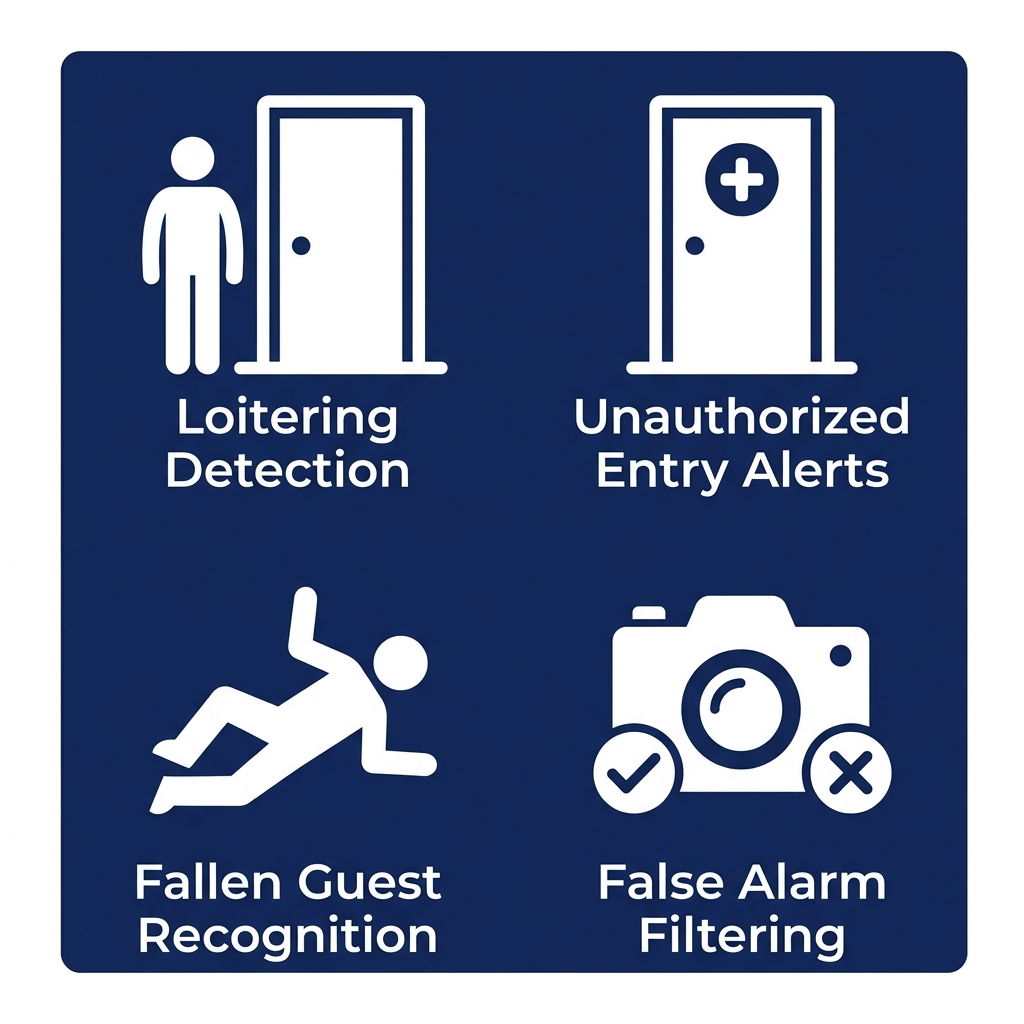
While our AI is designed to work over existing closed-circuit television (CCTV) systems, hotels do not need to totally overhaul their existing systems. In compliance with BC’s PIPA, we restrict surveillance to common areas and never guest rooms. Our hybrid model ensures AI is monitoring 24/7, and licensed guards validate alerts and deploy rapid response when needed.
Verified data is utilized to perform comprehensive and ongoing security audits. Audits help us improve our protective services and ensure the peace of mind of our valued customers.
3. Comprehensive Security Audits
Video monitoring offers an immediate threat detection solution. However, a more comprehensive evaluation of an organization’s overall security posture is required on a recurring basis. Our security experts evaluate the physical and operational gaps that exist within an organization, as aligned with the ASIS International practice standards and guidelines.
We follow a four-step audit framework—inspection, assessment, recommendation, and implementation—that incorporates thorough onsite walkthroughs, staff interviews, incident log reviews, and risk scoring. Throughout the evaluation, we remain compliant with British Columbia’s Security Services Act and the Personal Information Protection Act (PIPA), ensuring all licensing requirements and privacy standards for CCTV and visitor data are met without offering legal advice.
We recommend annual audits or re-assessments whenever threat levels or operations change significantly. Access control systems, including keyless entry and biometrics, IP camera placement with PTZ, perimeter security, and emergency response protocols are assessed. Findings, including those pertaining to access control and entry point security, directly inform the implementation of strict visitor management protocols.
4. Strict Visitor Management Protocols
Results from security audits indicate areas of weakness that strict visitor management protocols can remedy. Hotels and commercial properties in the Vancouver region, and throughout the Lower Mainland, can benefit from implementing a layered approach to security, consisting of concierge-led check-in paired with technology. These approaches strengthen hotel security plans. Our protocols ensure that every visitor is screened without compromising the guest arrival experience.
Concierge-led check-in acts as a visible security checkpoint. Digital kiosks and self-registration portals provide visitor management systems that validate visitor information, improve throughput and accuracy of visitor logs, and provide records and logs readily available. Maintaining accurate visitor logs and verified visitor information helps reduce unauthorized access. These systems, in conjunction with NFPA codes, allow real time visitor tracking and compliance with emergency lockdowns. The levels of automation and human oversight are adjusted to the foot traffic and risk profile of the property.
These layered visitor controls are complemented by randomized mobile patrols that further deter and detect unauthorized activity.
5. Randomized Mobile Patrols
We have strict visitor policies at the front entrance, and equally important patrols throughout the property. To stay one step ahead of criminals, we use mobile patrols with randomized schedules and routes, making guard presence unpredictable. This irregularity prevents criminals from exploiting predictable security gaps.
Our patrol units use GPS to time and log their locations, giving hotel management proof of patrols and accountability. Our mobile patrols complement static guards by covering parking lots, perimeter fences, and secondary building entrances when the checkpoint officer is occupied. One mobile unit can efficiently monitor multiple zones, reducing the need for numerous fixed posts while maintaining comprehensive coverage.
Patrols help document risks by reporting deficiencies like insufficient lighting and unsecured access points. These reports support our clients’ risk management and insurance requirements by demonstrating due diligence and helping them identify and address security weaknesses proactively.
When paired with sophisticated electronic access control systems, random mobile patrols create a multi-layered security environment that deters theft and vandalism without relying on predictable routines.
6. Advanced Access Control Systems
While randomized patrols provide dynamic deterrence, advanced access control systems provide a fixed perimeter of security which denies unauthorized entry. At Regent Security, we provide advanced access control systems for hotels in Vancouver and throughout British Columbia. With our systems, only guests and authorized personnel have access to the restricted areas of the hotel.
Advances in technology have resulted in modern solutions that prioritise keyless entry by means of mobile credentials, cards or biometric verification such as fingerprint or facial recognition. With these systems, hotels can program access down to individual zones—guest floors, back offices, and storage rooms—while automatically generating detailed audit trails for every entry attempt.
Combining these systems with CCTV and alarm response provides a secure and responsive mesh. When the system detects an unauthorized access attempt, it can trigger a real-time alert and pull up the relevant camera feed. Our systems and solutions are site specific and tailored to the unique layout and risk profile of a property. We provide a range of security systems and solutions which complement the existing layers of security for a property.
Ultimately the technology is only as good as the people who manage it. This makes well-trained staff essential for incident response.
7. Staff Training and Crisis Drills
Advanced access control systems can protect only to the extent that front-line staff has been adequately trained to understand their operation and respond to alarms and other incidents. As indicated in Regent Security’s hotel security protocols, the British Columbia Security Services Act mandates that security guards employed at hotels complete both basic and advanced training, in addition to holding a valid security guard’s license. Therefore, it is imperative for hotels to verify that the above compliance requirements are satisfied prior to employing any security staff.
Detailed crisis management plans must be documented, prepared for site-specific incidents, and reviewed after every drill or real incident. It is important to conduct post-drill debriefs to capture lessons learned and update plans to immediately adjust procedures. We recommend running realistic, site-tailored exercises at least quarterly, covering fire, medical, active threat, and guest disturbance scenarios. Each drill should test techniques to de-escalate and resolve conflicts, and verify the proper use of the property’s CCTV and access control systems.
We offer hotel-specific, site-tailored training programs, supported by over 200 licensed and insured professionals, that ensure every hotel can mount a rapid, coordinated response that protects people and property.
8. Elevating Guest Satisfaction with Visible Security
Staff who are well-trained form the core of any effective security program, but their impact is amplified when supported by visible security infrastructure that guests can see and trust.
We create "active security" through the use of AI-based behavioral analytics to detect and classify various threats in our video surveillance system. Our behavioral analytics are used to identify anomalies and distinguish threats from non-threatening motion such as shadows or wildlife. This allows our system to understand and detect threats like loitering near guest doors or unauthorized access to restricted areas, reducing false alarms. As part of a comprehensive security program, proactive detection directly supports loss prevention and gives guests a better sense of security without the need for intrusive surveillance.
Licensed security guards, trained under British Columbia’s Security Services Act, create a strong visual deterrent in parking areas and hotel entrances/exits. A visible security presence, integrated with access control and other security infrastructures, builds confidence in guests that their room has been secured. As a result, a security program can become a "guest experience differentiator" in the hospitality industry.
Through such program synergies, both guest experience and security are strengthened.
Building a Comprehensive Hotel Security Program
Visible security measures boost guest satisfaction but are a layer of a security program. A robust program underpins loss prevention strategies and combines compliance with the BC Security Services Act—licensed guards, mandatory training—with layered technology: IP PTZ cameras in high-risk areas and keyless access (mobile credentials, biometrics). With over 200 licensed, insured professionals with 24/7 coverage, we help hotels build programs integrating people, process, and technology. Contact us for a site-specific quote; services are subject to site assessment, custom quotation; results and pricing may vary. Response times and alarm outcomes may vary; CCTV must comply with applicable privacy laws in British Columbia. Please consult a licensed security professional for site-specific advice; this is general guidance, not a substitute for professional or legal advice.
Request Your Custom Security Proposal
From visible on-site guards to AI-powered live monitoring, these strategies are designed to protect your hotel, guests, and reputation. We deliver all these layers with over 200 trained, licensed, and insured professionals providing 24/7 coverage across British Columbia. With more than 15 years of experience serving Vancouver and the Lower Mainland, we understand the local regulations that matter—including the BC Security Services Act and PIPA privacy requirements. Our team will assess your property’s unique vulnerabilities and build a comprehensive, site-specific security program that integrates access control, randomized patrols, and staff training. A tailored solution not only deters theft and vandalism but visibly boosts guest satisfaction. Take the next step toward a more secure hotel by requesting a custom quote based on your specific needs. Your property’s safety and your guests’ peace of mind deserve a trusted partner.

