
Loss Prevention Strategies Retail: Essential Guide for 2026
Table of Contents
- Retail Loss Prevention Fundamentals
- The Real Cost of Retail Shrinkage and Loss
- Key Advantages of Professional Loss Prevention
- Implementing Loss Prevention: Strategies and Technology
- Proven Best Practices to Strengthen Loss Prevention
- A Proactive Approach to Long-Term Retail Security
Retail Loss Prevention Fundamentals
Retail loss prevention is a systematic business strategy that protects assets, reduces inventory shrinkage, and maintains safe shopping environments. As Canadian retailers face increasing challenges from organized retail crime, effective loss prevention in Vancouver and other major metropolitan areas has become essential for protecting profitability.
At Regent Security, we understand that professional loss prevention represents a revenue protection investment rather than an operational cost. Every dollar recovered through prevention flows directly to the retailer’s bottom line, making inventory shrinkage control a critical financial priority. Industry standards set by the Canadian Security Association (CANASA) emphasize that comprehensive loss prevention strategies retail programs must address four primary causes of loss: external theft, internal theft, administrative errors, and vendor fraud. While external theft typically receives the most attention, internal loss often carries a higher average value per incident.
Our approach balances proactive deterrence with reactive response capabilities. Visible guard presence, regular floor patrols, and employee training create effective shoplifting prevention strategies that discourage theft before it occurs. This stands in contrast to purely reactive security measures that only respond after incidents happen. Modern loss prevention integrates with CCTV surveillance, access control systems, and incident reporting to create complete protection strategies that safeguard merchandise, employee morale, customer experience, and brand reputation.
The following sections explore specific loss prevention techniques and technologies that translate these fundamentals into actionable protection for your retail business.
The Real Cost of Retail Shrinkage and Loss
Retail inventory shrinkage is a silent but substantial profit leak that demands urgent attention. For Canadian businesses, crafting robust loss prevention strategies retail begins with quantifying the real financial and operational toll of missing merchandise. We understand that every lost item cuts directly into your bottom line, making a clear understanding of the four main drivers—external theft, internal theft, vendor fraud, and administrative errors—the foundation of an effective response.
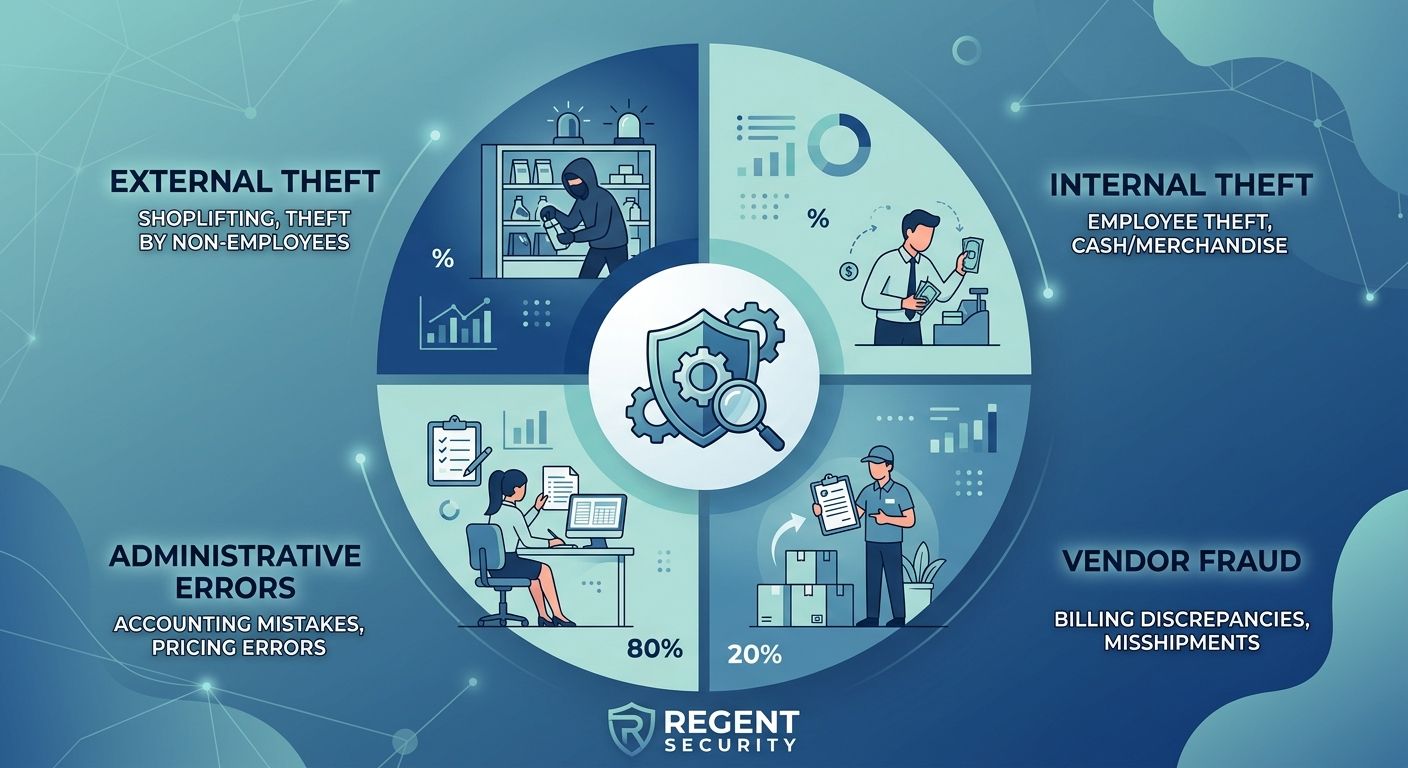
A professional infographic breaking down the primary sources of retail shrinkage into four clear segments for educational use.
The Main Drivers of Inventory Shrinkage
Inventory shrinkage—the loss of products between manufacture or shipment and the point of sale—disproportionately erodes retail profit margins. The Retail Council of Canada reports that shrinkage drains billions of dollars from the industry each year, with each driver contributing to that total in distinct ways. External and internal theft together account for the largest share. Shoplifting, defined under the Criminal Code as the unlawful taking of merchandise, remains a persistent challenge. Employee theft, whether through direct stealing or collusion, compounds these losses; as made accessible through BC Laws, both acts carry serious legal consequences. Implementing shoplifting prevention strategies that combine physical deterrents with vigilant staff practices is a critical early step, and standards from UL Canada help guide the placement of surveillance and access controls to reduce these criminal opportunities.
Vendor fraud, such as short shipments or invoice manipulation, introduces another layer of risk that often goes undetected until financial audits expose discrepancies. Strong receiving protocols and verification—aligned with industry benchmarks from UL Canada—form a frontline defence against these losses. Administrative errors, including inaccurate inventory counts, mislabelled stock, or data entry mistakes, may lack criminal intent but still cause significant shrinkage. These errors can represent as much as 20–30% of total inventory variance in some Canadian stores. Tackling them demands rigorous inventory controls and regular reconciliation, reinforcing the case for standards-based operational checklists. Together, these four drivers underscore that theft deterrence approaches must address both human behaviour and systemic weaknesses
Assessing Retail Vulnerabilities to Internal and External Theft
A structured vulnerability assessment is the essential first step in any shrink reduction measures plan, moving from general awareness to targeted action. Begin with the physical layout. Blind spots, poor lighting, and cluttered product displays create inviting environments for shoplifters. We recommend auditing every aisle and entry point against UL Canada’s security system criteria, which specify optimal CCTV coverage, mirror placement, and sightline clearance. Even simple adjustments—repositioning high-value items away from exits and improving illumination—can yield immediate deterrence.
Staff behaviours are equally critical. Low alertness, inconsistent adherence to security protocols, and unsafe routines open the door to both external theft and internal collusion. We find that gaps often stem from a lack of ongoing training rather than malicious intent. Formalizing clear expectations and encouraging proactive customer engagement significantly reduce opportunities for theft. Resources from the Canadian Security Association offer additional checklists for retail vulnerability assessments, helping managers build a culture of shared responsibility around inventory shrinkage control.
Procedural gaps, such as irregular inventory counts, lax receiving verification, or the absence of employee background checks, leave the business exposed even when physical and staff defences are in place. Tightening these processes—for example, by mandating double-checks on inbound shipments and instituting cycle counting—closes the loop. While the legal framework outlined in BC Laws acts as a deterrent, it is never a substitute for proactive security measures. For a more thorough evaluation, our team at Regent Security provides professional vulnerability assessments that integrate these insights. Once these vulnerabilities are identified, selecting the right mix of protective measures becomes straightforward.
Key Advantages of Professional Loss Prevention
The advantages of partnering with a professional service like Regent Security are substantial. Our multi-layered approach combines immediate deterrence with long-term strategic planning, ensuring your business not only recovers from losses but actively prevents them.
Reducing Financial Loss Through Prevention
Effective loss prevention strategies retail professionals deploy go far beyond simply catching a thief in the act. Our proactive methodology integrates undercover security, advanced CCTV surveillance, and detailed customer behavior analysis to intercept theft, fraud, and internal shrinkage at the source. These shoplifting prevention strategies are designed to protect your profit margins directly. By employing sophisticated inventory shrinkage control tactics, we identify vulnerabilities in your operational workflow, from the point of sale to the stockroom. These approaches to prevent shoplifting create a hostile environment for internal and external theft, directly safeguarding your bottom line without disrupting the genuine customer experience.
Enhancing Customer and Staff Safety
A visible security presence is one of the most powerful tools for creating a safe retail environment. Our uniformed guards and regular patrols serve as an immediate deterrent to potential criminals, significantly reducing the opportunity for theft and violent incidents. For your staff and shoppers, this presence fosters a tangible sense of your peace of mind. When employees know that trained, licensed, and insured professionals are on-site, their focus naturally returns to customer service and sales. This commitment to a safer atmosphere is a core element of our shoplifting prevention strategies, ensuring that everyone within the store feels secure. The result is a more positive shopping experience where visitors linger longer and employees perform with greater confidence, knowing their well-being is a top priority.
Cost-Effective Solutions Tailored to Your Business
We understand that every retail operation has a unique budget and risk profile, which is why we never apply a one-size-fits-all pricing model. The cost of our service is influenced by several key factors, including store square footage, required hours of coverage, the number of guards assigned, and the degree of technology integration, such as CCTV monitoring. To ensure you receive maximum value, we begin with a free, comprehensive consultation to assess these exact needs. This allows us to provide a custom quote, ensuring you pay only for the services essential for your protection. All our loss prevention strategies are designed to comply with rigorous security standards in Canada, ensuring both effectiveness and regulatory alignment. Understanding these benefits, the next step is exploring how Regent Security tailors these solutions to your specific retail environment.
This methodical strategy, backed by our 24/7 availability, licensed personnel, and rapid deployment capabilities, ensures that your tailored security plan provides robust protection without unnecessary expenditure. We believe that professional security should be an accessible and scalable asset for businesses across Vancouver, Burnaby, and Surrey.
Implementing Loss Prevention: Strategies and Technology
Effective loss prevention strategies for retail require a coordinated blend of human expertise, surveillance technology, and operational protocols. Below we outline how Regent Security designs multi-layered systems that protect commercial assets in Vancouver’s busiest districts.
Layered Security: Combining Personnel and Technology
Retail businesses in Vancouver face theft from both external shoplifters and internal sources. A layered security approach is the most effective countermeasure. Regent Security designs integrated systems where each layer reinforces the next:
- Uniformed security guards provide visible deterrence and immediate intervention.
- Trained undercover officers observe covertly to catch internal theft or organized shoplifting.
- CCTV surveillance covers all zones, capturing evidence and feeding live feeds to our monitoring centre.
- Access control systems restrict entry to sensitive areas, such as stockrooms, and log every instance.
- Intrusion detection secures the property after hours with sensors and alarms.
Our personnel are licensed in accordance with the BC Security Services Act, ensuring all activities meet provincial standards. Before implementation, we conduct site assessments to identify vulnerabilities, then tailor the solution to each location. By combining these layers, we create a seamless defense that detects and deters loss at multiple points, significantly reducing opportunities for theft.
Monitoring and Reporting: The Backbone of Loss Prevention
Even the best-layered defenses need oversight. When staff are occupied, suspicious activity can slip through. Real-time monitoring fills this gap. Our 24/7 command centre uses AI-driven video analytics to detect anomalies like loitering or hiding merchandise the moment they occur. Every event is flagged for immediate review.
Beyond live surveillance, our checkpoint reporting software captures guard reports, incident logs, and time-stamped patrol data. Over weeks and months, this creates a rich dataset that reveals patterns of inventory shrinkage—whether it’s a specific shift with higher losses or a particular product line being targeted. These insights feed into strategies for shoplifting prevention and controlling inventory shrinkage, enabling proactive adjustments such as repositioning cameras or increasing undercover presence at certain times. Our retail loss prevention strategies evolve with the data, staying ahead of emerging theft tactics.
Incident Response and Follow-Up Procedures
When a theft occurs, a disorganized reaction can escalate danger. Our structured incident response protocol begins with immediate alarm verification. Our team rapidly deploys to the site, secures the area, and preserves physical and digital evidence. Where safe, our guards detain the suspect until law enforcement arrives—strictly in compliance with provincial security legislation and our internal protocols.
After the police handover, we launch a post-incident review. We examine CCTV footage, access logs, and witness statements to identify the root cause—whether it was a procedural gap, equipment blind spot, or insider collusion. This analysis drives corrective actions: updating patrol routes, enhancing training, or fine-tuning sensor placements. We share a comprehensive report with management, demonstrating patterns and recommending long-term fixes.
By closing the loop between detection, response, and analysis, we strengthen the overall loss prevention framework and make recurrence less likely. This integrated approach goes beyond presence, evolving into a true partnership. In the next section, we’ll explore the benefits of outsourcing these functions to a dedicated provider. With Regent Security, your peace of mind comes from knowing that each layer works together to protect your property, anytime and anywhere.
Proven Best Practices to Strengthen Loss Prevention
To address the prevalent theft challenges, implementing effective loss prevention in Vancouver requires a blend of proactive staff training, integrated technology, and rigorous audits.
Training Staff to Recognize and Deter Theft
Loss prevention strategies retail centre on equipping staff with the skills to identify and deter theft. Frontline employees should be trained to recognize behavioral indicators such as excessive loitering, avoidance of eye contact, and attempts to conceal items in bags or clothing. Proactive engagement is a hallmark of effective shoplifting prevention strategies: greet each customer, offer assistance, and maintain a visible floor presence. We also recommend establishing confidential internal reporting protocols so staff can flag suspicious activity without fear of reprisal, using a standardized incident log to capture incident details. Role-playing exercises reinforce these skills under realistic scenarios. We further advise that store layouts be arranged to eliminate blind spots, enabling staff to monitor customer movements more effectively, while regular briefings on recent theft trends keep the team vigilant. All training must align with industry-recognized standards from the Canadian Security Association and respect legal limits defined by BC Laws on detention and apprehension. Empowered employees become active participants in loss prevention, directly impacting shrinkage reduction.
Integrating Technology for Real-Time Alerts
To amplify loss prevention strategies retail, we integrate technology that delivers instantaneous alerts. Modern video analytics, when connected to point-of-sale systems, automatically flag irregular transactions such as voided sales, excessive discounts, or no-sale drawer openings. Electronic article surveillance tags deactivate at checkout and trigger real-time alarms if merchandise passes sensors without purchase. Mobile alerts notify management immediately when multiple high-risk events occur within a short window. Such real-time alerts also enable remote monitoring and rapid dispatch of security personnel, ensuring no incident goes unnoticed. Our team at Regent Security leverages these advanced surveillance tools to give retailers in Vancouver a decisive edge. This layered approach, aligned with best practices from the Canadian Security Association, transforms reactive security into proactive deterrence. By minimising the window between incident and response, integrated technology supports overall inventory shrinkage control and measurably reduces theft.
Conducting Regular Audits and Inventory Checks
Rigorous audits and inventory checks are indispensable for inventory shrinkage control. We recommend weekly cycle counts on high-theft items, comparing physical stock against system records to rapidly identify discrepancies. Surprise cash register audits on random shifts detect internal theft patterns such as sweethearting and procedural non-compliance. Immediate reconciliation of variances through a documented root-cause analysis prevents losses from compounding; linking findings to corrective action closes the loop. The unpredictable nature of surprise audits serves as a powerful deterrent against internal theft, keeping honest employees protected. All audit protocols should comply with the documentation standards set by BC Laws, ensuring that every step of the loss prevention process remains lawful and defensible. Regent Security’s inventory management solutions incorporate these rigorous checks to help Vancouver businesses maintain accurate stock levels and reduce shrinkage. Regular audits not only catch theft but also reinforce a culture of accountability throughout the organization.
By integrating these practices, retailers build a resilient loss prevention framework that adapts to evolving threats.
A Proactive Approach to Long-Term Retail Security
Addressing modern retail theft requires shifting your focus from reactive responses to loss prevention strategies for retail in BC that emphasize comprehensive and protective planning. In contrast to simply reacting to incidents, partnering with a professional security provider like Regent Security allows businesses to systematically identify vulnerabilities and build a sustained, protective barrier.
A foundational risk assessment begins this journey by evaluating store layout, inventory handling, and staffing procedures. By integrating our on-site on-site security guards (including undercover loss prevention specialists) with modern technology such as CCTV monitoring, we design a layered layer of deterrence and detection tailored to your specific operation. This allows us to deploy effective shoplifting prevention strategies in Vancouver while addressing inventory shrinkage control through data-driven store management.
Ensuring that any research-backed approach adheres to provincial legislation is critical. Our experts ensure every plan aligns with the Government of British Columbia’s legal framework for detention and privacy, as well as the Canadian Security Association (CANASA) professional standards for ethical security deployment. The same proactive principles apply across industries, and our expertise extends to construction site security, ensuring every business asset is protected.
Through ongoing reviews and security audits provided by Regent Security, your retail loss prevention strategies evolve to meet new trends and threats. This sustained partnership not only reduces theft but increases employee and customer confidence, delivering the reliable peace of mind that comes from knowing your operations are secure for the long term.
This article was researched and written with the assistance of AI tools.
Resources
- Get Expert Loss Prevention Services in Vancouver
- Get AI-Powered Construction Site Security in Vancouver
- Get Tailored Retail Loss Prevention in Vancouver
- Get Multi-Layered Loss Prevention Strategies for 2026
- Get AI-Powered CCTV Monitoring in Vancouver
- Get Expert Access Control Installation in Vancouver
- Get Keyless Entry Systems with Mobile App Control
- Access Security Training and Membership with CANASA
- Find Safety Certification and Security Standards in Canada
- Find BC Legislation Including Security Services Act

